Launch & Growth
How to Increase Domain Rating in 2026: The Complete DR Playbook for SaaS & Startups
The only Domain Rating guide you need: how Ahrefs DR is calculated, how many referring domains it takes to go from 0 to 30, a week-by-week playbook, DR vs DA explained, honest DR boost service criteria, and the authority signals that get you cited in AI answers.

Contents (13)
- Key Takeaways
- What Is Domain Rating and How Is It Calculated?
- What a Higher Domain Rating Actually Gets You
- How Many Referring Domains Do You Need? Realistic Timelines
- The 60-Day Playbook: DR 0 to 30, Week by Week
- Beyond DR 30: The Tactics That Actually Scale
- Should You Pay for It? DR Boost Services, Judged Honestly
- The Part Most DR Guides Skip: Authority for AI Search (GEO)
- Common Mistakes That Waste the Quarter
- How to Measure Whether It Worked
- How to Improve Moz Domain Authority (DA), and How It Differs From DR
- DIY Checklist
- FAQ
Quick answer: You increase Domain Rating by earning followed links from many unique authoritative domains - not by accumulating more links from the same ones. The fastest legitimate path for a site under DR 20 is 20 to 50 manual directory and launch-platform submissions at seven to ten a day, which lands most new sites at DR 20 to 30 within 30 to 60 days. Above DR 30, directories run out and the only inputs left are editorial links: original data, a free tool, digital PR, guest posts and link intersects. Nofollow links do nothing for the number, bought link packages get wiped by recalibrations, and DR itself is not a Google ranking factor - it is the filter everyone else applies to you.
Every domain starts at DR 0, including the good ones. The problem with sitting at zero is not that Google punishes you for it - Google does not see the number at all. The problem is everyone else: the guest-post editor who filters submissions at DR 20, the link builder who sorts prospects by authority before writing a single email, the partner and affiliate manager who pull your domain in Ahrefs before the first call. At DR 0 you get filtered out of conversations before anyone reads a word you wrote.
The useful part is that the first twenty or thirty points are, by a wide margin, the cheapest you will ever buy. This guide is the complete version: how DR is calculated, the week-by-week playbook for DR 0 to 30, the honest verdict on paid DR boost services, and the authority work that keeps paying above DR 30 - including the signals that get you cited inside AI answers.
Key Takeaways
- Only unique followed referring domains count: ten links from one site count once, which is why "5,000 backlinks" is a meaningless offer and "40 new referring domains" is a real one.
- The scale is logarithmic: DR 0 to 20 is a short walk, 20 to 40 is a hike, and 40 to 60 is a project with a budget. Any plan promising linear progress is describing something other than DR.
- Volume targets: 20 to 50 followed referring domains puts a fresh site in the teens to low twenties; 50 to 100 pushes toward the high twenties and thirties.
- Directories are the on-ramp, not the plan: they run dry around DR 30. Everything above that is editorial links, original data and free tools.
- Pace at seven to ten submissions a day: forty referring domains appearing on a two-week-old domain inside 24 hours is the footprint Ahrefs' September 2025 recalibration was built to discount.
- DR is not a Google ranking factor: it is an Ahrefs estimate the industry uses as a filter. Chase it for the doors it opens, not because rankings follow automatically.
- Judge a paid service on three things: a specific DR target, a metric you can verify free, and a written refund formula. Everything else is noise.
- Brand mentions beat backlinks for AI citation: mentions correlate 0.664 with AI citation probability against 0.218 for backlinks - directory profiles pay twice.
What Is Domain Rating and How Is It Calculated?
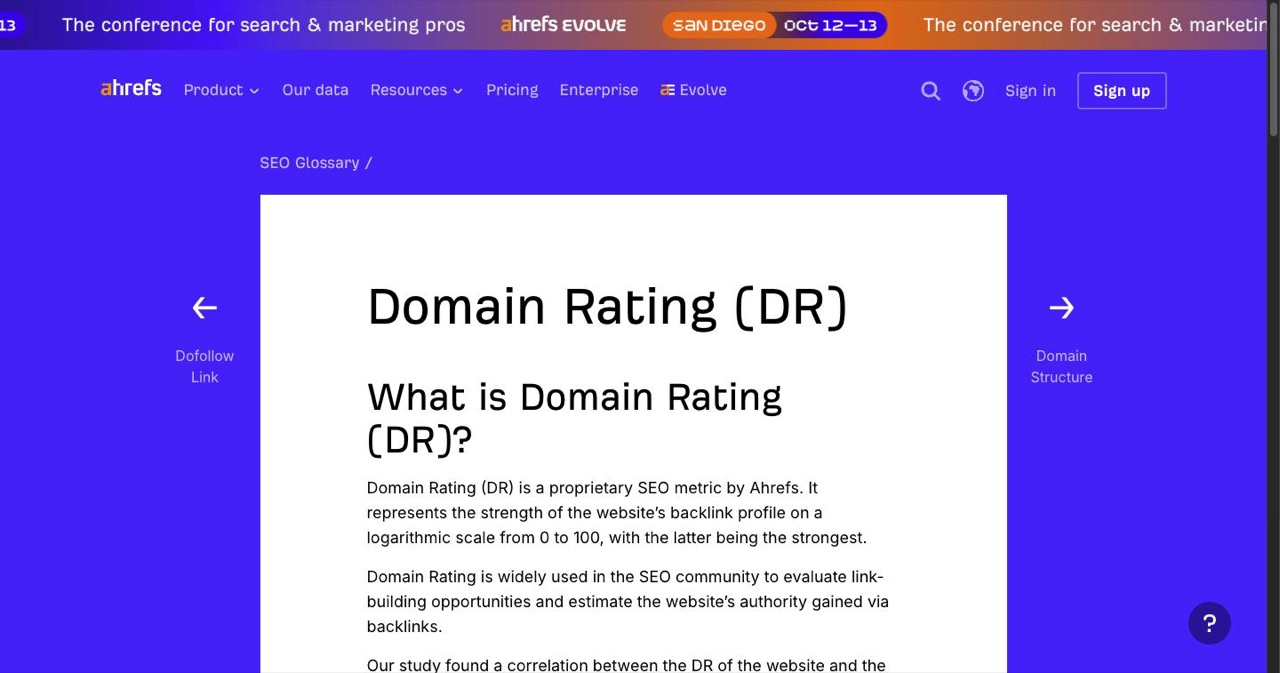
Domain Rating is Ahrefs' 0 to 100 score for the strength of a website's backlink profile, measured against every other site in their index of over 16 trillion backlinks. It is the most widely quoted authority metric in the industry - when somebody says "we only accept guest posts from DR 40+ sites," they mean this number.
Ahrefs describes the mechanics publicly:
- Count the unique domains linking to you with at least one followed link. Ten links from the same site count once.
- Weight each by that domain's own DR. A link from a DR 80 site is worth far more than one from a DR 8 site.
- Dilute by how many unique domains that site links out to. A DR 80 page linking to five sites passes far more than a DR 80 page linking to fifty thousand - which is why two directory listings with identical headline DR can be worth very different amounts.
- Plot the result on the logarithmic 0 to 100 curve.
Four consequences fall straight out of that, and every decision in this guide follows from them:
- It is purely link-based. Content volume, domain age and traffic do not factor in. DR responds to exactly one input, which makes it one of the most controllable metrics you have - and one of the easiest to over-optimize.
- Only unique referring domains count. One link each from 50 domains beats 50 links from 5 domains, every time.
- Nofollow links do nothing for DR. Links carrying
rel="nofollow",ugcorsponsoredare not counted. Plenty of high-profile placements are nofollow by policy - claim them for traffic and brand, but do not count them toward the DR plan. - It updates fast, but only after discovery. Ahrefs recrawls continuously and recomputes DR roughly daily. The lag is the crawler finding your new link - days to a few weeks per placement. That gap is why honest timelines are measured in weeks, and why a campaign that finishes on day 14 is still paying out on day 35.
The September 2025 recalibration
On 26 September 2025 Ahrefs shipped a significant update to how DR and UR are computed. Sites woke up to drops of six to ten points with no change to their backlink profiles. The reported thrust: low-quality referring domains counted for less, the separation between followed, nofollow, UGC and sponsored links got stricter, and patterns that looked mass-produced got discounted.
The practical read: padding works less well than it used to, and clean growth held its value. A DR number bought through volume can be un-bought by a model change; one built from real placements on real sites tends to stay where it is.
DR vs DA vs "authority": kill the confusion first
These terms get used interchangeably by people who should not be trusted with your SEO budget.
| Metric | Owner | What it measures | Update cadence |
|---|---|---|---|
| Domain Rating (DR) | Ahrefs | Pure backlink profile strength: unique followed referring domains, weighted and diluted | Roughly every 12-24 hours |
| Domain Authority (DA) | Moz | Ranking likelihood, blending link profile with broader signals | Monthly |
| Authority Score | Semrush | Backlinks plus traffic and spam signals | Ongoing |
If you have high DR but low DA, your backlinks are strong but something else - content, experience, technical health - is weak. The gap tells you where to look. For SaaS founders, DR is the number that gets quoted because Ahrefs is the dominant tool in the startup ecosystem.
And to say it plainly once: neither DR nor DA is a Google ranking factor. Google has no published equivalent score. DR correlates with rankings because both follow from the same cause - more sites linking to you - but the correlation runs through the links, not through the score.
What a Higher Domain Rating Actually Gets You
Worth being concrete, because "authority" is vague and the benefits are not.
- Outreach that gets answered. Link builders, guest-post editors, podcast bookers and PR contacts all filter by DR because it is the fastest signal available. Moving from DR 8 to DR 40 changes the reply rate on the exact same email.
- Access to gated placements. A large share of quality sites publish a minimum DR in their contributor guidelines. Below it you are not rejected - you are filtered out before a human sees you.
- Stronger internal equity. More referring domains of decent quality is the substance; DR is the readout. That profile is what carries weight through your internal links to the pages you care about.
- Credibility in commercial conversations. Partnerships, affiliate programmes, sponsorships and acquisitions all involve somebody pulling your domain in Ahrefs. A DR that matches the claim you are making removes friction.
- Better competitive judgement. Knowing your number and your competitors' tells you which keywords are winnable on authority - saving months of content aimed at pages you were never going to take.
- Compounding discovery. Higher DR means more organic visibility, which attracts more natural links from people citing what they found - the flywheel that makes the first 30 points worth grinding for.
What it does not get you: rankings by itself. DR 25 with no traffic and no rankings is a metric, not a business. For page-level ranking, URL Rating and content-intent match matter more.
How Many Referring Domains Do You Need? Realistic Timelines
The honest version, as a table:
| Starting point | Target | Time | Cumulative followed referring domains | What does the work |
|---|---|---|---|---|
| DR 0-10 | DR 15-20 | 1-4 weeks | 20-50 | Directories, launch platforms, review sites |
| DR 15-20 | DR 25-30 | A further 4-8 weeks | 50-100 | Remaining directories, niche verticals, first editorial links |
| DR 30 | DR 40-50 | 6-12 months | Several hundred | Editorial links almost exclusively |
| DR 50 | DR 60-70+ | 12-24+ months | Hundreds more | Sustained PR, data assets, partnerships |
Two caveats, because these are ranges rather than promises. The counts assume decent quality - indexed pages, real traffic, a followed link; fifty listings on abandoned link farms will not do what twenty on live directories will. And the widely quoted rule that "30-60 domains at DR 40+ gets a fresh site to DR 20" is roughly right, but the DR of your linkers matters more than the count.
What the published case numbers actually say
Submission services publish results in the range of DR 0 to 24 in three to four weeks off roughly 124 new referring domains, and in one case DR 0 to 24 inside a single week. Those are vendor-reported and self-selected - the best outcomes from a customer base, not the median, and the fastest describe a crawl-and-count timeline that is hard to reconcile with Ahrefs' own discovery lag.
Founder write-ups on Reddit and Dev.to tend to be less dramatic and more believable: DR 0 to 6 in three weeks alongside a thousand or so referral visitors, or a steady climb into the teens across a couple of months. Multi-month accounts of DR 5 to 28 exist too, but they cover eight months, not eight weeks.
Put together, the defensible claim is this: a directory-led push gets most new sites into the teens to mid-twenties within 30-60 days. Anything faster is an exceptional starting position, a few very strong links, or a number that will not hold.
The 60-Day Playbook: DR 0 to 30, Week by Week
This is the execution plan - what to do on which days, and what to expect at each checkpoint.
Week 1: Baseline, then assets
Do not skip the baseline. Without it you cannot tell a real gain from a recalibration, and you cannot hold anyone - including yourself - to a result.
- Record today's DR. Use our free Domain Rating checker, take a screenshot, write the date on it.
- Record your referring domain count in Ahrefs' free Webmaster Tools or the Site Explorer trial. This number moves first - DR follows it by a week or two.
- Check five competitors. Pull the top five results for a keyword you want and note their DR. That is your actual target. If they sit at 25, chasing 50 is wasted money.
- Audit the existing profile. Pull referring domains, scan anchor text for over-optimization (40% exact-match anchors is a Penguin-era flag), and disavow anything toxic through Google Search Console.
- Build the submission kit. One folder: logo in PNG and SVG, three screenshots, a 60-character tagline, a 160-character short description, a 400-character long description, two 700-character variants written differently rather than copy-pasted, your category list, a founder bio, and a dedicated email alias so confirmation mail does not drown your inbox.
The variants matter. Directories increasingly deduplicate on description text, and identical paragraphs across forty sites is the single most common reason a listing gets held or dropped.
Weeks 1-2: The high-impact submissions
This is where most of the movement comes from. Two rules govern it: dofollow first, and a natural pace.
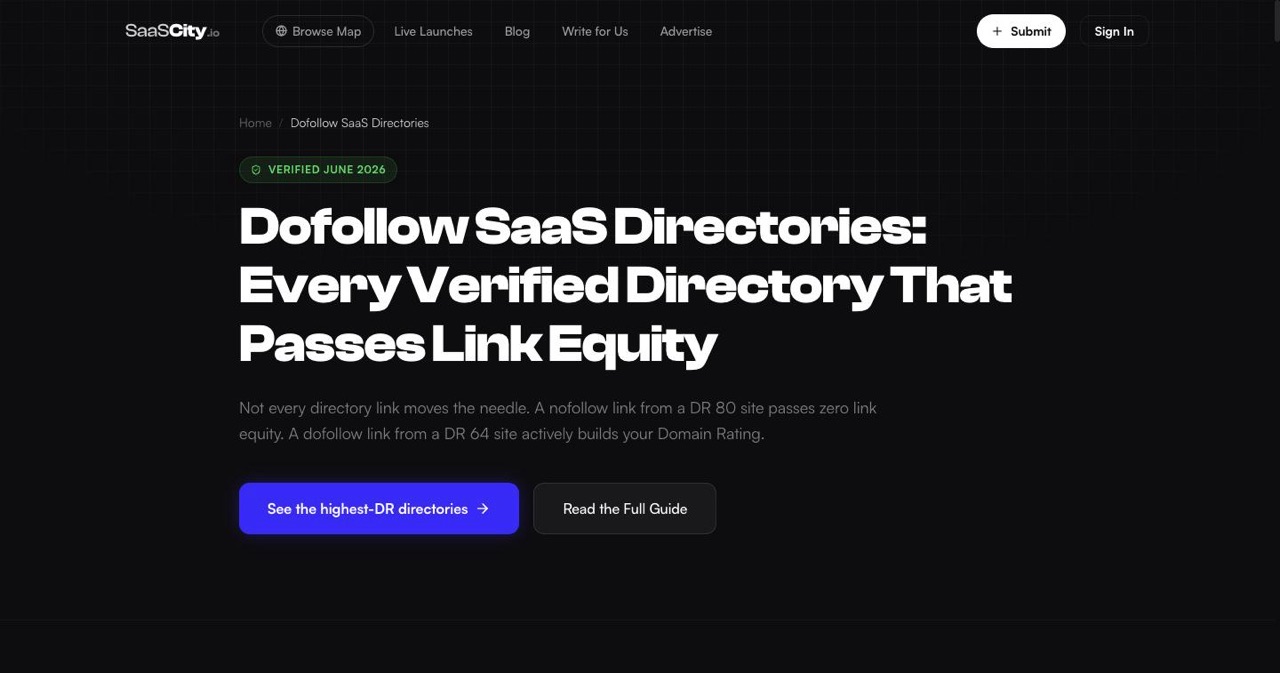
Sort your target list by whether the link is followed - it is the only kind DR counts. Several high-DR profiles, including big review platforms and company databases, hand out nofollow links. Claim them anyway for referral traffic, brand searches and AI-answer citations, but do not count them toward the DR plan. Our verified free dofollow directory list marks the followed ones, and the high-DR directory shortlist sorts what is left by authority.
Pace yourself at seven to ten submissions a day. Not because a directory will notice, but because forty referring domains appearing on a two-week-old domain inside 24 hours is exactly the footprint the 2025 recalibration was built to discount.
Work in this order:
- Launch platforms and review sites you can claim in minutes - Product Hunt (dofollow, DR ~90), Indie Hackers, AlternativeTo, SaaSHub, SourceForge, your category's main review site.
- The big baseline profiles - G2, Capterra, Crunchbase, Trustpilot, BetaList. Mostly nofollow, but they establish the brand entity signals that make every later link look natural, and they feed AI-answer citations.
- General startup and SaaS directories, working down by DR. The free directory list and the high-DR shortlist are the two lists to work from.
- Anything with a real audience in your category, even at modest DR. A DR 35 directory that sends buyers beats a DR 60 one that sends nobody.
Track everything in a sheet: directory, URL, date submitted, dofollow yes/no, status, live URL. You will need it in week four.
List on SaaSCity while you are here. We are a directory ourselves, and a free one. Submitting your product takes about two minutes, puts you in the live launch feed alongside the rest of the launches, and - once you add the verification badge - the listing is a permanent dofollow link rather than a nofollow mention. The badge is deliberate: it is how we keep the followed links pointing at products whose makers are willing to point back. You still take a slot in the weekly queue (15 free launches a week); Quick Pass skips both the badge and the wait, and puts you on our live 3D city map.
Expected by end of week 2: 20-40 new referring domains submitted, perhaps half crawled and counted. DR typically starts moving in the second week, not the first.
Weeks 2-4: Vertical directories and the indexation sweep
The generalist lists are finished. What is left is narrower and, per link, often better.
- Go vertical. Directories specific to your category convert better and dilute less - the page your link sits on has ten outbound links rather than ten thousand. Our vertical roundups cover AI tools, developer tools, no-code tools, Chrome extensions and mobile and iOS apps.
- Sweep for listings that never went live. Take the tracking sheet and check each one. Search
site:directory.com "yourbrand"for anything you cannot find manually. Expect a fifth to a third of submissions to have stalled in moderation, been silently rejected, or gone live on a page nobody has crawled. Resubmit or email the moderator - the cheapest link recovery you will ever do. - Claim the profiles that already exist. Aggregators generate pages about products automatically, often unclaimed, with a nofollow link or none. Claiming converts them.
- Start the free reclaim work. Unlinked brand mentions (a quick email converts at 20-30%) and broken links pointing at old URLs of yours. Both take an afternoon, both are free.
Expected by end of week 4: 40-70 referring domains total, DR usually in the teens to low twenties for a site that started at zero.
Weeks 4-8: Compound, and switch inputs
The directory well runs dry somewhere around here - the point most people misread as a plateau in DR rather than a plateau in effort.
- Ship one genuinely linkable asset. A free tool, original data from your own product, an annual survey, a definitive guide to something narrow. This is the only tactic in the entire playbook with compounding returns - one good asset earns links for years without further work. Ours is the DR checker you have been using; that is not a coincidence.
- Work link intersects. Sites already linking to two of your competitors are the warmest prospects that exist. Ahrefs' Link Intersect surfaces them in minutes.
- Keep a floor of five to ten new referring domains a week. Below that, DR stalls; the relative nature of the metric means standing still is a slow slide.
- Watch for the lag, and do not panic-buy. Links from week three are still landing in week six. The most common mistake at this stage is concluding the plan failed on day 30 and doubling down on volume from somewhere cheap.
Expected by end of week 8: 60-100 referring domains, DR 20-30 for most sites that started at zero and did the work.
Beyond DR 30: The Tactics That Actually Scale
Everything above is the on-ramp. The next twenty points come from editorial links - slower, more expensive per link, and the only thing that keeps working above the low thirties. Ranked by return on effort:
1. Linkable assets (the only compounding tactic). Free tools and calculators are the gold standard - an interactive tool that solves a real problem earns hundreds of referring domains passively. Original research and benchmark reports make you the primary source everyone cites. Comparison and alternative pages ("Your Product vs Competitor", "Top 10 Alternatives to X") target high-intent queries and get linked from Reddit threads and roundups. Publish at least one flagship asset per quarter.
2. Digital PR and data-driven stories. A study, benchmark or stat-heavy report is the best link magnet a SaaS can produce - journalists cite data and bloggers embed charts. Pitch launches and funding news to tech press, and newsjack trending stories in your industry. This is how you get DR 70+ links without paying anyone.
3. Guest posting on relevant publications. Still works, but only on publications your audience actually reads, DR 40+. Pitch something you genuinely know, personalize every email, and lead with what their readers get. One post on a DR 60 SaaS blog beats ten on DR 15 generic marketing blogs. (We take guest posts, for the record.)
4. Reclaim and intersect. Unlinked brand mentions, broken links on resource pages in your niche (find them with Ahrefs' broken-link report, offer your content as the replacement), and link intersects against competitors. Warm prospects, high conversion, low glamour.
5. Integrations, partners and open source. Every tool you integrate with has a "works with" page; getting listed is an email away and often yields a DR 50-80 dofollow link. Affiliate and referral programs turn promoters into linkers. Partner directories, changelogs and READMEs are ordinary places a real product gets linked from - most people never ask.
6. HARO and expert roundups. Responding to journalist queries earns links from major publications. Respond within hours, answer only what you are qualified to answer, and include data or examples. A 10% hit rate is several high-DR links a month.
7. Prefer low-outbound linkers. Same effort, more passed equity. A curated editorial mention on a page linking to five sites beats a slot in a 200-tool roundup where equity splits 200 ways.
For these channels in the order a new SaaS should work them, see how to get backlinks for SaaS.
What to avoid, full stop
- Bulk link packages. "500 backlinks for $99" comes from foreign directories, comment spam and forum profiles. DR may twitch upward on volume; rankings will not follow, and the footprint is hard to undo.
- PBNs and link schemes. Explicitly prohibited by Google. SpamBrain detection has grown sharper and the recovery is a disavow file plus a reconsideration request - months of work.
- Over-optimized anchors. If 40% of your backlinks say "best CRM software," that is a flag.
- Ten more links from a domain that already links to you. Reads as effort in a spreadsheet, does close to nothing.
- A profile that triples in a fortnight. Growth that fast looks like what it usually is.
Should You Pay for It? DR Boost Services, Judged Honestly
There are three broad tiers in this market, and the difference shows up in whether the number holds.
Marketplace gigs - $15 to $100 on freelance platforms, promising huge DR jumps in days. Bulk, automated, and the number that goes up tends to come back down. The "6-month stability guarantee" attached to those offers is not a coincidence; it is roughly the shelf life. One startup we tracked bought a 100-backlinks-for-$200 package: DR rose 5 to 15 on volume alone, organic traffic never moved, Google issued an unnatural-links manual penalty three months later, and after two months of disavowing the DR settled at 8.
Do it yourself - the playbook above. Genuinely effective for a site under DR 30, costs nothing but hours: somewhere between forty and eighty hours of form-filling, moderation-chasing and spreadsheet maintenance across two months. Exhaust this before paying anyone.
If you have the method but not the hours, our directory submission service does the directory part for you. It submits your product to 100 to 370 directories, depending on the package, from $99 one-time, and emails you a report of every submission, its status and a screenshot, within 7 to 10 days. Each package guarantees your site a minimum Domain Rating, as Ahrefs measures it: DR 15+ with Growth, 25+ with Storm and 27+ with Superstorm. If your site is still below it when the package is done, we keep submitting at no extra cost until it gets there. Rankings and traffic are not guaranteed, and each directory decides what it lists.
A managed service - you name a target, someone else does the work, and the result is guaranteed in writing. This is what you are buying when you stop having time to do it yourself. The only three things worth judging a provider on:
| Question | What good looks like |
|---|---|
| What is the target? | A specific DR number, not "significant growth" |
| How is it measured? | On a metric you can pull yourself, free, any day |
| What if they miss? | A written refund with an actual formula |
Add a clean spam score as part of the commitment, growth spread over weeks, and a baseline recorded before work starts. Walk away from arithmetically impossible prices ($19 for DR 50 works only one way), unstated measurement, timelines in days rather than weeks, and vague adjectives with no number attached.
We compared the submission services on the market with live pricing if you are weighing that route.
The Part Most DR Guides Skip: Authority for AI Search (GEO)
Google AI Overviews, Perplexity, ChatGPT and Claude now answer millions of queries that used to go to blue links. Getting cited inside those answers is Generative Engine Optimization - and it changes what "authority" is worth building.
The number worth memorizing: brand mentions correlate 0.664 with AI citation probability, versus 0.218 for backlinks. Unlinked mentions - someone writing your name without linking - matter roughly three times more for citation than a link does. Which means your directory work pays twice: once in referring domains, and again in the mention graph AI systems read.
What AI systems prefer to cite:
- Original statistics with clear sourcing - the reason data studies earn links and citations simultaneously.
- Direct answers at the top of sections - the format this guide uses, and the reason to structure your own content the same way.
- Expert author bios with verifiable credentials - E-E-A-T is not optional anymore.
- Reviews on third-party platforms - G2, Trustpilot, Capterra ratings feed the citation models.
- Recent content - AI systems have a strong recency bias; content older than three months sees a measurable drop in citations. Refreshing your best posts is an AI visibility tactic, not housekeeping.
For a startup in 2026, a sensible allocation is roughly 70% classic SEO / 30% GEO in months 1-6, shifting toward 55/45 by months 7-12. You need ranked content before you can have cited content - the order matters.
Common Mistakes That Waste the Quarter
- Chasing the number instead of the profile. DR 25 with no traffic is a trophy, not a business. The honest case for DR is the doors it opens - optimize for that, not the readout.
- Chasing quantity over quality. One link from a DR 50+ relevant site beats fifty from DR 5 spam. Quality always beats quantity, and since the 2025 recalibration it beats it by more.
- Ignoring relevance. A hundred referring domains with nothing to do with your category moves DR and little else. The links that move rankings are ones a reader might plausibly click.
- Treating directories as the whole plan. They are the on-ramp. A profile made entirely of listings is exactly the shape recalibrations discount.
- Buying links without vetting. If you buy placements at all, check DR, organic traffic and spam score, require contextual in-content links, and avoid sites selling slots to hundreds of unrelated niches. Better: spend the budget on a linkable asset.
- Expecting overnight results. Links appear in Ahrefs in 7-14 days, DR moves over 30-60 days, ranking improvements land at 60-120 days. Plan in quarters, not weeks.
- Neglecting link maintenance. Directories die, get sold, drop listings. Re-audit at 90 days.
- Reading a recalibration drop as your own failure. When Ahrefs recalibrates, everybody moves. Check the referring domain count before concluding anything.
How to Measure Whether It Worked
Four numbers, checked monthly, tell you the truth:
- Unique followed referring domains. The leading indicator - it moves first and it is the one you actually control. Aim for +5-10/month early on.
- Listings live and indexed. Submitted is not published, and published is not crawled.
site:searches and your tracking sheet settle it. - Referral traffic by source. Small, and that is fine - it separates the directories worth revisiting from the pure-link ones.
- Long-tail ranking movement. Not head terms. Positions 30-80 creeping up is the earliest honest sign new authority is doing something. Cross-reference with Google Search Console.
Free tooling covers all of it: our DR checker for the baseline, Ahrefs Webmaster Tools for referring domains and audit flags, Google Search Console for rankings and indexation.
How to Improve Moz Domain Authority (DA), and How It Differs From DR
Some editors, partners and marketplaces quote Moz Domain Authority instead of DR. The two scores try to answer the same question with different data, so it helps to know what each one reads.
| Domain Authority (DA) | Domain Rating (DR) | |
|---|---|---|
| Owner | Moz | Ahrefs |
| Scale | 1 to 100, logarithmic | 0 to 100, logarithmic |
| Built from | Moz's own link index, run through a machine-learning model that predicts how likely a domain is to rank compared with other domains | Ahrefs' own link index: unique referring domains with a followed link, weighted by their own DR |
| Where to check | Moz Link Explorer, or Moz's free Domain Analysis tool | Ahrefs Site Explorer, or the free Ahrefs Website Authority Checker |
Three things follow from that:
- The numbers will not match. Each tool counts the links its own crawler has found and runs its own formula. A site at DR 30 can sit well above or below DA 30. Compare DA with DA and DR with DR.
- Both are comparative. A score says how your link profile stacks up against the other sites in that tool's index. It can slip in a month where you gained links, because other sites gained more.
- Neither is a Google ranking factor. Google does not use either score. Both are third-party estimates built to model what search engines reward.
Raising DA takes the same work as raising DR:
- Earn links from more distinct domains. Both models count a new linking domain for far more than another link from a site that already links to you. The directory and editorial work in this guide moves both scores.
- Favor relevant, well-linked sites. A link from a domain with a strong link profile of its own counts for more in both models than one from a thin site.
- Recover lost and broken links. Redirect old URLs that still have links pointing at them with a 301, and ask sites that link to your dead pages to update the link.
- Use internal links for page-level scores. Both domain scores are driven by links from other sites. Internal links decide which of your pages get that equity, which Moz reports as Page Authority and Ahrefs as URL Rating.
Pick one score as your working number and check the other once a quarter. If DA trails DR for months, open Moz Link Explorer and see which of your linking domains Moz has not found yet before you change anything.
DIY Checklist
- Record baseline DR and referring domain count
- Check five competitors' DR to set a real target
- Audit existing links; disavow the toxic ones
- Build the asset kit with multiple description variants
- Submit 7-10/day, dofollow first, tracked in a sheet
- Claim baseline profiles (G2, Crunchbase, Product Hunt, AlternativeTo)
- Sweep for unpublished and unindexed listings at week four
- Go vertical once the generalist lists are exhausted
- Ship one linkable asset
- Hold five to ten new referring domains per week
- Convert unlinked mentions and broken links
- Re-audit at 90 days
Start with the free routes: work the free directory list until it runs out. For most sites under DR 20 that is worth real points at zero cost.
FAQ
What is Ahrefs Domain Rating (DR)? Domain Rating is Ahrefs' proprietary 0-100 score for backlink profile strength, measured against every other site in their index. It counts unique referring domains with at least one followed link, weighted by each linking domain's own DR and diluted by its outbound links. Content, age and traffic do not factor in.
Is Domain Rating a Google ranking factor? No. Google neither reads DR nor has an equivalent score. DR correlates with rankings because both follow the same inputs - followed links from authoritative domains. It is a health proxy and an industry filter, not a ranking input.
What is the difference between Domain Authority and Domain Rating? DA is Moz's metric (link profile blended with ranking likelihood, monthly updates); DR is Ahrefs' (pure backlinks, ~daily updates). High DR with low DA usually means strong links but weak experience - the gap localizes the problem. SaaS defaults to DR because Ahrefs dominates the ecosystem.
How many referring domains do I need for DR 20 or DR 30? No fixed number - each domain is weighted by its DR and diluted by outbound links. Working estimate from zero: 20-50 followed referring domains lands the teens to low twenties; 50-100 pushes the high twenties and thirties.
How long does it take to increase Domain Rating? Directory-led: DR 0 to teens-to-mid-twenties in 30-60 days. DR 30 to 50: 6-12 months of editorial links. DR 50 to 70+: a year or more. Links surface in Ahrefs within 7-14 days of discovery and DR moves in steps.
Do nofollow links increase Domain Rating? No - DR counts only followed referring domains. Claim nofollow placements anyway: Google treats nofollow as a hint since 2019, they drive referral traffic and brand searches, and mentions on authoritative platforms feed AI citations.
Can I increase Domain Rating for free? Yes - directories, launch platforms, reclaimed broken links and unlinked mentions move most sites under DR 20 meaningfully at zero cost (10-20 hours). Pay only when free routes are exhausted.
Is a DR boost service safe? Hold providers to a specific DR target, a metric you can verify free, and a written refund formula - plus clean spam score and growth spread over weeks. Anything else is walk-away territory.
What is a good Domain Rating? Whatever the top five results for your target keyword sit at. DR 30-40 competitors means that is your target; DR 70 means the page is not winnable on authority yet.
Why did my DR drop when I did not lose links? DR is relative (others gaining faster slides you), links get recrawled and found removed or nofollowed, and Ahrefs recalibrates the model itself - the September 2025 pass moved scores index-wide.
Domain Rating is one of the few numbers in SEO you can move on purpose. The curve favors you at the start, the input is understood, and the first twenty or thirty points are genuinely available to anyone willing to spend the hours. Spend them deliberately: check your baseline, work the list in order, and let the compounding start.
Get your SaaS in front of founders
List your product on the SaaSCity live city map - a permanent listing, real discovery, and a backlink from a high-DR directory. Free to start; upgrade for a dofollow link and a building on the map.