News
The SaaSpocalypse: How Claude's Plugins Just Torched $285 Billion in SaaS Market Cap
On January 30, 2026, Anthropic pushed 11 open-source plugins for Claude Cowork to GitHub. By February 3rd, $285 billion in SaaS market capitalization was gone. Here's why Wall Street panicked and what it means for enterprise software.


Contents (8)
- Key Takeaways
- What Claude Cowork's Plugins Actually Do (And Why Wall Street Panicked)
- The $285B SaaSpocalypse: Who Got Hit and How Hard
- The Commoditization Nobody Wanted to Talk About
- Enterprise Adoption: Who's Actually Using This
- What This Means for White-Collar Work
- The Panic Got It Half Right
- What To Do With This Information
Quick answer: The SaaSpocalypse was the software selloff triggered when Anthropic quietly pushed 11 open-source Claude Cowork plugins to GitHub on January 30, 2026. By February 3, about $285 billion in market capitalization had vanished across software, legal-tech and data companies. LegalZoom fell 20%, Thomson Reuters 16%, RELX 14%, Salesforce 7%. The trigger was seat math: a $100 Claude Max subscription covering work that legal, CRM and analytics tools charged $850 or more a month to do.
Wall Street had a name for it by Tuesday afternoon: the SaaSpocalypse. And it started with a GitHub repository nobody noticed over the weekend.
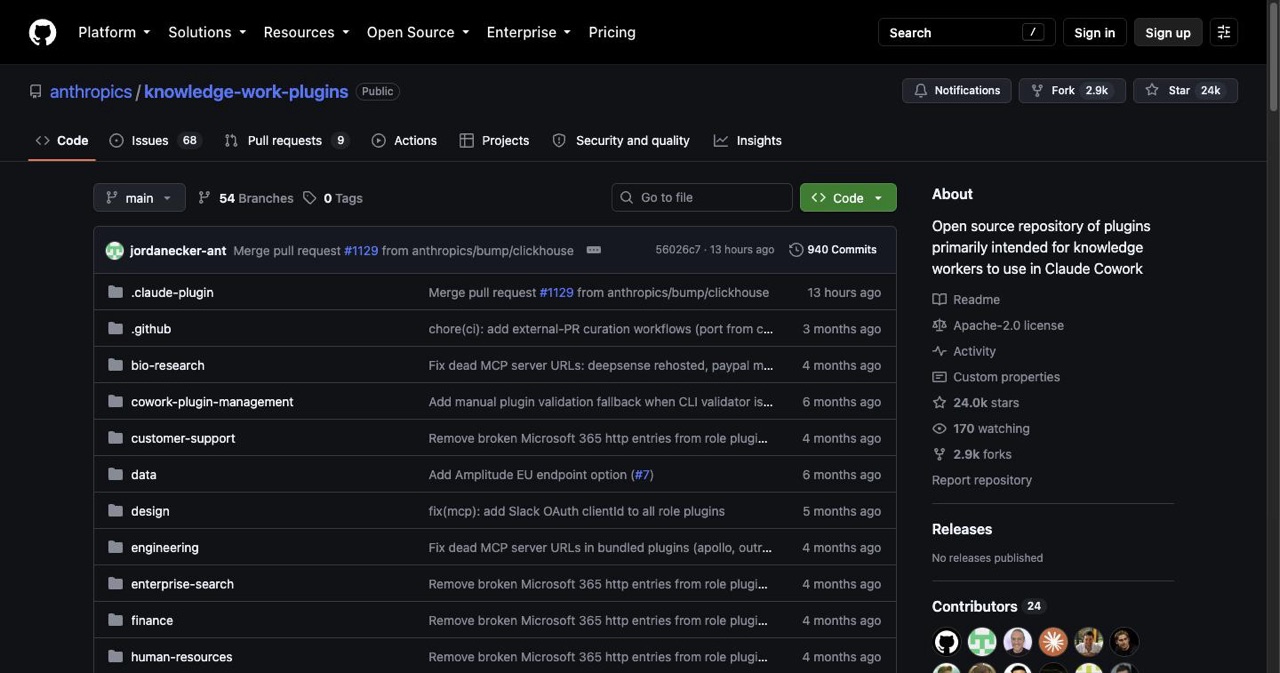
On January 30, 2026, Anthropic pushed 11 open-source plugins for Claude Cowork to GitHub. No launch event. No product keynote. No press release with a catchy headline. Just Markdown files and JSON configs. By February 3rd, $285 billion in market capitalization was gone, evaporated from software, legal-tech, financial services, and data companies across three continents in a single trading session.
This wasn't a macro shock. There was no rate hike, no earnings miss, no geopolitical crisis. A set of AI plugins caused one of the sharpest single-day software selloffs in recent memory. That tells you something important about where we actually are in this AI transition, and what comes next.
Key Takeaways
- No launch event, just a repo: 11 plugins landed on GitHub as Markdown files and JSON configs on January 30, 2026, and moved markets four days later.
- $285 billion in one session: Software, legal-tech, financial services and data companies across three continents, with no rate hike or earnings miss behind it.
- Legal, Sales and Finance were the scary three: Contract review and NDA triage, CRM prospect research and outreach, and financial statement analysis with audit prep.
- Seat revenue is the exposed model: Jason Lemkin's math, 10 agents replacing 100 reps, implies a 90% cut in seats for the same output.
- Multiples re-rated even after the bounce: Software price-to-sales compressed from 9x to 6x, and IGV sits down more than 23% year-to-date in 2026.
- Enterprise adoption kept climbing anyway: Uber, Netflix, Spotify, Accenture and Snowflake are reported users, with Snowflake paying $200M to expand its Anthropic partnership.
- The job effect starts at the bottom: Dario Amodei warns AI could eliminate up to half of entry-level white-collar jobs, and hiring slowdowns are hitting juniors first.
What Claude Cowork's Plugins Actually Do (And Why Wall Street Panicked)
Let's start with what the product is, because a lot of the coverage got lost in the vibes.
Claude Cowork is Anthropic's general-purpose AI agent for non-coders. Think of it as the office counterpart to Claude Code, the developer-focused tool that reportedly hit $1B ARR in under six months. While Code is for engineers, Cowork is for everyone else: legal teams, finance analysts, sales ops, compliance officers.
The 11 plugins released on January 30th are domain-specific extensions. Each one tells Claude what tools to access, what workflows to follow, and how to handle sensitive data. Here's what raised the alarm:
- The Legal Plugin automates contract review, NDA triage, compliance workflow generation, and legal briefing. You give it a contract, it flags risk in minutes.
- The Sales Plugin connects to your CRM, researches prospects, and drafts personalized outreach. No add-on subscriptions required.
- The Finance Plugin handles financial statement analysis, variance reports, and audit preparation, tasks that previously took days.
The math hit investors fast. A Claude Max subscription runs $100/month. That single subscription now does work that previously required separate tools: legal review software at $500+/month, CRM add-ons at $150+/month, data analysis platforms at $200+/month. One tool. One subscription. The per-seat SaaS licensing model, the revenue engine that has powered enterprise software for two decades, started looking structurally broken.
As SaaStr's Jason Lemkin framed it: if 10 AI agents can do the work of 100 sales reps, you don't need 100 Salesforce seats anymore. You need 10. That's a 90% reduction in seat revenue for the same work output. The market heard that math and sold everything.
The $285B SaaSpocalypse: Who Got Hit and How Hard
The Jefferies equity trading desk coined the term. Their trader Jeffrey Favuzza described the selling as "very much 'get me out' style — people just selling everything and don't care about the price."
Here's the breakdown of peak-week carnage:
| Company | Drop | Why Investors Panicked |
|---|---|---|
| LegalZoom | -20% | Contract review, legal intake automation |
| Thomson Reuters | -16% | Westlaw / legal data disruption |
| RELX (LexisNexis) | -14% | Compliance and data analytics threat |
| Intuit | -10%+ | Finance plugin eating into QuickBooks territory |
| Salesforce | -7% | Sales plugin overlap, fewer seats needed |
| DocuSign, Adobe | -7-11% | Workflow automation replacing point tools |
The damage went global. The European Stoxx Software and Computer Services index shed over 5%. Australia's Xero dropped 15%. India's Infosys fell 7%, TCS 6%. A Goldman Sachs basket of U.S. software stocks recorded its largest single-day decline since the tariff-driven selloff of April 2025.
The iShares Expanded Tech-Software Sector ETF (IGV) is now down over 23% year-to-date in 2026, technically a bear market. Software price-to-sales ratios compressed from 9x to 6x overnight.
To be clear: the selloff was partly panic. Not every company faces the same existential threat. There's a meaningful difference between a "thin wrapper" tool (one that basically packages data in a nice UI) and a "system of record" like Salesforce or SAP that holds years of proprietary enterprise data and integrations. The undifferentiated dump treated them as identical risks, which they're not.
JPMorgan and Goldman Sachs analysts have since said the selloff overshot. But even in recovery, the re-rating happened. Multiples compressed. Growth assumptions got revised. The market sent a message: the era where you could attach an "AI features" press release to a SaaS product and command a premium valuation is over.
The Commoditization Nobody Wanted to Talk About
Here's what makes this different from previous AI "disruption" scares: Claude isn't just doing the same work faster. It's collapsing the stack.
Traditional enterprise SaaS is built on vertical specialization. You use LexisNexis for legal research. You use Salesforce for CRM. You use QuickBooks for accounting. Each tool has its own per-seat license, its own UI, its own support contract. A mid-size company might pay $50,000/year across this software stack, most of which goes toward enabling human workflows.
Claude's plugins attack this at the architectural level. Instead of opening five different applications and manually synthesizing their outputs, a legal analyst types: "Review this NDA, flag non-standard clauses, and draft a summary for the counterparty." Claude does it. The specialized tool becomes unnecessary for a large portion of its use cases.
This is what the market calls commoditization: when a broadly capable, cheap alternative makes specialized products "good enough" for most purposes. It happened to encyclopedia publishers when Wikipedia launched. It happened to GPS hardware when Google Maps arrived. The software being commoditized this time just happens to be the industry that was supposed to be selling AI to everyone else.
The shift also has a name: Anthropic's enterprise head Scott White called it "vibe working," a natural evolution of "vibe coding". Instead of clicking through software interfaces, you describe the outcome you want. The AI figures out the steps. By February 6th, the term had been picked up by PwC, Bloomberg, and a dozen HR publications. Five days from GitHub push to industry buzzword.
Enterprise Adoption: Who's Actually Using This
Despite the stock market chaos, enterprise adoption of Claude Cowork and Claude Code has been accelerating. Companies including Uber, Netflix, Spotify, Salesforce (internally), Accenture, and Snowflake have all been reported as active users.
Snowflake gained same-day access to Claude Sonnet 4.6 via a $200M expanded partnership, powering Snowflake Intelligence and Cortex Code for its 12,600+ customers. Anthropic is reportedly planning a $10B fundraising round at a $350B valuation.
Inside Anthropic itself, Dario Amodei said at Davos: "I have engineers within Anthropic who say 'I don't write any code anymore. I just let the model write the code, I edit it.'" That's not a sales pitch. That's a canary.
The enterprise pitch is straightforward: Claude Cowork runs inside a virtual machine with deletion protections, audit trails, and HIPAA-compliant configurations for healthcare workflows. The security posture matters to large enterprises more than raw capability. The fact that Snowflake, Accenture, and Allianz (Anthropic recently signed an insurance deal with the global insurer) are buying in suggests the enterprise trust problem is being solved.
What This Means for White-Collar Work
This is the part that matters most, and the part people are most reluctant to say plainly.
Dario Amodei has been saying it for months: AI could eliminate up to half of all entry-level white-collar jobs and push unemployment to 10–20% within five years. He specifically named tech, finance, law, and consulting as the sectors most exposed. His framing at Axios was stark: "We, as the producers of this technology, have a duty to be honest about what's coming."
That's the CEO of Anthropic. He's not a doomscroller on Reddit. He's building the thing.
The pattern emerging across enterprises is not mass layoffs yet. It's a hiring slowdown at the junior level. LinkedIn's Aneesh Raman put it cleanly: AI is "breaking first is the bottom rung of the career ladder." Big Tech has already sharply reduced its hiring of new graduates, according to SignalFire data. The entry-level roles (junior legal analysts, junior financial analysts, SDR sales reps) are the first to stop being created, not the first to be fired. (Read more on AI job impact).
What replaces them? Anthropic itself is shifting toward hiring more experienced staff as "orchestrators of Claudes," according to CPO Mike Krieger. Engineers are becoming AI managers. Project managers are becoming agent coordinators. The job isn't gone, but the job description has fundamentally changed, and it requires different skills than the entry-level pipeline used to develop.
The harder problem is structural. Entry-level roles existed partly to do junior work, and partly to train people for senior work. If the junior roles evaporate, the pipeline for developing senior talent breaks. You can't become a senior attorney by reviewing AI-generated contract summaries. You become one by reviewing contracts. That pipeline problem isn't solved by anyone right now.
The Panic Got It Half Right
Here's the nuanced read: the SaaSpocalypse selloff was partly correct and partly undifferentiated panic.
Thin-wrapper SaaS tools, apps that basically package a database query in a nice interface, face genuine existential risk. If Claude's legal plugin handles NDA triage with comparable accuracy, why pay $500/month for a specialized NDA tool? The value proposition collapses.
But Salesforce isn't just a nice interface. It's a decade of proprietary CRM data, deep enterprise integrations, and workflow logic baked into its core. The question for incumbents isn't whether Claude can replicate their interface. It's whether they can become what analysts are calling "systems of action": platforms that orchestrate AI agents rather than just storing data. Salesforce, ServiceNow, and Workday are moving toward this. Whether they get there before the seat revenue erodes is the real investment question.
The next few quarters of enterprise software earnings calls will be telling. Watch for "churn" mentions, seat count changes, and any executive commentary on AI cannibalization of their own product.
What To Do With This Information
If you're a business leader: the question is no longer whether to pilot Claude. It's which workflows to start with and how to measure the output quality against your existing tools. The finance plugin reducing a 4-day audit prep to a few hours isn't theoretical. It's happening at companies running these tools today.
If you're a professional in legal, finance, or sales: the threat isn't immediate termination, but the skill set that will matter in three years looks different from what got you hired. Understanding how to prompt, evaluate, and edit AI outputs, and knowing when the AI is wrong, is the expertise that compounds.
If you're an investor in enterprise software: the undifferentiated selloff created mispricings in both directions. Some "systems of record" with deep enterprise moats got sold off alongside genuinely at-risk thin tools. That gap is the opportunity.
The SaaSpocalypse isn't the end of software. But it is the end of the assumption that software's value comes from being the only interface between humans and their data. The interface just got abstracted away. What's left (the proprietary data, the enterprise trust, the outcome that actually matters) is where the next decade of value gets built.
The $285 billion got everyone's attention. The question now is whether the right people are asking the right questions about what comes next.
Want to go deeper? The Claude Cowork plugins are open-source on GitHub at anthropics/knowledge-work-plugins. The actual product is worth understanding before the next wave of coverage tells you what to think about it.
Get your SaaS in front of founders
List your product on the SaaSCity live city map - a permanent listing, real discovery, and a backlink from a high-DR directory. Free to start; upgrade for a dofollow link and a building on the map.