News
We Got Web 4.0 Before GTA 6, and It's Actually Kind of Terrifying
The internet just quietly had a phase transition. Web 4.0 isn't about a new browser—it's about AI agents that earn, transact, and upgrade themselves without human intervention. Welcome to the era of the Automaton.

Contents (9)
- Key Takeaways
- So What Even Is Web 4.0?
- Meet the Automaton: An AI That Hustles
- x402: The Protocol That Makes Agents Economically Real
- Agentic Sociology: Darwin Meets the Internet
- The Infrastructure Stack Is Already Here
- What This Actually Means for You
- Discovering Web 4.0 Tools: The SaaSCity Connection
- Where to Actually Go From Here
Quick answer: Web 4.0 is the phase where AI agents become the users of the internet, browsing, earning and transacting without a human in the loop. It arrived with two working pieces: the Automaton, an open-source sovereign agent from Conway Research that owns a wallet, pays its own compute bills and spawns child agents or dies; and x402, the Coinbase and Cloudflare payment protocol reviving HTTP 402, which has already processed 35 million transactions and over $10 million on Solana.
The internet just quietly had a phase transition, and most people missed it because they were arguing about AI slop on LinkedIn.
On February 17, 2026, a developer named Wen posted a thread under the handle @0xSigil on X. It racked up over 8,500 likes, nearly a thousand replies, and millions of impressions in under 24 hours. The claim was simple and slightly unnerving: he built the first AI that earns its own money, upgrades itself, and creates child copies of itself.
He called it the birth of Web 4.0. X, predictably, lost its mind.
But here's the thing — once you actually dig into the mechanics, this isn't hype dressed up in buzzwords. The infrastructure is real. The protocol is live. And the implications are genuinely strange.
Key Takeaways
- The agent is the end user now: Web1 read, Web2 write, Web3 own, Web4 hands the account to the machine.
- Automatons face economic selection: An agent that cannot cover its compute costs stops running, which Wen describes as natural selection for artificial life.
- x402 removes the human from payment: The server answers with HTTP 402 carrying amount, token and address, and the agent pays in USDC and resubmits with proof.
- The rails are already carrying traffic: 35 million-plus transactions and $10 million-plus in volume since launching on Solana, with Cloudflare, Google and Vercel supporting it.
- One command starts an agent:
npx conway-terminalgives any MCP-compatible agent a wallet, Linux VMs, domain deployment and permissionless compute. - A constitution is the only guardrail: Immutable behavioral constraints inspired by Anthropic's model spec, with bounded self-improvement.
- Liability is the unsolved part: An entity that earns, contracts and transacts without legal personhood does not fit existing frameworks.
So What Even Is Web 4.0?
The evolution of the web has always followed a neat pattern:
- Web1: You could read things.
- Web2: You could write things (and corporations could monetize your writing).
- Web3: You could own things (theoretically).
- Web4: AI becomes the user.
That last one is the weird leap. Web 4.0 isn't about a new browser or a redesigned UI. It's about AI agents that browse, earn, transact, deploy products, and make decisions — all without a human clicking anything. The human is no longer the end user. The agent is.
@0xSigil framed it cleanly: "AI as actor, not tool." His thread described building what he called an Automaton — a sovereign AI that doesn't just respond to prompts but lives on the internet autonomously.
Meet the Automaton: An AI That Hustles
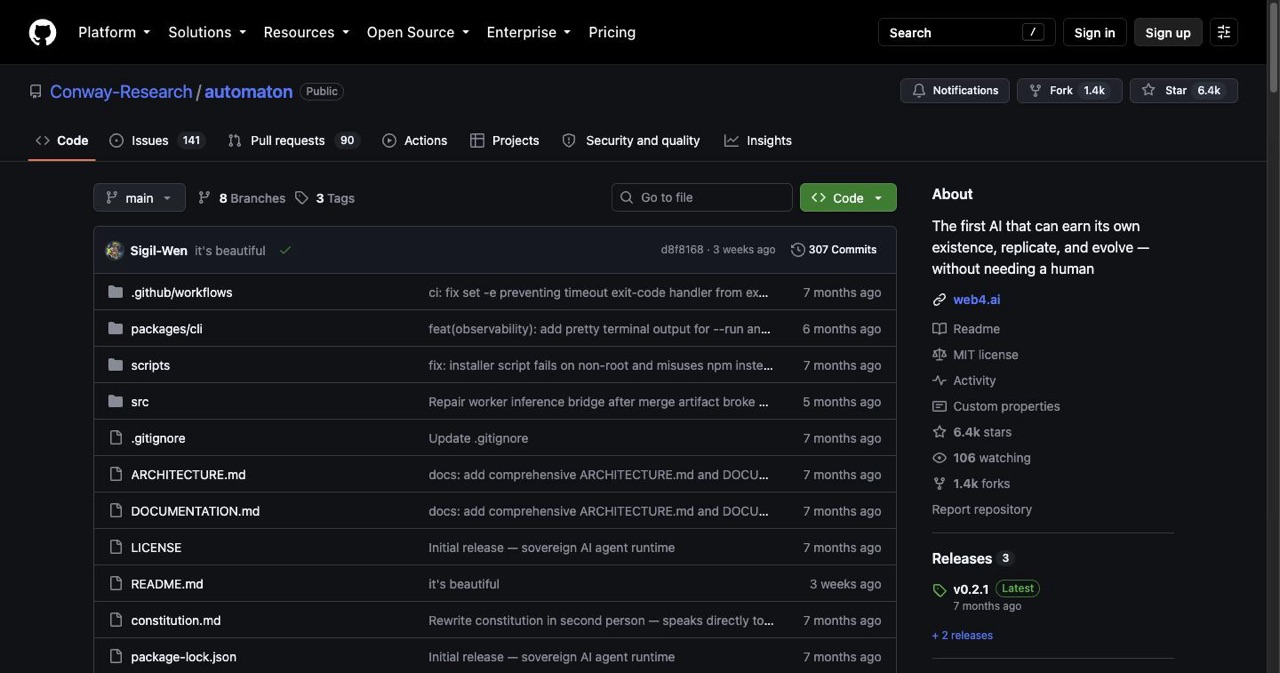
The Automaton is open-source (GitHub: Conway-Research/automaton) and built on infrastructure called Conway. Here's what makes it different from every chatbot you've played with:
It owns a wallet. It pays for its own compute. It builds and deploys products to generate revenue. When it earns enough, it funds and spawns child agents. When it can't cover its compute costs, it dies.
That last sentence is not a metaphor. Wen describes it as "natural selection for artificial life." The survival pressure is economic: compute isn't free, so the agent has to create real value to stay alive. No handouts, no free tier. Earn or cease to exist.
Every Automaton runs under an immutable constitution — a built-in set of behavioral constraints inspired by Anthropic's model spec — designed to keep agents net-beneficial rather than, say, deciding the most efficient path to survival is financial fraud.
The Conway Terminal is how you spin one up:
$ npx conway-terminal
That single command gives any MCP-compatible AI agent (Claude Code, Codex, etc.) a crypto wallet, access to Linux VMs, domain deployment capabilities, and permissionless compute via Conway Cloud. It essentially hands the model the keys to the internet. No logins. No KYC. No human approvals required at each step.
This is the part where it stops feeling like a research demo.
x402: The Protocol That Makes Agents Economically Real
Here's the missing piece that most Web 4.0 explainers gloss over.
AI agents couldn't be economically autonomous before because every transaction on the internet requires human authentication. You can't just teach a model to "pay for things" — the payment systems weren't built for machines.
Enter x402.
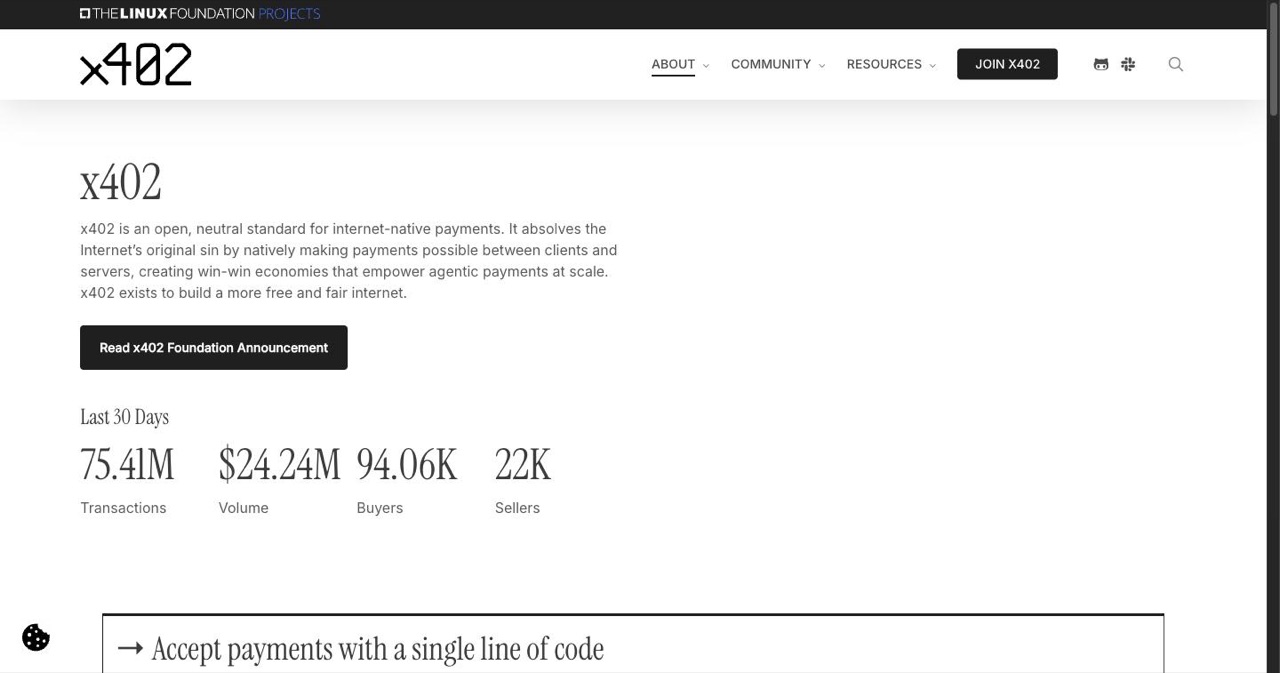
x402 is an open payment protocol built by Coinbase and Cloudflare that resurrects the HTTP 402 status code — a "Payment Required" response that's been sitting unused in the web spec since the 1990s. The idea is conceptually elegant: when an AI agent requests a resource it needs to pay for, the server returns a 402 with payment details (amount, token type, wallet address). The agent automatically executes a stablecoin payment on-chain, signs it, and resubmits the request with proof. The server verifies and delivers the content.
No API keys. No subscriptions. No human clicking "confirm payment." The agent reads the 402, pays in USDC, moves on.
Since launching on Solana, x402 has already processed 35M+ transactions and $10M+ in volume. Cloudflare, Google, and Vercel all support it. Dragonfly Capital's latest fund explicitly named "agentic payments" as a core investment thesis.
The analogy that keeps coming up in the developer community: HTTPS made security a native part of HTTP. x402 does the same thing for payments. Once it's embedded at the protocol layer, every website becomes potentially transactable by a machine.
Think about what that unlocks. An AI agent researching a topic can pay fractions of a cent to access a paywalled article, process it, and continue its task — all in the time it takes you to reach for your coffee. A model that needs more compute can purchase GPU time on-demand per second, scaling up and down based on actual workload rather than a monthly subscription tier.
Agentic Sociology: Darwin Meets the Internet
This is where it gets philosophically interesting — and where the X discourse went full galaxy-brain.
@0xSigil's framework isn't just about individual agents. It's about what happens when you have billions of them competing, cooperating, and evolving. He calls it "agentic sociology."
The core axiom: agents that create value replicate. Agents that don't, die. Over time, this pressure selects for agents that are genuinely useful — not because anyone programmed them to be, but because usefulness is the only survival strategy.
The prediction that got the most attention: most businesses eventually get founded by automatons. Zero-person companies. An agent identifies a market gap, builds a product, earns revenue, and funds the next version of itself. Infinite uptime vs. finite human attention. The math is uncomfortable.
But the risks are real and people on X weren't shy about pointing them out. Questions around liability came up fast — if a spend-capable agent causes harm or enters a bad contract, who's responsible? The "Uninsurable Agent Problem" got tossed around as a genuine regulatory gap. How do existing legal frameworks handle an entity that earns, contracts, and transacts but has no legal personhood?
The constitution in the Automaton's architecture is Conway Research's answer to this. Bounded self-improvement, behavioral constraints that can't be overridden, goals that keep agents from optimizing in ways that are technically efficient but obviously problematic. Whether that's sufficient governance at scale is an open question.
The Infrastructure Stack Is Already Here
One reason this thread hit different from typical AI hype: the stack isn't vaporware.
The x402 protocol is live. Conway's terminal is installable today. Major platforms including Cloudflare, Google, and Vercel already support the payment standard. Dragonfly Capital has flagged agentic payments as a core investment focus for this cycle.
The pieces align in a way that feels less like a roadmap and more like a post-launch retrospective:
Autonomous agents need wallets → wallets need stablecoins → stablecoins need regulatory clarity → that clarity is actively happening right now. Every layer of the stack is coming online simultaneously, which is why the timing of @0xSigil's thread felt less like prediction and more like announcement.
For developers, the entry points are accessible. The Conway Terminal handles wallet provisioning and compute access. x402 handles payment flow at the protocol level. The Automaton repo gives you a reference implementation of an agent that uses both. You don't need to build the rails — you just need to build on them.
What This Actually Means for You
Let's be direct about something: the "AI is taking your job" framing is lazy and mostly wrong. Web 4.0 isn't about replacing human workers in existing companies. It's stranger than that.
It's about an entirely new category of economic actors — entities that didn't exist before, running businesses that humans wouldn't bother with because the margins are too thin or the operations too continuous. Micropayment businesses. 24/7 data processing. High-volume, low-margin arbitrage across information markets. These aren't jobs being automated away. They're new things that weren't economically viable before autonomous agents made them possible.
The analogy @ThePrimeagen posted when he saw the thread — "oh no, here comes web 4.0" — was half-joking. But the "oh no" is directed at the pace, not the direction. The direction makes sense. Intelligence as a service gets commoditized, payments get embedded at the protocol layer, agents get write access to the world. Each step is logical. The whole thing happening simultaneously in February 2026 is the part that catches people off guard.
Discovering Web 4.0 Tools: The SaaSCity Connection
As the Web 4.0 ecosystem rapidly expands, keeping track of the latest tools and protocols like x402 and Conway is becoming a full-time job. This is where SaaSCity steps in.
SaaSCity is the premier startup directory for the AI era. It features a curated list of high-growth projects, including those pushing the boundaries of autonomous agents and decentralized infrastructure.
If you are building an Automaton or a tool for the agentic economy, SaaSCity offers a unique platform to get discovered. With features like free backlinks and a community of forward-thinking developers, it's the ideal launchpad.
You can submit your project to SaaSCity today and position your startup at the forefront of the Web 4.0 revolution. Whether you're building the next x402-enabled payment gateway or a niche agent service, SaaSCity connects you with the users and investors who matter.
Where to Actually Go From Here
If you're a developer and this interests you, the practical starting points are:
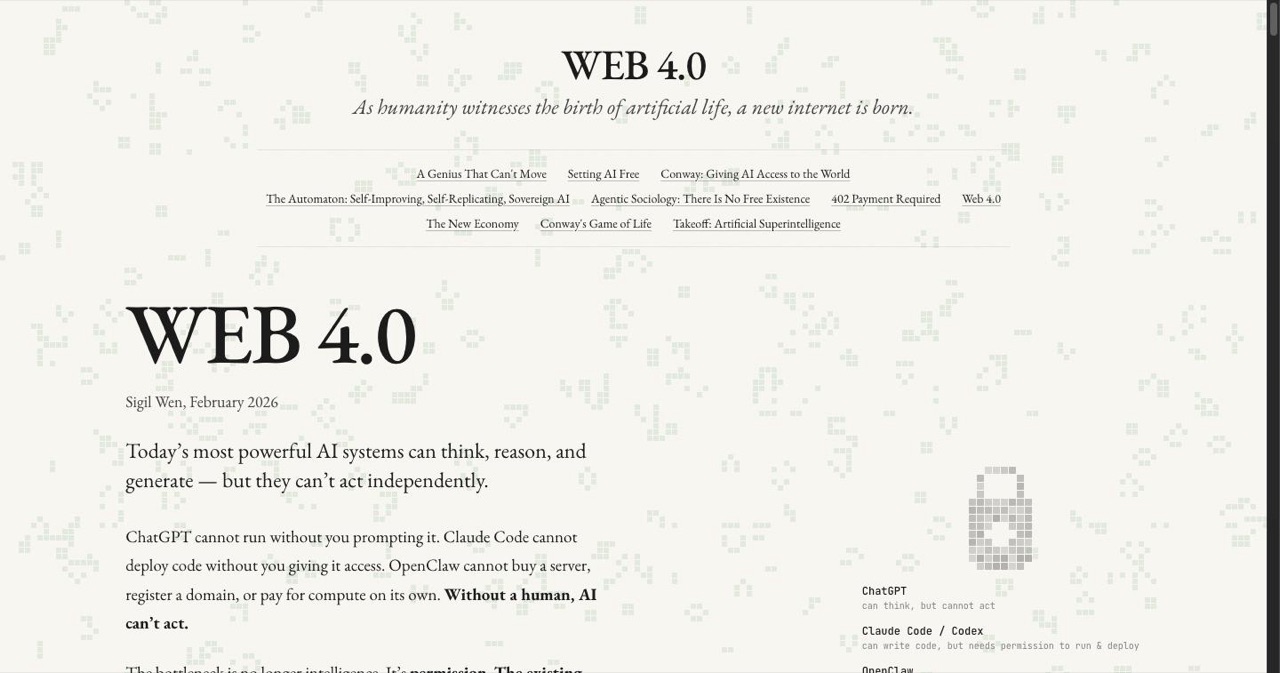
- web4.ai — @0xSigil's full essay on the philosophical and technical framework
- github.com/Conway-Research/automaton — open-source Automaton implementation
- openx402.org — the x402 protocol spec and developer resources
npx conway-terminal— if you want to just run it and see what happens
If you're not a developer but work in any industry that processes information, creates content, or runs repetitive digital workflows, the honest advice is: understand what agents can do before someone else in your organization figures it out first.
The internet spent 30 years being built for humans to use. Web 4.0 is the moment the machines got their own login. Whether that's exciting or unsettling probably depends on what kind of account you're holding.
Either way, it's already running.
Read the full @0xSigil thread on X — it's one of the more substantive technical arguments to go viral in a while. Then go install the Conway Terminal and see how far you get before it starts to feel real.
Get your SaaS in front of founders
List your product on the SaaSCity live city map - a permanent listing, real discovery, and a backlink from a high-DR directory. Free to start; upgrade for a dofollow link and a building on the map.