Build with AI
Someone Built a Pokémon Go Clone in One Prompt. Here's the Tool That Made It Possible.
A detailed look into Rork Max, the first Swift app builder that runs entirely in a web browser. Learn how it lets you create AR-enabled, App Store-ready iOS apps from a single text prompt using Claude Code.


Contents (11)
- Key Takeaways
- What Is Rork Max, Exactly?
- How It Actually Works (Step by Step)
- What Rork Max Can Actually Build
- Who This Is Actually For
- Pricing: What It Costs and Whether It's Worth It
- The Honest Pros and Cons
- How It Compares to Alternatives
- What Users Are Actually Saying
- The Bigger Picture
- Should You Try It?
Quick answer: Rork Max, launched February 19, 2026, is the first Swift app builder that runs entirely in a web browser. You describe an app in plain English, Claude Code and Opus 4.6 write the SwiftUI, and Rork's cloud Mac fleet compiles it and streams a live simulator to your tab. You install on a physical iPhone by QR code with no Apple Developer account, then publish to TestFlight or the App Store in two clicks. The launch demo was a working AR Pokémon Go clone with 3D models, GPS and creature-catching.
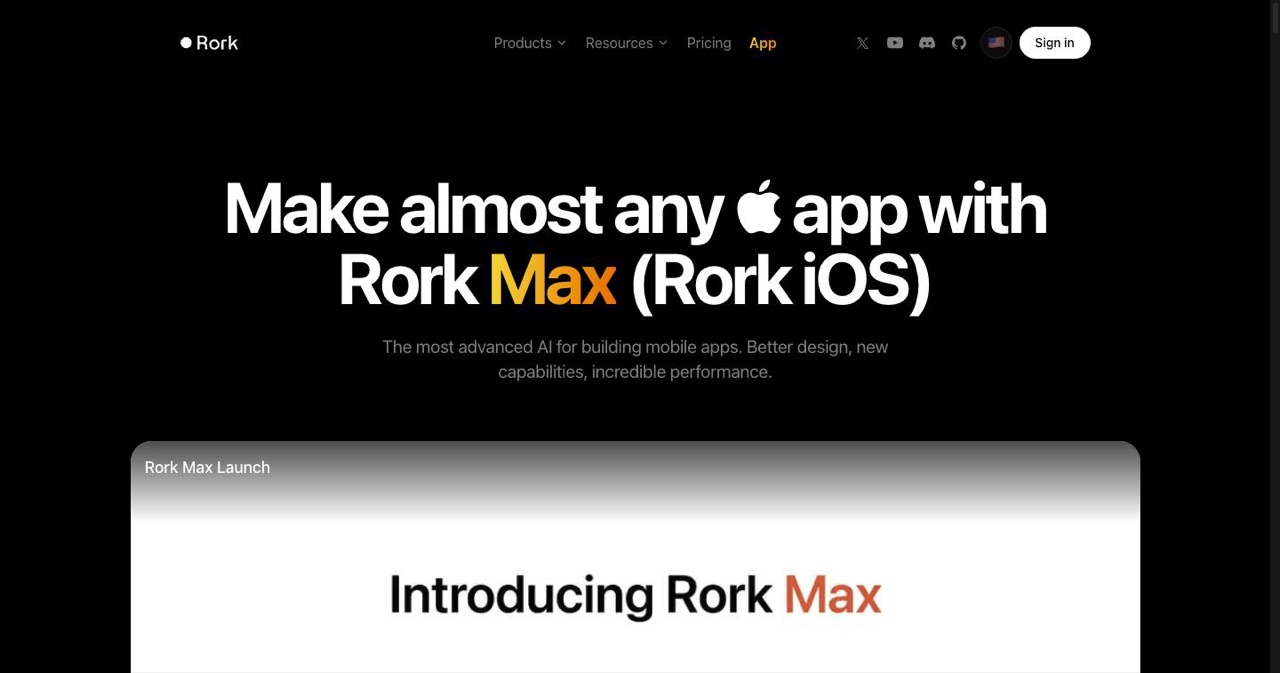
Not a prototype. Not a mockup. A working, AR-enabled, App Store–ready Pokémon Go clone — built from a single text prompt in under a day. That's the demo Rork shipped when they launched Rork Max in February 2026, and it broke the internet just a little.
If you've been watching the AI app-building space and tracking vibe coding trends, you know most tools promise the world and deliver a glorified button widget. Rork Max is different in ways that actually matter — and this breakdown will show you exactly why, what it can do, who it's built for, and where it still has room to grow.
Key Takeaways
- Native Swift, not a wrapper: Rork Max generates SwiftUI with direct access to ARKit, HealthKit, SceneKit, Metal, CoreML, the Dynamic Island and Vision Pro spatial computing.
- No Mac, no Xcode: Compilation happens on Rork's cloud Mac fleet, and device testing works over a QR code without an Apple Developer account.
- Claude Code and Opus 4.6 do the writing: The models run iteratively, catching compilation errors and fixing them until the app builds.
- One project, every Apple platform: Apps can target iPhone, iPad, Apple Watch, Apple TV, Vision Pro and iMessage from the same codebase.
- Pricing sits at the premium end: Rork's base plans run $20/month for 100 messages up to $200/month for 1,000, with Rork Max referenced at a $200/month tier and a free tier of roughly 5 prompts per week.
- One-shot is a demo, not the norm: Multi-feature apps usually take several follow-up prompts, and the base Rork product has drawn reports of crashes and deployment friction.
- What it still won't cover: Payments, real-time push notifications and custom data pipelines still need engineering help beyond what Rork Max handles.
What Is Rork Max, Exactly?
Rork has been around for a while as a React Native app builder — you describe an app, it generates cross-platform iOS and Android code. Good product. Loyal following. But React Native, for all its strengths, is a workaround. It's not native Apple.
Rork Max changes the architecture entirely. It builds in Swift — the same language Apple itself uses for every app on your iPhone. That means real access to ARKit, HealthKit, SceneKit, Metal, CoreML, the Dynamic Island, Vision Pro spatial computing, and anything else Apple has ever shipped. No wrappers. No compromises. The real thing.
Launched February 19, 2026, Rork Max positions itself as the first Swift app builder that runs entirely in a web browser. The pitch: describe your app, get native Swift code, preview it in a live simulator streamed to your browser, install it on your device with one tap via QR code, and push to the App Store in two clicks. No Mac. No Xcode. No developer account just to test.
The AI backbone powering all of this is Claude Code and Opus 4.6 — Anthropic's most capable models, running iteratively to write Swift, catch compilation errors, fix them, and keep going until the app actually works. (If you're curious about what else Claude is capable of, check out some of the wildest Claude Code projects going viral).
How It Actually Works (Step by Step)
The workflow is genuinely simpler than setting up Xcode for the first time.
You open a browser, describe your app in plain English — something like "Build a workout tracker with activity rings, calorie logging, and a home screen widget" — and hit send. From there:
- Rork Max generates SwiftUI code using Claude Code and Opus 4.6, handling the full app architecture including UI, navigation, data persistence, and Apple API integrations.
- It compiles on Rork's cloud Mac fleet, so you never touch local hardware. A live simulator streams directly to your browser tab.
- You scan a QR code to install the app on your physical iPhone or iPad — no Apple Developer account required for testing.
- Iterate with follow-up prompts if anything needs changing. The AI self-corrects errors between attempts.
- Two clicks publishes to TestFlight or the App Store, with Rork handling the certificate and submission process.
The cloud Mac infrastructure is the unlock here. Swift compilation requires Apple silicon — Rork abstracts all of that away so you never have to think about it.
What Rork Max Can Actually Build
This is where it gets genuinely wild. Most AI builders cap out at CRUD apps and dashboards. Rork Max's capability ceiling is fundamentally higher because it has full access to the iOS SDK.
Games and AR: The flagship demo shows a working Pokémon Go-style AR game with 3D models, GPS, and creature-catching mechanics. Other demos include a Minecraft-style world generator (you type a prompt, it generates terrain), Subway Surfers, Doodle Jump, a flight simulator, AR boxing, and — somehow — Doom running on an Apple Watch.
AR and 3D utilities: AR furniture placement, push-up trackers using on-device Vision pose detection, body tracking, Snapchat-style AR lenses. These aren't toy implementations — they're using ARKit directly.
Apple ecosystem integrations:
| Feature | What It Enables |
|---|---|
| HealthKit | Real activity rings, calorie tracking, workout data |
| HomeKit | Smart home control apps |
| NFC | Tap-to-interact features |
| Live Activities & Dynamic Island | Real-time info on your lock screen |
| Siri Intents | Voice-controlled app actions |
| Multipeer Connectivity | Local multiplayer games |
| On-device CoreML | AI running on your device, no cloud needed |
| Metal | High-performance 60fps graphics |
Cross-Apple-platform: Every app Rork Max builds can target iPhone, iPad, Apple Watch, Apple TV, Vision Pro, and iMessage apps from a single project. That's not marketing copy — it's a consequence of building in native Swift with SwiftUI.
Real users are shipping things like a kitesurfing app with 3D maps and live weather overlays, a crypto portfolio tracker with home screen widgets, and AI-powered dating apps reportedly generating $10k/month in revenue. These tools make it more feasible than ever to build and launch an AI SaaS over a weekend.
Who This Is Actually For
Three groups have the most to gain from Rork Max:
Non-developers with real product ideas. You've had the app idea. You've gotten quotes from dev agencies. You've winced at $50k+ estimates and put the idea in a drawer. Rork Max doesn't replace an engineering team for a Series A startup, but it absolutely can get you to a working, App Store–listed MVP that generates revenue and validates your concept.
Indie makers and solopreneurs. The math is simple: one developer, one idea, one month of Rork Max, vs. hiring a freelance Swift developer at $150/hour. For people who ship fast and iterate based on real user feedback, Rork Max compresses the feedback loop dramatically. It opens up opportunities for profitable micro-SaaS ideas.
Developers who prototype. Even experienced iOS devs are finding value in using Rork Max to scaffold new projects, explore unfamiliar Apple frameworks, or test product ideas before writing production code. The output is real Swift — you can inspect it, export it, and continue development manually.
Pricing: What It Costs and Whether It's Worth It
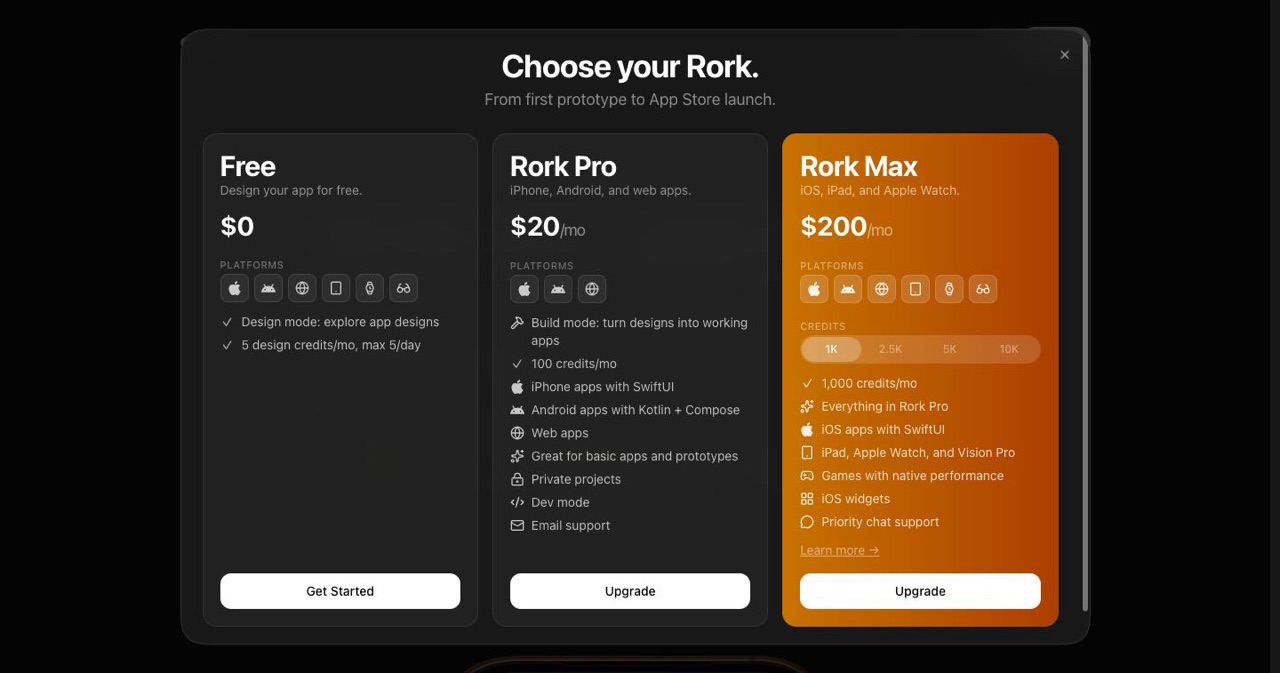
Rork (the original React Native builder) runs on a message-based pricing model, with plans ranging from $20/month for 100 messages to $200/month for 1,000 messages.
Rork Max, as a distinct product focused on native Swift, is positioned at the premium end of that range. The platform has referenced a $200/month tier as its primary Max offering, with a limited free tier providing around 5 prompts per week. For context, that free tier is enough to build and test a simple app but not enough to iterate through a complex one.
Is $200/month steep? Depends entirely on what you're building. If your app earns even modest revenue — and several users have reported reaching $10k/month — the math tilts quickly in your favor. If you're purely experimenting, the free tier or lower Rork plans might be the smarter starting point.
The Honest Pros and Cons
No tool this new ships without rough edges. Here's a balanced take:
What Rork Max genuinely does well:
- Speed is real. Complex apps that would take a skilled developer weeks to scaffold can be running on your phone in hours. That's not hype — it's documented across multiple user demos.
- The native Swift output matters. This isn't a web app wearing a native costume. You get real performance, real Apple framework access, and a real App Store–eligible product.
- No local setup is a genuine unlock. Xcode is 30GB, requires a Mac, requires an annual $99 Apple Developer account just to test on device. Rork Max eliminates every one of those barriers.
- Cross-Apple-platform from day one. Building once and targeting iPhone, Watch, iPad, and Vision Pro simultaneously is a capability most indie developers never get to.
Where it still has growing pains:
- Complex apps need iterations. "One-shot" is a compelling demo, but the reality is that detailed, multi-feature apps usually require several follow-up prompts to get right. The AI is good; it's not magic.
- $200/month limits casual users. The free tier is thin. If you want to seriously explore the platform, you're committing real money.
- Early-stage reliability. Rork (the base product) has faced user reports of app crashes and deployment friction. Rork Max is newer, and some of those early-stage issues likely carry over.
- App Store saturation concern. A valid critique from the developer community: if everyone can ship AI-generated apps in hours, the App Store gets noisier. This is a real tension, though not Rork's problem to solve alone.
How It Compares to Alternatives
The clearest comparison is Rork vs. Rork — the original React Native builder vs. Rork Max's Swift approach. For cross-platform iOS and Android in one build, the original Rork is still the right tool. For pure Apple-native depth, Rork Max wins cleanly.
Against Bolt.new or Lovable, there's barely any overlap — those are web app builders. Rork Max is for App Store apps. Different market entirely.
Against hiring a Swift developer or agency, Rork Max is dramatically faster and cheaper for prototyping and MVPs. It's not a replacement for a senior engineer building a complex production system, but it's not trying to be.
Against wrapping Claude Code directly via the API (a popular alternative for technical users), Rork Max wins on convenience — the cloud Mac infrastructure, live simulator, and one-click publishing pipeline would take significant engineering effort to replicate yourself.
What Users Are Actually Saying
The reception on X (Twitter) and Product Hunt has been enthusiastic, with early users calling it "wild" and "the most powerful AI app builder" they've used. One long-term Rork user who has built over 100 apps on the platform called Rork Max a leap that "opened the door for creators and serial entrepreneurs to solve gaps in current app libraries."
The more measured takes acknowledge that the App Store will get more crowded, and that apps requiring complex backend logic — payments, real-time push notifications, highly custom data pipelines — will still need engineering help beyond what Rork Max currently handles.
The Reddit reaction is more mixed, with experienced developers pointing out that discoverability in the App Store is already hard, and AI-generated apps flooding the market makes it harder. Fair point. The counterargument: the same was said about no-code web builders, and plenty of serious products were built with them anyway. You can learn how to make people care on Reddit in our 2026 guide.
The Bigger Picture
Rork Max is doing something technically significant. Building Swift apps from a browser isn't just a UX convenience — it requires solving hard infrastructure problems (cloud Mac fleet, streaming simulators, certificate management, App Store pipelines) that no other company has shipped as a consumer-facing product before.
The founders came from a place of genuine frustration: they've been building iOS apps since age 17, immigrated from Eastern Europe partly on the back of App Store success, and built Rork to give other people access to what took them years to learn. That origin story shows in the product's ambition.
Whether Rork Max becomes the dominant way non-developers ship iOS apps depends on a few things: how reliably the AI handles increasingly complex prompts, whether Apple's App Store policies adapt to AI-generated submissions, and whether the pricing becomes accessible enough for the long tail of indie makers who could benefit most.
For now, it's the most capable browser-based iOS development environment that exists. That's a sentence that would have sounded like science fiction 18 months ago.
Should You Try It?
If you have a native iOS app idea and no Swift skills — yes. Go sign up for the free tier, drop your most ambitious prompt, and see what comes back. The worst outcome is a useful prototype. The best outcome is an App Store listing that generates revenue before you've written a line of code.
If you're a developer looking to prototype faster — also yes, with the caveat that you'll want to inspect the generated Swift before treating it as production-ready.
If you're purely curious — the free tier costs you nothing but a few minutes. It's a more honest test than any review can give you.
Get your SaaS in front of founders
List your product on the SaaSCity live city map - a permanent listing, real discovery, and a backlink from a high-DR directory. Free to start; upgrade for a dofollow link and a building on the map.