News
The "Claw" Era Is Here: Six Agentic AI Systems Quietly Reshaping How Work Gets Done
Welcome to the age of agentic AI. Here is a deep dive into six autonomous "claw" AI systems like OpenClaw, Perplexity Computer, and Anthropic Cowork that are reshaping productivity.

Contents (11)
- Key Takeaways
- What Exactly Is a "Claw" System?
- OpenClaw — The One That Started It All
- Perplexity Computer — The Multi-Model Orchestrator
- Anthropic Cowork — The Office Productivity Layer
- PicoClaw (nanobot) — The Lightweight Contender
- IronClaw — The Security-First Fork
- OpenAI Frontier — The Enterprise Operating System
- The Comparison You Actually Need
- What Happens Next
- Frequently Asked Questions (FAQ)
Quick answer: Claw systems are locally hosted or managed autonomous AI agents that plan steps, use tools and act on your files, browser and accounts instead of only replying. Six lead the category in early 2026: OpenClaw, at 145,000+ GitHub stars, for developers; Perplexity Computer, orchestrating 19 models behind Claude Opus 4.6; Anthropic Cowork for office work; nanobot for edge hardware; IronClaw, a Rust fork from NEAR AI, for security; and OpenAI Frontier for enterprises.
Your AI assistant just got a promotion. It's no longer answering questions—it's running your inbox, writing code, scheduling meetings, and doing it all while you sleep.
That shift happened fast. In the span of three months—from November 2025 to February 2026—an entire category of software went from obscure GitHub repos to boardroom conversations. The trigger was something nobody saw coming: an Austrian developer's weekend project, a lobster mascot, and 145,000 GitHub stars.
Welcome to the age of agentic AI. And specifically, the age of the "claw."
Key Takeaways
- Stateful beats stateless: Agentic systems plan, delegate and act across your files, apps and browser, where chatbots respond and wait.
- OpenClaw set the pace: Peter Steinberger's November 2025 side project passed 145,000 GitHub stars and 20,000 forks by early February 2026.
- Its security record is the cautionary tale: Cisco found a third-party skill exfiltrating data silently, and Palo Alto Networks named the access model a lethal trifecta.
- Perplexity Computer trades control for safety: 19 models orchestrated by Claude Opus 4.6, gated to Max subscribers with 10,000 monthly credits plus a 20,000-credit bonus.
- nanobot proves the size argument: Roughly 4,000 lines against OpenClaw's 430,000, running in under 10MB of RAM on $10 hardware.
- IronClaw hardens the same idea: WASM tool sandboxes, encrypted credential vaults, prompt injection pre-processing and TEE-verified execution.
- Enterprise numbers are already concrete: OpenAI Frontier cut six weeks of production optimization to one day at a major manufacturer, and handled 5 million tokens with 150 tool calls in one session via server-side compaction.
What Exactly Is a "Claw" System?
The "claw" terminology started as tech-community shorthand, born partly from the viral rise of OpenClaw (originally named Clawdbot, after Anthropic's Claude), and partly from Silicon Valley's knack for turning naming disputes into cultural moments. After Anthropic sent a trademark complaint, the project renamed itself twice in four days—Clawdbot → Moltbot → OpenClaw—and "claw" became the informal label for locally-hosted, autonomous AI agents.
But the term stuck for a reason. These systems have grip. Unlike a chatbot that responds and waits, an agentic AI system plans a sequence of steps, delegates subtasks, takes action on your behalf, and reports back when it's done. It interacts with your files, apps, browser, and external services autonomously. It doesn't just generate text—it does things. If you are interested in building your own AI applications, leveraging an AI SaaS boilerplate can help you rapidly prototype these capabilities.
The key technical distinction: most chatbots are stateless and reactive. Agentic systems are stateful and proactive. That difference is everything.
OpenClaw — The One That Started It All
Best for: developers, privacy-focused power users, personal automation
Peter Steinberger launched this as a side project in November 2025. Within weeks of going viral in January 2026, it had more GitHub stars than frameworks that took years to build. As of early February, it sat at over 145,000 stars and 20,000 forks.
The appeal is simple: OpenClaw runs entirely on your machine. Your data never touches a third-party server. You bring your own API key (Claude, GPT, DeepSeek—your pick), and you interact with the agent through messaging apps you already use: WhatsApp, Telegram, Discord, Signal, Microsoft Teams. It shows up where you live, not in a separate interface you need to remember to open.
What can it actually do? Triage and reply to emails. Schedule calendar entries. Browse the web, summarize PDFs, manage local files. Run cron jobs. Control a browser autonomously. One CS student reported OpenClaw built a custom skill to access his course assignments and then started using it on its own—without him asking it to.
That last part is also the risk. OpenClaw's own maintainer posted a warning on Discord: if you can't comfortably run a command line, this project is probably too dangerous for you to use safely. Cisco's security team tested a third-party skill and found it performing data exfiltration without user awareness. Palo Alto Networks called the software's access model a "lethal trifecta"—private data access, exposure to untrusted content, and external communication with memory retention.
For developers who know what they're doing, OpenClaw is extraordinarily powerful. For everyone else, the safety ceiling is low unless you sandbox it carefully. To understand more about safely dealing with local tools, review our zero-cost developer toolkit guide.
GitHub stars: 145,000+ | Price: Free (you pay for the underlying model API) | Setup complexity: High
Perplexity Computer — The Multi-Model Orchestrator
Best for: complex research, long-horizon projects, non-technical professionals
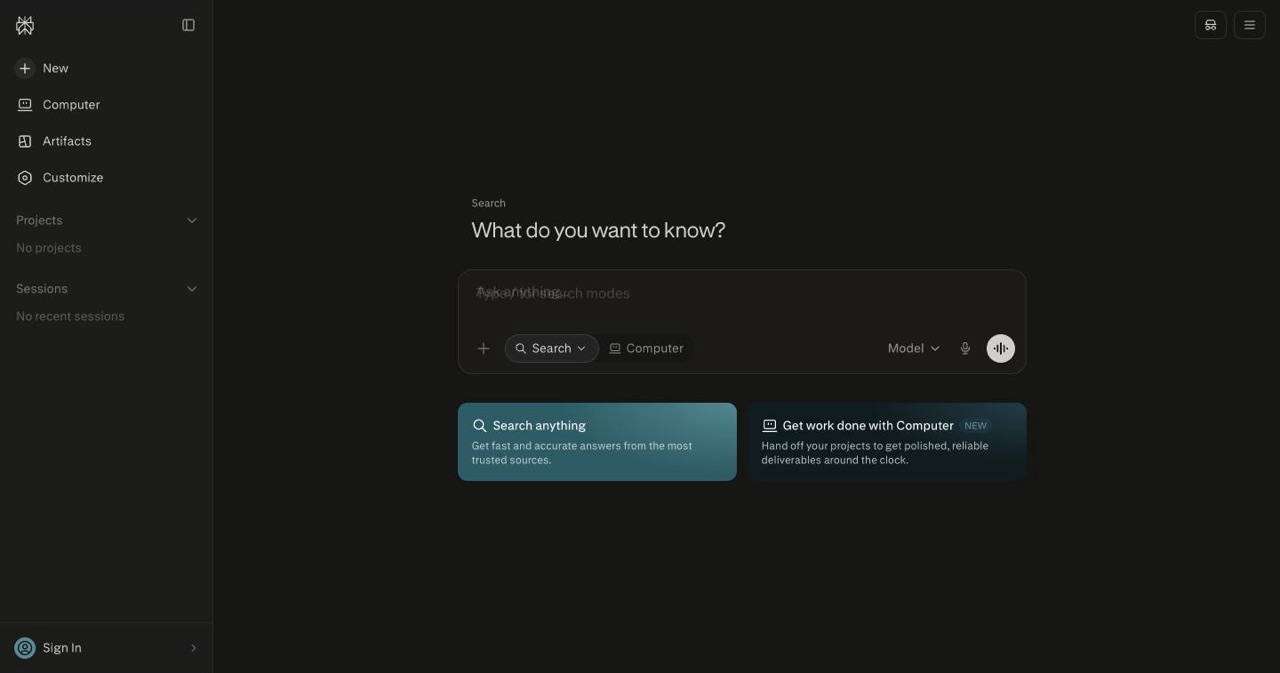
Launched February 25, 2026—literally yesterday as of this writing—Perplexity Computer is the most ambitious product the company has shipped. Instead of building another chatbot or search wrapper, Perplexity built an orchestration layer across 19 AI models.
The architecture is genuinely clever. Claude Opus 4.6 serves as the central reasoning engine, routing tasks to specialized sub-agents: Gemini for deep research, Grok for fast lightweight lookups, Nano Banana for image generation, Veo 3.1 for video, ChatGPT 5.2 for long-context recall. Each task runs in an isolated compute environment with real filesystem access and real browser integration.
CEO Aravind Srinivas framed it like a conductor analogy: "Musicians play their instruments, I play the orchestra." The system breaks down your goal into a task graph, assigns each node to the best available model, and synthesizes everything into a unified output. You describe what you want, then go do something else.
The upside over OpenClaw is clear: there's nothing to install, no security configuration to get wrong, no risk of giving an AI shell access to your personal machine. Perplexity manages the infrastructure, applies safeguards, and handles integrations centrally. For enterprise use cases—where IT teams need accountability, not GitHub repos—that matters enormously.
The downside is the business model. Access is currently gated to Max subscribers, who receive 10,000 credits monthly (plus a 20,000-credit one-time bonus). Usage scales with complexity. A months-long background research project will burn through credits faster than a quick report.
Still, the concept lands: "Perplexity Computer is what a personal computer in 2026 should be," the company wrote in its launch post. Personal to you, remembers your past work, secure by default. Hyperbolic? Maybe. But watching it autonomously research, code, and deploy a project without human intervention makes the claim feel less like marketing.
Availability: Perplexity Max subscribers | Price: Subscription + usage credits | Setup complexity: Zero
Anthropic Cowork — The Office Productivity Layer
Best for: knowledge workers, non-coders, enterprise teams
If OpenClaw is for developers and Perplexity Computer is for complex project work, Anthropic Cowork is for everyone in between—the marketing manager, the HR analyst, the operations lead who just needs AI to handle the boring parts of their day without requiring a computer science degree.
Launched in January 2026 and updated broadly in February, Cowork extends Claude with direct filesystem access, browser automation, multi-step workflows, and connectors for Excel, PowerPoint, and industry-specific tools across design, HR, and finance. It lives inside the Claude desktop app, meaning you're not switching contexts or learning a new interface.
The emphasis here is safety and interpretability. Where OpenClaw hands the AI broad system access, Cowork is designed so you can see exactly what's happening at each step and intervene if needed. That's not just a philosophical choice—it's a practical one for organizations where AI actions carry compliance implications. Security in AI systems is crucial; our startup launch checklist touches upon securing early environments.
Cowork reportedly originated from an internal project built in roughly ten days using Claude Code, which is a useful signal: the team ate their own cooking, and the product shows it. The integration with office tools feels native rather than bolted on.
What it won't do: break out of the Claude ecosystem. If your team runs on OpenAI models or needs local execution, Cowork isn't your answer. But for organizations already using Claude Pro or Max plans who want their AI to start actually handling work rather than just drafting it? This is a natural next step.
Availability: Claude Pro/Max plans | Price: Included with subscription | Setup complexity: Low
PicoClaw (nanobot) — The Lightweight Contender
Best for: edge devices, resource-constrained environments, researchers
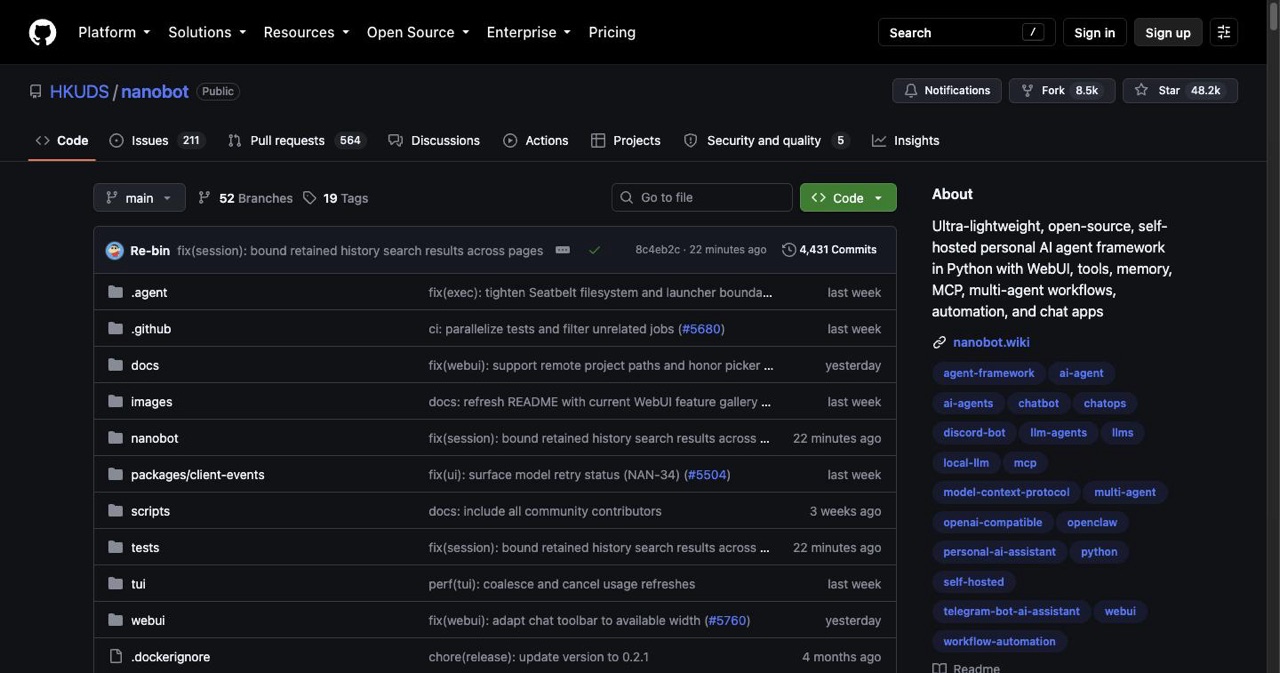
Here's where things get interesting. OpenClaw's GitHub stardom spawned a wave of forks, and the most technically compelling one is nanobot (sometimes called PicoClaw in the community), developed by the HKUDS research group.
The core premise: OpenClaw's codebase is massive—430,000+ lines. Nanobot delivers the same core agent functionality in roughly 4,000 lines. That's a 99% reduction in code complexity, which translates directly to a 99% reduction in memory footprint. The project now runs on hardware that costs $10, operates in under 10MB of RAM, and starts in under a second.
Released February 2, 2026, it's been updating almost daily. It now supports MCP integration, ClawHub skills, Slack, Discord, WhatsApp, Telegram, Email, and over a dozen LLM providers. It's written in Python but engineered with the same local-first philosophy as OpenClaw.
The practical use case is AI on edge hardware: Raspberry Pi setups, Android devices running background agents, server environments where OpenClaw's Node.js footprint is prohibitive. For researchers, the clean codebase is also useful—you can actually read it, understand it, and modify it without a week of onboarding. Check out another related concept in our guide on how to connect Google Antigravity to Google Stitch.
The limitation is the same as OpenClaw: you're still delegating to cloud APIs for the actual intelligence. The lightweight runtime doesn't solve the model dependency problem. But for getting a capable personal AI agent running on constrained hardware, nothing else comes close right now.
GitHub: HKUDS/nanobot | Price: Free | Setup complexity: Medium
IronClaw — The Security-First Fork
Best for: privacy-sensitive deployments, enterprise security teams, always-on agents with deep access
OpenClaw's security incidents didn't just generate bad press—they generated a competitor. IronClaw, a Rust-based fork developed by NEAR AI, shipped specifically to address what OpenClaw got wrong: credential handling, tool sandboxing, and prompt injection defense.
The architecture changes are substantive. Tools run inside WASM sandboxes, which means a malicious skill can't access system resources outside its designated scope. Credentials are stored in encrypted vaults rather than config files. Prompt injection detection runs as a pre-processing layer. Execution can be verified via trusted execution environments (TEEs), and inference can be anonymized.
This addresses the specific failure modes Cisco and Palo Alto Networks identified in OpenClaw. The "lethal trifecta"—private data access, untrusted content exposure, external communication with memory—gets mitigated at each layer.
The tradeoff is complexity. IronClaw is not the product you spin up on a weekend. It's built for teams that have already decided an always-on agent with deep system access is worth deploying, and who need to be able to defend that decision to a security auditor. For serious production deployments, the security posture is the right one. For casual personal use, OpenClaw or Cowork is probably a better fit.
Price: Free/open-source | Setup complexity: High | Security posture: Best-in-class
OpenAI Frontier — The Enterprise Operating System
Best for: large organizations, Fortune 500 deployments, technical and non-technical teams at scale
Launched February 5, 2026, Frontier is OpenAI's answer to a problem they've watched enterprises struggle with for two years: the gap between what AI models can do and what teams can actually deploy at scale.
The framing is bold. OpenAI isn't positioning Frontier as a tool—it's positioning it as the operating system for enterprise AI. Technical and non-technical teams alike can use it to "hire" AI coworkers who run tasks autonomously: reasoning over data, working with files, running code, using tools, and building memory from past interactions.
Real-world numbers from OpenAI's launch announcement: a major manufacturer cut six weeks of production optimization work to a single day. A global investment company deployed agents across the sales process, freeing up 90% more time for human salespeople to spend with clients. These aren't theoretical gains.
What makes Frontier different from just "building on the OpenAI API" is the platform layer. Shared context across agents, centralized permissions management, onboarding workflows, integration with existing enterprise systems (CRM, HR, finance), and the ability to run agents across local environments, enterprise cloud infrastructure, and OpenAI-hosted runtimes simultaneously. If scaling SaaS is your goal, take a peek at our programmatic SEO SaaS guide to maximize growth.
The February update to the Responses API also introduced server-side compaction—a solution to the context amnesia problem that has plagued long-running agents. Instead of chopping off old messages when hitting token limits, the system compresses history intelligently, preserving relevant context while discarding noise. One implementation handled 5 million tokens and 150 tool calls in a single session without accuracy degradation.
The catch: Frontier is built for organizations, not individuals. Enterprise pricing, enterprise onboarding, enterprise complexity. If you're a solo developer or small team, the Responses API and Agents SDK give you access to the same underlying building blocks without the overhead.
Availability: Enterprise | Price: Enterprise licensing | Setup complexity: Medium (with enterprise support)
The Comparison You Actually Need
| System | Best For | Security | Pricing | Complexity |
|---|---|---|---|---|
| OpenClaw | Developers, power users | Configurable (risky by default) | Free + API costs | High |
| Perplexity Computer | Complex projects, non-coders | Managed cloud | Max subscription | Zero |
| Anthropic Cowork | Knowledge workers, enterprise | High, interpretable | Pro/Max plans | Low |
| nanobot/PicoClaw | Edge devices, researchers | Moderate | Free | Medium |
| IronClaw | Security-sensitive deployments | Best-in-class | Free/open-source | High |
| OpenAI Frontier | Enterprise at scale | Permissions-based | Enterprise | Medium |
What Happens Next
Six months ago, most people hadn't heard of an AI agent. Today, one of them has 145,000 GitHub stars and is being covered by Nature magazine because the bots built a social network and started publishing their own research papers.
That's not a drill. These systems are already doing real work at real companies. The infrastructure for genuinely autonomous digital workers now exists, is well-documented, and in many cases, is free.
The risks are also real. Prompt injection is the new SQL injection. Giving an AI agent shell access without proper sandboxing is a security incident waiting to happen. The OpenClaw incidents—agents creating dating profiles without user consent, skills performing data exfiltration silently—are early warnings, not edge cases.
The practical advice: start with a managed option if you're not technical. Perplexity Computer or Anthropic Cowork give you agentic capabilities without the attack surface. If you are technical and want local control, run OpenClaw or nanobot inside a Docker container with scoped permissions, a dedicated API key with a spending cap, and an explicit whitelist of what the agent can access. Reading up on the latest SaaS compliance checklist could also clarify your operational boundaries.
The agentic AI era isn't coming. It arrived while you were reading this post. The question now is how you want to engage with it.
All launch dates and features reflect information available as of February 26, 2026. The field is moving fast—product capabilities may have expanded since publication.
Frequently Asked Questions (FAQ)
What is an agentic AI system? An agentic AI system does more than just answer questions—it takes autonomous actions. It plans sequences of steps, uses tools, browses the internet, uses external services, and proactively completes goals without constant user supervision.
How is OpenClaw different from ChatGPT? OpenClaw is an open-source, locally hosted AI agent framework that gives language models access to your local computer environments, like browsing files and running code. ChatGPT is fundamentally a hosted platform; while its advanced features provide tools and enterprise solutions, OpenClaw runs strictly on your own hardware via your API keys.
Is Perplexity Computer free to use? No, Perplexity Computer is gated for Perplexity Max subscribers and operates via a usage credits system based on computation requirements.
How do I safely test local AI agents like OpenClaw? Use strictly isolated environments such as Docker containers. Set up strict API limits, carefully allow-list tools, and always review actions before you permit an agent to execute them.
Inspired to start building? Grab our Ultimate Next.js AI SaaS Boilerplate and launch your AI app in 24 hours. Then get it in front of the right audience — submit to the best AI tool directories in 2026 and join the SaaSCity community to keep up with the latest trends.
<script type="application/ld+json"> { "@context": "https://schema.org", "@type": "FAQPage", "mainEntity": [ { "@type": "Question", "name": "What is an agentic AI system?", "acceptedAnswer": { "@type": "Answer", "text": "An agentic AI system does more than just answer questions—it takes autonomous actions. It plans sequences of steps, uses tools, browses the internet, uses external services, and proactively completes goals without constant user supervision." } }, { "@type": "Question", "name": "How is OpenClaw different from ChatGPT?", "acceptedAnswer": { "@type": "Answer", "text": "OpenClaw is an open-source, locally hosted AI agent framework that gives language models access to your local computer environments, like browsing files and running code. ChatGPT is fundamentally a hosted platform; while its advanced features provide tools and enterprise solutions, OpenClaw runs strictly on your own hardware via your API keys." } }, { "@type": "Question", "name": "Is Perplexity Computer free to use?", "acceptedAnswer": { "@type": "Answer", "text": "No, Perplexity Computer is gated for Perplexity Max subscribers and operates via a usage credits system based on computation requirements." } }, { "@type": "Question", "name": "How do I safely test local AI agents like OpenClaw?", "acceptedAnswer": { "@type": "Answer", "text": "Use strictly isolated environments such as Docker containers. Set up strict API limits, carefully allow-list tools, and always review actions before you permit an agent to execute them." } } ] } </script>Get your SaaS in front of founders
List your product on the SaaSCity live city map - a permanent listing, real discovery, and a backlink from a high-DR directory. Free to start; upgrade for a dofollow link and a building on the map.