Reviews
AstraPixels: Someone Rebuilt the Million Dollar Homepage as a Live Solar System
An indie hacker sells asteroids for $5 each on a pixel-art map where every rock sits at its real orbital position. It hit #2 on Product Hunt in a day. The astronomy is the retention mechanic, and that is the whole trick.

Contents (10)
Quick answer: AstraPixels is a pixel-art map of the Solar System where every body sits at its real computed position and roughly 3,000 main-belt asteroids sell for $5 each, with a paid dofollow upgrade on top of nofollow-by-default claim links. Built by indie hacker Nick Launches, it launched on Product Hunt on August 8, 2026 and finished the day at #2 with 288 points. Positions come from the open-source astronomy-engine library, and claim URLs are checked monthly so dead links decay visibly and eventually return to inventory.
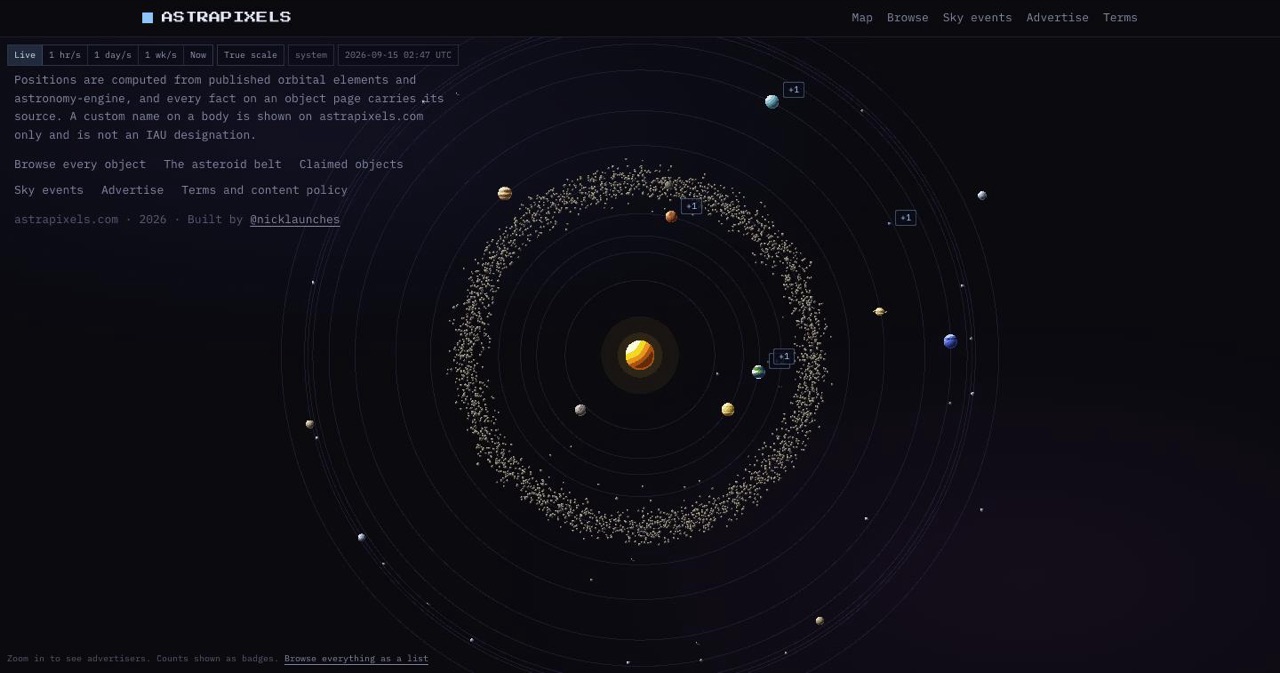
Someone sold an asteroid for $5 on Saturday. The buyer named it Shiba, paid another $10 to make the link followed, and it was live on the map roughly eight minutes after checkout.
The asteroid is real. It is about 0.9 km wide, currently sitting in Leo at around 3.21 AU. The ownership is not real, and the site says so on every page that could possibly confuse you about it.
That combination is AstraPixels, which launched on Product Hunt on August 8, 2026 and finished the day at #2 with 288 points, filed under Web App, Art, Advertising and Maps and GPS. It is a pixel-art map of the Solar System where every body sits at its real current position, and where roughly 3,000 rocks in the main belt are quietly for sale.
Disclosure: Nick Launches is a sponsor of SaaSCity, and we bought a placement on AstraPixels ourselves on launch day (more on that below). We had nothing to do with building it, and every number in this post came from the live site, its terms page and the public Product Hunt launch.
Key Takeaways
- Real positions, not a canned animation: Bodies are placed from published orbital elements via the open-source astronomy-engine library, which is why the time scrubber and jump-to-date field work at all.
- Inventory that cannot sell out: Around 3,000 procedural rocks split across the inner (754), middle (1,141) and outer (1,105) belt zones, backed by a real belt holding over a million bodies wider than a kilometre.
- The $5 rock is a label, not ownership: A claim is a name, link and sprite on astrapixels.com, explicitly not an IAU designation, and nothing is filed with any astronomical body.
- Links are nofollow by default: A paid dofollow upgrade exists, which is the configuration Google's spam policies expect from anything selling placements.
- Rot is rendered: Claim URLs are checked monthly, three consecutive failures mark a claim derelict with a decaying sprite, and 90 more days returns it to inventory.
- The impression contract is strict: Hovers count only after 400ms of continuous visibility, hidden tabs do not count, sessions cap at 20 billable impressions per placement, and the rate is $1.20 per 1,000.
- The free layer carries the paid layer: A 171-body catalogue and a rolling 180-day sky-events page give people a reason to return after the launch spike.
The map is the product. The rocks are the business model.
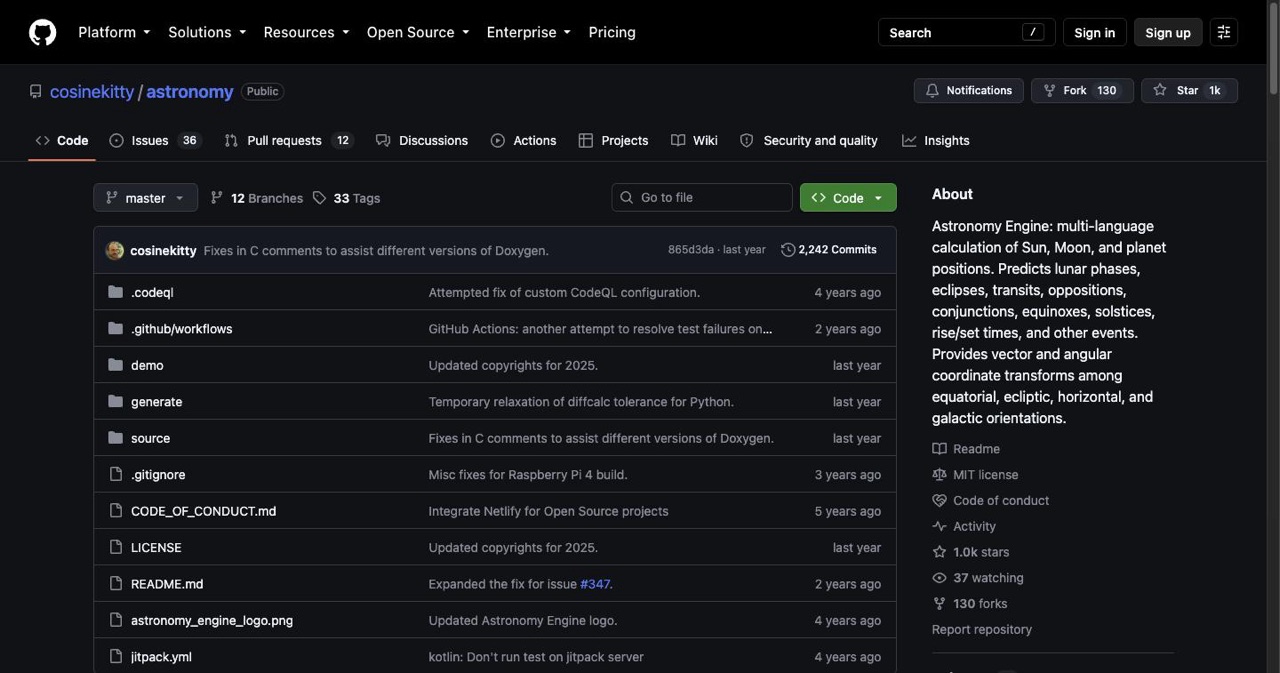
Open the site and you get a zoomable Solar System rendered in chunky pixels, Sun at the middle, out through the planets to the Kuiper belt. Nothing about it looks like a scientific instrument. Then you start touching the controls.
There is a time scrubber with live, 1 hour, 1 day and 1 week rates, plus a jump-to-date field. Run it forward and the inner planets sprint while Neptune barely twitches, which is the sort of thing you know intellectually and have probably never watched happen. There is a true-scale toggle that reveals how brutally compressed the default view is. Turn it on and the pretty diagram collapses into a lot of black nothing with a few specks in it, which is the honest picture.
Positions are computed from published orbital elements with astronomy-engine, an open-source library that does the ephemeris maths. This is the load-bearing choice in the whole project. A static list of coordinates would have looked identical on launch day and been quietly wrong by October. Computing from elements is what makes the time controls anything more than a canned animation.
There are 171 catalogued bodies with sourced facts and current positions. There is a sky-events page covering the next 180 days: 14 events on the day I checked, mixing conjunctions (defined there as two planets within three degrees), oppositions, the eight major annual meteor showers, eclipses and Earth's perihelion. Each one gets a UTC time and a note that UTC is not local visibility, which is a small honesty most astronomy widgets skip.
The belt page is where the two halves of the project meet. Around 3,000 procedurally generated rocks, deterministic orbits, split across three zones: 754 in the inner belt from 2.1 to 2.501 AU, 1,141 in the middle from 2.501 to 2.825, 1,105 in the outer from 2.825 to 3.3. The page notes that the real belt holds over a million bodies wider than a kilometre, which is a polite way of saying the inventory can be extended more or less forever.
Who built it
Nick Launches (@nicklaunches) is an indie hacker with a former life as a CTO at a $2.4M ARR company, and he writes mostly about SEO and shipping small products in public at nicklaunches.com. That background shows up in the design of this thing more than in the astronomy.
The pitch he made on Product Hunt was not "look at my space toy." It was an argument about why every Million Dollar Homepage clone dies, followed by a product built as three specific answers to that.
The 2005 problem
Alex Tew sold a million pixels for a dollar each in 2005 to pay for university. It worked, made him rich, spawned a thousand imitators, and every single imitator failed. Not because the idea was bad. Because the idea has three structural holes:
The inventory is finite and the novelty is not renewable. You sell out and the business ends, or you never sell out and the page looks like a ghost town, which kills the remaining sales. There is no third outcome.
Nobody has a reason to come back. A grid of logos is interesting exactly once. After launch week your advertisers are paying for a page nobody loads, and they notice.
The links rot. This is the one that actually destroys the asset. Audits of the original grid a decade on found a large share of links dead or redirected somewhere unrecognisable. What advertisers bought as permanent placement decayed into a wall of 404s, and the page became a museum piece instead of an ad unit.
If you have ever run a directory, you already know this feeling. It is the same failure mode. It is why we spent a month cutting our own directory list from 2,972 entries to 2,404, dropping everything dead, parked or off-topic, and why our directory submissions guide tells you to check a directory's outbound links before you pay it anything.
The three fixes
Fix one: inventory that cannot sell out. Rocks are procedural. The belt genuinely contains over a million bodies above a kilometre wide, so the generator can keep producing them at the $5 floor for as long as anyone keeps buying. The scarce stuff — the Sun, the eight planets, comets, nearby stars — is not sold at all. It is leased annually and lapses if you stop paying. Permanent inventory that never runs out, scarce inventory that recycles. Both problems solved with the same split.
Fix two: a reason to return. This is the astronomy. The sky-events calendar is a genuine utility with a rolling six-month window, and real orbital positions mean the map is different every time you open it. The commercial layer is parked on top of something people would use if nothing were for sale. That is the actual innovation here, and it is not a space innovation.
Fix three: enforced link health. Claim URLs are checked monthly. Three consecutive failures mark a claim derelict, with an email at each failure, so you get about 90 days of warning. A derelict rock keeps its spot and its name but renders as a visibly decaying sprite. Ninety days in that state and it returns to inventory. Fix the URL and the next passing check clears it.
A dead link becomes a visible, ugly thing on the map rather than an invisible 404. The page polices its own quality because rot is rendered.
The pricing, in full
Worth reading the actual rate card, because it is more considered than "pixels cost money":
| Placement | Price | Terms |
|---|---|---|
| Main-belt asteroid | $5 one-time | Yours indefinitely, custom name |
| Named asteroids | up to $99 one-time | Larger, catalogued bodies |
| Moon | $49 | One-time |
| Orbital advertiser satellite | $29 once | 90 slots total across all planets |
| Planet sponsor | $249 / year | One per planet, 8 exist, tints the sprite |
| Tooltip sponsor row | $9 / mo base ($4.50 founding) | Billed per 1,000 desktop hovers |
| Modal header strip | $19 / mo base ($9.50 founding) | Billed per 1,000 modal opens |
| Network native card | $6 / mo base ($3 founding) | Rotates across all objects |
| Sun, comets, nearby stars | Annual lease | Lapses without renewal |
The measurement rules are the part I did not expect from a weekend-scale project. A hover only counts after 400ms of continuous visibility. Hidden tabs do not count and the timer stops when the tab loses focus. There is a per-session cap of 20 billable impressions per placement. Rate is $1.20 per 1,000. The stated principle is "the client proposes, the server decides," meaning browser-reported events are not trusted as billing truth, and only aggregated daily totals are kept rather than raw event logs.
That is a more disciplined impression contract than some ad networks charging real money ship.
There are no accounts. Stripe collects an email and that is the whole identity system. Refunds run 14 days for anything not yet approved and live, pro-rata on unexpired leases.
What people actually said
The Product Hunt thread split along a predictable line, and the split is instructive.
Alex Cloudstar (@alexcloudstar) got there fastest: it reads as a toy until you use the time scrub and the true-scale toggle, and then it is an instrument. Leopold (@leo404) said the pixel style makes space feel approachable instead of overwhelming. AJ (@build_with_aj) said it made him smile.
The dissent was blunt. Rustam Nafikov (@staminator): "Poor graphics stopped me from digging deeper." Which is fair and is the exact risk of the aesthetic. Pixel art reads as cute by default, and cute is a filter that some people apply before they touch a single control. Mobile zoom got flagged as twitchy by early users too.
On X the jokes were the obvious ones about selling asteroids you do not own. The site's answer is on every relevant page: a name here is a label on this map, not an astronomical designation, and nothing goes to the IAU. Say it clearly enough and the joke stops being a liability.
The most interesting comment pattern was people describing the sales layer as optional or secondary. For a project whose entire revenue model is the sales layer, that is the review you want. It means the free thing carries itself.
Author's note: we bought one
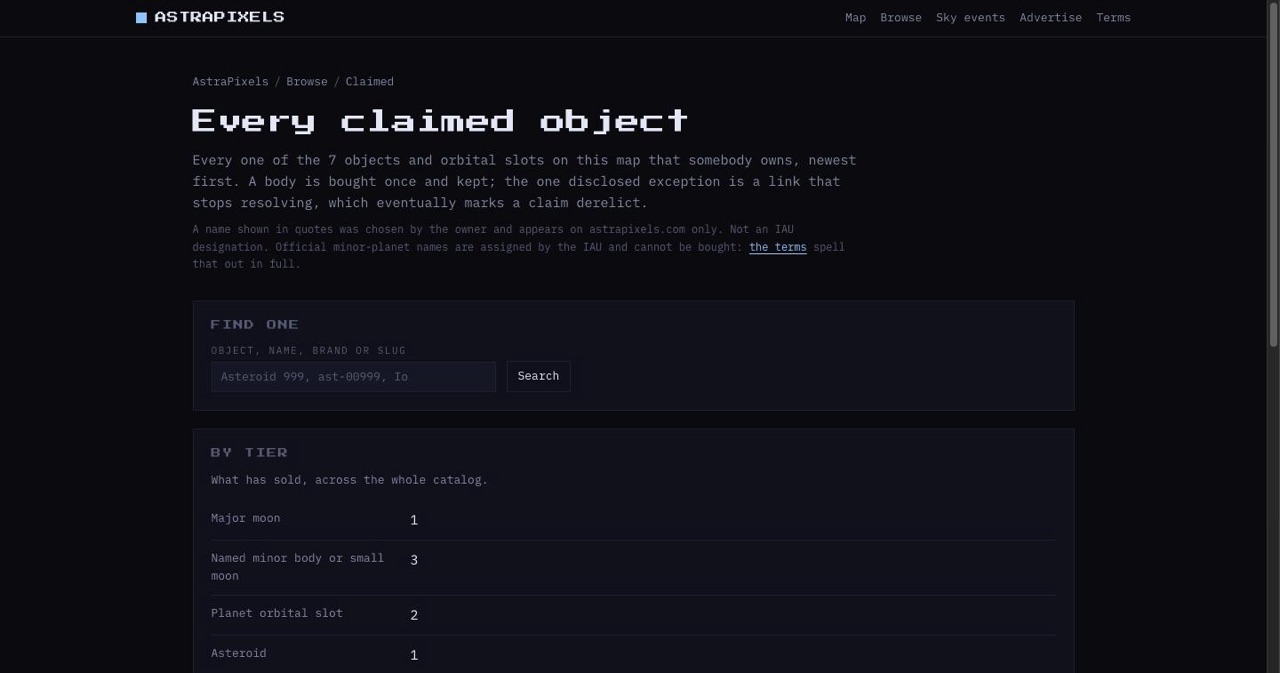
Full transparency, and because it is a good bit — SaaSCity owns a moon on that map. I claimed Juliet on launch day, 8 August 2026, and you can see it on the site's claimed objects page next to the first asteroid sale.
Juliet is real and genuinely strange. It is one of the inner moons of Uranus, about 94 km across, spotted by Voyager 2 in 1986, and named after the Shakespeare character because Uranus does not do Greek gods like everyone else. It orbits its planet in under twelve hours. It also sits in the most overcrowded neighbourhood in the Solar System: the inner Uranian moons are packed so tightly that astronomers expect some of them to eventually cross paths and collide, and Juliet and Desdemona are the usual candidates.
So we own a doomed moon in a traffic jam, on a website, for less than the cost of a team lunch. Worth every cent. It is also the only ad placement I have ever bought where I learned something while spending the money, which is more or less the argument this whole post is making.
— n1.ghosty, SaaSCity
What indie hackers should take from this
Strip away the space and there is a repeatable structure here.
The paid layer sits on a free utility that would exist anyway. Not a lead magnet, not a gated demo. A thing with genuine repeat value that the ads live inside. Most launches invert this and wonder why traffic dies on day three.
Scarcity is engineered on purpose, in both directions. Cheap infinite floor, expensive leased ceiling. The floor makes impulse buys frictionless and the ceiling is where the actual revenue lives, and neither can starve the other.
The link policy is a product decision, not a legal footnote. Nofollow by default with a paid dofollow upgrade is the correct configuration for anything selling placements in 2026. It means the followed links are the ones someone paid to vouch for, and Google's spam policies treat undisclosed paid follows as a problem for both ends of the link. Getting this right at launch is much cheaper than retrofitting it onto a few hundred legacy listings later, which we can tell you from experience. Our breakdown of which directories actually pass link equity covers the buyer's side of the same question.
Launch-day placement compounds. Finishing #2 buys a badge, a permanent Product Hunt page and a wave of first customers. If you are planning your own, our Product Hunt alternatives guide covers the other 40+ launch surfaces worth hitting the same week, because one launch day is a spike and a launch sequence is a curve.
The open question is retention. Real orbital mechanics should pull people back. Whether a sky-events calendar actually beats the gravity of everything else competing for a browser tab is a claim that needs three months of data, not three days. The $5 rock economics have the same asterisk: at that price the model needs volume that only arrives if the map keeps drawing traffic. Ask again in November.
If you are the one launching next
The lesson underneath AstraPixels is that a placement is only worth what the page it sits on is worth. A link from a dead grid is nothing. A link from something people open on purpose is an asset.
That is the standard we hold SaaSCity to. Every listing is a building on a live city map that people actually browse, every plan carries a dofollow link, and dead listings get swept rather than left to rot. You can submit your product for free and be on the map this week.
And if the reason you care about any of this is Domain Rating, the 0-to-30 DR playbook is the method written out week by week, and how to increase your Ahrefs DR covers what actually moves the number. You can check where you're starting with our Domain Rating checker in about ten seconds.
Then go look at the map. Turn on true scale first. It is a very different website after you do.
Get your SaaS in front of founders
List your product on the SaaSCity live city map - a permanent listing, real discovery, and a backlink from a high-DR directory. Free to start; upgrade for a dofollow link and a building on the map.