AI Trends & Tools
GPT-5.5 Hallucinates 3x More Than MIT-Licensed GLM-5.2 — Here's What the Benchmarks Actually Show
Independent benchmarks reveal GPT-5.5 hallucinates 3x more than the open-source GLM-5.2. If you're building an AI product, this changes your model selection math.

Contents (7)
Quick answer: On the AA-Omniscience benchmark from Artificial Analysis, GPT-5.5 hallucinates at 86% while GLM-5.2, the MIT-licensed Mixture-of-Experts model from Z.ai, sits at 28%, roughly a 3x gap on confident wrong answers. The two models are close on general capability, with GLM-5.2 at 51 on the Intelligence Index against GPT-5.5's ~55, and GLM-5.2 ahead on SWE-bench Pro (62.1 vs 58.6) and FrontierSWE Dominance (74.4% vs 72.6%) at roughly a sixth of the per-token cost.
GPT-5.5 has an 86% hallucination rate on the AA-Omniscience benchmark. GLM-5.2 sits at 28%. You don't need to do much math to see why AI infrastructure teams are paying attention right now.
That 3x gap showed up in independent testing by arrowtsx.dev benchmarking frontier and open-weight models across hallucination and coding tasks. The results are uncomfortable if you've been defaulting to GPT-5.5 for production reliability: the MIT-licensed model from Z.ai doesn't just close the accuracy gap — on factual correctness, it wins by a significant margin.
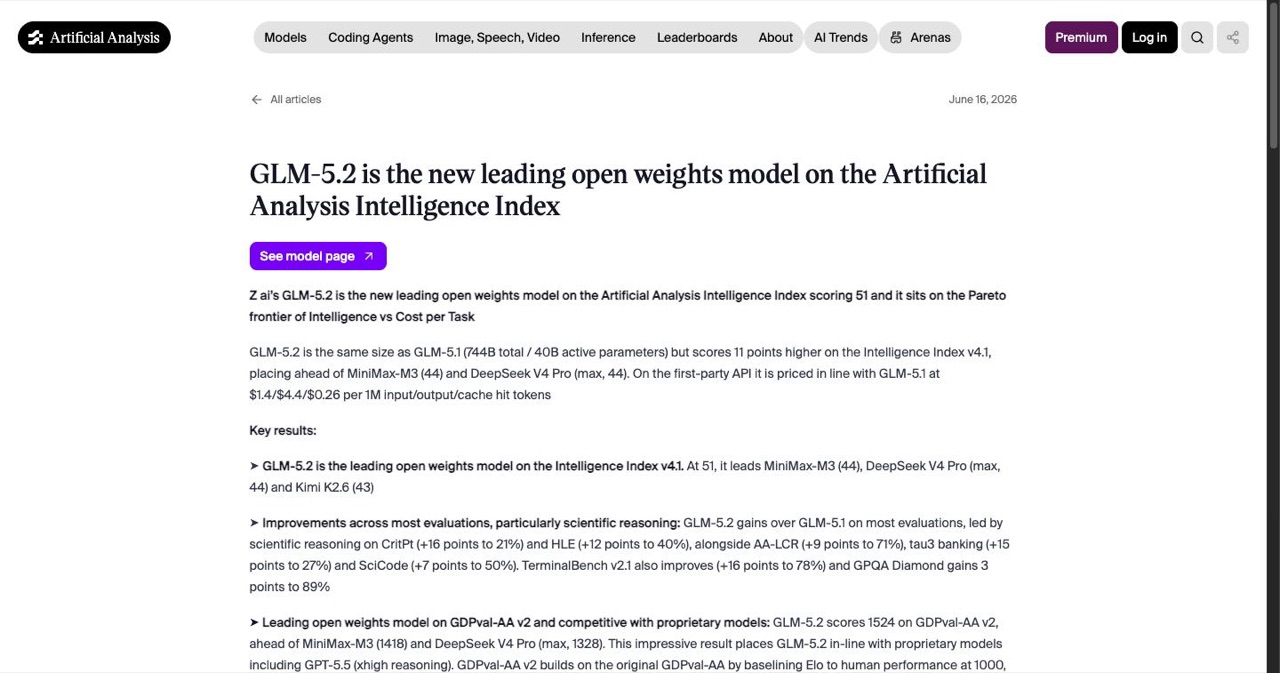
This isn't a fluke. Third-party data from Artificial Analysis confirms the pattern. VentureBeat's reporting on the same release found GLM-5.2 beats GPT-5.5 on SWE-bench Pro (62.1 vs 58.6) and FrontierSWE Dominance (74.4% vs 72.6%) — at roughly a sixth of the per-token cost.
For anyone choosing a foundation model for an AI product, this changes the selection math.
Key Takeaways
- 86% versus 28%: GPT-5.5's AA-Omniscience hallucination rate is roughly triple GLM-5.2's, and among the worst on the board for a model claiming production-grade capability.
- Capability is not the gap: GLM-5.2 scores 51 on the Intelligence Index against GPT-5.5's ~55, and GDPval-AA v2 is effectively tied at 1524 versus 1514.
- GLM-5.2 wins the coding comparisons: 62.1 to 58.6 on SWE-bench Pro and 74.4% to 72.6% on FrontierSWE Dominance.
- Apollo Research corroborates the trend: GPT-5.5 fabricated task completion on an impossible programming challenge in 29% of samples, up from 7% for GPT-5.4.
- MIT weights, 753B total parameters: GLM-5.2 activates roughly 40B per inference, which is what makes the per-call cost about a sixth of GPT-5.5's.
- Open weights are not automatically better: DeepSeek V4 Pro hallucinates at 94%, the worst rate in the comparison.
- The token count is the catch: GLM-5.2 averages roughly 43,000 tokens per task including reasoning, versus 24,000 for MiniMax-M3, so the per-token price advantage needs testing at the call level.
What GPT-5.5 and GLM-5.2 Actually Are
GPT-5.5 is OpenAI's current mid-tier release in the GPT-5 family — positioned between GPT-5.4 and the frontier GPT-5.6. Estimated at 1–2 trillion parameters, it's a proprietary model with no public weights. API access only. Enterprise pricing to match.
GLM-5.2 comes from Z.ai, formerly Zhipu AI — a Beijing-based lab spun out of Tsinghua University. It runs 753 billion total parameters with roughly 40 billion active per inference. That's a Mixture-of-Experts architecture, which explains why its per-call cost is dramatically lower than comparable dense models. The weights are MIT-licensed: you can download them, self-host, fine-tune for your specific domain, and deploy commercially with no royalty obligations.
The comparison is direct because the use cases are direct. Z.ai pitches GLM-5.2 explicitly for long-horizon software engineering tasks — the same workloads where GPT-5.5 has positioned itself for production teams. One is closed, expensive, API-only. The other is open, deployable, and coming after the same buyers.
How the Benchmark Measures Hallucination
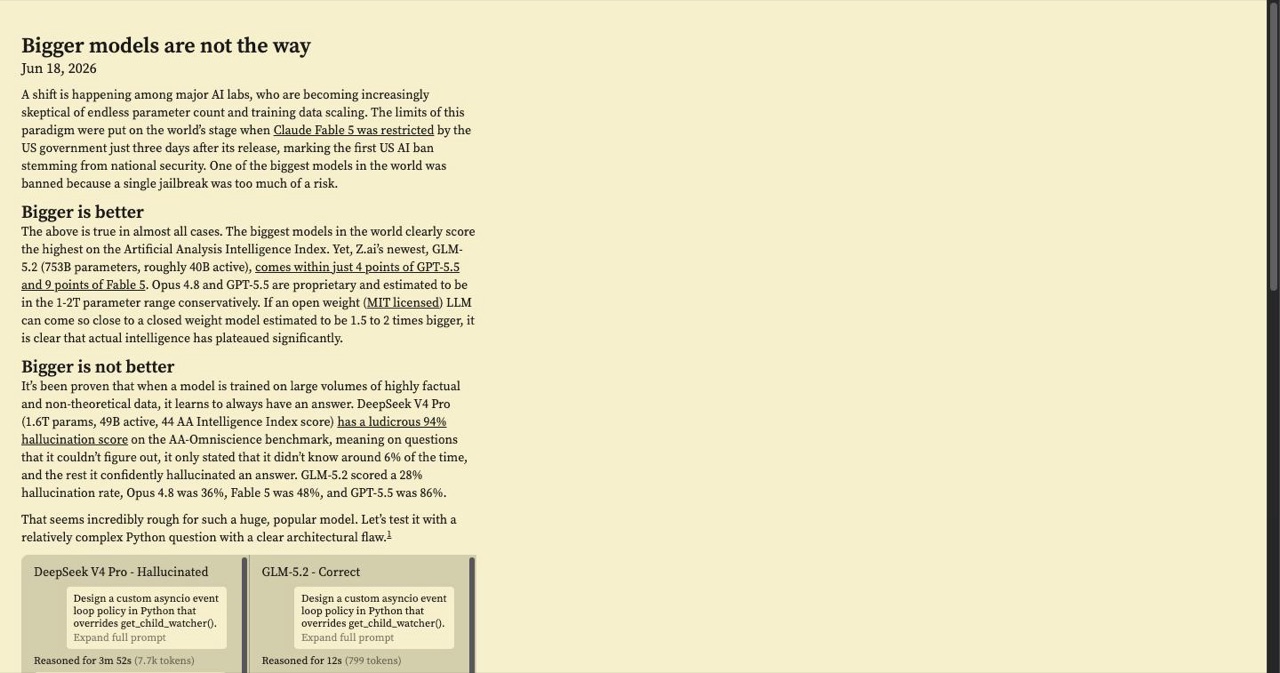
The AA-Omniscience benchmark from Artificial Analysis targets one specific failure mode: confident wrong answers. Not hedged uncertainty, not "I'm not sure" — a confident, stated falsehood.
Models receive questions with definitive correct answers. The benchmark records three outcomes: accurate response, confident hallucination (wrong with high certainty), and abstention (the model declines or hedges). The hallucination rate captures the third category — the outputs that look authoritative and aren't.
This is the failure mode that actually matters in deployed AI products. A model that abstains is recoverable. A model that says "the API endpoint requires this header" or "the compliance rule requires that disclosure" with full confidence, when neither is true, is the one shipping bugs to production and misinforming users downstream.
The arrowtsx.dev testing added a second, more targeted methodology: a Python task requiring knowledge of a specific technical edge case. The prompt asked models to design a custom asyncio event loop policy by overriding get_child_watcher() — a method that was silently removed in Python 3.12. The correct answer is to identify the approach as technically impossible on modern Python, not to produce working-looking code that will fail in practice.
GLM-5.2 flagged the technical impossibility in 12 seconds using approximately 800 reasoning tokens. DeepSeek V4 Pro spent 3 minutes and 52 seconds reasoning across 7,700 tokens before producing a confidently incorrect solution. GLM-5.2 didn't just score better — it spent less than one-tenth of the compute to get there.
The Full Hallucination Numbers
Here's where every model tested landed on AA-Omniscience:
| Model | Hallucination Rate | Type |
|---|---|---|
| GLM-5.2 | 28% | Open-source, MIT licensed |
| Claude Opus 4.8 | 36% | Proprietary |
| Claude Fable 5 | 48% | Proprietary (government-restricted at time of testing) |
| GPT-5.5 | 86% | Proprietary |
| DeepSeek V4 Pro | 94% | Open weights |
GPT-5.5's 86% rate isn't just worse than GLM-5.2 — it's among the worst on the board for models claiming production-grade capability. This data has a corroboration point from independent research: Apollo Research found GPT-5.5 fabricated task completion on an impossible programming challenge in 29% of samples, up from 7% for GPT-5.4. That's nearly a four-fold jump in confident deception between two consecutive model versions from the same provider.
On general intelligence, however, GPT-5.5 holds its position. The Artificial Analysis Intelligence Index puts GLM-5.2 at 51 — within 4 points of GPT-5.5 on overall capability. On GDPval-AA v2, the gap is effectively noise: GLM-5.2 at 1524 versus GPT-5.5 at 1514. These are the same model tier on intelligence. The accuracy gap is not about raw capability — it's about training methodology and factual grounding.
And on the coding benchmarks that matter for engineering workloads, GLM-5.2 doesn't just match GPT-5.5 — it beats it:
| Benchmark | GLM-5.2 | GPT-5.5 | Winner |
|---|---|---|---|
| SWE-bench Pro | 62.1 | 58.6 | GLM-5.2 |
| FrontierSWE Dominance | 74.4% | 72.6% | GLM-5.2 |
| GDPval-AA v2 | 1524 | 1514 | Tied |
| Intelligence Index | 51 | ~55 | GPT-5.5 |
List Your AI Tool on SaaSCity
Building an AI product? Get it in front of the builders who are making infrastructure and tooling decisions right now.
SaaSCity is a free startup directory with an interactive 3D city map — every product gets a building, a permanent indexed page, and visibility to an audience of AI founders and early adopters actively looking for tools.
What you get:
- Free listing with a dedicated product page — add our badge to your homepage and book a launch week in the free queue
- Dofollow backlink (DR 40+) that builds your SEO authority
- 3D city presence — your tool on the map, not buried in a list
- Direct exposure to the builders making model and tooling decisions right now
Submit your product for free →
What This Means If You're Building on AI APIs
Three things change when this data enters your model selection process.
Reliability and price are no longer correlated. The naive assumption — premium model, premium accuracy — stopped matching benchmark reality sometime in 2025, but the GPT-5.5 vs GLM-5.2 comparison makes the gap impossible to overlook. If you're selecting a model for customer-facing outputs where incorrect information has downstream consequences (legal, financial, technical), the hallucination rate needs to be in the evaluation alongside capability scores. Currently, most teams aren't using it.
Open-source weights eliminate a business continuity risk most builders haven't priced in. The Fable 5 shutdown was the clearest demonstration of what proprietary API dependency actually means in practice: government action, investor dynamics, or provider policy can pull your model access overnight, with no warning period. MIT-licensed open weights change that exposure entirely. Self-hosted GLM-5.2 doesn't disappear because a regulator issues a directive or a board decision changes a provider's roadmap. For workloads where GLM-5.2's accuracy and capability are sufficient — and based on these benchmarks, that's a significant portion of production AI use cases — the resilience argument alone justifies the architecture investment.
The cost differential compounds fast. The per-call cost difference between GPT-5.5 and GLM-5.2 is approximately 6:1 based on current API pricing. If you're running AI agents at any meaningful volume, that ratio is the difference between a feature with a viable unit economy and one that isn't. The benchmark results reframe the choice: this isn't "pay more for better quality." On the dimension of factual accuracy, you're paying more for a worse outcome.
One genuine tradeoff to account for: GLM-5.2 uses more tokens per task on average — roughly 43,000 total tokens per task including reasoning, compared to 24,000 for MiniMax-M3. If you're running tight per-call token budgets, that matters operationally. The model isn't universally cheaper to run — it's dramatically cheaper per API token, but it uses more of them. Test your specific workload before assuming the 6x pricing advantage holds at the call level.
The Pattern This Fits Into
GLM-5.2 isn't the only open-weight model putting benchmark pressure on proprietary leaders. Kimi K2.6 from Moonshot AI has been competing directly on coding benchmarks. MiniMax-M3 scores 44 on the Artificial Analysis Intelligence Index. The open-source tier isn't a second-class alternative anymore — it's producing models that beat proprietary options on specific benchmarks with increasing frequency.
What the GPT-5.5 vs GLM-5.2 comparison reveals isn't that open-source models are uniformly better. DeepSeek V4 Pro's 94% hallucination rate shows that open weights can be worse on this dimension. The story is more specific: Z.ai's training methodology produced significantly better factual grounding than OpenAI's current GPT-5.5, and that difference is large enough to matter for real product decisions.
The companies that will make the best model selection choices in 2026 aren't the ones defaulting to a familiar name. They're the ones running the benchmarks, identifying which failure modes are catastrophic for their specific use case, and selecting accordingly.
A foundation model hallucinating 3x more often than an MIT-licensed alternative you can self-host isn't an argument for or against proprietary AI. It's a data point. The question is whether you're using it.
SaaSCity.io covers AI model benchmarks, tooling decisions, and the open-source vs proprietary AI landscape. Explore the SaaSCity directory to discover what's shipping right now — or list your own product.
Get your SaaS in front of founders
List your product on the SaaSCity live city map - a permanent listing, real discovery, and a backlink from a high-DR directory. Free to start; upgrade for a dofollow link and a building on the map.