News
Kimi-K2.7-Code Drops: Moonshot AI's Strongest Open-Source Coding Model Yet (+21.8% on Kimi Code Bench v2)
Moonshot AI just released and open-sourced Kimi-K2.7-Code, its most capable coding model. +21.8% on Kimi Code Bench v2, 30% fewer reasoning tokens, better long-horizon performance, and 6x High-Speed Mode coming soon. Available now via API and Kimi Code.

Contents (10)
- Key Takeaways
- How We Got Here: The K2 Lineage in 90 Seconds
- What Exactly Is Kimi-K2.7-Code?
- Launch Your AI Startup on SaaSCity
- The Numbers: What Changed and Why It Matters
- Pricing, Efficiency, and the 6x High-Speed Mode
- How to Start Using Kimi-K2.7-Code Today
- What the Developer Community Is Saying
- The Bigger Picture
- Get Started
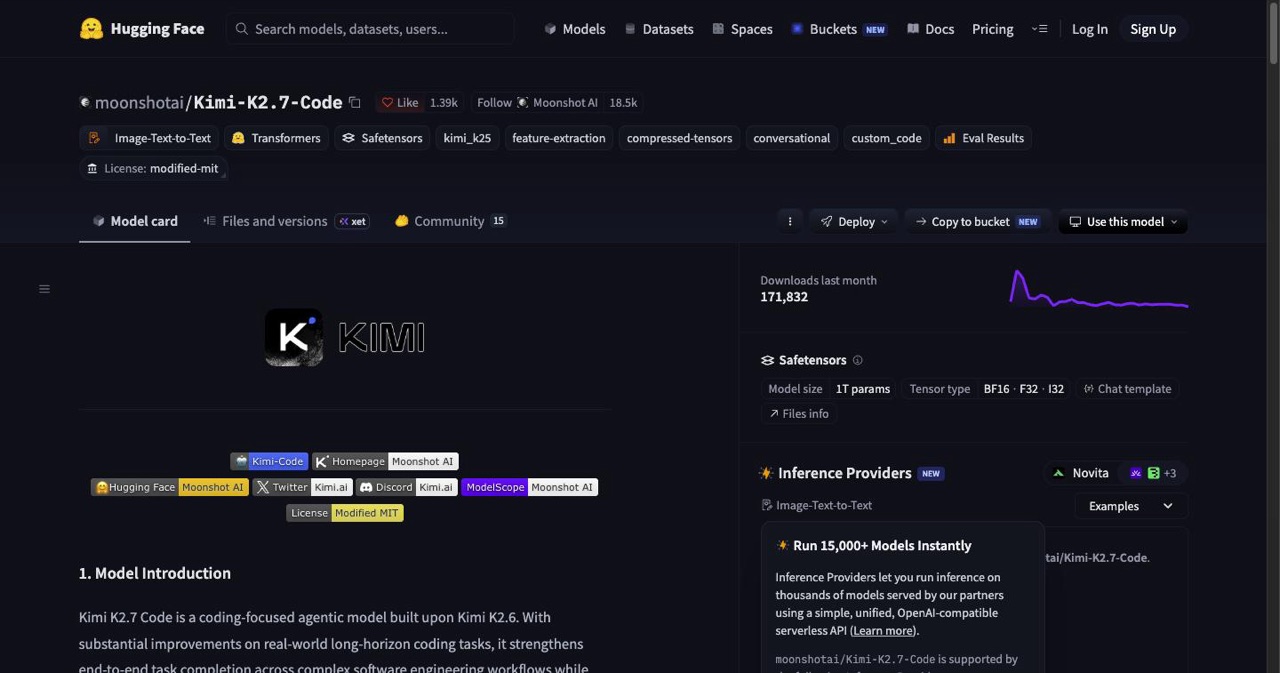
Quick answer: Kimi-K2.7-Code is Moonshot AI's coding-specialized model, open-sourced on June 12, 2026 under a Modified MIT License. It keeps the K2.6 chassis, a 1T-parameter Mixture-of-Experts with a 256K context window, and adds coding fine-tuning that lifts Kimi Code Bench v2 from 50.9 to 62.0 while cutting reasoning tokens by 30 percent. Weights sit on Hugging Face at roughly 594 GB in INT4, and API output costs $4.00 per million tokens.
Moonshot AI just shipped a coding model that thinks less and does more — and that's exactly the point.
This morning, June 12 2026, the team behind Kimi dropped a fresh announcement: Kimi-K2.7-Code is live, open-sourced, and ready to use today. Not a preview. Not a waitlist. Weights on Hugging Face, API on platform.moonshot.ai, and a new beta program to get your hands on what's coming next.
The headline numbers are hard to ignore: +21.8% on Kimi Code Bench v2, +31.5% on MLS Bench Lite, and — the one developers are talking about most — 30% fewer reasoning tokens compared to K2.6. Less time spinning its wheels, more time actually writing your code. If you are tracking model costs, you might want to compare this with the best AI agent coding token plans in 2026.
This isn't a minor patch. Kimi-K2.7-Code is a focused, production-oriented release that addresses the exact complaints developers had about previous large reasoning models: too much internal monologue before doing anything useful, too many failures on long multi-file tasks, and instruction drift over extended sessions. If those sound familiar, keep reading.
Key Takeaways
- Open weights on day one: Kimi-K2.7-Code shipped on June 12, 2026 with weights on Hugging Face, an API on platform.moonshot.ai, and no waitlist.
- Benchmark jumps: Kimi Code Bench v2 goes 50.9 to 62.0, MLS Bench Lite 26.7 to 35.1, and MCP Mark Verified 72.8 to 81.1 against K2.6.
- 30 percent fewer reasoning tokens: Accuracy and efficiency improved together on MCP Atlas and Mark Verified, which models usually trade against each other.
- Thinking-only model: There is no instant mode. It runs forced thinking and preserve-thinking only, with recommended temperature 1.0 and top_p 0.95.
- API pricing: $0.19 per MTok on cache hit, $0.95 input, $4.00 output, with a limited-time launch promotion.
- Self-hosting is 594 GB: Native INT4 from quantization-aware training, served through vLLM, SGLang, or KTransformers with OpenAI-compatible APIs.
- License caveat at scale: Modified MIT, free commercially until you pass 100M monthly active users or $20M monthly revenue, at which point "Kimi K2" must appear in your UI.
- 6x High-Speed Mode is teased, not shipped: Moonshot noted it as coming soon without a timeline or full details.
How We Got Here: The K2 Lineage in 90 Seconds
Moonshot AI, the Beijing-based lab that's been one of the most consistent open-weight shippers in the last year, has been sprinting through the K2 series at a pace that makes most other labs look slow.
The original Kimi K2 (July 2025) was the opening shot: a 1-trillion-parameter Mixture-of-Experts model with 32B active parameters per token, already competitive on SWE-Bench and LiveCodeBench. K2.5, released in January 2026, added native multimodal support — text, images, video — and introduced Agent Swarm, which let the model coordinate up to 100 parallel sub-agents on a single task. K2.6, which shipped in April 2026, was a serious step up: 300 concurrent sub-agents, 4,000 coordinated tool calls, 12-hour autonomous coding sessions, and benchmark scores (SWE-Bench Verified at 80.2%, SWE-Bench Pro at 58.6%) that put it ahead of GPT-5.4 and Claude Opus 4.6 on agentic coding tasks.
K2.7-Code is different in kind. It's not trying to expand what the model architecture can do — it's making it do the existing things better, faster, and more reliably. Coding-specialized fine-tuning, tightened instruction following, and a rethought approach to reasoning efficiency. Built directly on the K2.6 foundation but trimmed and tuned specifically for developers running production workloads.
The open-source commitment that's defined the whole series? Still intact. Modified MIT License. Same as every K2 release before it.
What Exactly Is Kimi-K2.7-Code?
Under the hood, the architecture will be familiar if you've tracked the K2 series. This is still the 1T MoE chassis: 61 transformer layers (one dense), 384 experts with 8 selected per token plus one shared, Multi-head Latent Attention, SwiGLU activation, and a 160K vocabulary. Context window sits at 256K tokens. Vision is handled by MoonViT, a 400M parameter encoder that gives the model native image understanding — and experimental video input via the official API.
For inference, the model ships in native INT4 quantization (quantization-aware training, not post-training quantization), which means it's optimized for INT4 from the ground up — not shaved down after the fact. Supported inference stacks: vLLM, SGLang, and KTransformers, all exposing OpenAI-compatible APIs.
One thing to note: Kimi-K2.7-Code does not have an instant/non-thinking mode. It runs in forced thinking and preserve-thinking modes only. That's intentional — this model was built for deep agentic work, not quick one-liners. Recommended settings are temperature=1.0, top_p=0.95.
What's actually new vs K2.6 is the specialization: coding-focused fine-tuning that improves instruction-following fidelity in long contexts and end-to-end task success rates on complex multi-file projects. Moonshot describes it simply: "Kimi's strongest coding model to date." The benchmarks back that up.
Launch Your AI Startup on SaaSCity
If you're building an AI-powered coding agent, developer tool, or custom SaaS boilerplate leveraging Kimi-K2.7-Code, you need a strategy to get in front of users.
SaaSCity.io is the premier SaaS directory designed specifically for the next generation of software products. When you list your startup, you get a permanent page, and on a paid plan your product gets visualized as a building in our interactive 3D digital city.
- 📈 Increase Domain Rating: Boost your SEO with valuable dofollow backlinks.
- 🚀 Find Early Adopters: Connect directly with a community of founders, developers, and tech buyers.
- 🆓 100% Free to List: Submit your app in under 2 minutes.
Submit your project today and start growing your user base.
The Numbers: What Changed and Why It Matters
Let's get straight to the data.
| Benchmark | K2.6 | K2.7-Code | Change |
|---|---|---|---|
| Kimi Code Bench v2 | 50.9 | 62.0 | +21.8% |
| Program Bench | 48.3 | 53.6 | +11.0% |
| MLS Bench Lite | 26.7 | 35.1 | +31.5% |
| Kimi Claw 24/7 Bench | 42.9 | 46.9 | +9.3% |
| MCP Atlas | 69.4 | 76.0 | +9.5% |
| MCP Mark Verified | 72.8 | 81.1 | +11.4% |
Kimi Code Bench v2 is Moonshot's internal suite of diverse, end-to-end coding tasks — the kind that simulate real developer workflows across languages and project types, not cherry-picked competitive benchmarks. A 21.8% relative jump there is significant. Program Bench and MLS Bench Lite add external validation of the same trend.
The MCP benchmark improvements (Atlas, Mark Verified) signal something broader: the model handles tool-based agentic contexts better, which matters if you're building agents that interact with real APIs, filesystems, and external services. These aren't synthetic tasks. They measure whether the model can actually get things done in a connected environment.
But the number that's generating the most reaction today is the 30% reduction in reasoning tokens.
For anyone who's run K2.6 or comparable thinking models through complex coding sessions, you've seen the pattern: the model burns 3,000 tokens reasoning through a problem it could have started solving 1,500 tokens ago. That's not just a UX annoyance — it's a direct cost. On long agent runs with hundreds of tool calls, that reasoning overhead compounds fast. (Check out how developers optimize these costs in our guide on saving LLM token costs for AI agents).
Cutting it by 30% while simultaneously improving task success rates is the combination that counts. Fewer tokens in, better code out. On the MCP Atlas and Mark Verified benchmarks, the model is both more accurate and more efficient, which is rare. Models usually trade one for the other.
For teams running K2.6 in production today, the math is straightforward: equivalent or better outputs, meaningfully lower token costs per run.
Pricing, Efficiency, and the 6x High-Speed Mode
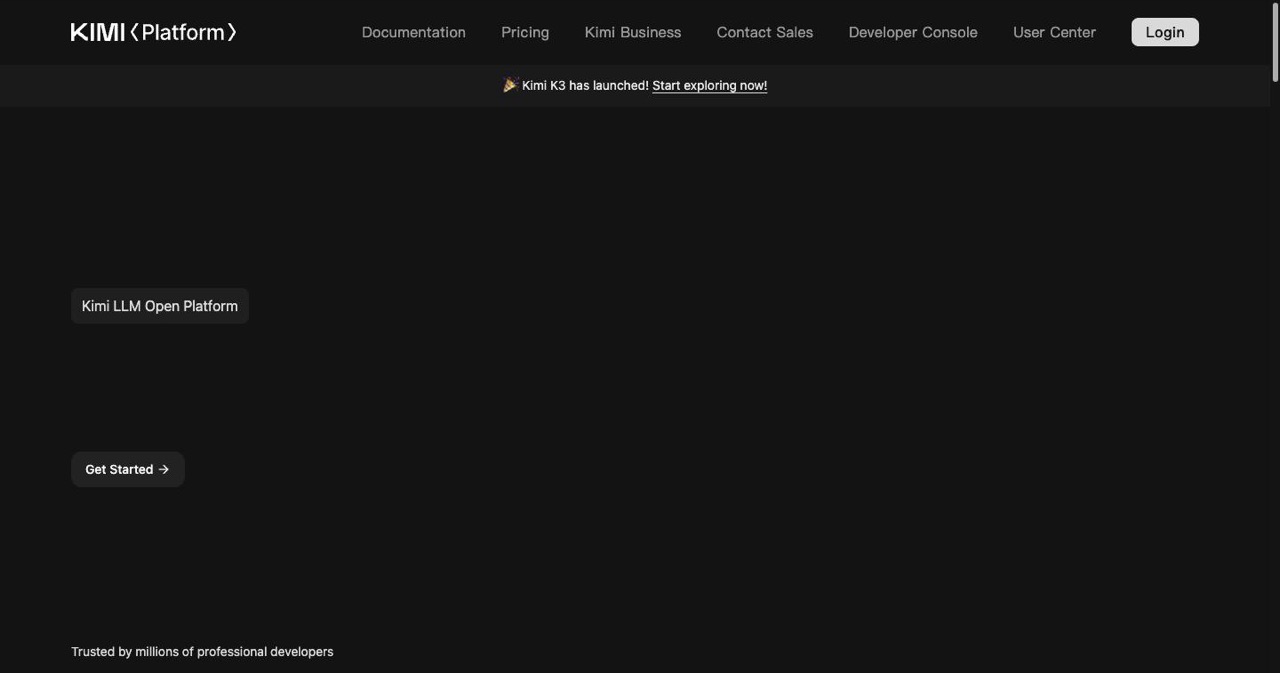
Current API pricing on platform.moonshot.ai:
- Cache Hit: $0.19/MTok
- Input: $0.95/MTok
- Output: $4.00/MTok
There's a limited-time promotion running on the platform right now. The cache hit pricing in particular is aggressive for long agentic workflows where you're repeatedly passing large system prompts and context.
And there's a bigger efficiency story coming: 6x High-Speed Mode. Moonshot teased this in the release announcement without full details, but the implication is a substantial inference optimization that would make K2.7-Code dramatically faster in production environments. No timeline given, but it's noted as "coming soon" — which in Moonshot's release cadence has historically meant weeks, not months.
For developers building coding agents at scale, the combination of 30% token reduction today and a potential 6x throughput improvement on the horizon changes the unit economics of running frontier-quality open-source models in production. This is what "open-source is viable for production coding" actually looks like in practice — not just open weights you can technically run, but a cost and performance profile that competes with closed API providers.
How to Start Using Kimi-K2.7-Code Today
Three paths, depending on your setup:
Via the API — Head to platform.moonshot.ai or platform.kimi.com. The API is OpenAI and Anthropic-compatible, so if you're already calling models programmatically, swapping in kimi-k2.7-code as the model name is essentially the whole migration. Get an API key, set your endpoint, done.
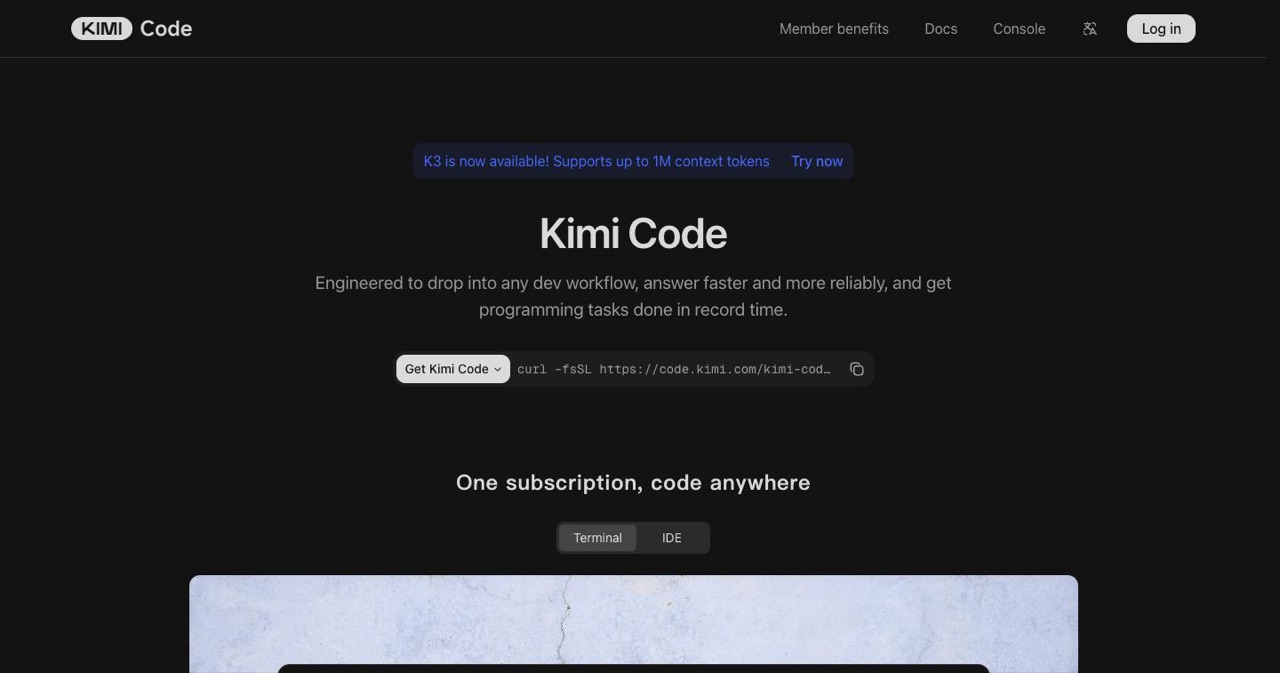
Via Kimi Code CLI — kimi.com/code is Moonshot's recommended agent framework for production coding. It's built specifically for this model family and handles file operations, shell commands, web search, sub-agent orchestration, and large codebase analysis natively. For serious coding agent work, this is the better entry point than a raw API call. If you are exploring alternative frameworks, take a look at our ultimate guide to vibe coding in 2026 to see how agent CLI tools compare.
Self-hosted — Weights are live on Hugging Face at moonshotai/Kimi-K2.7-Code. The INT4 quantized version comes in around 594 GB — same as K2.6. If you're already running K2.6 locally with vLLM or SGLang, the migration path is straightforward. The deployment guide is in the repo.
The Modified MIT License gives you broad commercial use rights. The only restriction kicks in at enterprise scale: products exceeding 100M monthly active users or $20M monthly revenue need to display "Kimi K2" visibly in their UI. Below those thresholds, it's functionally standard MIT.
Today, Moonshot also launched the Kimi Code Beta Program — early access to upcoming models and features before public release. You can apply at kimi.com/code/beta. Given the pace of K2 releases, being in that program seems worth it.
What the Developer Community Is Saying
The response on X has been fast and positive. The reactions breaking through the noise most consistently: the "less overthinking" framing, long-horizon reliability, and continued commitment to open weights.
One comment captures what's resonating: "Less overthinking + better long-horizon performance = actual usable coding agent." That's the product promise in a sentence. Developers building on top of K2.6 have been waiting for the reasoning token problem to get addressed — K2.7-Code makes a real dent in it.
There's also genuine curiosity about how it stacks up against Cursor's Composer (which has Moonshot's own K2.5 checkpoint baked in, trained with extensive proprietary data). That comparison will emerge over the next few days as people run real-world evaluations. There are also calls from the local inference community — Unsloth users in particular — for faster quantized variants to make self-hosting more accessible.
Some community members have flagged that the Kimi Code Bench v2 numbers are Moonshot-internal, not externally verified yet. That's a fair caveat. At the same time, the model is available now for anyone to evaluate directly, which is the most important form of verification.
The Bigger Picture
Moonshot has shipped five significant model versions in under a year. Each one has moved the open-source coding benchmark needle. K2.7-Code isn't the flashiest release in the series — it doesn't introduce a new paradigm or dramatically expand what the model can do. It makes the existing things work better in the conditions that actually matter for shipping software.
That's more valuable than it sounds. The gap between "achieves X on a benchmark" and "reliably does X in a three-hour agent session across a real codebase" has historically been where open-source models fall apart. K2.7-Code is specifically targeted at closing that gap — better instruction following under long-context pressure, fewer cascading failures in multi-file tasks, lower token overhead across the board.
With 6x High-Speed Mode still incoming and an active beta program for what's next, this is clearly a model family with more in the pipeline.
Get Started
- Try the API: platform.moonshot.ai
- Use Kimi Code CLI: kimi.com/code
- Download weights: huggingface.co/moonshotai/Kimi-K2.7-Code
- Join the Beta: kimi.com/code/beta
The frontier-level coding agent no longer requires a closed API. It just got cheaper to run, more reliable on long tasks, and it's sitting on Hugging Face waiting for you to pull it.
SaaSCity.io covers AI models, developer tools, and startup ecosystems. List your startup on the SaaSCity directory to get found and gain high-quality dofollow backlinks.
Get your SaaS in front of founders
List your product on the SaaSCity live city map - a permanent listing, real discovery, and a backlink from a high-DR directory. Free to start; upgrade for a dofollow link and a building on the map.