News
Leanstral 1.5: Mistral's 'Proof Abundance for All' and What It Means for SaaS Builders
Mistral drops Leanstral 1.5 with a tagline that sounds like a manifesto. Here's what the model actually does, how it stacks up, and why SaaS founders should pay attention.

Contents (7)
Quick answer: Leanstral 1.5 is Mistral AI's open-weight theorem-proving model for Lean 4, shipped June 30, 2026 under the tagline "Proof Abundance for All." It is a 119B-parameter mixture-of-experts model with 128 experts, 4 active per token, roughly 6.5B active parameters, and a 256k context window. Apache 2.0 licensed on Hugging Face and free in Mistral's Labs tier, it solves 587 of 672 PutnamBench problems at about $4 each, against $300 or more for Seed-Prover 1.5.
A math problem that costs $300 to solve with ByteDance's Seed-Prover costs about $4 with Mistral's newest model. Same problem. Same standard of proof, checked by a compiler, not a paragraph that merely sounds convincing.
That's the headline number buried in Leanstral 1.5, which Mistral AI shipped on June 30, 2026 under the tagline "Proof Abundance for All." Before going further: this isn't a general chatbot release, and it's not trying to out-talk Mistral Large, Qwen, or Llama. It does one job — proving that code and math are actually correct — and it does that job at a price nobody else in the space has hit yet.
Key Takeaways
- Narrow specialist, not a chatbot: Leanstral 1.5 does autoformalization and automated theorem proving in Lean 4, translating claims into formal language a compiler can check.
- Small active footprint: 119B total parameters across 128 experts, 4 active per token, about 6.5B active parameters, with a 256k context window.
- Free and self-hostable: Apache 2.0 weights on Hugging Face, plus $0 serving in Mistral's console as model ID leanstral-1-5.
- Benchmarks: 100% on miniF2F (saturated), 587 of 672 PutnamBench problems, and 43.2 on FLTEval pass@8 versus 39.6 for Claude Opus 4.6.
- Compute buys correctness: 44 Putnam problems at a 50,000-token budget, 244 at 200,000, 493 at 1 million, and all 587 at 4 million.
- Real-repo results: It proved O(log n) complexity for an AVL tree across a 2.7-million-token session and surfaced 5 unreported bugs across 57 open-source repositories.
- Documented pushback: Hacker News commenters argued the varint overflow bug is what fuzzing already catches, and the model card shipped without fresh benchmarks against its predecessor.
What Leanstral 1.5 Actually Is
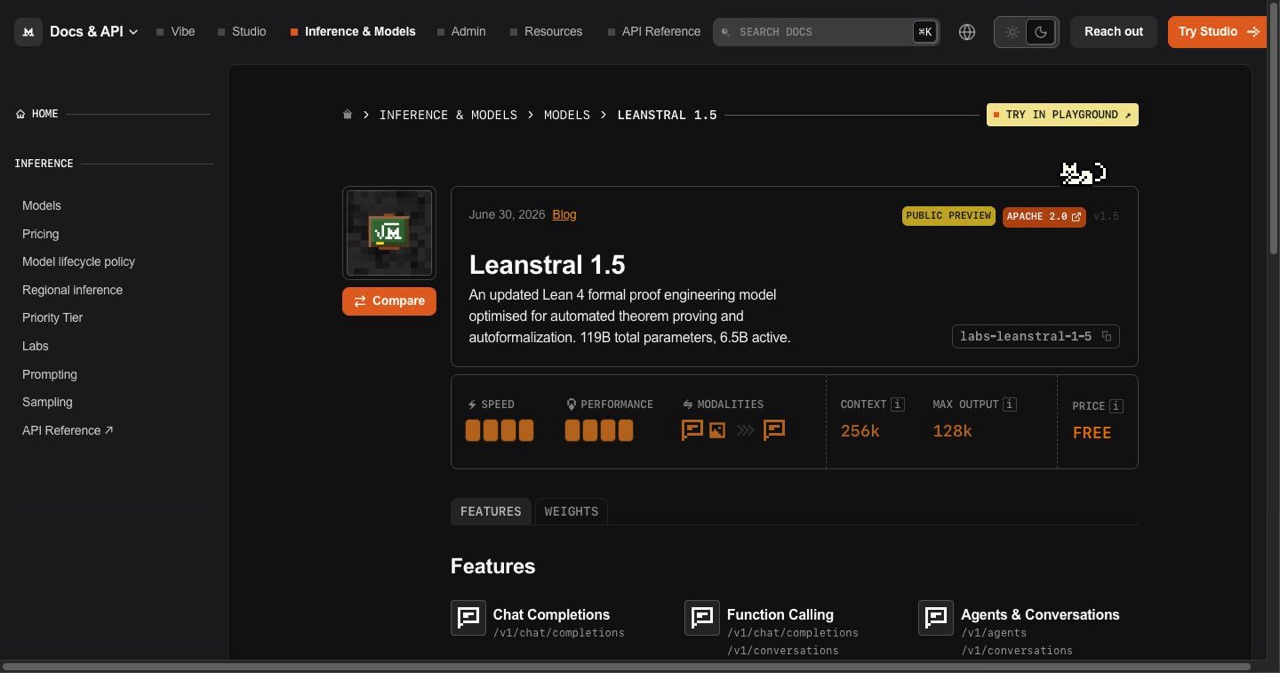
Leanstral 1.5 is a mixture-of-experts model: 119 billion total parameters, 128 experts, with only 4 active per token, landing at roughly 6.5 billion active parameters for any given forward pass. Context window is 256k tokens. It's Apache 2.0 licensed, sitting on Hugging Face for anyone who wants to self-host, and Mistral is also serving it for $0 through their console as a Labs-tier model, per the official model card.
Its actual job is autoformalization and automated theorem proving in Lean 4 — translating a claim about code or math into Lean's formal language, then constructing a proof that a compiler can mechanically verify. Mistral trained it in three stages: mid-training, supervised fine-tuning, then reinforcement learning with CISPO across two environments. One is a multiturn proof loop — submit an attempt, read the compiler's rejection, retry. The other is a full code-agent environment where the model edits files, runs bash commands, and talks directly to the Lean language server. Long sessions stay inside the context window through what Mistral calls context compaction, compressing earlier turns so a multi-million-token proof attempt doesn't fall over.
How It Stacks Up
Ignore Mistral Large, Qwen, and Llama for this comparison — none of them are built to do formal proof work, so a head-to-head would measure the wrong thing. The real rivals are other proof specialists, and here's where Leanstral 1.5 lands, per Mistral's release notes and MarkTechPost's independent benchmark writeup:
| Benchmark | Leanstral 1.5 | Rival model |
|---|---|---|
| miniF2F (val + test) | 100% (saturated) | DeepSeek-Prover-V2-671B: 88.9% (test) |
| PutnamBench | 587/672 solved | Seed-Prover 1.5: ~7 fewer problems solved |
| FLTEval pass@8 | 43.2 | Claude Opus 4.6: 39.6 |
| Cost per PutnamBench problem | ~$4 | Seed-Prover 1.5 (high setting): ~$300+ |
A couple of those numbers deserve context instead of just admiration. DeepSeek-Prover-V2-671B is a much bigger model (671B total, 37B active) from April 2025 that only solved 49 of 658 PutnamBench problems in its own paper — a different, older benchmark snapshot, and one Hacker News commenters were quick to point out is "three generations old" in AI time. That's a fair complaint about the framing, even if Leanstral's raw numbers are still genuinely strong against current specialists like Seed-Prover.
The more interesting number is how Leanstral scales with compute. Given 50,000 tokens of budget, it solves 44 Putnam problems. At 200,000 tokens, 244. At 1 million tokens, 493. At the full 4 million token budget, all 587. Performance climbs close to monotonically the longer you let it think — which is the actual argument for why "proof abundance" isn't just a slogan: you can trade cash for correctness in a way that's predictable.
What "Proof Abundance for All" Actually Means
Formal verification isn't new — Coq, Isabelle, and Lean have existed for decades, and mathematicians have used them to check famously hard proofs. What's new is who could afford to run it at scale. A frontier system like Seed-Prover 1.5, at its highest effort setting, can run $300 or more to close out a single hard problem. That's a price point that makes sense for a research lab chasing a leaderboard, not for a five-person startup that just wants to know its billing logic doesn't have an edge case.
Mistral's bet is that dropping the cost to about $4 a problem, and giving the model itself away for free, moves formal verification from "thing academic labs do" to "thing your CI pipeline could do." They're backing that claim with real examples: Leanstral proved the O(log n) time complexity of an AVL tree implementation across a 2.7-million-token session, and — run against 57 open-source repositories — surfaced 5 previously unreported bugs, including an integer overflow in a varint decoder.
Worth noting: that bug-finding claim didn't land cleanly with everyone. On the Hacker News thread that pushed Leanstral to #5 with 586 points and 127 comments, several commenters argued that a varint overflow is exactly the class of bug that ordinary fuzzing and property-based testing already catch in seconds, and that showcasing it undersells what formal verification is actually good for. That's a fair critique, and it's the kind of pushback worth knowing about before you take a vendor's demo bullet point at face value.
What It Means for SaaS Builders
Most SaaS teams aren't writing Lean 4 by hand, and that's fine — you don't have to, to get value here. The realistic path in is agentic: Mistral's recommended entry point is the Vibe agent interface, which can point Leanstral at a codebase (including translating Rust into Lean through the Aeneas toolchain) without you writing a single proof yourself. If you're running anything where a silent logic error is expensive — billing and metering code, concurrency-heavy job schedulers, anything touching money or data integrity — a free model built specifically to hunt for that class of mistake is worth a trial run, even if the fuzzing crowd on Hacker News has a point that it won't catch everything a good test suite wouldn't.
The bigger signal is pattern, not product. This is the second time in four months Mistral has shown that a small, free, open-weight specialist can out-benchmark an expensive proprietary system in its own lane — the original Leanstral, back in March 2026, beat Claude Sonnet by 8 points at pass@16 while costing 15 times less to run. It's the same story playing out with Qwen 3.6 27B beating Alibaba's own 807 GB flagship on SWE-bench at a fraction of the size. If you're deciding whether to build a feature in-house or lean on a frontier API, that trend line matters more than any single release: narrow, free, open-weight models are closing gaps faster than general flagships are widening them. It's also worth reading benchmark claims from any lab, Mistral included, with the same skepticism this community brought to Leanstral — see how GLM-5.2's benchmarks held up against GPT-5.5's marketing for a recent example of a vendor number not surviving contact with independent testing.
There's also a quieter geopolitical thread here. Mistral is a French lab betting, again, that open weights are a business model rather than a charity project — the same wager Switzerland's Apertus made explicit for sovereign AI. Whether that model survives contact with venture-scale competitors is a live debate; a thread on the Leanstral HN post argued a $0-priced model builds zero customer lock-in, while others countered that commodities can still be profitable businesses. Worth watching either way if you're building on top of European open-weight infrastructure.
Community Reaction
Sentiment on Hacker News split about where you'd expect. Supporters pointed out that a 6.5B-active-parameter model beating specialized rivals many times its size, and running on consumer hardware, is a real engineering result. Skeptics pushed back on two fronts: the "benchmaxxed" framing of some comparisons, and a real question of whether Mistral is describing a product or a feature that happens to be free. AI Weekly's early coverage also flagged that the model card shipped without fresh benchmarks against its own predecessor — those numbers only surfaced days later when outlets like MarkTechPost ran their own comparisons. That's a legitimate transparency gap worth remembering the next time any lab, not just Mistral, drops a model with a big claim and a thin changelog.
List Your AI Tool on SaaSCity
Building something in the AI inference or dev-tooling space? Get it in front of the founders who are actually deciding what to build on.
- Free with our badge on the SaaSCity directory — add the badge to your homepage, book a week in the free queue, or skip the queue with Quick Pass ($14.99)
- Dofollow backlinks from a domain with growing DR
- Visibility on our interactive 3D city map, seen by founders and engineers browsing the ecosystem
- Submit your product at saascity.io/live/submit
"Proof abundance for all" is a tagline, and taglines are cheap. What isn't cheap, historically, is the thing Mistral just priced at $4 a problem. If Leanstral 1.5 does even half of what its benchmarks claim, the real test isn't the leaderboard — it's whether you point it at your own repo and see what comes back. That's a more honest benchmark than anything in this post, including the table above.
SaaSCity.io covers the AI tools and models shaping how SaaS gets built. Explore the SaaSCity directory to discover what's shipping right now — or list your own product.
Get your SaaS in front of founders
List your product on the SaaSCity live city map - a permanent listing, real discovery, and a backlink from a high-DR directory. Free to start; upgrade for a dofollow link and a building on the map.