Build with AI
AWS Lambda MicroVMs: Why Your AI Coding Tool Needs Stateful Sandboxes
AWS Lambda MicroVMs give SaaS builders VM-grade isolation with container-speed startup — finally a real answer for running untrusted, AI-generated code per user session.

Contents (7)
Quick answer: AWS Lambda MicroVMs are a serverless compute primitive announced June 22, 2026 for running user-generated and AI-generated code in isolated, stateful sandboxes. They run on Firecracker, the same microVM technology behind Lambda's 15 trillion monthly invocations, and combine VM-level isolation with near-instant launch, session-long memory and disk state, and pause-to-idle pricing. You package a Dockerfile as a MicroVM Image, zip it to S3, and launch per-user instances from a Lambda function with the new CreateMicroVm API action.
Every AI coding assistant on the market runs into the same wall eventually: where does the user's code actually execute? Not your servers, not shared containers — somewhere isolated enough that one user's malicious or buggy script can't touch another's session. Until last week, the honest answer was "expensively, and not very well."
AWS just changed that math. On June 22, 2026, AWS announced Lambda MicroVMs — a serverless compute primitive purpose-built for running user-generated and AI-generated code in isolated, stateful sandboxes.
Key Takeaways
- Announced June 22, 2026: Lambda MicroVMs are a serverless primitive built for isolated execution of user-submitted and AI-generated code.
- Firecracker underneath: The same microVM technology already carrying Lambda's 15 trillion monthly invocations, so the isolation layer is hardened rather than new.
- Three defining properties: VM-level isolation with near-instant launch, stateful sessions that keep memory and disk, and pause-to-idle instead of staying hot or tearing down.
- Packaging is a Dockerfile: Build a MicroVM Image, zip it, upload to S3, then launch instances from a Lambda function via the
CreateMicroVmAPI action. - It closes a three-way tradeoff: VMs gave isolation at minutes of startup, containers gave speed but a shared kernel, and plain Lambda gave neither state nor long interactive sessions.
- Best-fit workloads: AI coding assistants and code interpreters, notebook-style analytics, vulnerability scanners executing untrusted payloads, and game servers running user scripts.
- Containers and EC2 still have a place: Reach for them when you need custom networking, GPU passthrough, or persistent multi-tenant infrastructure outside the session model.
What MicroVMs Actually Are
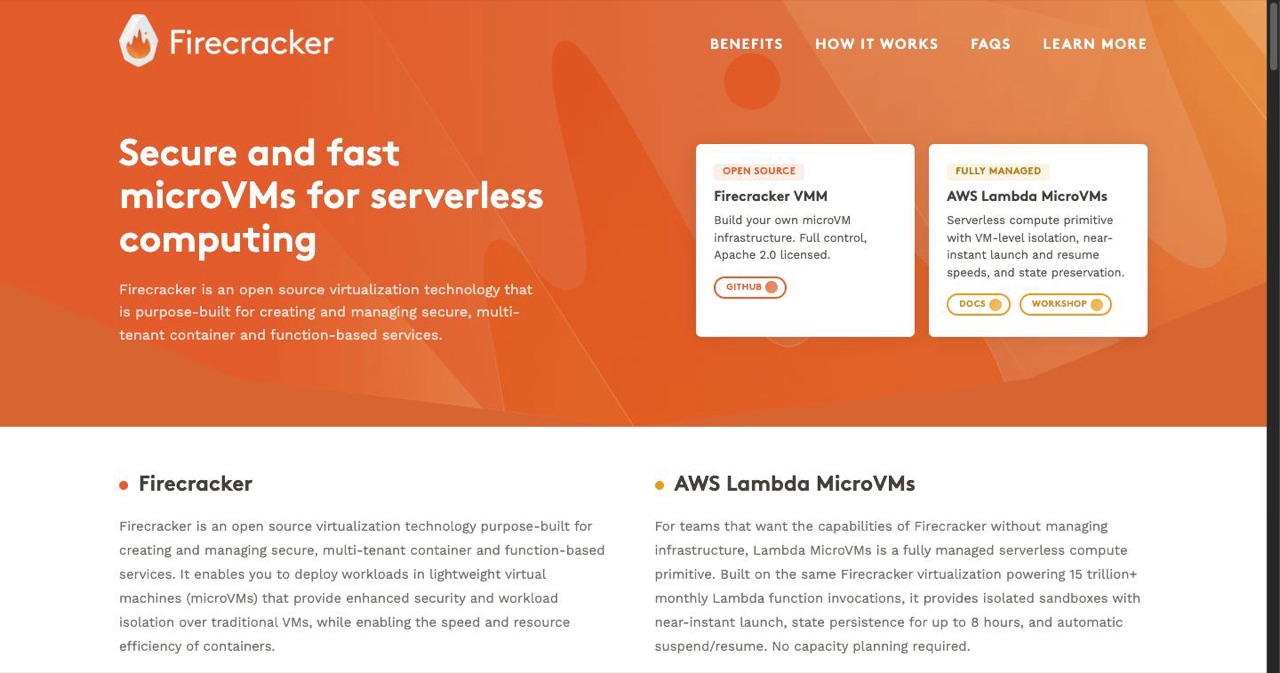
MicroVMs run on Firecracker, the same microVM technology already handling Lambda's 15 trillion monthly invocations. That pedigree matters — this isn't a new unproven isolation layer, it's a new exposure of infrastructure AWS has hardened for years.
Three properties make this a genuinely new primitive, not just "Lambda with extra steps":
- VM-level isolation, near-instant launch. You get the security boundary of a full virtual machine without the multi-minute boot time VMs traditionally cost you.
- Stateful sessions. A MicroVM retains memory and disk state for the length of a session — write a file, install a package, leave a process running, and it's still there when the user comes back.
- Pause-to-idle. When a user steps away, the MicroVM pauses instead of staying hot or tearing down. You stop paying full compute cost without losing session state.
You build a MicroVM Image as a Dockerfile, package it into a zip, and upload to S3. A Lambda function then launches instances of that image via a new CreateMicroVm API action, scaling per user or per session with no fleet of EC2 instances to manage.
The Three-Way Tradeoff This Solves
For years, SaaS builders running anything user-submitted have picked their poison from three bad options:
- VMs — strong isolation, but slow startup measured in minutes. Fine for long-lived infrastructure, terrible for "user clicks a button and expects code to run in 2 seconds."
- Containers — fast startup, seconds not minutes. But they share a kernel with the host, so running untrusted or AI-generated code means heavy hardening work (gVisor, Kata, seccomp profiles) just to get isolation guarantees anywhere near a VM's.
- Lambda functions — event-driven, stateless, cheap. Not designed for interactive, long-running sessions where a user expects to keep typing, running, and iterating against the same environment.
MicroVMs sit in the gap nobody could fill: VM-grade isolation, sub-second launch, and statefulness across an interactive session. That's not an incremental improvement — it's a missing primitive that a lot of AI-native SaaS architecture has been working around with duct tape.
Where This Actually Matters for SaaS Builders
- AI coding assistants and interactive code environments. Every "Cursor for X" or AI app builder needs to execute generated code somewhere. MicroVMs mean you can give each user session a real sandboxed runtime instead of routing through a shared, heavily-fenced container pool.
- Data analytics platforms. Notebook-style products where users run arbitrary queries or scripts against their own data session — now isolatable per user without provisioning a VM per customer.
- Vulnerability scanners. Executing untrusted payloads to test for exploits is exactly the workload VM isolation exists for. MicroVMs make doing this at SaaS scale economically sane.
- Game servers running user scripts. Modding platforms and scriptable game backends get the same isolation-plus-state benefit without running dedicated VM fleets per active session.
If you're building anything in the AI agent space — and we've covered the cost side of that shift in how Headroom cuts LLM token costs 60-95% for AI agents — MicroVMs solve the execution half of the problem while token-efficiency work solves the reasoning half. Both matter if your margins depend on running AI agents at scale.
Architecture Impact: What Changes for You
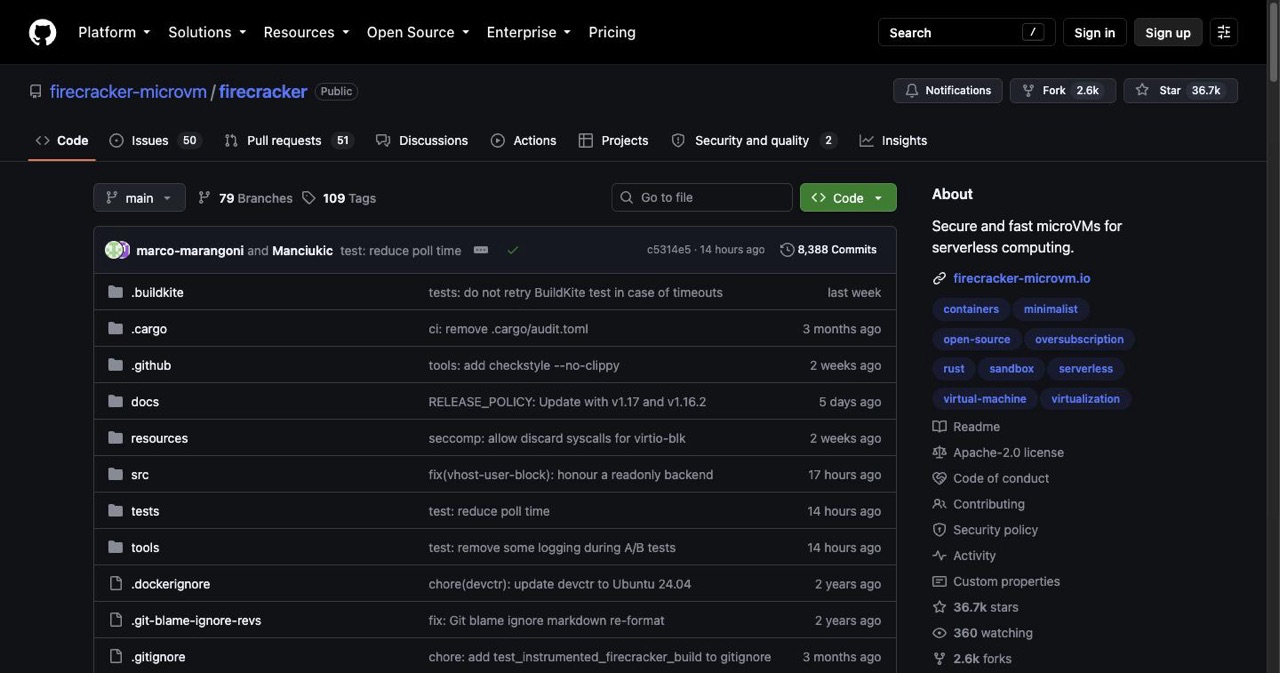
The practical shift is that "per-user sandbox" stops being a make-or-buy decision between rolling your own Firecracker orchestration (what AWS, Fly.io, and a few others have done internally for years) and accepting container-level isolation risk. Now it's an API call.
That has downstream effects on how you think about infra cost and model choice too. As compute gets cheaper and more specialized — see OpenAI's custom Jalapeño chip and what it means for AI SaaS margins — the execution layer was the remaining piece still priced like general-purpose infrastructure. MicroVMs being a native serverless primitive (pay for active compute, pause to near-zero on idle) brings sandboxed execution cost curves in line with where model inference cost is already heading.
It also changes what you can promise users. Session persistence without dedicated infrastructure means an AI coding tool can say "your environment is still here when you come back" without the team manually provisioning workspace VMs per customer. That's the same shift that's reshaping product expectations around model capability — see our take on GPT-5.6 and Sol from OpenAI's next-gen model for SaaS founders: better underlying capability keeps raising the bar for what "table stakes" looks like in AI tooling, and now the execution layer is catching up to match.
Building With This? Get Found
If you're shipping an AI tool, dev sandbox, or code execution platform on top of MicroVMs (or anything else), list it on SaaSCity. We're a gamified directory built around a 3D city map where founders, indie hackers, and investors actually browse for tools — not a static list nobody opens.
Submit your tool: https://saascity.io/live/submit
Closing
MicroVMs aren't flashy — there's no demo of a chatbot getting smarter. But for anyone building infrastructure where users execute code, this is the primitive that's been missing since serverless and containers diverged. Isolation without the wait, statefulness without the dedicated VM. If your roadmap has "let users run code" on it anywhere, this is worth a serious look before you build (or keep maintaining) your own sandboxing layer.
Get your SaaS in front of founders
List your product on the SaaSCity live city map - a permanent listing, real discovery, and a backlink from a high-DR directory. Free to start; upgrade for a dofollow link and a building on the map.