News
OpenAI Custom Chip Jalapeño: 50% Cheaper AI Inference and What It Does to Your SaaS Margins
OpenAI and Broadcom just unveiled Jalapeño — a 3nm custom inference ASIC built in nine months that claims 50% lower cost per token than current GPUs. Here's what the specs mean and why SaaS founders should be paying attention.

Contents (8)
Quick answer: Jalapeño is OpenAI's first custom chip, announced with Broadcom on June 24, 2026. It is a 3nm inference-only ASIC fabricated by TSMC and racked by Celestica, using a systolic array design and eight on-package HBM stacks to cut the memory latency that dominates LLM decoding. Broadcom claims roughly 50% lower cost per inference token than current GPUs, on internal pre-production benchmarks. Microsoft pre-committed to about 40% of initial output. Production ramps 2027 to 2028.
Nine months. That's how long it took OpenAI to go from a blank whiteboard to silicon wafers rolling off TSMC's 3nm production line — and that timeline might tell you more about where AI is going than any benchmark will.
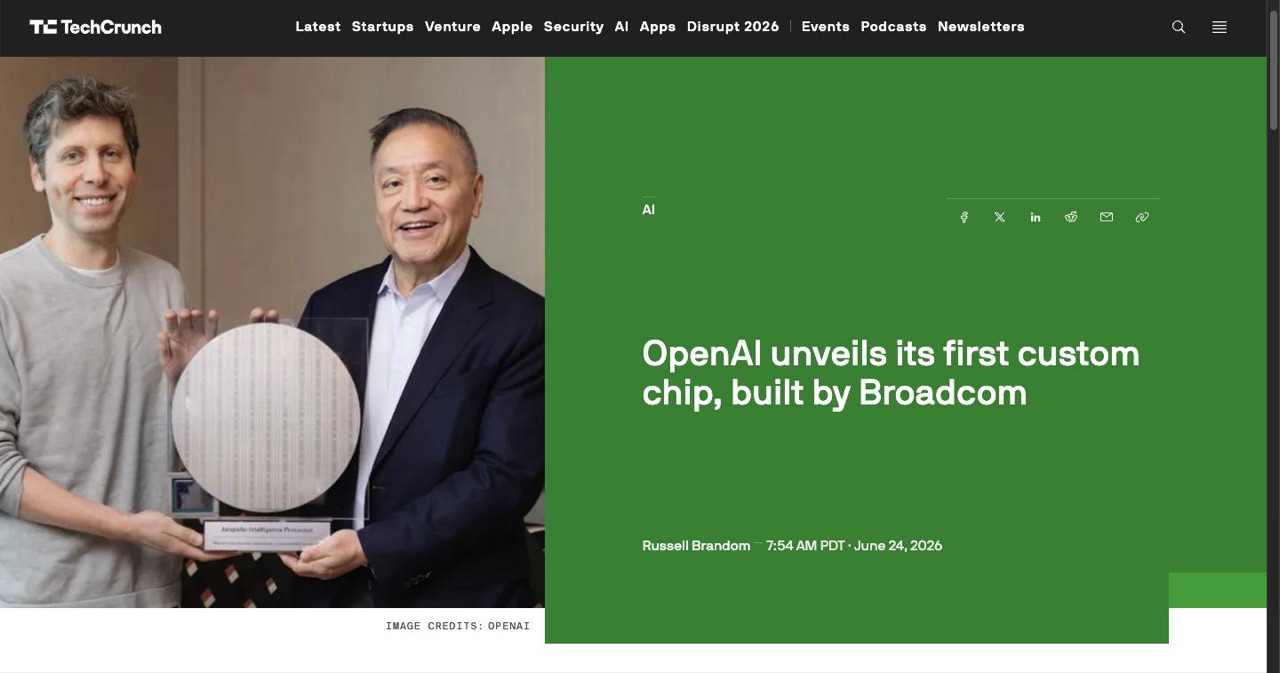
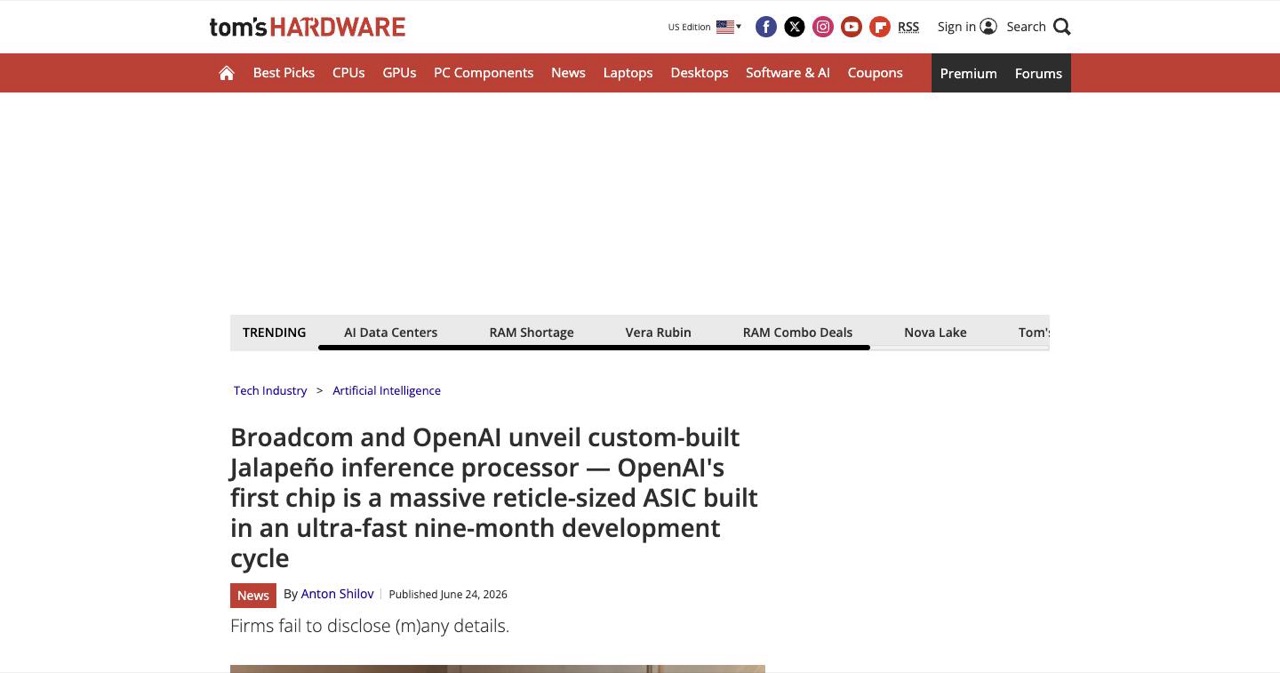
On June 24, 2026, OpenAI and Broadcom unveiled Jalapeño, OpenAI's first custom ASIC, purpose-built for AI inference. The headline claim: roughly 50% lower cost per inference token compared to current-generation GPUs. OpenAI president Greg Brockman described the OpenAI custom chip as "part of our long-term full-stack infrastructure strategy to make compute more abundant." Broadcom CEO Hock Tan called the collaboration "a fundamental commitment to scaling the physical infrastructure required for the next decade of AI."
Measured words. Also a direct signal: the company that built its entire existence on Nvidia hardware just shipped its own.
For SaaS founders building on AI APIs, the implications cut deeper than a cheaper inference bill.
Key Takeaways
- Inference only: Jalapeño does not handle training. Pre-training and fine-tuning stay on Nvidia hardware, which freed the whole transistor budget for decoding.
- Nine-month cycle: architecture to tape-out in nine months against a typical 18 to 24, with OpenAI's own models accelerating design verification.
- The 50% claim is internal: Hock Tan's figure comes from pre-production samples with no third-party validation yet.
- Microsoft is anchored in: Azure shaped part of the design spec and pre-committed to roughly 40% of initial production output.
- Four-partner stack: OpenAI on architecture and kernels, Broadcom on RTL and layout, TSMC on 3nm fabrication, Celestica on board and rack integration.
- 2027 is the real date: prototypes land late 2026, the production ramp runs 2027 to 2028, and API pricing may reflect the cost change only after that.
- Concentration risk stands: cheaper inference for OpenAI does not give API customers a pricing SLA or a second supplier.
What Jalapeño Actually Is
Jalapeño is a custom inference processor — an ASIC (Application-Specific Integrated Circuit) designed from scratch to run large language models efficiently at scale. Where a GPU is a general-purpose compute accelerator adapted for AI workloads, every design decision in Jalapeño was made with one job in mind: LLM inference.
The chip was co-designed by OpenAI and Broadcom, fabricated by TSMC on its 3nm node, and assembled into racks by Celestica. The partnership structure covers the full stack:
| Layer | Partner |
|---|---|
| Architecture & kernel optimization | OpenAI |
| RTL design & physical layout | Broadcom |
| 3nm fabrication | TSMC |
| Board and rack integration | Celestica |
| ~40% of initial production pre-committed | Microsoft |
Microsoft's position matters. Azure shaped a meaningful portion of Jalapeño's design spec, and Microsoft has pre-committed to purchasing roughly 40% of initial production output. This isn't speculative demand. The chip has a major buyer before it reaches production scale, which substantially de-risks the ramp.
The development speed is the other remarkable thing. Nine months from initial architecture design to tape-out is believed to be the fastest ASIC development cycle ever achieved for high-performance advanced semiconductors. Typical custom silicon takes 18–24 months from architecture to tape-out. OpenAI used its own models to accelerate design verification — which is worth pausing on. AI speeding up its own hardware development is not a future scenario. It just happened.
The Technical Core: Why This Chip Is Fast for Inference
If you've spent time optimizing LLM workloads, you know the real bottleneck isn't usually raw compute — it's memory bandwidth and data movement. Attention layers in transformer models require constant reads from the KV cache. Every token generated triggers another round of memory access. GPUs handle this adequately; they don't handle it optimally. They're built for a broad set of parallel compute workloads, not the specific access patterns of autoregressive decoding at scale.
Jalapeño's architecture targets that gap directly.
Systolic array design. Processing elements pass data to adjacent neighbors in synchronized patterns, keeping the pipeline fed without redundant memory reads. This maps well to the matrix multiplications that dominate transformer inference.
Eight HBM stacks on-package. Eight High-Bandwidth Memory stacks are integrated directly into the chip package rather than routed through system memory. The key benefit isn't raw bandwidth numbers — it's latency. Stacking HBM directly cuts the round-trip time that stalls processing elements during memory-intensive attention computation.
3nm fabrication. TSMC's 3nm node delivers better performance per watt than the 4nm and 5nm nodes used in most current inference hardware. OpenAI's official claim is "substantially better performance per watt than current state-of-the-art alternatives." That's their own benchmark, not third-party validation, but the process node advantage is real.
Inference-only scope. Jalapeño doesn't try to handle training. Pre-training and fine-tuning stay on Nvidia hardware. That constraint is a feature: every transistor budget decision could optimize for inference rather than splitting resources with training requirements.
Current status: engineering samples running GPT-5.3 Codex workloads internally. TSMC is producing approximately 50–60 ASICs per 300mm wafer — standard for complex advanced-node chips, but per-unit cost depends heavily on whether yields improve at production volume. A detailed technical report is coming in the months ahead.
The 50% Number: What It Means and What It Doesn't
Broadcom CEO Hock Tan cited roughly 50% cost savings per inference token compared to current-generation GPUs, with early lab testing backing the performance-per-watt claims. These are internal benchmarks on pre-production samples. Independent verification hasn't happened yet.
Treat the number as directional, not contractual.
First-generation silicon regularly encounters yield surprises. A figure that looks clean in controlled testing can soften when full-scale production variance enters the picture. Broadcom says the detailed report is coming. Until then, the claim is what it is: a compelling internal result that needs external confirmation.
What does track independently: Nvidia's pricing power on inference compute is structural, not technical. H100 and H200 cluster rentals are expensive not because the hardware costs that much to produce per inference op, but because demand exceeds supply and Nvidia has been the only viable supplier at the frontier. A credible alternative that delivers meaningfully lower cost per token at scale doesn't just reduce the bill — it removes Nvidia's ability to set inference prices unilaterally for that workload.
Google's TPUs and Amazon's Trainium chips proved this model works. Those are programs with years of iteration behind them. Jalapeño is version one with a nine-month development cycle. The trajectory matters more than the current benchmark.
Deployment Timeline: When This Actually Matters
This is where expectations need calibration.
- June 24, 2026: Public announcement and first wafer handover
- Late 2026: Prototype deployments internally and at select Azure facilities
- 2027–2028: Full production ramp
ChatGPT users and API customers won't feel Jalapeño in their response times or pricing this year. The chip is in internal testing, moving toward prototype deployment, before it touches the data center scale that handles global production traffic. OpenAI's plan involves "gigawatt-scale data centers with Microsoft and other partners beginning in 2026" — but gigawatt-scale at prototype volume is different from gigawatt-scale at the load that actually serves 800 million ChatGPT sessions.
The realistic inflection: 2027 is when Jalapeño starts having a meaningful effect on OpenAI's infrastructure cost structure. 2028 is when it becomes a primary cost driver. If the production ramp hits targets, that's when API pricing may begin to reflect the underlying cost improvement.
List Your AI SaaS on SaaSCity
Infrastructure costs are shifting. The products that win in a cheaper-inference world will be the ones that already built distribution and audience before the cost floor dropped.
SaaSCity.io is the premier directory for AI tools and developer-facing SaaS. Every listing gets visualized as a building on an interactive 3D city map — visible to founders, engineers, and early adopters looking for exactly what you're building.
- Free to list: Submit your project in under 2 minutes — no credit card, no catch.
- Earn dofollow backlinks: Every listing earns high-quality backlinks that compound your domain authority over time.
- 3D map visibility: Your product appears on the SaaSCity engine — the most distinctive directory experience in the space.
- Reach the right audience: AI-native founders, tooling engineers, and early adopters — not generic traffic.
Submit your product for free →
What This Means for AI SaaS Margins
Here's the actual so-what for founders building on AI APIs right now.
Lower inference costs flow downstream — eventually. OpenAI's gross margins on API inference are negative or near-zero at scale. The company has been selling tokens below cost to win market share. If Jalapeño delivers close to the claimed 50% reduction in infrastructure cost per token, API pricing can drop while unit economics improve simultaneously. That's a structural shift, not a promotional discount.
For SaaS products where inference cost is a real line item — copilots, document processing, AI-native workflows that run multiple passes — this trajectory matters. Costs that currently compress your margins could be structurally lower in 18–24 months. Plan your unit economics with that in mind, but don't run your next quarter on an assumption it'll arrive on schedule.
The Nvidia pricing dynamic changes. Every major AI company is executing the same strategy: build custom silicon to escape GPU rental economics. Amazon's Trainium for Anthropic, Google's TPUs for Gemini, now Jalapeño for OpenAI. As custom inference silicon matures across the industry, the cost structure of frontier inference shifts away from Nvidia's pricing power. Labs that internalized their compute gain a durable margin advantage over those renting GPU clusters at market rates.
When evaluating which AI provider to build on — including from a pure token cost perspective — the provider's infrastructure trajectory is now a legitimate factor. A lab running on rented Nvidia hardware has a different long-term cost ceiling than one running on purpose-built silicon.
Cheaper inference opens new product shapes. One of the quiet design constraints on AI product architecture has been inference cost. Agentic workflows, long-context reasoning chains, multi-step verification loops — these are expensive to run at current GPU rental rates. At half the cost, product shapes that weren't viable at today's margins become buildable. The question isn't just "what does this do to my API bill?" It's "what products become possible when inference costs 50% less?"
This compounds with techniques teams are already using for LLM token cost reduction. Structural infrastructure savings on top of prompt compression aren't redundant — they stack.
Concentration risk isn't solved. Jalapeño is good news for OpenAI's cost structure. It doesn't remove the risk of building entirely on one provider's API. Custom silicon makes OpenAI more vertically integrated and more independent of Nvidia — but that independence doesn't transfer to API customers. If you're buying inference from OpenAI, you still have one provider, no pricing SLA, and no visibility into when or whether they pass savings downstream. That's a separate problem from inference cost, and Jalapeño doesn't touch it.
The Bigger Picture
OpenAI, Google, Amazon, Apple. All four are running the same play: own the inference stack. The era where Nvidia was the inevitable infrastructure layer for AI inference is ending — not because Nvidia is in trouble, but because every frontier lab is carving out the inference workload specifically and building silicon that's better at it than a general-purpose GPU.
Jalapeño's significance isn't primarily the chip. It's that OpenAI — a company that started as a research nonprofit with no semiconductor background — produced a credible 3nm ASIC in nine months by using its own models to accelerate design verification. That's the proof of concept. If AI can compress its own hardware development cycle from 24 months to 9, the pace at which custom silicon can iterate just changed structurally.
Brockman put the underlying thesis plainly: "We have a deep understanding of the workload. We've really been looking for specific workloads that are underserved." OpenAI runs more LLM inference than any other organization on earth. That operational knowledge, baked into silicon, is a durable competitive advantage over chip vendors who have to optimize for every possible workload at once.
The inference cost pressure is real. The timeline runs through 2027. The question for AI SaaS builders isn't whether to anticipate it — it's whether your architecture, your margins, and your product roadmap will be positioned to capture what gets possible when the cost floor drops.
SaaSCity.io covers AI infrastructure, SaaS trends, and the tools founders use to build. Explore the SaaSCity directory to discover what's shipping right now — or list your own product.
Get your SaaS in front of founders
List your product on the SaaSCity live city map - a permanent listing, real discovery, and a backlink from a high-DR directory. Free to start; upgrade for a dofollow link and a building on the map.