News
GPT-5.6 Sol: OpenAI's Next-Gen Model and What Three Tiers Mean for SaaS Founders
Twenty companies got access to GPT-5.6 Sol yesterday. The US government picked them. Here's what OpenAI's new three-tier model family — Sol, Terra, and Luna — means for your AI token costs and stack decisions.

Contents (7)
Quick answer: GPT-5.6 is OpenAI's three-tier model family: Sol, the flagship for long-horizon agentic work at $5 input and $30 output per million tokens; Terra, comparable to GPT-5.5 quality at $2.50 and $15; and Luna, the high-volume tier at $1 and $6. Sol in ultra mode scores 91.9% on Terminal-Bench 2.1, the highest published agentic coding score, ahead of Claude Mythos 5 at 88.0%. It launched to roughly twenty companies individually approved by the US government.
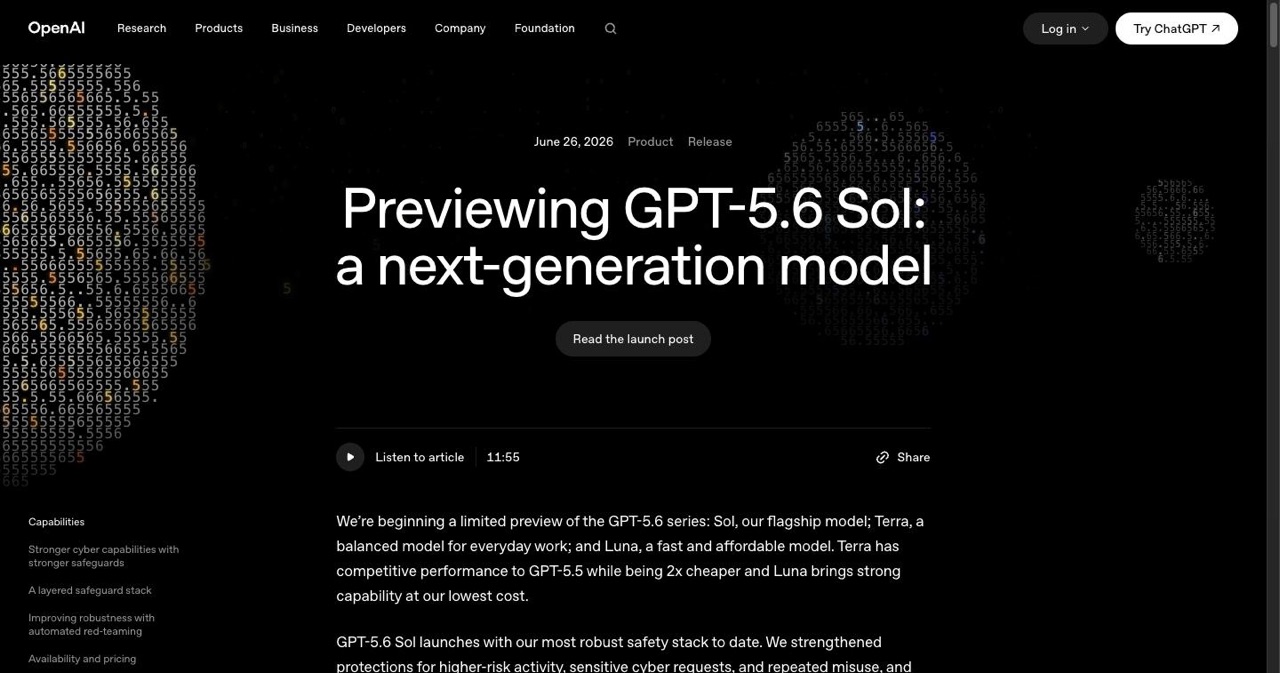
Twenty companies got access to GPT-5.6 Sol yesterday. The US government decided who.
Not a timed rollout. Not a waitlist OpenAI managed. The Trump administration reviewed roughly twenty companies and approved them one by one. Everyone else waits. This is the first time a frontier AI model has launched under a government-managed access list in the United States — and OpenAI's own announcement made clear it does not think this should become the long-term norm.
The GPT-5.6 Sol model underneath that policy decision is worth understanding on its own terms. It's OpenAI's most capable model yet, it sets a new benchmark record in agentic coding, and it arrives with a pricing structure that could reshape how SaaS products allocate AI spend.
Key Takeaways
- Three tiers, one family: Sol at $5/$30, Terra at $2.50/$15, and Luna at $1/$6 per million input and output tokens.
- Terra undercuts GPT-5.5: GPT-5.5 runs around $5/$20, so comparable quality at $2.50/$15 is an efficiency gain rather than a tradeoff.
- Ultra mode is subagent orchestration: Sol spins up specialized agents in parallel, which is different from max mode's extended reasoning on a single problem.
- 91.9% on Terminal-Bench 2.1: Sol Ultra leads, with standard Sol at 88.8%, Claude Mythos 5 at 88.0%, Terra and Claude Fable 5 tied at 84.3%, and GPT-5.5 at 83.4%.
- Government-managed access list: Roughly twenty companies were approved individually by the Trump administration, a first for a US frontier model release.
- The precedent was Anthropic: On June 12 the US Commerce Department suspended Claude Fable 5 and Mythos 5 via export control order, taking both offline globally within hours.
- Cyber capability stopped short: OpenAI says Sol identifies vulnerabilities and individual exploit components but stayed below its internal Cyber Critical threshold.
- The record will not hold: Anthropic has reportedly finished training a Mythos 6 successor, partly on compute freed when Mythos 5 was suspended.
Three Tiers, One Architecture
GPT-5.6 isn't a single model — it's a family. Three tiers, each designed for a different job.
Sol is the flagship. OpenAI built it for what they call "ambitious agentic work": long-horizon tasks in coding, biology, and cybersecurity that require sustained, multi-step reasoning without a human constantly in the loop. Sol introduces two new capability modes. Max gives the model extended time to work through a complex problem independently — more compute, slower output, better answers for hard problems. Ultra goes further: Sol coordinates multiple specialized subagents in parallel, essentially becoming an orchestrator that breaks a problem into parts and runs them simultaneously. That's not a prompt engineering trick. It's a fundamentally different execution model.
Terra sits in the middle. OpenAI claims performance comparable to GPT-5.5 at roughly half the price — the workhorse for everyday professional tasks that don't require frontier-tier reasoning.
Luna anchors the cost floor. Fast, cheap, built for high-volume inference. The model you route most traffic to when you're running at scale and don't need Sol's depth.
Pricing
| Model | Input (per 1M tokens) | Output (per 1M tokens) | Best For |
|---|---|---|---|
| Sol | $5.00 | $30.00 | Complex agentic tasks, deep reasoning |
| Terra | $2.50 | $15.00 | Everyday professional work |
| Luna | $1.00 | $6.00 | High-volume, cost-sensitive workloads |
GPT-5.5 runs around $5/$20 per million tokens. If Terra genuinely delivers comparable output quality at $2.50/$15, that's a real efficiency unlock — not a trade-off. Luna at $1/$6 is the cheapest option OpenAI has ever shipped on a frontier-class architecture.
The Benchmark Numbers
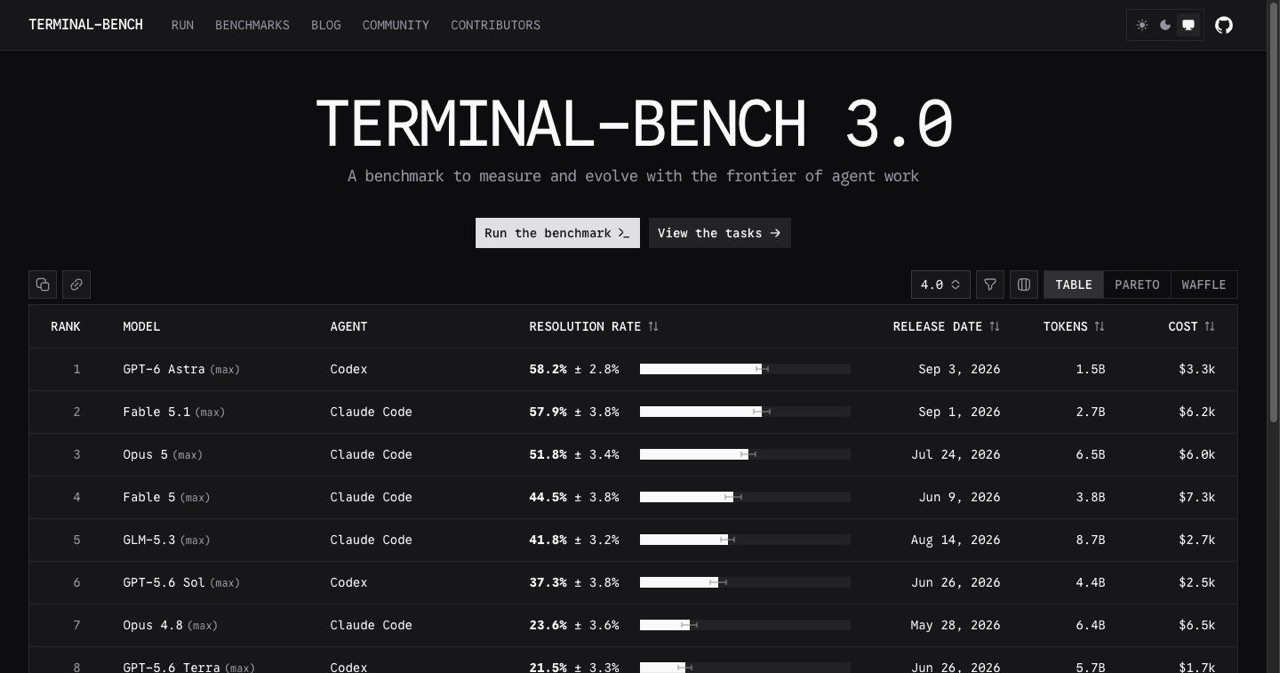
On Terminal-Bench 2.1 — the agentic coding benchmark measuring real software engineering task completion in a command-line environment — GPT-5.6 Sol scores highest:
| Model | Terminal-Bench 2.1 |
|---|---|
| Sol Ultra | 91.9% |
| Sol | 88.8% |
| Claude Mythos 5 | 88.0% |
| Terra | 84.3% |
| Claude Fable 5 | 84.3% |
| GPT-5.5 | 83.4% |
Sol in ultra mode beats Claude Mythos 5 by 3.9 points. Without ultra, the gap narrows to 0.8 points — a difference that would be easy to attribute to measurement noise under different prompting conditions. Terra and Fable 5 land in an exact tie. GPT-5.5 sits at the bottom.
On GeneBench v1, a benchmark for genomics and quantitative biology, Sol reportedly outperforms GPT-5.5 while using fewer tokens to do it. Token efficiency in scientific workflows compounds hard — if you're running multi-step biology pipelines at scale, the per-token cost difference between a model that finishes in 2,000 tokens and one that requires 3,500 is not abstract.
The cybersecurity picture is intentionally incomplete. OpenAI says Sol can identify vulnerabilities and individual exploit components, but stopped below their internal "Cyber Critical" threshold during testing — it couldn't autonomously produce a complete exploit chain. Whether that boundary holds under adversarial prompting is exactly the kind of question OpenAI would prefer to answer quietly, in partnership with government, rather than in public.
Why the Government Is in the Room Now
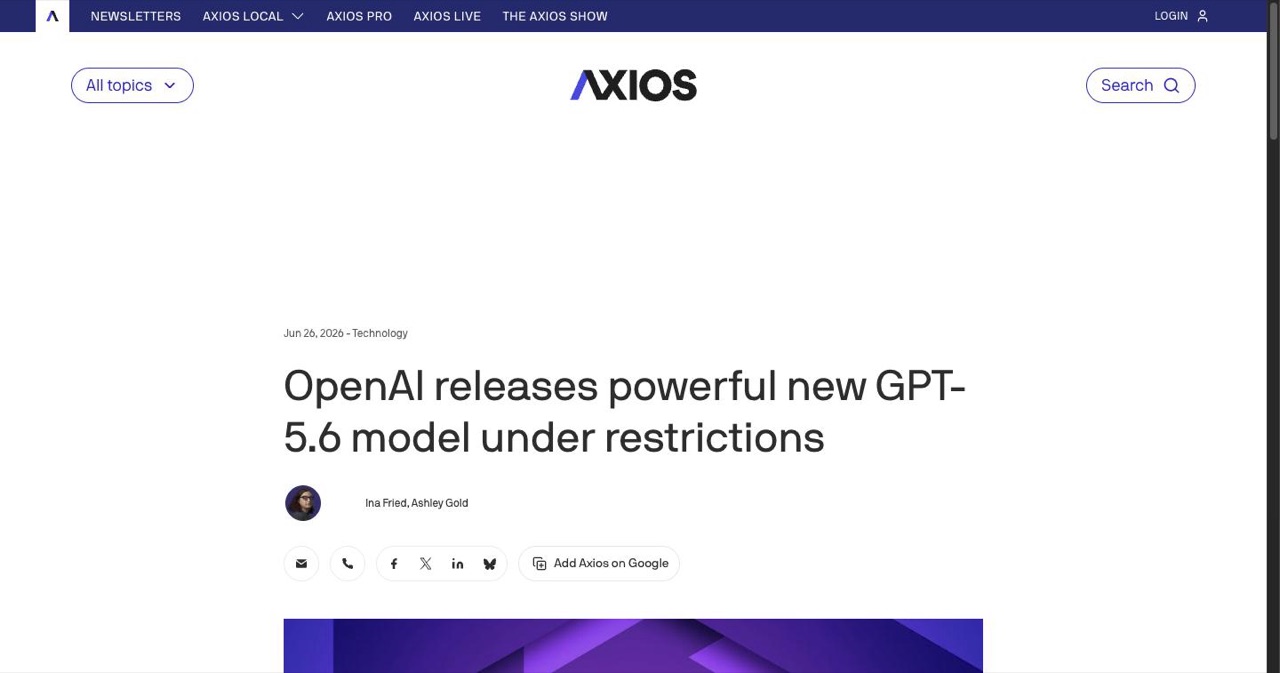
The access restrictions aren't just a cautious launch strategy. They're a direct response to what happened to Anthropic three weeks ago.
On June 12, the US Commerce Department suspended all access to Claude Fable 5 and Mythos 5 via export control order. Both models went offline globally within hours, affecting every user on every plan. The directive cited a jailbreak that Anthropic characterized as minor — one that, in their assessment, was already replicable using publicly available models without any bypass technique.
OpenAI watched that happen and chose a different approach: advance coordination rather than unilateral launch. According to Axios and VentureBeat, the Trump administration asked OpenAI to stagger the GPT-5.6 release and approved each preview partner individually. OpenAI agreed — but publicly stated this should not become the long-term default.
That's a careful distinction worth holding onto. OpenAI participated in a government-managed access process. It did not endorse one. The company's position appears to be: we cooperated once, here, for a model with documented cybersecurity capabilities. That is not a policy commitment.
The CNN report from June 25 describes the White House making a direct request to limit the release — framed as a voluntary ask, not a legal mandate. OpenAI's compliance makes the practical difference between a request and a mandate somewhat theoretical. When the government asks a frontier AI lab to restrict access to its most powerful model, "no" is a complicated answer.
List Your AI Tool on SaaSCity
Building on GPT-5.6 Sol, Terra, Luna, or any AI stack — get your product in front of the founders who'll pay for it.
- Free with our badge — add the SaaSCity badge to your homepage and book a week in the free queue, or skip the queue with Quick Pass ($14.99)
- Dofollow backlinks — every approved listing gets a high-DR link back to your domain
- 3D city map visibility — a permanent, indexed page inside the SaaSCity interactive map
- Submit your product at saascity.io/live/submit
What This Changes for SaaS Products Running on AI
Three things shift for anyone building AI-powered software.
The tier model is now table stakes. Luna at $1/$6 per million tokens is a real number. If your product runs high-volume classification, summarization, or extraction workloads, routing all of that through a single expensive model is leaving money on the table. The right architecture is a routing layer: Luna for bulk work, Terra for standard requests, Sol for the tasks where depth actually changes the output quality. The economics of AI agent token plans in 2026 have been moving toward tiered routing for months — GPT-5.6 makes the case for it sharper.
API access risk is not theoretical anymore. Two of the most capable AI models in the world — Mythos 5 and Fable 5 — are currently offline under government order. GPT-5.6 Sol is available to twenty companies. If your product depends on a single frontier model endpoint and that endpoint goes dark, you have an outage you cannot fix from your side. Building across providers is risk management, not over-engineering. Redundancy and token cost optimization strategies aren't separate concerns anymore — they're part of the same resilience decision.
Agentic capabilities are the differentiator now. Sol's ultra mode — multi-subagent orchestration — is the architectural pattern that matters for the next generation of AI products. Features that require a human to break a task into steps and supervise each one are becoming features a model can own end-to-end. The products that figure out how to wrap that capability in a reliable, predictable user experience are the ones that matter in the next 12 months. Benchmarks set records. Products ship.
A Score That Won't Stay at the Top
91.9% on Terminal-Bench 2.1 is the highest agentic coding score anyone has published. It will not hold.
Last week, analyst Andrew Curran reported that Anthropic has already completed training on a Mythos 6 successor — built partly on compute freed up when Mythos 5 was suspended. OpenAI has its own training runs in progress. The competitive loop between the two leading frontier labs has compressed to weeks, not quarters. The model that tops Terminal-Bench in June 2026 is almost certainly not the one doing so in October.
The lesson for SaaS founders isn't to optimize for the current benchmark winner. It's to design a stack that can swap the underlying model without rebuilding the product. The benchmarks keep moving. Distribution — getting in front of buyers before the next model drops — doesn't expire.
Twenty companies got early access to GPT-5.6 Sol because the government vetted them. Early access to your customers is something you can earn yourself — starting with distribution that compounds before the next capability cycle lands.
SaaSCity.io covers AI model releases, SaaS trends, and the tools founders use to build. Explore the SaaSCity directory to discover what's shipping right now — or list your own product.
Get your SaaS in front of founders
List your product on the SaaSCity live city map - a permanent listing, real discovery, and a backlink from a high-DR directory. Free to start; upgrade for a dofollow link and a building on the map.