Build with AI
Headroom: Cut LLM Token Costs 60-95% on AI Agents Without Losing a Single Answer
Every tool call and search result eats up valuable context window tokens. Discover Headroom, the open-source context compression layer designed for AI agents that cuts LLM token costs by 60-95%.

Contents (11)
- Key Takeaways
- The Problem Nobody Talks About Enough
- What Headroom Is (The 30-Second Version)
- How Headroom Actually Works: The Architecture
- The Benchmarks (The Part That Actually Matters)
- Getting Started in Under 5 Minutes
- Advanced: The Features Worth Knowing About
- Honest Limitations
- Why This Is Infrastructure, Not a Nice-to-Have
- Building Something in This Space?
- The Bottom Line
Quick answer: Headroom is an open-source context compression layer built by Tejas Chopra that sits between an AI agent and its LLM provider, cutting 60-95% of token usage on tool-heavy workloads. It ships as a Python library, a drop-in proxy server, and an MCP server. A four-stage pipeline aligns cache-breaking values, routes content to specialized compressors (SmartCrusher for JSON and logs, tree-sitter CodeCompressor for source, Kompress-base for prose), scores conversation history, and keeps originals locally through Compress-Cache-Retrieve so the model can fetch full data in about 1ms.
Your last agent run ate 80,000 tokens. A quick audit shows 70,000 of them were tool outputs nobody asked to compress.
That's the reality of building with AI agents in 2026. Every search result, every file read, every log dump lands raw in the context window. The model charges you for every token — whether it needed to see all 10,000 lines of that JSON array or not.
Tejas Chopra saw the same thing. Staring at a $287 monthly Claude bill, he traced the waste: most of it was redundant boilerplate, verbose API responses, and near-identical search results repeated call after call. The model didn't need all of it. It rarely even used most of it.
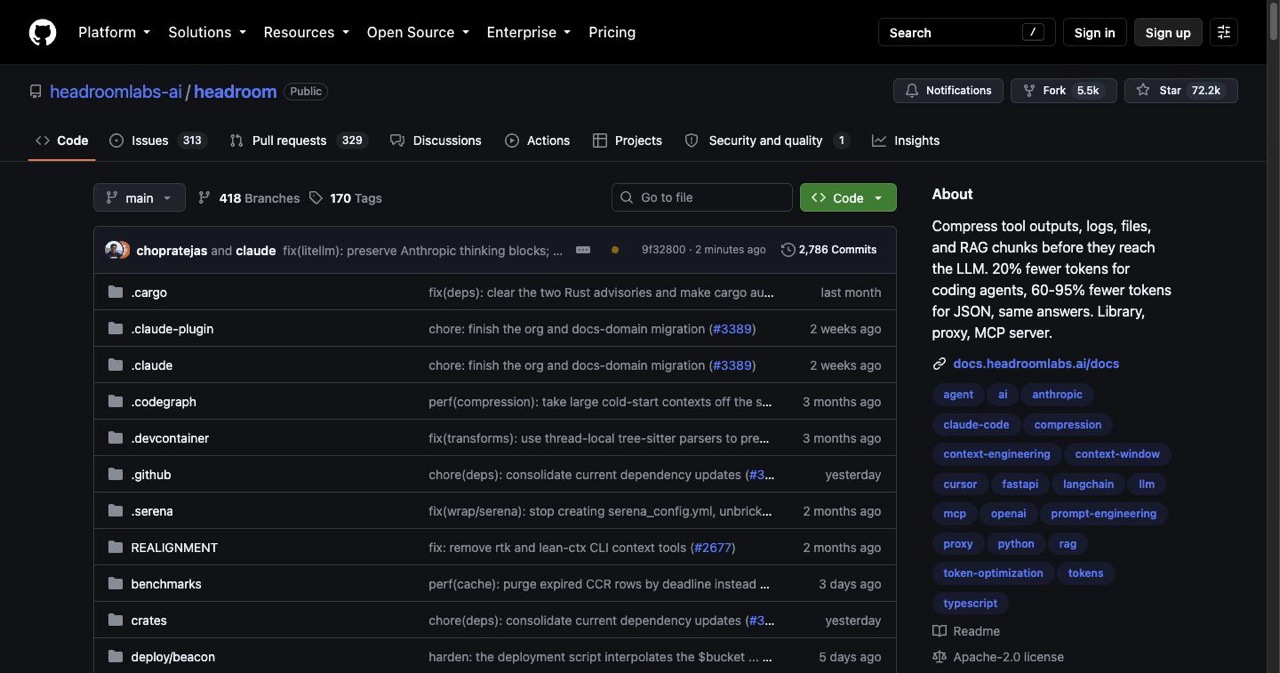
So he built Headroom — an open-source context compression layer that sits between your agent and your LLM provider, quietly cutting 60-95% of your token usage before the model ever sees the prompt.
This post breaks down how it works, where it shines, and why AI agent context optimization is becoming essential infrastructure for anyone building seriously with LLMs.
Key Takeaways
- Origin: Tejas Chopra built Headroom after tracing a $287 monthly Claude bill to redundant boilerplate, verbose API responses, and near-identical repeated search results.
- Three ways to run it: A Python library, a drop-in proxy (
headroom proxy --port 8787), and an MCP server exposingheadroom_compress,headroom_retrieve, andheadroom_stats. - CCR is the safety net: Compressed originals are kept locally in a hash plus LRU/SQLite cache, and the model can pull them back with a retrieve tool at roughly 1ms latency.
- Measured savings: Code search over 100 results dropped from 17,765 to 1,408 tokens (92%), SRE incident debugging from 65,694 to 5,118 (92%), GitHub issue triage 73%, codebase exploration 47%.
- Accuracy held: GSM8K stayed at 0.870, TruthfulQA rose from 0.530 to 0.560, and BFCL tool use preserved 97% at 32% compression.
- Overhead: Median proxy overhead sits around 52ms, small relative to the inference time saved on tool-heavy calls.
- Licensing and adoption: Apache 2.0, 59+ GitHub contributors, on PyPI at v0.23+ as of June 2026, with LangChain, LiteLLM, Vercel AI SDK, Agno, and Strands integrations.
The Problem Nobody Talks About Enough
Building agents is easy. Making them cost-efficient is a different skill entirely.
Here's what happens in a typical agentic workflow: your agent calls a search tool, gets back 100 results with full metadata, then calls a code reader, pulls in three files, then queries a database and gets a 5,000-row JSON response. By the time you're three tool calls deep, you're looking at 50,000–100,000+ input tokens per turn.
The brutal part? Most of it is noise.
Duplicate schema definitions repeated in every API response. Log lines that follow the same pattern hundreds of times. Search results that are 90% similar to each other. Tool outputs that include timestamps, session tokens, and UUIDs that shift every call — which also kills your provider's KV cache hit rate, so you're paying for cache misses on top of the bloat.
💡 Related: Uncontrolled token costs are the biggest bottleneck for autonomous coding. Compare the best AI agent coding token plans in 2026 to optimize your budget.
Simple truncation isn't the answer. You cut the wrong lines, you lose the one anomaly that actually mattered. LLM summarization is lossy, adds its own latency, and often costs more tokens than it saves. Throwing larger context windows at the problem just moves the line — it doesn't fix the economics.
The real fix has to be content-aware, reversible, and cheap to run. That's exactly what Headroom does.
What Headroom Is (The 30-Second Version)
Headroom is an open-source "context optimization layer" that intercepts content before it reaches your LLM. You get 60-95% token reduction on tool-heavy workloads, with accuracy preserved on every major benchmark they've run.
It ships as three things: a Python library, a drop-in proxy server, and an MCP server. Use whichever fits your stack without rewriting your agent logic. The latest release landed on PyPI earlier this month (June 2026), now at v0.23+.
What makes it different from naive approaches:
- Content-aware routing — detects what type of content it's compressing (JSON, code, logs, prose) and routes each to a specialized compressor
- Reversible compression (CCR) — never actually throws data away; the LLM can retrieve originals on demand
- Cache optimization — stabilizes dynamic prompt elements to maximize provider-side KV cache hits
- Local-first — your data never leaves your machine
💡 Related: Interested in more cutting-edge agent frameworks? Read our showdown of MaxClaw vs. KimiClaw AI agents.
How Headroom Actually Works: The Architecture
The pipeline runs four stages. Understanding them tells you exactly where the savings come from.
Stage 1: CacheAligner
Before any compression happens, CacheAligner extracts and relocates volatile elements — timestamps, UUIDs, session tokens, anything that changes every call. Moving these to a stable position in the prompt dramatically improves KV cache hit rates on providers like Anthropic and OpenAI. Sub-millisecond overhead. This single stage is worth deploying even if you're skeptical about everything else.
Stage 2: ContentRouter + Compressors
This is where the heavy lifting happens. ContentRouter detects content type and routes to the right algorithm:
SmartCrusher handles JSON arrays, API responses, and logs. Rather than simple truncation, it uses statistical sampling with anomaly preservation, deduplication, schema factoring, and a Kneedle algorithm on bigrams to find statistical outliers worth keeping. It always preserves the start (schema/headers), the end (recency), and importance-scored items from the middle. Result: 83-95%+ compression on repetitive arrays while keeping every error, exception, and edge case intact.
CodeCompressor is AST-aware via tree-sitter, covering Python, JS, Go, Rust, Java, and C++. It strips function bodies while preserving signatures, or passes through exact content when full fidelity is critical.
Kompress-base is a custom transformer model hosted on HuggingFace, trained on agentic traces specifically for prose and unstructured text.
Stage 3: Context Manager
Handles rolling windows and scoring across full conversation history — weighting by recency, semantic relevance, error signals, and importance. Low-value items that get evicted don't disappear. They go to CCR.
Stage 4: CCR (Compress-Cache-Retrieve) — The Safety Net
This is what makes the whole system trustworthy.
When Headroom compresses 500 items down to 20, it doesn't delete the other 480. It stores originals locally (hash + LRU/SQLite cache), injects a summary marker in the compressed output ("87 passed, 2 failed, 1 error"), and makes a headroom_retrieve tool available to the model. If the LLM decides it actually needs the full data, it calls the tool. Local lookup, ~1ms latency, zero network round-trip.
In practice, the model almost never retrieves — because the compression preserves the signal. But the retrieval path means you're never gambling with correctness. That's the difference between a compression tool and one you can actually trust in production.
The Benchmarks (The Part That Actually Matters)
Claims are cheap. Numbers reproducible with python -m headroom.evals are not.
Real agent workloads:
| Workload | Before | After | Saved |
|---|---|---|---|
| Code search (100 results) | 17,765 tokens | 1,408 tokens | 92% |
| SRE incident debugging | 65,694 tokens | 5,118 tokens | 92% |
| GitHub issue triage | 54,174 tokens | 14,761 tokens | 73% |
| Codebase exploration | 78,502 tokens | 41,254 tokens | 47% |
Accuracy on standard benchmarks (Baseline vs. Headroom):
| Benchmark | Category | Baseline | Headroom | Delta |
|---|---|---|---|---|
| GSM8K | Math reasoning | 0.870 | 0.870 | ±0 |
| TruthfulQA | Factual accuracy | 0.530 | 0.560 | +0.030 |
| BFCL | Tool use | — | 97% preserved | at 32% compression |
The TruthfulQA improvement isn't a typo. When you strip low-signal noise, models sometimes answer more accurately because relevant signal is less diluted. That's a real finding from their evals, not marketing spin.
Proxy overhead sits at median ~52ms. On tool-heavy agent calls, that's noise — the savings in LLM inference time and token costs more than cover it. Community telemetry backs this up: 50k+ proxy sessions, 1.4 billion tokens saved in sampled fleets, thousands of dollars in real cost savings for teams running production agents.
Getting Started in Under 5 Minutes
Zero-code option (Proxy mode):
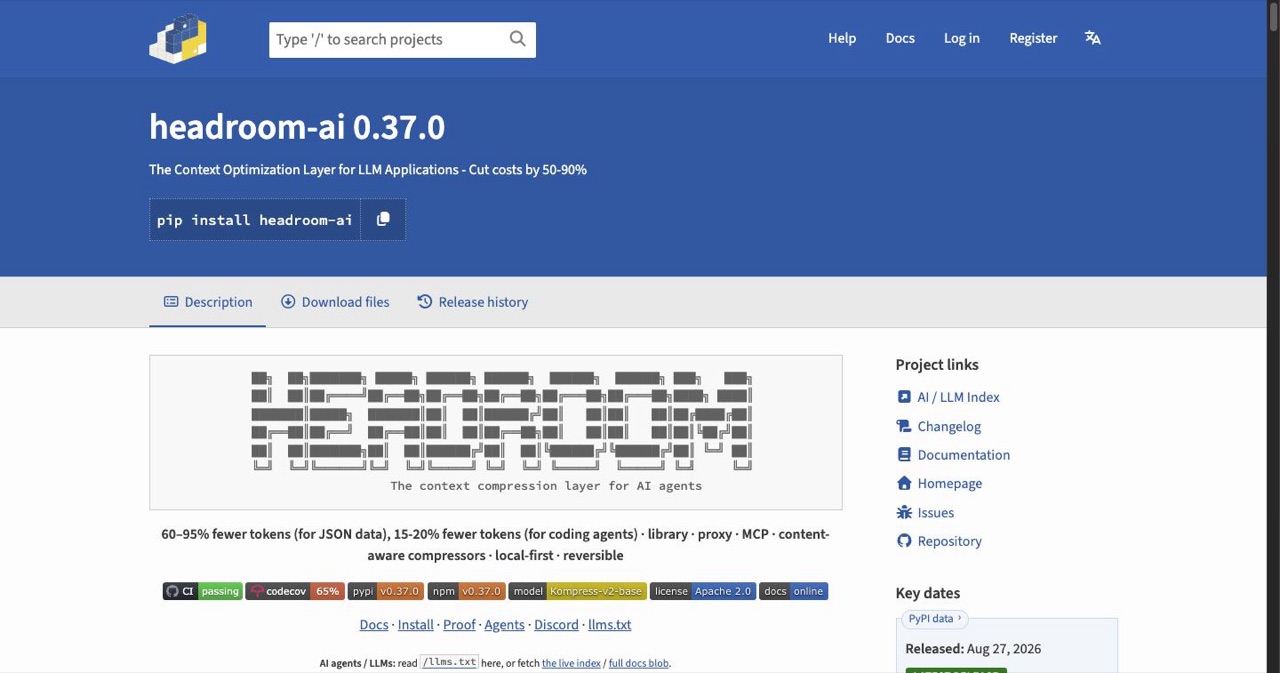
pip install "headroom-ai[proxy]"
headroom proxy --port 8787
Change your base_url to http://localhost:8787. Done. Works with any OpenAI-compatible client — Claude Code, Cursor, Codex, Aider, whatever you're using.
Wrap your coding agent directly:
headroom wrap claude --memory --code-graph
headroom wrap cursor
headroom wrap codex
Python library for programmatic compression:
from headroom import compress

compressed = compress(tool_output, content_type="json")
MCP server for frameworks that support MCP tooling — exposes headroom_compress, headroom_retrieve, and headroom_stats directly to your agent.
Install extras scale with what you need. pip install "headroom-ai[all]" grabs everything, or stay lean with specific extras: [mcp], [code], [langchain], [ml], [memory], etc.
💡 Related: Building a developer tool or AI agent? Make sure you submit it to the best directories for developer tools for organic search visibility.
Advanced: The Features Worth Knowing About
headroom learn is the most interesting one. It mines failed sessions, identifies where compression hurt rather than helped, and writes corrections directly to CLAUDE.md, AGENTS.md, or GEMINI.md. Self-improving compression tuned to your actual workload — not generic benchmarks.
SharedContext handles multi-agent setups: a shared store with automatic deduplication and provenance tracking across Claude, Codex, Gemini, and anything else in your fleet. Inter-agent message compression hits up to 80% in tests.
TOIN (Tool Output Intelligence Network) watches patterns across sessions and improves future compression scoring automatically. The longer you run it, the sharper it gets on your specific usage patterns.
Honest Limitations
Codebase exploration only hit 47% compression in the benchmarks — when every file is unique and relevant, there's less structural redundancy to find. ContentRouter adds small overhead on short content (it's smart enough to skip compression when savings wouldn't be meaningful, but the routing check still runs). The CCR local store has configurable memory overhead worth monitoring on constrained deployments.
Also: this is purpose-built for tool-heavy, agentic flows. Short conversational exchanges won't see the same ROI. Where it absolutely earns its place: coding agents, RAG pipelines, SRE and debugging agents, and any workflow pumping large structured outputs through an LLM repeatedly.
Why This Is Infrastructure, Not a Nice-to-Have
Token costs scale linearly with usage. But complexity — and therefore per-task token consumption — scales faster. As agents move from experiments to production infrastructure running thousands of tasks per day, the economics shift dramatically.
Context compression middleware is to agent cost what CDNs are to bandwidth cost. Not glamorous. Not the part you tweet about. But the part that determines whether your unit economics make sense at scale.
The project has 59+ contributors on GitHub, ships under Apache 2.0, and has an active Discord. Integrations are appearing fast: LangChain (HeadroomChatModel), LiteLLM callback, Vercel AI SDK middleware, Agno, Strands. At current trajectory, this is the kind of library that quietly becomes a default dependency in agent stacks.
💡 Related: Ready to build your own AI application? Follow our step-by-step guide to building an AI SaaS in 2026 or read our comparison of the best open-source AI SaaS boilerplates.
Building Something in This Space?
If you're building developer tools, agent infrastructure, or LLM cost optimization products — this category is exploding right now, and early distribution matters.
SaaSCity.io is a gamified startup directory where 695+ founders have listed their tools on an actual isometric city map. It has a domain rating of 42 and hands out dofollow backlinks, which is genuinely useful when you're trying to build early SEO traction. Submitting takes two minutes. If you're building anything in the AI tooling space, put your startup on the map here — the community browsing live launches skews heavily toward founders and early adopters who actively want to find tools like yours.
The Bottom Line
You're paying for tokens you don't need. Most of them are repetitive JSON structures, verbose logs, and near-duplicate search results that the model would happily work with in compressed form — and the benchmarks show it answers just as well, sometimes better.
Headroom fixes that without touching your agent logic, without risking data loss (CCR has your back), and without meaningful latency overhead. The architecture makes sense, the numbers are reproducible, and the community adoption is real.
Star the repo, wrap your next agent session, and run the evals on your own workloads. The savings numbers from your specific use case will tell you more than any table I can publish here.
Looking for more AI infrastructure tools? Browse the live AI tool launches on SaaSCity — or list your own project and get a DR 66 dofollow backlink while you're at it.
Get your SaaS in front of founders
List your product on the SaaSCity live city map - a permanent listing, real discovery, and a backlink from a high-DR directory. Free to start; upgrade for a dofollow link and a building on the map.