News
Bending Spoons Bought Miro for 90% Less Than Its 2022 Valuation. Here's the 2026 SaaS Exit Math
Miro has $600M in ARR, 4 million paying users, and 99% of the Fortune 100 as customers. Bending Spoons just bought the whole company for $1.355 billion, about 90% below the $17.5B price tag Miro carried in 2021. Here's what the math actually says about exits in 2026, and why the founders who'll be fine are the ones who stopped renting their distribution.


Contents (7)
Quick answer: On September 10, 2026, Bending Spoons S.p.A. (Nasdaq: BSP) agreed to buy Miro for $1.355 billion in cash enterprise value. Adding Miro's roughly $435 million in net cash implies about $1.79 billion in equity value, roughly 2.26x Miro's ~$600 million ARR and about 90% below the $17.5 billion valuation Miro carried after its January 2022 round. Miro is profitable, has nearly 4 million paying users and 99% of the Fortune 100. Close is expected in Q4 2026, pending regulators.
A company with $600 million in annual revenue, 4 million people paying to use it, and 99% of the Fortune 100 on its customer list just sold for less than a fifth of what it was "worth" four years ago. Read that twice. It's not a distressed fire sale. It's not a company that ran out of money. It's Miro, and the math behind why it happened is the most useful thing a SaaS founder can read this month.
You're reading this on a startup directory's blog, so the disclosure up front: SaaSCity is a listing site, and this post ends with a pitch for it. But stay for the numbers first, because they explain why that pitch exists at all.
Key Takeaways
- The price: $1.355 billion enterprise value, all cash, with $295 million of shareholder proceeds rolling into newly issued Bending Spoons stock instead of cashing out.
- The multiple is the story: About 2.26x ARR in 2026 against roughly 30x implied by the $17.5 billion January 2022 mark, which nobody ever paid in cash.
- Miro is healthy, not distressed: Profitable since its last round, ~$600 million ARR with close to 90% from business and enterprise accounts, 750+ customers over $100,000 a year, and 20 Fortune 100 contracts above $1 million.
- Same buyer, five weeks earlier: Airtable went for $1.285 billion enterprise value on August 4, 2026, roughly 2.6x its ~$480 million ARR, against an $11 billion 2021 peak.
- Funded by fresh debt: A €500 million facility with an 80% SACE guarantee plus roughly €985 million in other credit lines, close to €1.49 billion lined up after the July 1, 2026 Nasdaq listing.
- Headcount risk is unannounced but real: Bending Spoons cut most of Evernote's US team in 2023 and about three-quarters of WeTransfer's staff in 2024; nothing has been said about Miro's 1,600 people across 14 hubs.
- Profitability protects optionality, not your multiple: What a buyer pays is set by category and growth rate in the year you sell, which is why distribution assets you own outright compound independently of exit multiples.
The deal, in one paragraph
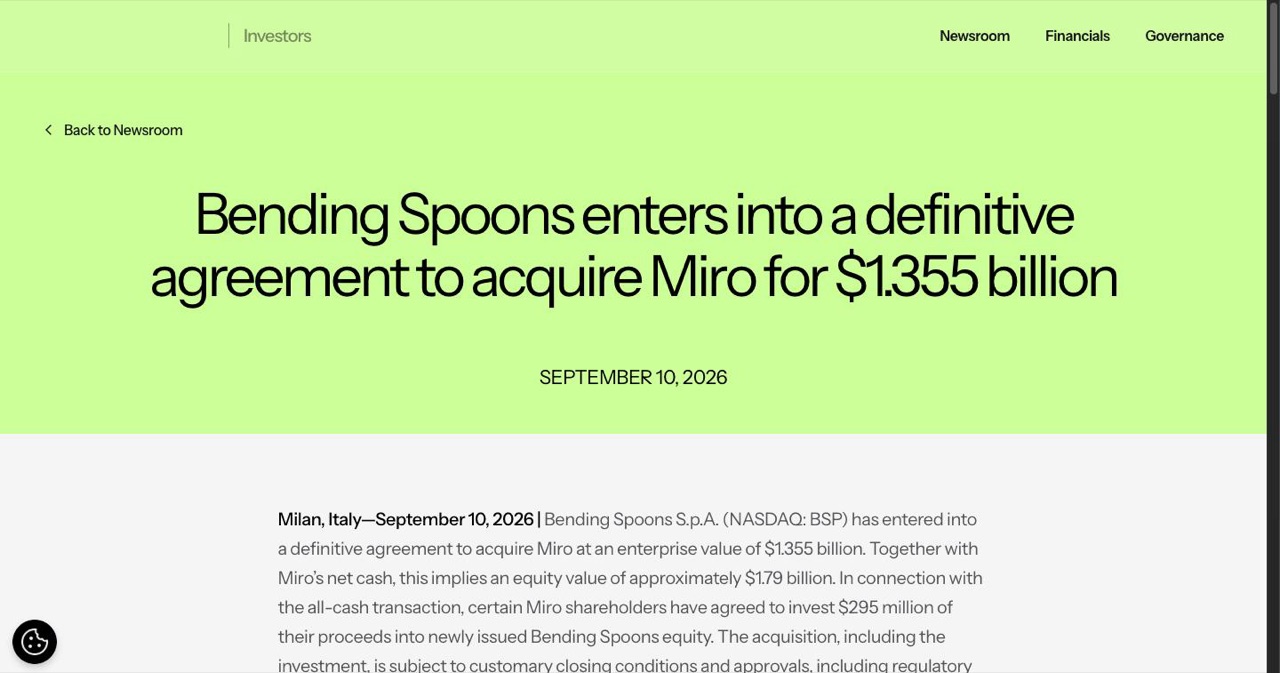
On September 10, 2026, Bending Spoons S.p.A. (Nasdaq: BSP) signed a definitive agreement to buy Miro for $1.355 billion in cash, an enterprise-value figure confirmed in Bending Spoons' own investor release and matched by Bloomberg the same day. Add Miro's roughly $435 million in net cash and the deal implies an equity value of about $1.79 billion. Some Miro shareholders are rolling $295 million of their payout back into fresh Bending Spoons equity rather than cashing out clean. Both boards approved it unanimously. Close is expected in Q4 2026, pending regulators.
Miro raised $400 million in January 2022 at a $17.5 billion valuation, a number TechCrunch reported at the time and referenced again in its coverage of the sale, which put the headline discount at 90% in its own title. Do the arithmetic on equity value against equity value ($1.79B against $17.5B) and you land at an 89.8% drop, near enough to "90%" that nobody's rounding is doing anything dishonest. This is a real, profitable, growing company that just changed hands for roughly a tenth of its ZIRP-era paper mark.
Miro isn't the company you'd guess from that headline
Here's the part that should stop you before you file this under "another SaaS unicorn pops." Miro is not struggling. Miro's own announcement and the Bending Spoons release lay out a business that, on paper, looks like exactly the kind of company you'd expect to command a premium, not a discount.
- Roughly $600 million in ARR, with close to 90% of it coming from business and enterprise accounts, not self-serve individuals.
- Profitable since its last funding round, and it hasn't raised outside money since that January 2022 round.
- Over 100 million total users and nearly 4 million paying users.
- More than 250,000 customer organizations, over 750 of which each pay north of $100,000 a year in ARR.
- 99% of the Fortune 100 use it, and among those Fortune 100 accounts, 20 have contracts worth more than $1 million a year.
- Roughly 1,600 employees across 14 hubs, co-headquartered in San Francisco and Amsterdam, with its biggest US office in Austin.
- Founded 15 years ago by CEO Andrey Khusid and Oleg Shardin. It bought the product-strategy platform Reforge in March 2026, bringing on Reforge's leadership as Miro's Chief Growth Officer and Chief Strategy Officer, according to Miro's own announcement of that deal.
Khusid's own statement on the sale leans into the same framing: "We started Miro fifteen years ago to give teams one place to think together and bring ideas to life," and he's called the current chapter one where "the best version of Miro is still ahead of us." Bending Spoons CEO Luca Ferrari's line on the deal is worth sitting with too: "It's a privilege, and no small responsibility, to welcome a product that over 250,000 organizations have integrated into their workflows." Neither of those reads like language you use to describe a distressed asset.
None of that stopped the price from landing 90% below the 2021 number. That gap is the entire story, and it's not really about Miro at all.
The math nobody wants to say out loud
Here's the number that explains everything: $1.79 billion in equity value against roughly $600 million in ARR works out to about 2.26x revenue. That's the actual price a real acquirer, paying real cash, was willing to put down for a profitable, enterprise-heavy, category-leading SaaS company in September 2026.
Compare that to January 2022. A $17.5 billion valuation against whatever ARR Miro was running at the time (widely estimated in the $150-200 million range by trackers like Getlatka) implied something closer to 30x revenue, sometimes higher depending on which trailing figure you use. That multiple was never a price. It was one growth-stage investor's bet on a market where money was free and every SaaS company's revenue was assumed to compound at software-eats-the-world speed forever. Nobody was ever going to write a $17.5 billion check to buy the whole business outright at that multiple, and in September 2026, nobody did.
The gap between "valued at" and "sold for" is the whole lesson. A funding-round valuation is a mark on one investor's cap table math, agreed to by one buyer for one slice of the company, often with a liquidation preference stacked on top that protects that investor no matter what the common stock is later worth. It was never a claim that the entire company was worth that number in cash, and 2021-2022 minted hundreds of these marks that nobody could ever fully cash out at.
Here's the number that matters more for anyone doing exit math today:
| Company | 2021 peak valuation | 2026 sale price (enterprise value) | Current ARR | Implied ARR multiple | Discount from peak |
|---|---|---|---|---|---|
| Miro | $17.5B (Jan 2022) | $1.355B | ~$600M | ~2.26x | ~90% |
| Airtable | $11B+ (2021) | $1.285B | ~$480M | ~2.6x | ~88% |
Both deals were done by the same buyer, five weeks apart, at the same rough ARR multiple, against the same order of magnitude discount. That's not a coincidence. That's a buyer with a repeatable playbook meeting a market that has settled on what mature, profitable SaaS is actually worth.
Same buyer, same playbook, twice in five weeks
Bending Spoons isn't a random private equity shop that stumbled into two big SaaS names. It's a 2013-founded Milan company, run by CEO Luca Ferrari alongside Matteo Danieli, Francesco Patarnello and Luca Querella, that listed on Nasdaq on July 1, 2026 at $29 a share, above its $26-28 range, valuing the company at roughly $18.4 billion, up from an $11 billion private mark just a year before. FY2025 revenue was $2.6 billion with $500 million in net profit. It owns Airtable, AOL, Brightcove, Eventbrite, Evernote, Tractive, Vimeo, WeTransfer, Komoot, and 50-plus other brands, and by its own account it has never sold a company it's bought.
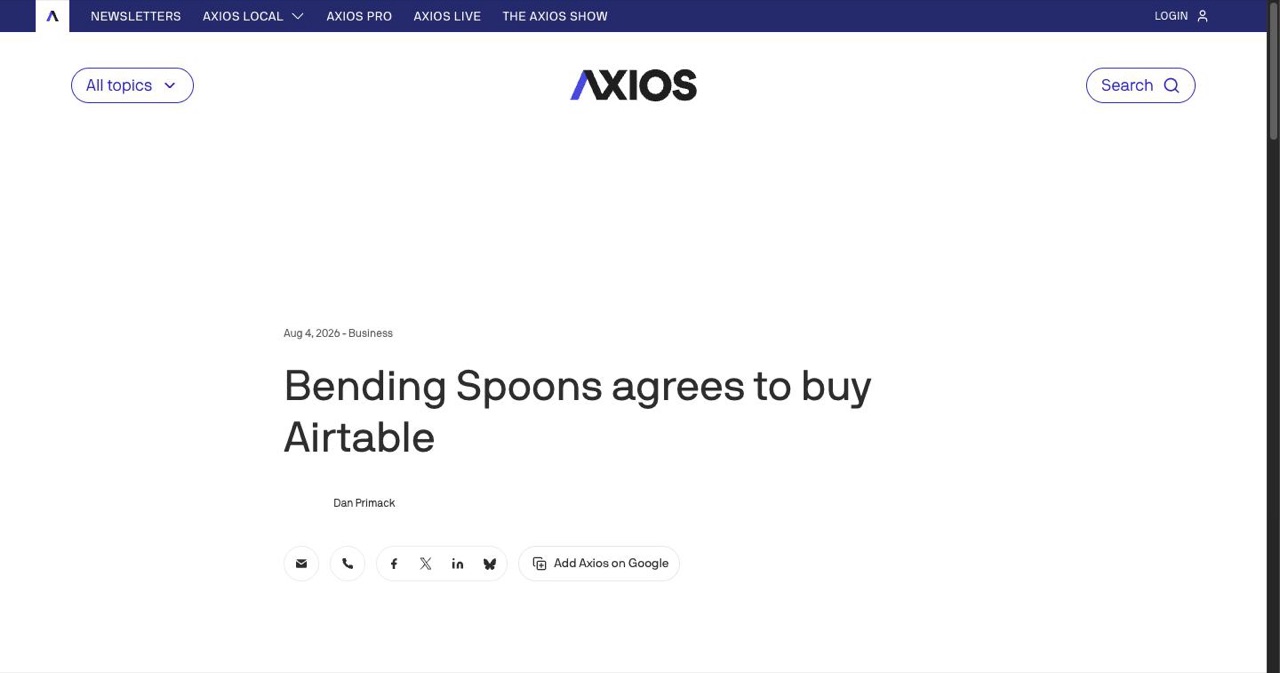
The Airtable deal, announced August 4, 2026, was the template: an all-cash, $1.285 billion enterprise-value acquisition of a company that peaked over $11 billion in 2021 and had already been trading on secondaries near $4 billion earlier in 2026, with ARR around $480 million growing more than 20% year over year. Miro is the same shape of deal, bigger, five weeks later.
Funding it isn't cheap. Weeks before the Miro announcement, Bending Spoons closed a €500 million loan backed by an 80% guarantee from Italy's export credit agency SACE, on top of roughly €985 million in other new and expanded credit lines lined up since its IPO, close to €1.49 billion in fresh capacity built specifically for this kind of shopping spree.
What Bending Spoons is buying isn't hope. It's cash flow at a discount, from founders and investors who need liquidity after four years of a paper valuation that was never going to convert to cash any other way. That's a rational, repeatable trade for the buyer, and a hard one to argue with for a board sitting on a decade-old cap table.
Worth naming plainly, because it's the one thing nobody should assume: nothing has been announced about layoffs at Miro. Bending Spoons has a track record elsewhere, cutting most of Evernote's US team after that 2023 deal and roughly three-quarters of WeTransfer's staff within months of the 2024 close, per Reworked's reporting on the pattern. Miro had already cut about 119 roles (7%) in February 2023 and roughly 275 more (18%) in October 2024, weeks after launching what it called its biggest product release in over a decade. What happens to Miro's 1,600 people and 14 offices after this deal closes is genuinely unknown right now, and anyone telling you otherwise is guessing.
What this actually means if you're building toward an exit
Two things are true at once, and founders need to hold both.
First: the buyer pool for mature SaaS has consolidated into fewer, better-capitalized players willing to pay real cash at real multiples, not fictional multiples pegged to a 2021 mood. If you're building toward an acquisition, your realistic buyer list increasingly includes companies like Bending Spoons, public-market-funded roll-ups that pay 2-3x ARR for profitable, enterprise-weighted businesses. That's not a tragedy. It's a clearer, more honest market than the one that produced Miro's original $17.5 billion mark, and it's a number you can actually plan around instead of hoping to beat.
Second: "we're profitable and don't need to raise again" is not, by itself, a valuation defense. Miro is proof. It's been cash-flow positive since 2022, hasn't touched outside capital since, kept growing ARR, kept adding Fortune 100 logos, and still sold for a tenth of its old paper number. Profitability protects your optionality. It does not protect your multiple, because your multiple is set by what a buyer will actually pay for your category and growth rate in the year you sell, not by how healthy your bank balance is. Cognition's climb to a $48 billion Series E valuation this same year is the mirror image of this story: proof that the money hasn't disappeared, it's just gotten far more selective about which category and which growth curve earns a premium multiple versus a discount one.
If there's a single actionable takeaway, it's this: figure out today, honestly, what a real acquirer would pay for your business in cash, at the multiple your category and margin profile actually commands in 2026, not the multiple your seed round implied. Our piece on what actually makes software saleable goes deeper on the mechanics of building toward a number a buyer will actually sign, rather than a number your cap table wishes were true.
The distribution asset you control when the multiple doesn't
Here's the honest tie-in, and it's the reason this piece lives on a directory's blog instead of a pure news site. When growth multiples compress the way they have since 2022, the things that keep a company defensible and saleable stop being "how big is the round we raised" and start being "how much of our distribution do we actually own." A backlink profile, a set of directory citations, a presence in the sources AI answer engines cite when someone asks "what's a good alternative to X," none of that depends on a funding market's mood. It compounds quietly whether the exit environment is generous or brutal.
We wrote the fuller framework on this in our DR-based guide to choosing SaaS launch directories, and the short version applies directly here: distribution assets you own outright are cheap relative to what they protect. SaaSCity is built around that idea. A free listing gets you a permanent, indexed page, and adding the SaaSCity badge to your own site earns you a dofollow backlink plus a slot in the next Monday launch. If you want it live faster, Quick Pass is $19.99 and goes live within 24 hours with a building on a live city map; Premium at $39.99 adds a launch post the team writes, with three sponsored links. The domain sits at DR 66 at the last Ahrefs check (October 2026), every listing gets human editorial review before it goes public, and none of it depends on what a Series C values you at.
Miro didn't lack customers, revenue, or a real product. What it couldn't do was make a 2021 valuation mean anything in 2026 cash. That's not a Miro problem. It's the problem every founder building toward an exit right now should be pricing in before someone else prices it for them.
Go pull up your own last valuation and ask honestly: is that a number a buyer would sign a check for today, or a number one investor agreed to in a different market? If you're not sure, that's the audit worth running this week, and building the distribution you actually own is the cheapest place to start closing the gap.
Get your SaaS in front of founders
List your product on the SaaSCity live city map - a permanent listing, real discovery, and a backlink from a high-DR directory. Free to start; upgrade for a dofollow link and a building on the map.