News
Cognition Just Raised $2B at a $48B Valuation — AI Coding Isn't Winner-Take-All (2026)
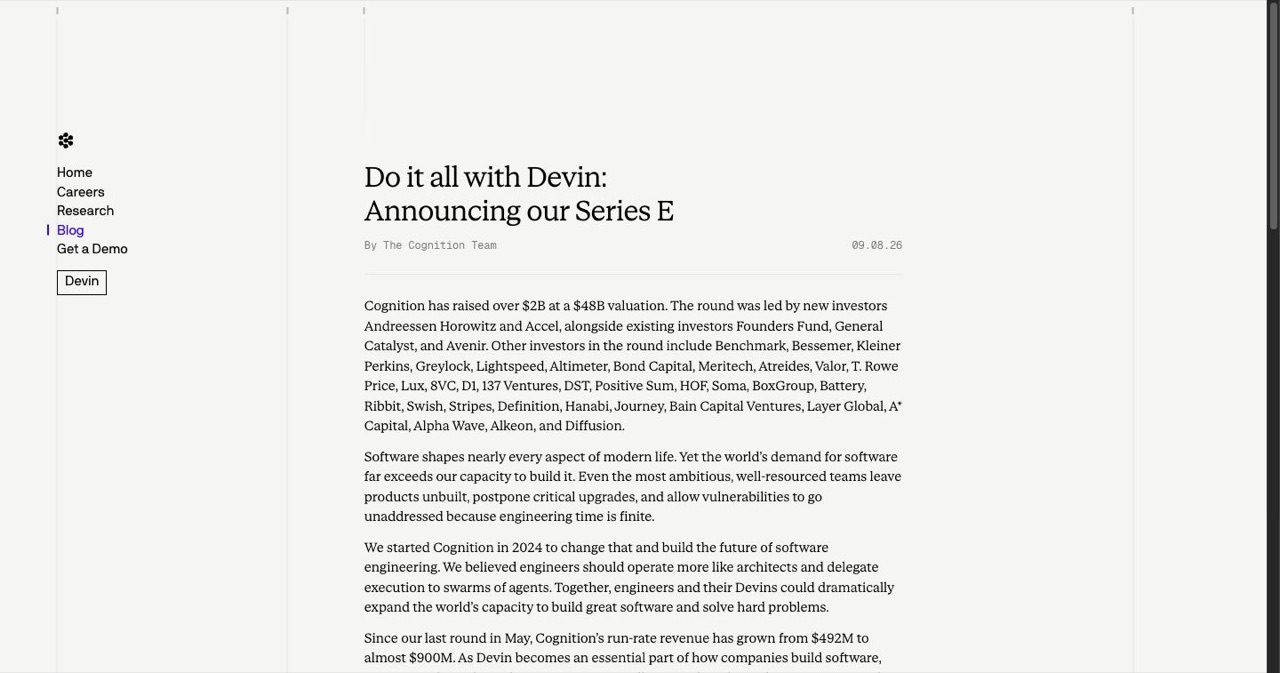
Cognition, the company behind Devin, closed a $2B+ Series E at a $48 billion valuation on September 8, 2026, less than four months after its last round. Revenue nearly doubled, burn is enormous, and Cursor just sold to SpaceX for $60B anyway. You're reading this on a directory's blog, so here's the honest read on what a $48B coding agent means for everyone building smaller tools in the same lane.

Contents (8)
- Key Takeaways
- The round, and how fast it happened
- The revenue number, and the asterisk on it
- What Devin actually does now, beyond "AI writes code"
- The part investors are actually pricing: burn and the model question
- Cursor, SpaceX, and the tell that this isn't winner-take-all
- What this means if you're not raising a Series E
- The honest bottom line
Quick answer: On September 8, 2026, Cognition, the company behind the Devin coding agent, closed a Series E of more than $2 billion at a $48 billion post-money valuation, led by Andreessen Horowitz and Accel. Run-rate revenue went from $492 million in May 2026 to nearly $900 million by September, while The Information estimates 2026 cash burn could reach $800 million. The round landed four months after a $25-26 billion round, and weeks after SpaceX closed its $60 billion all-stock acquisition of rival Cursor.
Cognition just told the market that a $48,000,000,000 price tag for an AI coding agent is a reasonable number to write down on a term sheet. Then, in the same week, a company that could have raised at $50 billion instead sold itself outright for $60 billion because it couldn't afford its own GPU bill. If you build software for a living, both of those sentences are about you.
On September 8, 2026, Cognition announced it had closed a Series E of more than $2 billion at a $48 billion post-money valuation. TechCrunch's Marina Temkin broke the number the same day, and the headline she landed on is the one worth sitting with: investors don't think AI coding is winner-take-all. If they did, nobody would be writing a $2 billion check into the third company in this category to clear a $48 billion valuation in the space of a year.
Quick disclosure since we're going to talk about distribution and market structure for a while: you're reading this on SaaSCity's blog, a directory where SaaS founders list their products, and we'll get to where that fits later. First, the numbers, because they're wilder than the headline suggests.
Key Takeaways
- $2B+ at $48B post-money: Announced September 8, 2026, led by Andreessen Horowitz and Accel, with Founders Fund, General Catalyst, Avenir and NVIDIA in the syndicate.
- Four months between rounds: Cognition went from $10.2B in September 2025 to $25-26B in May 2026 to $48B in September 2026.
- Run-rate, not audited ARR: Revenue grew from $492 million in May to nearly $900 million in September, a figure TechCrunch notes is likely one month multiplied by twelve.
- Burn nearly matches revenue: The Information estimates up to $800 million of 2026 cash burn, driven partly by a leased Nvidia cluster costing hundreds of millions a year.
- Training its own model: Cognition is building a model on open-source foundations to cut its dependence on renting OpenAI and Anthropic frontier inference.
- Devin moved past code generation: Auto-Triage for incidents, Security Swarm for vulnerability triage, and Automations triggered from Slack, GitHub and Linear.
- The winner-take-all tell: a16z profited from the $60 billion SpaceX acquisition of Cursor, then weeks later led a $2 billion round into a direct Cursor competitor.
The round, and how fast it happened
Cognition builds Devin, an AI agent marketed as something closer to a software engineer than a code completion tool — it takes a ticket, writes the code, opens the pull request, and increasingly handles the work around the code too. The company was founded in 2024 by Scott Wu.
Here's the pace of the last twelve months, pulled from Cognition's own post and TechCrunch's reporting:
| Round | Date | Raise | Valuation |
|---|---|---|---|
| Series C-ish (with Windsurf) | September 8, 2025 | $400M | $10.2B |
| Series D | May 2026 | $1B | $25–26B |
| Series E | September 8, 2026 | $2B+ | $48B |
That September 2025 round is worth a second look because it's the same week, a year apart. TechCrunch's Rebecca Bellan reported at the time that Devin's ARR had gone from $1 million in September 2024 to $73 million by June 2025, and that the round came weeks after Cognition acquired Windsurf, the IDE startup Google had just poached the CEO from. Founders Fund led that one. A year later, the valuation is more than 4.5x higher, and the lead investors have flipped to Andreessen Horowitz and Accel, both new to the cap table, joined by existing backers Founders Fund, General Catalyst and Avenir. The rest of the syndicate reads like a roll call of the entire venture industry: Benchmark, Bessemer, Kleiner Perkins, Greylock, Lightspeed, Altimeter, Bond Capital, Meritech, T. Rowe Price, DST, Bain Capital Ventures, and, notably, NVIDIA itself, which is also one of Cognition's named enterprise customers.
Four months between a $26 billion round and a $48 billion round is not a normal financing cadence for any industry outside AI right now. It's worth naming that plainly rather than treating it as background noise.
The revenue number, and the asterisk on it
Cognition says its run-rate revenue grew from $492 million in May 2026 to nearly $900 million by September, roughly an 80 percent jump in four months. TechCrunch's reporting notes the obvious caveat: this is almost certainly a month's revenue multiplied by twelve, and Cognition hasn't published the underlying calculation. That method flatters any company riding a growth curve, because it assumes your best month repeats twelve times, not that growth continues, plateaus, or wobbles.
The Information reportedly expects Cognition to reach $4–5 billion in annualized revenue by the end of 2026. If that holds, the current $48 billion valuation is roughly 10x forward revenue rather than roughly 50x trailing run-rate, which is a much more digestible multiple by software standards. The entire valuation, in other words, is a bet on the projection, not a reflection of where the business is today. That's a completely normal thing for a hot AI company in 2026. It's also exactly the kind of number that looks very different in either direction a year from now.
Cognition names NVIDIA (chip design work), GE Aerospace, Citi, Mercedes-Benz and Modal as customers. TechCrunch adds NASA and Goldman Sachs to that list from its own reporting. That's a genuinely enterprise-heavy customer base for a two-year-old company, which is part of why investors are comfortable extrapolating the revenue curve rather than treating it as a fad.
What Devin actually does now, beyond "AI writes code"
The product has moved past "give it a ticket, get a PR" pretty deliberately in the last few months. Cognition's announcement highlights three newer capabilities:
- Devin Auto-Triage — a first pass at incident investigation, meant to cut down the time an on-call engineer spends figuring out what broke before they start fixing it.
- Devin Security Swarm — automated discovery and triage of vulnerabilities across a codebase.
- Devin Automations — work triggered directly from events in Slack, GitHub and Linear, rather than a human opening a session and typing a prompt.
That's a pattern worth noticing on its own: the growth isn't coming from writing marginally better code, it's coming from Devin doing more of the surrounding operational work that used to require a human to notice something was wrong in the first place. If you're evaluating where coding agents are headed next, that's the direction — from code generation toward operational agency across the whole engineering workflow, not just the editor. We've covered the harness side of that shift, where agents get wired into real engineering pipelines rather than toy demos, in our piece on agent-first engineering at enterprise scale.
The part investors are actually pricing: burn and the model question
Here's where the round gets less triumphant and more interesting as a business case study.
Cognition leases an Nvidia server cluster that reportedly costs hundreds of millions of dollars a year, and The Information estimates the company's total cash burn could reach $800 million in 2026. Against $900 million in run-rate revenue, that's not a company anywhere near breakeven — it's a company spending close to a dollar for every dollar it's currently bringing in, with the bet that the revenue curve outruns the burn curve before the money runs out.
A meaningful chunk of that burn is presumably going toward frontier model API calls, since Devin's agent loop runs on large language model inference at massive scale, multiplied across every customer running autonomous coding sessions all day. That's the same tax every AI-native SaaS company pays, just at a size most of us will never touch. Cognition's response is to train its own model based on open-source foundations, explicitly to cut reliance on renting OpenAI or Anthropic's frontier models and move closer to breakeven.
That's the exact decision every founder building on top of agent APIs eventually has to make, just with more zeros. Keep renting the best frontier model and let your margins float with someone else's pricing changes, or invest in something you control that's "good enough" and fixed-cost. We've written about the token-cost side of that trade-off for teams much smaller than Cognition in our guide to choosing AI models without getting whiplash from weekly releases and in our breakdown of what coding agents actually cost to run. One team we covered cut their agent token spend by 90 percent just by re-architecting how they called the model — proof that the "rent vs. own" decision isn't binary, there's a lot of room in between if you're paying attention to usage patterns before you reach for a training run.
Cognition's version of that decision just happens to involve leasing an entire GPU cluster instead of trimming a prompt.
Cursor, SpaceX, and the tell that this isn't winner-take-all
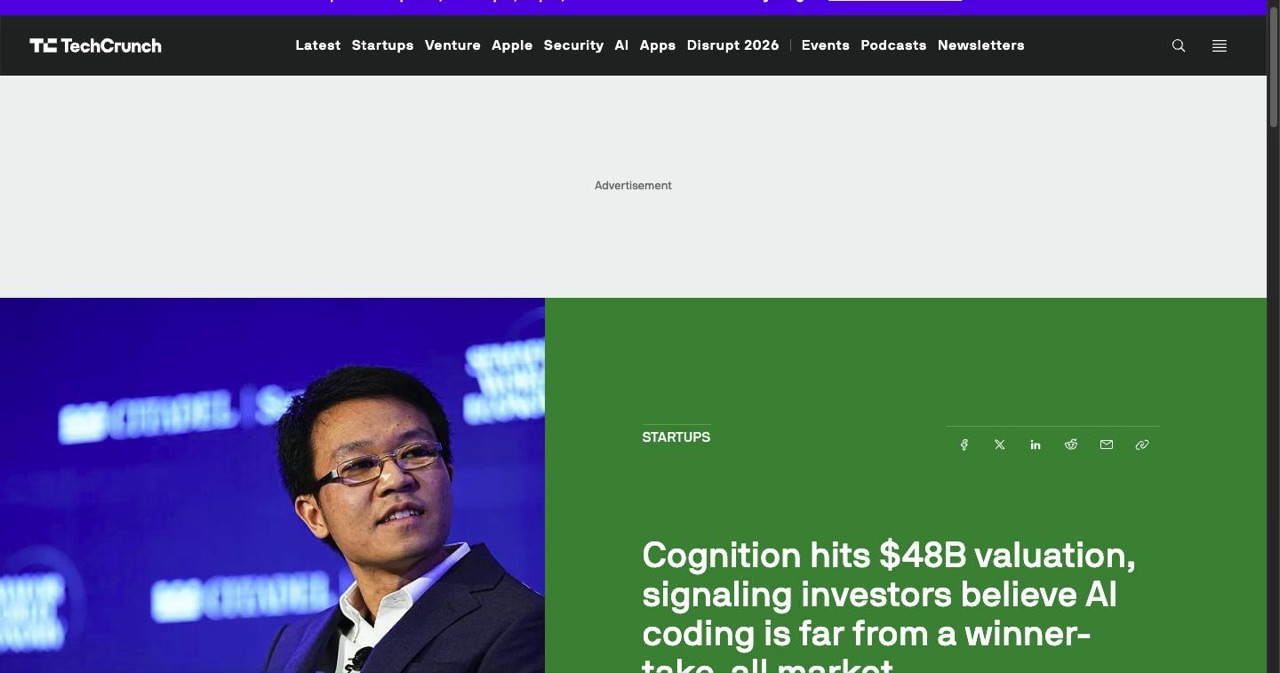
The comparison everyone in this space is making, and the one TechCrunch leads its headline with, is Cursor.
Cursor was in talks in April 2026 to raise a new round that would have valued it around $50 billion, on the back of annualized revenue that had crossed $2 billion. Instead, SpaceX agreed to acquire Cursor for $60 billion in stock, a deal announced June 16, 2026 and closed in August. By most accounts, Cursor didn't sell because it ran out of ideas or customers — it sold because it was compute-constrained, and the money it could raise as an independent startup wasn't going to be enough to fund the GPU capacity its growth demanded. SpaceX, flush with cash after its own IPO, could solve that problem in a way no Series E could.
| Company | Valuation moment | Revenue signal |
|---|---|---|
| Cognition | $10.2B (Sep 2025) → $26B (May 2026) → $48B (Sep 2026) | $492M → ~$900M run-rate |
| Cursor | ~$50B in talks (Apr 2026) → acquired by SpaceX for $60B (Jun 2026, closed Aug 2026) | $2B+ ARR at time of deal |
Now here's the detail that actually answers the winner-take-all question: a16z was a major Cursor backer and profited handsomely from the SpaceX sale. Weeks later, that same firm turned around and led a $2 billion round into Cognition — a direct Cursor competitor. If AI coding agents were a market where one company eventually eats everyone else's lunch, the smart money wouldn't be funding the runner-up right after cashing out of the leader. It would be doubling down on whoever just won. Instead, the same investors are placing bets across multiple horses in the same race, which is exactly what you'd expect them to do in a market they believe has room for several large, differentiated winners rather than one.
That's consistent with what's actually happening on the ground, too. Companies aren't picking a single coding agent and canceling every other subscription. Teams are running Devin for autonomous ticket work, Cursor or its successors for in-editor pairing, and Claude Code or Codex-style CLI agents for terminal-driven workflows, often all inside the same engineering org. Nobody has consolidated the market because nobody has actually needed to yet — the workflows are different enough that overlap doesn't mean redundancy.
What this means if you're not raising a Series E
Most of the people reading this aren't sitting on a $48 billion valuation, and that's the more useful lens on this news anyway.
The category isn't closed. A market that just minted its third multi-billion-dollar coding agent company in a year, with investors explicitly betting against consolidation, is not a market where a scrappy, narrower tool is automatically dead on arrival. If you're building something agent-adjacent — a code review layer, a niche vertical agent, a workflow tool that plugs into Devin or Cursor rather than competing with them head-on — the incumbents getting bigger doesn't shrink your lane. It validates that the lane exists.
The rent-vs-own model decision scales down, not just up. Cognition training its own model to escape API dependence is the same instinct behind every founder who's ever tried to fix a runaway OpenAI or Anthropic bill by switching models, caching aggressively, or picking a cheaper provider for lower-stakes calls. You don't need a GPU cluster to apply the lesson. Our piece on agent token economics covers the smaller-scale version of exactly this trade-off.
Distribution is the actual bottleneck once funding stops being the constraint. When three companies can each raise tens of billions of dollars to build roughly the same category of product, the differentiator stops being "can you build it" and starts being "can you get found." That's true at Cognition's scale and it's just as true for a two-person team shipping a niche AI tool. Getting listed somewhere buyers and other builders actually browse, rather than betting everything on a single acquisition channel, is the unglamorous other half of competing in a crowded market. It's also, not coincidentally, the entire reason SaaSCity exists: a free, human-reviewed startup directory with a live city map where your listing is a permanent page other founders actually see, not a form that vanishes into a database. Add the SaaSCity badge to your site and the backlink goes dofollow, plus it books you into the next Monday launch slot. Want it live faster? Quick Pass is $19.99 and goes live within 24 hours with a building on the map; Premium at $39.99 adds a launch post the team writes for you. Submitting takes about ten minutes, which is a very different fundraising ask than the one Cognition just closed.
The honest bottom line
A $48 billion valuation for a two-year-old company burning close to $800 million a year sounds unhinged in isolation. Set next to a $60 billion all-stock acquisition of its closest rival, funded by a company that just IPO'd, it starts to look less like irrational exuberance and more like a coherent bet: AI coding agents are becoming genuinely large businesses, several of them, at the same time, and the money backing them believes there's enough enterprise demand and enough distinct workflows to support more than one winner.
Whether that bet pays off depends on whether run-rate math built on a single strong month holds up over the next four rounds' worth of scrutiny. Whether it matters to you depends less on Cognition's cap table and more on whether you're treating your own model bill, and your own visibility, with the same seriousness a $48 billion company is now forced to.
If you're building in or around this space, the market just told you it's not closed. What are you doing to make sure someone can actually find what you built?
Get your SaaS in front of founders
List your product on the SaaSCity live city map - a permanent listing, real discovery, and a backlink from a high-DR directory. Free to start; upgrade for a dofollow link and a building on the map.