News
Shopify Acquires Tailwind CSS: The Framework That Won the AI Era and Lost the Business (2026)
Tailwind Labs just sold to Shopify, nine months after laying off three of its four engineers because AI answers had quietly wiped out 80% of its revenue. The framework stays MIT-licensed and free; the funnel that used to fund it is gone. Here's what the deal means if you ship on Tailwind, and why the fix looks a lot like what we push on this blog: stop renting your visibility to search and AI, and own a page somewhere AI actually cites, which is the exact trade a listing on SaaSCity is built around.

Contents (11)
- Key Takeaways
- What Shopify actually bought
- The eight months nobody covered until now
- The numbers, side by side
- Why Shopify, specifically
- The irony worth sitting with
- What this means if you ship on Tailwind
- The business model this exposes, beyond one framework
- The counter-move: own citations AI can't route around
- What developers are actually saying
- Bottom line
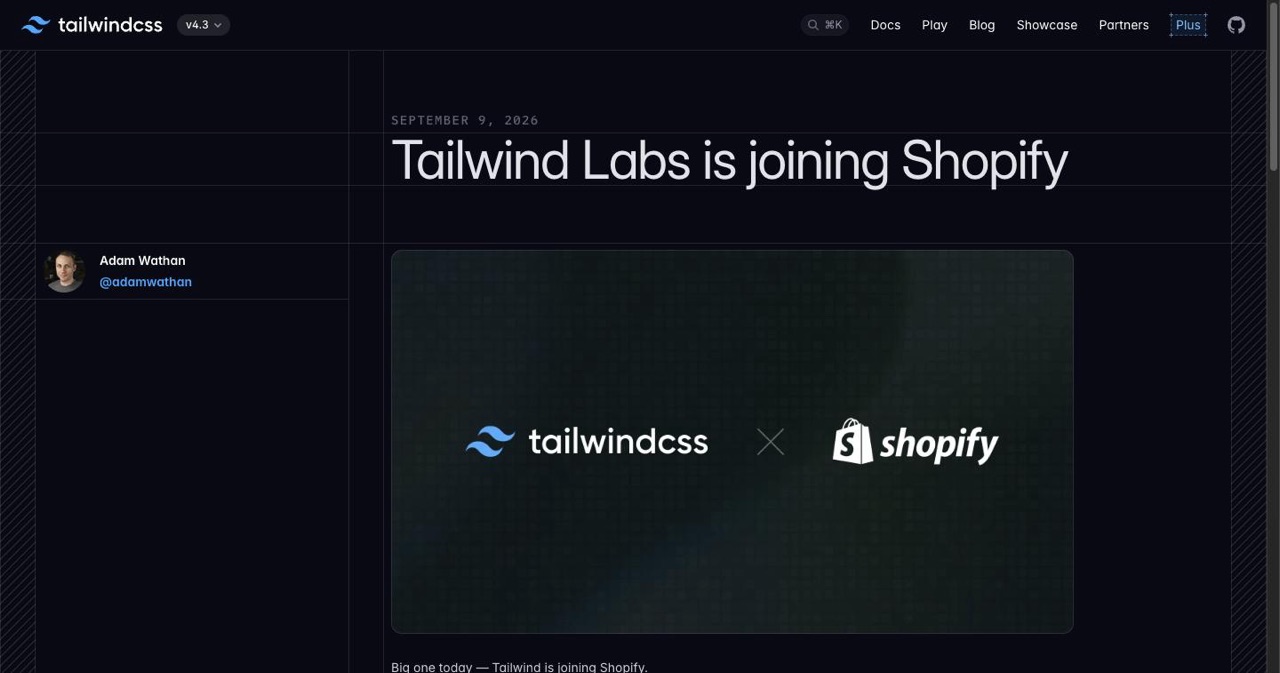
Quick answer: On September 9, 2026, Adam Wathan announced that Tailwind Labs was joining Shopify, with Tobias Lütke confirming the same day and no price disclosed. Tailwind CSS and the other open-source projects stay MIT-licensed and keep being maintained by the same team. Tailwind Plus and ui.sh are closed to new sign-ups, though existing buyers keep what they paid for. Eight months earlier, Wathan laid off 3 of 4 engineers after revenue fell about 80% while docs traffic dropped roughly 40% since early 2023.
Tailwind CSS runs on more than 110 million installs a week. It styles ChatGPT, X, Cloudflare, Reddit, and Shopify's own storefronts. And eight months before Shopify bought the company behind it, that company laid off three of its four engineers because it was going broke.
Same framework. Same install numbers, still climbing. Business quietly cratering underneath it. That gap is the whole story, and it's worth sitting with before you read another AI acquisition headline this year.
I'm reading this news the way you probably are, from inside a startup directory, so the disclosure up front: SaaSCity is a listing site, and this post ends with a pitch for it. But the pitch only makes sense once you understand what actually happened to Tailwind Labs, because it's the exact failure mode a directory listing is a partial fix for. Stick with the facts first.
Key Takeaways
- The license is unchanged: Tailwind CSS and Tailwind Labs' other open-source projects stay MIT-licensed, maintained by the same team with Shopify behind them.
- Paid products closed: Tailwind Plus and ui.sh stopped taking new sign-ups on September 9, 2026; existing customers keep access to what they bought.
- Usage never dipped: More than 110 million weekly installs, and 51% of 2025 State of CSS respondents reported using it.
- The funnel was the failure: Docs traffic fell roughly 40% since early 2023 as AI assistants answered the questions that used to send developers to the page selling Tailwind Plus.
- January was the warning: Wathan cut 3 of 4 engineers on January 6, 2026, leaving 5 people total, with revenue down close to 80%.
- Shopify's motive is dependency plus agents: Tailwind already styles Shopify admin and storefront surfaces, and utility classes suit the agentic commerce push.
- Price undisclosed: No figure appeared in the announcement or in BetaKit, Dealroom, or PYMNTS coverage.
What Shopify actually bought
On September 9, 2026, Adam Wathan announced that Tailwind Labs was joining Shopify, with Shopify CEO Tobias Lütke confirming it the same day. Neither side disclosed a price, and nothing in the BetaKit, Dealroom, or PYMNTS coverage that followed filled in a number.
Here's what did get spelled out, precisely, because the framing matters more than usual: Tailwind CSS and Tailwind Labs' other open-source projects stay MIT-licensed, full stop, and the existing team keeps maintaining them with Shopify's backing. Nothing changes there. What does change sits on the commercial side. Tailwind Plus and ui.sh, the paid component and template libraries that funded Tailwind Labs for years, are closed to new sign-ups. If you already own either, you keep everything you paid for. If you didn't buy in before September 9, you can't now. Commenters on Hacker News noticed the Plus product had already been pulled from the site's navigation entirely, a quiet tell that the commercial chapter was closing before the announcement even went up.
So: free framework survives, gets a bigger backer. Paid products stop taking new customers. That's the deal in one sentence, and if you stopped reading here you'd think this was a clean, boring outcome. It isn't, because of what happened in January.
The eight months nobody covered until now
On January 6, 2026, Wathan laid off three of Tailwind Labs' four engineers, 75% of the engineering team, in a company that was, by his own account, growing faster than it ever had. Usage up. Revenue down close to 80%. That's not a typo, and it's not a company that ran out of ideas. It's a company where the thing that used to bring in customers stopped working while the product kept getting more popular.
The mechanism is specific enough to be useful. Tailwind's documentation site was its acquisition funnel: developers landed there to learn the framework, and the same pages sold them on Tailwind Plus and ui.sh. Traffic to those docs is down roughly 40% from early 2023, not because fewer people use Tailwind, but because AI coding assistants now answer "how do I center a div with Tailwind" directly, without sending anyone to the source. Wathan said it plainly in a GitHub thread that started, of all things, as a pull request to add an llms.txt file: shipping something that makes it even easier for AI to answer questions instead of linking back to the docs would only speed up the thing killing his revenue.
That thread is worth reading in full if you build developer tools, because it shows a founder watching two good instincts collide in real time. Open source says: make your docs as machine-readable as possible. Revenue says: every machine-readable answer is a visit you don't get. Wathan closed the PR, then opened up about why, and the ensuing discussion turned into one of the more candid public post-mortems of the AI-traffic problem this year.
By ByteIota's count, the layoffs left Tailwind Labs at three co-founders, one engineer, and one part-time hire. Five people, maintaining infrastructure underneath a meaningful share of the production web. BetaKit reports that once the layoffs went public, several AI companies stepped up as sponsors, which bought time but didn't fix the underlying funnel problem. The Shopify deal is what actually fixed it.
The numbers, side by side
| Metric | Figure | Source |
|---|---|---|
| Weekly Tailwind CSS installs | 110M+ | Tailwind Labs, Sept 9, 2026 |
| Share of 2025 State of CSS respondents using it | 51% | Dealroom, citing the 2025 survey |
| Engineering team laid off | 75% (3 of 4 engineers) | devclass, Jan 8, 2026 |
| Revenue decline at time of layoffs | ~80% | Wathan, Jan 8, 2026 |
| Docs traffic decline since early 2023 | ~40% | Wathan / SEroundtable |
| Team size after layoffs | 5 (3 co-founders, 1 engineer, 1 part-time) | ByteIota |
| Deal price | Undisclosed | Shopify / Tailwind Labs |
Read that table across, not down. Every column on the left keeps going up except the one that pays the bills. That's not a Tailwind problem. It's the shape of what happens when your product's marketing and your product's documentation are the same page, and AI starts answering on that page's behalf without sending the click.
Why Shopify, specifically
Shopify didn't buy a struggling company out of charity. Tailwind is already inside Shopify's own stack, styling admin surfaces and storefront tooling, so owning it removes a dependency risk Shopify was carrying anyway. Finkelstein, Shopify's president, cited the 110-million-a-week install figure directly when explaining the scale that made the deal worth doing, according to PYMNTS.
The more interesting reason is where Shopify is headed. The company is building toward agentic commerce, storefronts and checkout flows that need to work for AI shopping agents as well as humans clicking around on a phone. Wathan framed the move as giving Tailwind CSS "a stable, long-term home," and said on the record that he'd always wanted the framework built in service of a real product rather than existing to sell itself. Shopify's storefronts are that product now, at a scale no five-person team could have chased alone.
The irony worth sitting with
Here's the part that should sting a little if you build developer tools: AI models reach for Tailwind by default. Ask any current coding assistant to style a component and it'll almost always reach for Tailwind's utility classes over hand-written CSS or a heavier component library, because utility classes are predictable, composable, and easy for a model to pattern-match against training data. Tailwind didn't just survive the AI shift. It became the framework AI prefers.
That's what makes the funnel collapse so pointed. The same shift that made Tailwind the default choice for AI-generated interfaces is the shift that gutted the business selling premium components on top of it. The framework won the AI era. The company almost didn't make it to see the win pay off.
What this means if you ship on Tailwind
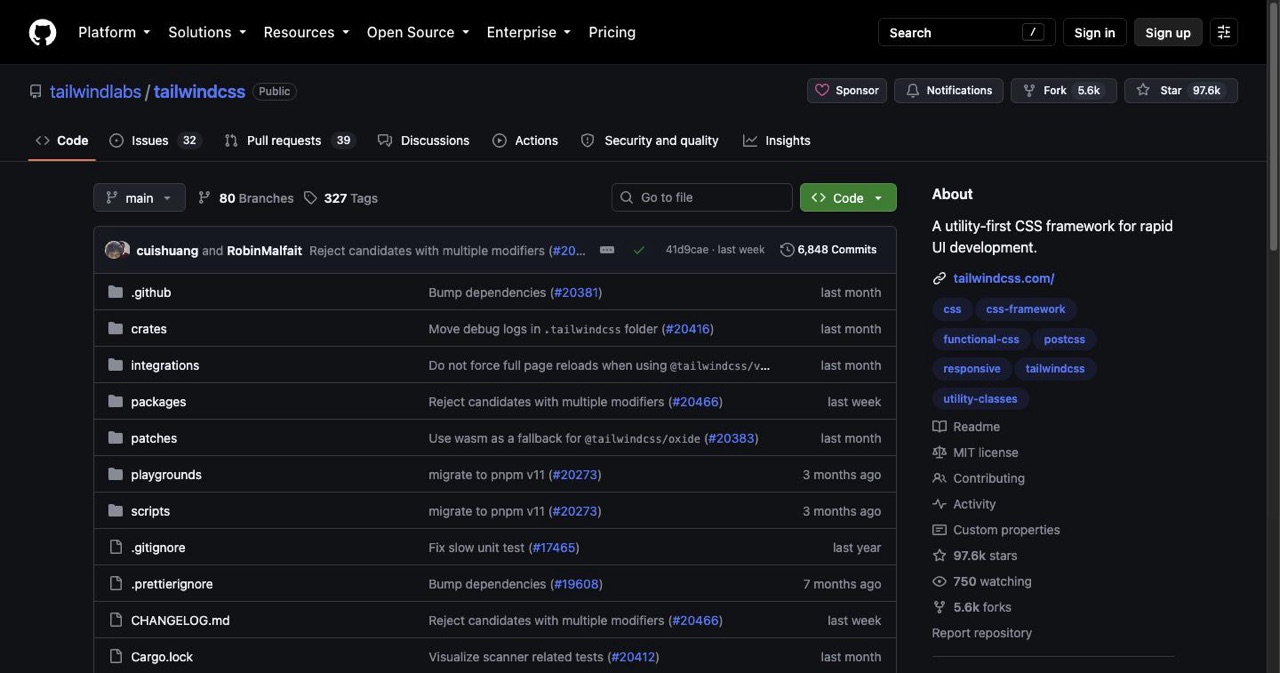
Nothing breaks tomorrow. The license didn't change, the framework didn't change, and Shopify has every incentive to keep Tailwind CSS healthy since its own storefronts depend on it. But a variable that didn't exist two weeks ago exists now: Tailwind's roadmap sits inside a commerce company built for merchants, checkout, and storefronts, not a company whose only job is CSS.
Three things worth doing, none of them dramatic:
- Pin your Tailwind version in production. You'd do this anyway for any dependency; do it deliberately here rather than riding
latest. - Keep design tokens in a thin layer you control, rather than hard-coding utility classes everywhere. If Tailwind's defaults or config format ever shift to serve Shopify's storefront needs first, a token layer is what lets you absorb that without a rewrite.
- Watch the GitHub repo, not the roadmap blog. Commit activity and issue triage tell you what's actually being maintained. Announcement posts tell you what's being sold. If you've read this far, our piece on what 40,000 indie launches actually ship with has the current numbers on how dominant Tailwind already is in the indie-hacker stack, which is exactly why this dependency is worth two minutes of attention instead of zero.
None of this is panic. It's the same low-effort hygiene you'd apply to any framework a company just acquired, and Tailwind earns it more than most because so much of the web now runs on it.
The business model this exposes, beyond one framework
Tailwind isn't the only company running "free core, paid layer on top" through a documentation funnel. It's just the highest-profile one to get caught by the AI-traffic shift so far. Any developer tool that gives away the product and monetizes through docs-driven discovery, paid templates, premium plugins, hosted add-ons, is exposed to the same math: usage climbs, AI answers the questions that used to require a docs visit, and the page that was supposed to convert readers into customers quietly stops doing its job.
If that sounds like your own funnel, the fix isn't to make your docs worse on purpose, Wathan explicitly didn't want to go that route either. It's to stop depending on one channel for discovery in the first place.
The counter-move: own citations AI can't route around
This is the actual lesson for SaaS founders and indie hackers reading this, not "watch out for CSS drama." Tailwind's mistake, if you can call it that, was having exactly one place where discovery turned into revenue. When AI intercepted traffic to that one place, the business had no second channel to fall back on.
The fix is building citations and backlinks that live outside your own docs, on pages AI answer engines already treat as trustworthy third-party sources. That's the whole idea behind GEO and AEO work, and we've written the fuller playbook on how to optimize a site for AI citations if you want the technical detail on schema, llms.txt, and crawler access.
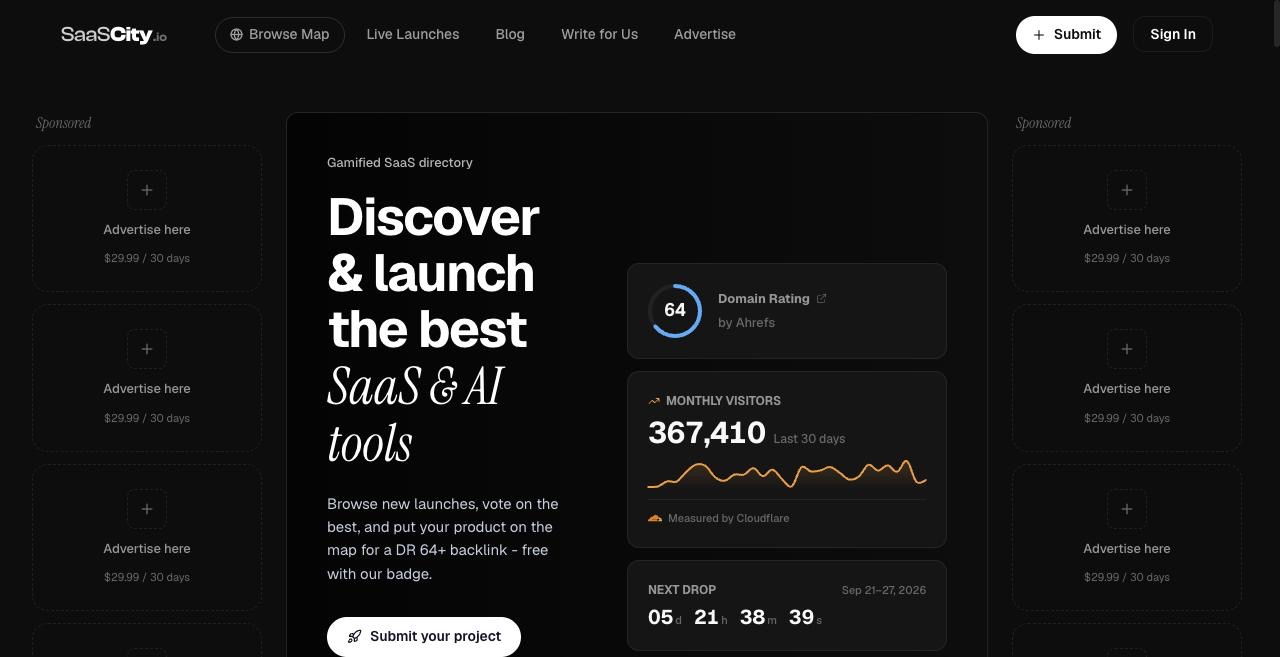
Directory listings are the cheapest version of that same move, and it's the honest reason this post ends here. A listing gives you an indexed page describing your product in plain, factual language, the kind of page a model can confidently repeat when someone asks for "a tool like X." SaaSCity is built around exactly that: a gamified startup directory with a live city map and human editorial review, not an auto-approved form. A free listing gets you a permanent listing page. Add the SaaSCity badge to your own site and you earn a dofollow backlink plus a slot in the next Monday launch. If you want it live faster, Quick Pass is $19.99 and goes live within 24 hours with a building on the map; Premium is $39.99 and adds a written launch post with three sponsored links. The domain sits at DR in the high 40s to mid 50s at the last Ahrefs refresh, which is a real, indexed link, not a bookmark on a page nobody crawls. None of that replaces good docs. It's insurance for the day AI eats a chunk of your docs traffic the way it ate Tailwind's, and you'd rather have a second channel already built than start one from zero while your revenue is already down 80%. For the deeper version of this argument, with the actual distribution numbers behind it, see our piece on the SEO benefits of listing SaaS products in directories.
If you're shipping UI right now and leaning on AI to help you build it, it's also worth a look at how to keep AI-generated frontend from looking like every other AI-generated frontend, since Tailwind being the model's default choice cuts both ways. Our guide on avoiding AI slop in vibe-coded frontend design covers that specifically.
What developers are actually saying
The Hacker News thread on the acquisition had topped 1,000 points and 400 comments within a day, and the mood isn't pure relief. Plenty of commenters are glad the framework has a stable home. Just as many are skeptical that "component library business" was ever a sound model to begin with, and a smaller group is uneasy that a framework used across half the web now answers to one commerce company's roadmap. The January thread about the original layoffs had a similar split: sympathy for Wathan personally, alongside a real argument about whether AI killed the business or just exposed a lifetime-pricing model that was never going to scale past its first wave of buyers.
Both things can be true. AI cut the funnel. The funnel was also fragile before AI touched it. That combination is exactly why one channel, however good, isn't a strategy.
Bottom line
Tailwind CSS isn't going anywhere, and if you're using it today, keep using it today. What should change is how you think about your own product's discovery funnel if it looks anything like Tailwind Labs' did: one docs page, one channel, one point of failure that AI can quietly route around. Tailwind had 110 million weekly installs and still nearly lost the company behind it. Install numbers were never the thing keeping the lights on. Citations were, and they went out first.
Go check where your own product gets cited outside your own site. If the honest answer is "nowhere," that's a smaller, cheaper version of the exact gap that forced Tailwind Labs to sell. Listing your product on SaaSCity is one afternoon toward closing it.
Get your SaaS in front of founders
List your product on the SaaSCity live city map - a permanent listing, real discovery, and a backlink from a high-DR directory. Free to start; upgrade for a dofollow link and a building on the map.