News
Claude Haiku 5.5 Is Cheap Enough to Change Your AI SaaS Margins (2026)
Running every customer query through Claude Sonnet 5.5 is burning cash you will never recover. Claude Haiku 5.5 dropped at $0.10 input and $0.50 output per million tokens, but its 100k pricing cliff and new tokenizer change the math. Here is how founders can route cheap subagents to turn 20% gross margins into 70%.

Contents (15)
- Key Takeaways
- The Full Claude API Lineup and Pricing Structure
- Two Traps That Erode Your Cost Reductions
- The 100,000 Token Tier Cliff
- Tokenizer Inflation and Real Cost per Task
- Benchmark Results: The Gap Between Index Scores and Token Burn
- The Effort Parameter and Output Token Burn
- Customer Production Results
- Production Workloads Suited for Haiku 5.5
- Workloads Where Haiku 5.5 Fails
- Architecture: The Two-Tier Supervisor-Worker Pattern
- Real-World Margin Comparison: An AI Ticket Automation SaaS
- Scenario A: Single-Model Pipeline Using All Sonnet 5.5
- Scenario B: Routed Pipeline with Haiku 5.5 Subagents
- Actionable Steps for Engineering Teams
Quick answer: On October 7, 2026, Anthropic launched Claude Haiku 5.5 (claude-haiku-5-5), cutting sub-100k token prices to $0.10 input and $0.50 output per million tokens. It is roughly 75% cheaper than Haiku 4.5, features a 1M context window, and scores 43 on the Artificial Analysis Intelligence Index. The trap: prompts above 100,000 tokens jump 5x in price, and a new tokenizer adds roughly 30% more tokens per string. Used as a subagent for classification, extraction, and context compaction, Haiku 5.5 moves AI SaaS gross margins from 20% to over 70%.
Running every customer query through Claude Sonnet 5.5 is burning cash you will never recover.
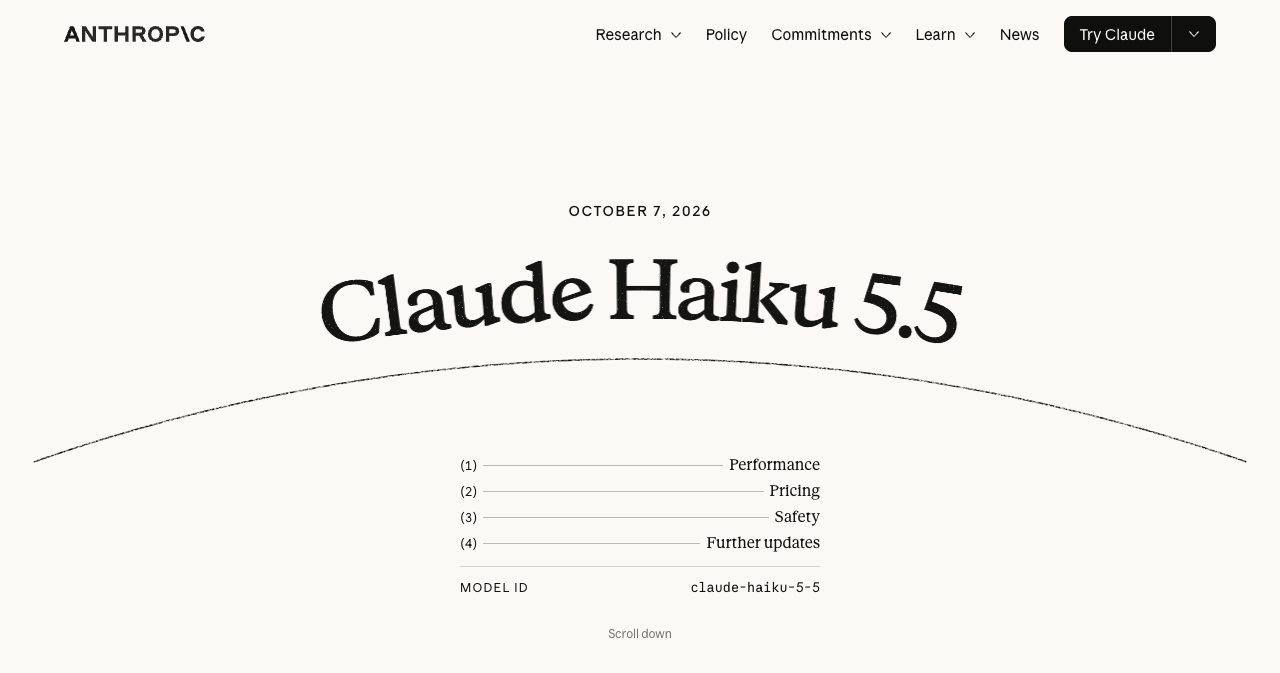
On October 7, 2026, Anthropic released Claude Haiku 5.5, identified under the model string claude-haiku-5-5. Within hours of the announcement, the release claimed the top spot on Hacker News, collecting 938 points and 442 comments from developers dissecting the economics in the Hacker News discussion. Amazon Web Services followed simultaneously with their own deployment overview on the AWS launch blog.
The release marks a quiet shift in software economics. For eighteen months, founders treated small language models as compromise engines. You reached for small models when you could not afford frontier inference, accepted degraded accuracy, and dealt with fragile JSON extraction. Haiku 5.5 changes that baseline. It matches or beats the frontier models from late 2024 while pricing input tokens at ten cents per million.
You are reading this on a directory blog. SaaSCity is a gamified startup directory with a live city map and human editorial review. You can claim a free listing page and a building on the map; adding the SaaSCity badge gives you a dofollow backlink and a Monday launch slot. We also offer Quick Pass ($19.99, live in 24 hours) and Premium ($99.99, a written launch post with three dofollow links; our domain sits at DR ~47-56 at the last Ahrefs refresh). We run our own background workers, scraping pipelines, and triage jobs, which is why inference economics show up directly on our balance sheet.
When small model pricing drops by 75% while reliability crosses the production threshold, unit economics shift. Features that sat at a 20% gross margin can operate above 70%. If you switch blindly without understanding the new tokenizer and prompt length limits, your monthly invoice will surprise you.
Key Takeaways
- Aggressive baseline pricing: Under 100,000 tokens, Haiku 5.5 costs $0.10 input and $0.50 output per million tokens, representing a 90% discount over Haiku 4.5.
- The 100k pricing cliff: Once a prompt crosses 100,000 tokens, prices multiply fivefold to $0.50 input and $2.50 output per million tokens.
- Tokenizer inflation: Haiku 5.5 uses Anthropic's newer tokenizer, which increases token counts by roughly 30% on identical raw text compared to Haiku 4.5.
- Adjustable effort parameter: Haiku 5.5 supports adaptive thinking with a default
mediumeffort, though max effort burns roughly 162,000 output tokens per task. - Subagent specialization: Anthropic explicitly designed Haiku 5.5 to run repetitive tasks like classification, routing, and compaction beneath Sonnet 5.5 or Opus 5.5 supervisors.
- Ecosystem price cuts: Anthropic halved Claude Sonnet 5.5 cache-read rates, reducing general agentic execution bills by roughly 20%.
The Full Claude API Lineup and Pricing Structure
Haiku 5.5 is Anthropic's lowest-cost offering to date. The headline number of $0.10 input and $0.50 output per million tokens puts it at parity with OpenAI's GPT-6 Luna. According to data published by Artificial Analysis on October 7, 2026, this rate sits at roughly 10% of the cost of previous Haiku releases.
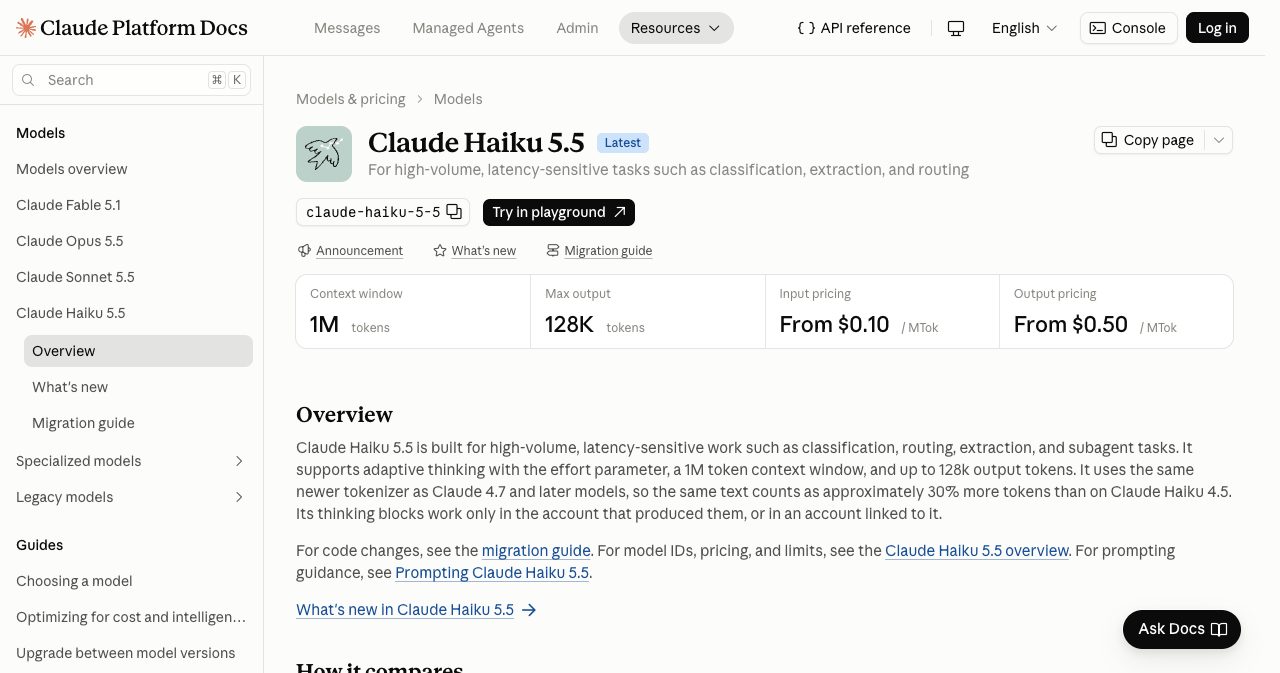
The Claude Platform docs overview outlines the complete rate card. Prompt caching makes high-frequency background jobs remarkably affordable. For prompts under 100,000 tokens, cache reads drop to $0.01 per million tokens, while 5-minute cache writes cost $0.125 per million tokens. Batch API calls receive an automatic 50% discount, pricing input at $0.05 and output at $0.25.
| Model | Input per MTok (<=100k) | Output per MTok (<=100k) | Input per MTok (>100k) | Output per MTok (>100k) | Cache Read per MTok | Cache Write per MTok |
|---|---|---|---|---|---|---|
| Claude Fable 5.1 | $10.00 | $50.00 | $10.00 | $50.00 | $1.00 | $12.50 |
| Claude Opus 5.5 | $4.00 | $20.00 | $4.00 | $20.00 | $0.40 | $5.00 |
| Claude Sonnet 5.5 | $2.00 | $10.00 | $2.00 | $10.00 | $0.10 | $2.50 |
| Claude Haiku 5.5 | $0.10 | $0.50 | $0.50 | $2.50 | $0.01 | $0.125 |
Alongside the Haiku release, Anthropic halved cache-read fees on Claude Sonnet 5.5 from $0.20 to $0.10 per million tokens. In production workflows where multi-turn agents repeatedly query the same system prompt, tool definitions, and repository state, that single change cuts Sonnet 5.5 operational costs by roughly 20%. Anthropic also introduced a monthly API credit for Claude Max and Team plan subscribers, alongside beta support for computer use and browser use inside the official Python and TypeScript SDKs.
Understanding these pricing bands is essential when balancing infrastructure budgets. Teams that run multi-step agent pipelines know that infrastructure expenses multiply quickly. In our analysis of agent harness costs across AWS, Strands, and DigitalOcean, compute overhead often rivals model expenses when systems run unoptimized loops. Selecting the correct model tier is the primary lever for controlling those costs.
Two Traps That Erode Your Cost Reductions
Updating the model identifier in code and expecting an automatic 90% cost cut will lead to an unpleasant billing surprise. Two technical realities alter the financial equation: the tiered context cliff and tokenizer inflation.
The 100,000 Token Tier Cliff
Haiku 5.5 features a context window of 1,000,000 tokens, expanding dramatically from the 200,000 token limit of Haiku 4.5. The maximum generation ceiling is 128,000 output tokens.
The trap lies in Anthropic's tiered pricing model. The moment your prompt reaches 100,001 tokens, input pricing jumps 5x from $0.10 to $0.50 per million tokens. Output pricing steps up from $0.50 to $2.50. Cache writes jump from $0.125 to $0.625, and cache reads rise from $0.01 to $0.05.
Many engineering teams treat large context windows as unbounded scratchpads. They pass complete customer histories, unpruned documentation trees, or large code repositories directly into the prompt. Crossing the 100k mark drops your cost savings against Haiku 4.5 from 90% to 50%.
Keeping prompts strictly below 100,000 tokens requires deliberate pruning. Techniques like the context-slimming methods covered in Spotify Portal's approach to cutting Claude Code token usage by 90% are necessary. By summarizing historical context and stripping boilerplate, your application remains safely in the lowest billing tier.
Tokenizer Inflation and Real Cost per Task
Token prices are quoted per token, but users pay for real text, JSON, and source code.
Haiku 5.5 adopts the newer tokenizer deployed across the Claude 4.7 and Claude 5 families. Because this tokenizer fragments specific words and code patterns differently than older implementations, the identical raw payload results in approximately 30% more tokens on Haiku 5.5 than on Haiku 4.5.
Consider a practical example: an extraction payload that registered as 50,000 tokens on Haiku 4.5 registers at approximately 65,000 tokens on Haiku 5.5.
Haiku 4.5 (Old Tokenizer):
50,000 input tokens @ $1.00 / MTok = $0.0500

Haiku 5.5 (New Tokenizer):
65,000 input tokens @ $0.10 / MTok = $0.0065
The price drop remains substantial: $0.0065 compared to $0.0500 represents an 87% effective reduction rather than the advertised 90% sticker price. If your prompt sat at 80,000 tokens on Haiku 4.5, tokenizer inflation pushes it to 104,000 tokens on Haiku 5.5. That crossing triggers the 5x pricing penalty:
Unpruned Legacy Prompt:
80,000 raw baseline -> 104,000 inflated tokens
104,000 input tokens @ $0.50 / MTok = $0.0520
An unoptimized prompt crossing the cliff ends up costing more than it did on the previous generation. Founders must measure cost per completed task rather than comparing nominal token rates.
Benchmark Results: The Gap Between Index Scores and Token Burn
To understand where Haiku 5.5 fits into production stacks, examine the benchmark figures published by Artificial Analysis on October 7, 2026.
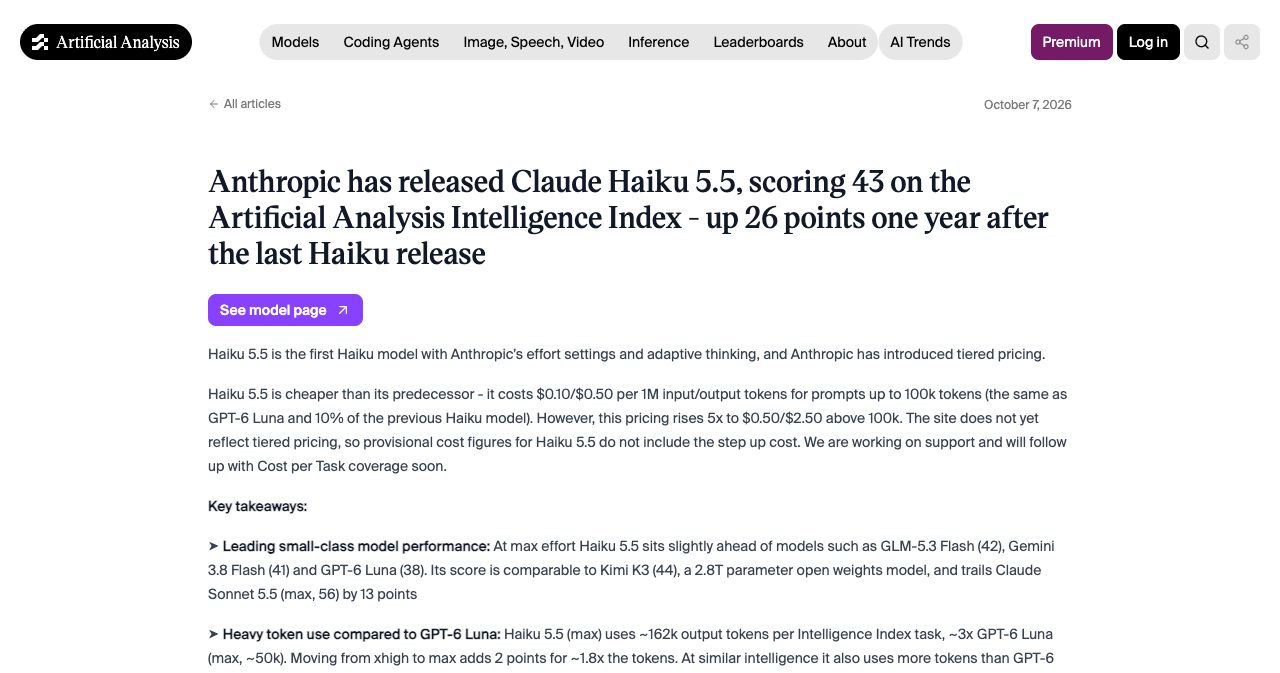
On the Artificial Analysis Intelligence Index, Haiku 5.5 posted a score of 43, an improvement of 26 points year-over-year. It edges out GLM-5.3 Flash (42), Gemini 3.8 Flash (41), and GPT-6 Luna (38). It performs on par with Kimi K3 (44), an open-weights model containing 2.8 trillion parameters. It trails Claude Sonnet 5.5 (56) by 13 points.
| Model | AA Intelligence Index | Terminal-Bench 4.0 | AA-Briefcase (Elo) | Hallucination Rate | Input / Output per MTok |
|---|---|---|---|---|---|
| Claude Sonnet 5.5 | 56 | 48% | 1,510 | 28% | $2.00 / $10.00 |
| Kimi K3 (2.8T) | 44 | 36% | 1,540 | 48% | Self-hosted |
| Claude Haiku 5.5 | 43 | 33% | 1,578 (max) | 40% | $0.10 / $0.50 |
| GLM-5.3 Flash | 42 | 31% | 1,495 | 46% | $0.12 / $0.60 |
| Gemini 3.8 Flash | 41 | 29% | 1,505 | 55% | $0.15 / $0.60 |
| GPT-6 Luna | 38 | 27% | 1,480 | 77% | $0.10 / $0.50 |
Haiku 5.5 achieved a 33% score on Terminal-Bench 4.0, up from 0% on Haiku 4.5. On AA-Briefcase, an evaluation designed to measure multi-step agentic knowledge work, it attained a maximum rating of 1,578 Elo.
Accuracy tests show nuanced tradeoffs. On AA-Omniscience, Haiku 5.5 achieved 36% accuracy, falling short of Gemini 3.8 Flash (55%) and GPT-6 Luna (44%). Its hallucination rate was measured at 40%, notably lower than Gemini 3.8 Flash (55%) and GPT-6 Luna (77%). When Haiku 5.5 lacks necessary information, it tends to decline to answer rather than fabricate claims. Artificial Analysis noted that the model's 35% result on AutomationBench-AA was depressed by a pre-release safety bug that triggered false-positive refusals, an issue Anthropic continues to tune.
The Effort Parameter and Output Token Burn
Haiku 5.5 is the first small Claude model to incorporate an adjustable effort parameter alongside adaptive thinking. The effort parameter accepts values ranging from low to maximum, defaulting to medium.
Adjusting this setting carries direct cost implications. Artificial Analysis observed that when Haiku 5.5 runs at maximum effort, it consumes approximately 162,000 output tokens per Intelligence Index evaluation task. OpenAI's GPT-6 Luna uses roughly 50,000 tokens for equivalent tasks.
At $0.50 per million output tokens, burning 162,000 tokens costs $0.081 per task. Generating 50,000 tokens on a model priced at $0.75 per million costs $0.037 per task. Leaving the effort parameter set to maximum on routine tasks eliminates your cost advantage through excessive reasoning generations. Keep effort set to low or medium for extraction and classification jobs, reserving higher effort for complex subagent tasks.
Customer Production Results
Anthropic shared several customer performance figures alongside the release:
- AI Teammates: over 30% lower task-completion latency and up to 2.5x faster inference speeds per agent turn.
- Ask in Document: running 8 million calls weekly, this service saw quality ratings rise from 0.76 to 0.84 across 400 test queries.
- Box AI: achieved an 11-point benchmark improvement over Haiku 4.5 at roughly half the latency.
- Devin Fusion: holds a score of 66.2 on FrontierCode with Haiku 5.5 running as the sidekick model.
These production figures map out distinct workload boundaries.
Production Workloads Suited for Haiku 5.5
- Intent routing: Inspecting user inquiries and directing execution to specialized agents.
- Schema extraction: Parsing invoices, receipts, and emails into structured JSON definitions.
- Context compaction: Condensing lengthy chat transcripts and tool results into tight summaries before passing them to supervisor models.
- Database query translation: Converting natural language filters into valid SQL or vector search parameters.
- Subagent operations: Running web search evaluation, filtering search results, and parsing DOM trees during browser automation.
Workloads Where Haiku 5.5 Fails
- Primary agentic software engineering: While Terminal-Bench performance improved to 33%, Sonnet 5.5 remains far more dependable for multi-file codebases. Anthropic explicitly cautions against relying on Haiku 5.5 for complex agentic programming.
- Deep architectural reasoning: Complex systems design tasks require the reasoning capabilities found in Opus 5.5 or Sonnet 5.5.
- Unverified direct code writes: Haiku 5.5 can introduce subtle edge-case errors when generating complex algorithmic code without supervisor oversight.
Developers struggling with these trade-offs will find relevant patterns in our guide to model fatigue and selecting AI models for SaaS applications. Picking the right tool for each layer prevents unnecessary cost overruns.
Architecture: The Two-Tier Supervisor-Worker Pattern
To protect SaaS gross margins, applications should abandon single-model pipelines. Sending every user request directly to Sonnet 5.5 or Opus 5.5 inflates inference costs unnecessarily.
The optimal design pairs an orchestrator model with lightweight subagents.
       [ Incoming User Request ]
                   │
                   ▼
       ┌────────────────────────┐
       │    Haiku 5.5 Router    │  <-- Cost: $0.10/MTok (Effort: low)
       │  (Triage & Validation) │
       └────────────────────────┘
                   │
         ┌─────────┴─────────┐
         ▼                   ▼
  [ Simple Query ]    [ Complex Goal ]
         │                   │
         │                   ▼
         │        ┌─────────────────────┐
         │        │ Sonnet 5.5 / Opus   │  <-- Cost: $2.00 - $4.00/MTok
         │        │    Orchestrator     │
         │        └─────────────────────┘
         │                   │
         │       ┌───────────┴───────────┐
         │       ▼                       ▼
         │  ┌──────────────┐     ┌──────────────┐
         │  │ Haiku Sub 1  │     │ Haiku Sub 2  │  <-- Parallel Workers
         │  │ (Data Parse) │     │ (Web Search) │      Cost: $0.10/MTok
         │  └──────────────┘     └──────────────┘
         │       │                       │
         │       └───────────┬───────────┘
         │                   ▼
         │        ┌─────────────────────┐
         │        │ Context Compactor   │  <-- Haiku 5.5 (Summary)
         │        └─────────────────────┘
         │                   │
         ▼                   ▼
       ┌────────────────────────┐
       │     Final Response     │
       └────────────────────────┘
In this architecture, Haiku 5.5 functions as an operational shield:
- Intake and validation: Haiku 5.5 parses incoming user input, validates parameter types, and filters conversational pleasantries. Simple inquiries resolve immediately at minimal cost.
- Task decomposition: For multi-step tasks, Sonnet 5.5 breaks the objective into distinct subtasks and delegates execution.
- Parallel worker execution: Multiple Haiku 5.5 worker instances run concurrent tasks, including database reads, search queries, and content parsing.
- Context compaction: Before results return to the orchestrator, Haiku 5.5 condenses the raw findings into concise summaries. This protects the orchestrator's context window from expanding beyond 100,000 tokens.
- Synthesis: Sonnet 5.5 reviews the compacted findings, applies reasoning, and generates the final response.
Teams implementing this workflow with official tooling can review our breakdown of Claude Code pricing and running expenses for practical budgeting strategies.
Real-World Margin Comparison: An AI Ticket Automation SaaS
To evaluate the financial impact, examine unit economics for an automated B2B customer support platform.
Assume this platform handles 10,000 support tickets daily across its customer base. Each ticket requires five processing operations:
- Intent categorization and priority tagging.
- Entity extraction (account IDs, issue codes, order details).
- Retrieval and document matching across company knowledge bases.
- Solution generation and ticket response drafting.
- Compliance and policy verification.
Scenario A: Single-Model Pipeline Using All Sonnet 5.5
In this legacy setup, all five operations run through Claude Sonnet 5.5.
- Total operations daily: 50,000 model requests.
- Average prompt size: 3,000 input tokens.
- Average response size: 600 output tokens.
- Total daily input tokens: 150 million tokens.
- Total daily output tokens: 30 million tokens.
Input cost calculation:
150 MTok * $2.00 / MTok = $300.00 daily
Output cost calculation:
30 MTok * $10.00 / MTok = $300.00 daily
Monthly model expense (30 days):
($300.00 + $300.00) * 30 = $18,000.00 monthly
If the business charges a flat subscription fee totaling $24,000 monthly, model costs represent 75% of revenue. Gross profit stands at $6,000, leaving a gross margin of 25%. After accounting for server hosting, customer support, and administrative software, the business operates near break-even.
Scenario B: Routed Pipeline with Haiku 5.5 Subagents
In the modernized setup, the workload is distributed according to cognitive demand:
- Steps 1, 2, 3, and 5 (categorization, extraction, retrieval filtering, and compliance verification) run on Haiku 5.5.
- Step 4 (response generation and synthesis) runs on Sonnet 5.5.
- Prompts use prompt caching for system guidelines.
Haiku 5.5 Operations (40,000 calls daily):
- Input tokens: 120 million tokens.
- Output tokens: 20 million tokens (concise JSON schemas).
Haiku input expense (assuming 50% cached reads at $0.01 and 50% base input at $0.10):
(60 MTok * $0.01) + (60 MTok * $0.10) = $0.60 + $6.00 = $6.60 daily
Haiku output expense:
20 MTok * $0.50 / MTok = $10.00 daily
Total daily Haiku expense: $16.60.
Sonnet 5.5 Operations (10,000 calls daily):
- Input tokens: 30 million tokens (with 50% cache hits at $0.10, 50% base input at $2.00).
- Output tokens: 10 million tokens at $10.00.
Sonnet input expense:
(15 MTok * $0.10) + (15 MTok * $2.00) = $1.50 + $30.00 = $31.50 daily
Sonnet output expense:
10 MTok * $10.00 / MTok = $100.00 daily
Total daily Sonnet expense: $131.50.
Combined Monthly Financials:
Total daily model expense: $16.60 + $131.50 = $148.10 daily
Monthly model expense (30 days): $4,443.00 monthly
The results speak for themselves:
| Metric | Scenario A (Sonnet 5.5 Only) | Scenario B (Haiku 5.5 Routed) | Difference |
|---|---|---|---|
| Monthly Model Bill | $18,000.00 | $4,443.00 | -$13,557.00 (-75.3%) |
| Monthly Gross Revenue | $24,000.00 | $24,000.00 | $0.00 |
| Monthly Gross Profit | $6,000.00 | $19,557.00 | +$13,557.00 (+225.9%) |
| Gross Margin | 25.0% | 81.5% | +56.5 percentage points |
By restructuring the workload, the SaaS business cut its API expenditure by more than 75%. Gross margin jumped from 25% to 81.5%, providing healthy cash flow to reinvest into customer acquisition and product development.
Actionable Steps for Engineering Teams
Founders looking to capture these margins should follow four implementation steps:
- Audit current API request logs: Group your model calls by task type. Identify every request used for JSON extraction, validation, intent routing, or search filtering.
- Implement strict prompt boundaries: Measure token consumption under the new tokenizer. Verify that prompts remain below 90,000 tokens to ensure you never cross the 100k pricing threshold.
- Default the effort parameter: Keep the effort parameter set to
mediumorlowin code. Do not enable high reasoning effort unless internal evaluations prove a measurable accuracy improvement on that specific task. - Deploy prompt caching: Structure system prompts and tool schemas consistently so caching applies across customer requests. At $0.01 per million tokens for cached reads, repeated calls become virtually free.
As model providers lower inference costs, competitive advantages will belong to teams that translate infrastructure savings into sustainable unit economics. Build your routing layers deliberately, watch your context boundaries, and structure your product to scale profitably.
Get your SaaS in front of founders
List your product on the SaaSCity live city map - a permanent listing, real discovery, and a backlink from a high-DR directory. Free to start; upgrade for a dofollow link and a building on the map.