News
Mistral Just Raised €3B — Europe's Largest Tech Round Ever. What It Buys SaaS Founders (2026)
Samsung just led the biggest check any European tech company has ever cashed, and Mistral is now worth more than €21 billion. Here's what a French AI lab's cap table has to do with your vendor risk, plus where SaaSCity fits since you're reading this on a directory's blog.

Contents (9)
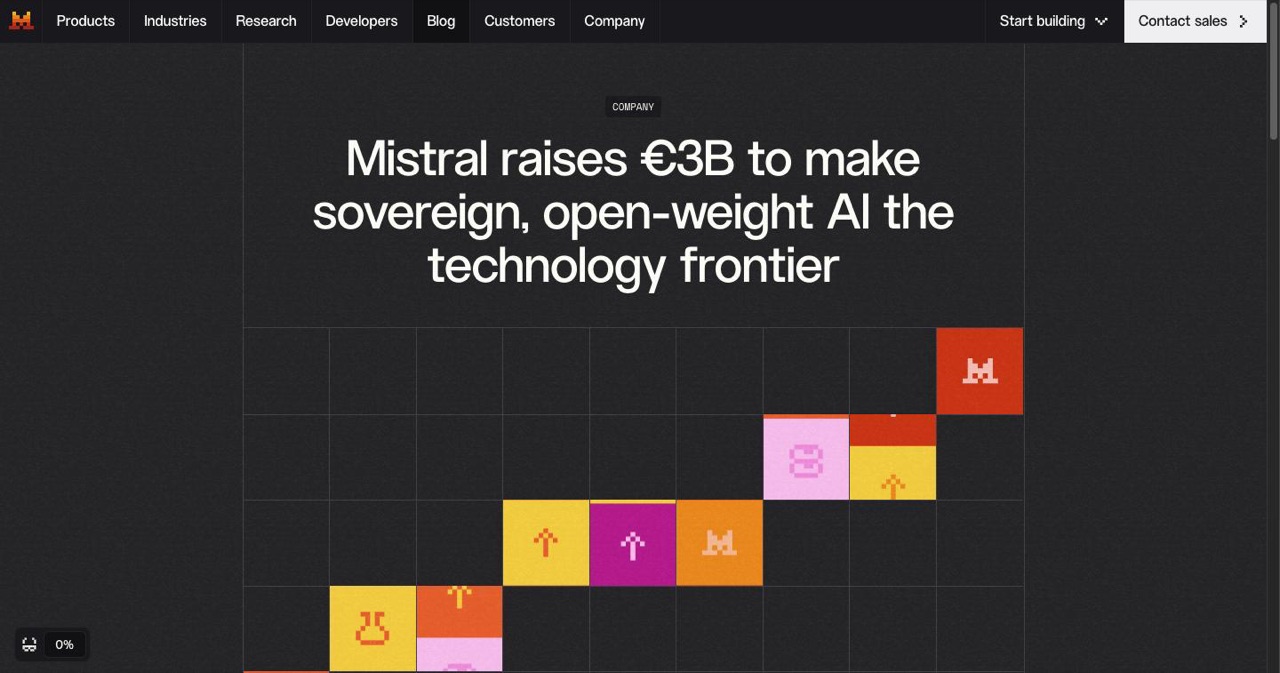
Quick answer: Mistral raised a €3 billion Series D on September 8, 2026 at a post-money valuation above €21 billion, which the company calls the largest equity round ever completed by a European technology company. Samsung Electronics led it, with EQT's Scaleup Europe Fund and PSG Equity co-leading and the Grand Duchy of Luxembourg among new investors. Mistral sells sovereign AI: open weights, its own AI Cloud compute, and products on top, across 20 countries and 125+ enterprise customers including Airbus, ASML and HSBC.
Sources and dates are linked inline. Mistral's own announcement published September 8, 2026, the same day as this post; funding-history figures below are cross-checked against Mistral's prior round announcements.
A three-year-old French startup just raised more money in one round than any European tech company ever has, and the money came with a lecture about vendor lock-in built right into the term sheet.
Quick disclosure since you're reading this on a startup directory's blog: SaaSCity is a free, human-reviewed directory with a live city map where founders list what they've built. I write about funding and model news here because it changes what founders can build on and who they're negotiating against, not because we have a stake in Mistral, Samsung, or anyone else in this round. More on where the directory fits near the bottom.
Key Takeaways
- The round: €3 billion at a €21 billion-plus post-money valuation, announced September 8, 2026, three years after the company launched.
- Samsung led it: Samsung Electronics took the lead seat, with EQT's Scaleup Europe Fund and PSG Equity co-leading and a national government, the Grand Duchy of Luxembourg, investing directly.
- Sovereign AI has four parts: Data inside your boundaries, controllable and customizable models, private and predictable compute, and auditable production systems.
- Customer base skews enterprise: 20 countries, 125+ enterprise customers, with Airbus, ASML and HSBC named specifically.
- Valuation nearly doubled in twelve months: The Series C closed at €11.7 billion in September 2025 on a €1.7 billion raise led by ASML.
- EU AI Act timing: Obligations for general-purpose AI models started applying in August 2026, so inspectable, self-hostable models make the required documentation easier to write honestly.
- The practical move: Widen the options list at your next architecture review rather than ripping out a working integration; most closed-API vendors fail at least two of the four sovereignty dimensions by design.
What actually got announced
Mistral confirmed it in a post on its own site dated September 8, 2026: a €3 billion Series D at a post-money valuation above €21 billion. The company's own framing, not a headline writer's: the largest equity fundraising round ever completed by a European technology company, three years after launch. Hacker News put it on the front page the same day, sitting north of 600 points with several hundred comments by evening.
Samsung Electronics led the round outright. Co-leads were EQT's Scaleup Europe Fund and PSG Equity, an existing investor stepping up. New money came from Advent International, funds and accounts managed by BlackRock, and, unusually, a sovereign entity: the Grand Duchy of Luxembourg. A long list of prior backers came back for more: a16z, ASML, Belfius, BNP Paribas CIB, Bpifrance, Carmignac, DST Global, Eurazeo, General Catalyst, Headline, Hillspire, Index Ventures, Korelya Capital, Lightspeed, NVIDIA, Phoenix Court's Solar fund, and Salesforce Ventures.
That's a genuinely unusual investor list for an AI lab. It reads like a European industrial roster crossed with Silicon Valley's usual AI syndicate, plus a chipmaker (ASML), a memory and device giant now in the lead seat (Samsung), and a national government. Nobody assembles that table by accident.
The climb, round by round
Mistral's funding history is the fastest ascent a European startup has ever put together, and lining the numbers up shows how steep the last year was specifically.
| Round | Date | Amount raised | Post-money valuation | Lead |
|---|---|---|---|---|
| Seed | June 2023 | ~€105M | ~$260M | — |
| Series A | December 2023 | ~€385M | ~$2B | a16z |
| Series B | June 2024 | ~€600M | ~€5.8B ($6.2B) | General Catalyst |
| Series C | September 2025 | €1.7B | €11.7B | ASML |
| Series D | September 2026 | €3B | €21B+ | Samsung Electronics |
Three years, five rounds, and a valuation that's roughly doubled year over year since the Series B. The jump from Series C to Series D alone is the interesting one: valuation nearly doubled in twelve months, on the back of a round nearly double the size of the previous one. For comparison, Hugging Face sold to NVIDIA this month for $12.9 billion, roughly 26 times its reported annualized revenue. Mistral just raised money at a valuation multiple that implies investors think this lab's trajectory looks more like a hyperscaler than a model shop.
Who's actually using it
The numbers Mistral put in its own announcement: operations in 20 countries, more than 125 enterprise customers, with Airbus, ASML, and HSBC named specifically as customers rather than just investors (ASML is both). That's a meaningfully different customer profile than the developer-and-startup base most AI labs lead with. Airbus and HSBC are the kind of accounts that run procurement reviews measured in months and demand answers about where their data goes, which lines up cleanly with the pitch Mistral is making about sovereignty rather than raw benchmark scores.
Sovereign AI, defined without the marketing gloss
Here's the phrase doing all the work in this announcement, and it's worth pulling apart because "sovereign AI" gets used loosely enough elsewhere that it's started to mean whatever a press release wants it to mean.
Mistral's own definition: control across four dimensions.
- Data stays inside the organization's boundaries. Not "we promise not to train on it," a structural guarantee that the data never has to leave your infrastructure to use the model.
- Models are controllable and customizable. You can fine-tune, quantize, or modify the weights instead of accepting whatever behavior a vendor ships this quarter.
- Compute is private and predictable. No shared rate limits, no surprise price changes, no capacity throttling during someone else's traffic spike.
- Production systems are auditable. You can actually inspect what's running and why it produced a given output, which matters a great deal once a regulator asks you to.
Compare that to plain open source, which really only guarantees the first half of point two: you can download the weights. It says nothing about whether you have anywhere sane to run them, whether the license lets you customize freely, or whether the lab behind the weights will still support the model in a year. Mistral's argument is that it's the only company selling all four dimensions as one stack: the open-weight models, the compute infrastructure they run on (its AI Cloud), and the products layered on top (Studio, Forge, and its "Vibe" and "Vibe for Code" agentic tools). OpenAI and Anthropic sell you a product and an API. Meta and DeepSeek hand you weights and wish you luck finding somewhere to run them affordably at scale. Mistral is betting the gap between those two groups is where enterprise budgets actually live.
Whether that bet pays off depends on execution nobody can verify from a funding announcement. What's verifiable is that Mistral now has €3 billion more runway to build it out.
Why this actually matters if you're building a SaaS product
Set the funding-round trivia aside for a second. Here's the part that should change a decision you make this quarter.
You now have a credible third pole in model supply, not just two. Through most of 2025 and early 2026, picking a foundation model meant choosing between OpenAI, Anthropic, and increasingly Google, with everyone else treated as a hedge rather than a primary vendor. A €21 billion, well-capitalized lab with 125+ enterprise customers and a genuine European base changes that calculus, especially for anyone building for EU customers who care where their data physically sits.
Open weights are the actual escape hatch from vendor lock-in, and this round makes that escape hatch better funded. If you build entirely on a closed API, a pricing change, a rate-limit policy, or a government export order can take your product offline with zero notice. Anthropic's Fable 5 and Mythos 5 got pulled by a US Commerce Department directive in June 2026, disabled globally within hours of a Friday-afternoon letter, as we covered when it happened. Nobody who'd architected a fallback path onto an open-weight model spent that weekend panicking. Open weights don't guarantee you'll never have a bad week, but they guarantee the bad week is one you can route around instead of one you have to wait out.
The EU AI Act just made auditability a compliance requirement, not a nice-to-have. The Act's obligations for general-purpose AI models started applying in August 2026, and EU-based SaaS companies building on top of a model now need to document training data provenance, risk classifications, and system behavior for anything customer-facing. If you can't see inside the model you're building on, writing that documentation honestly gets a lot harder. We went through the specific requirements in our EU AI Act compliance guide for SaaS founders; a sovereign, inspectable model stack doesn't make the paperwork disappear, but it makes the paperwork answerable.
Samsung leading signals where compute alignment is heading next. NVIDIA has been a Mistral backer since 2023, the same year it went all-in on model labs it wanted running on its chips. Samsung stepping into the lead investor seat on a €3 billion round reads the same way: a hardware and memory giant with every incentive to make sure a frontier lab optimizes for its silicon and its device ecosystem, not just its balance sheet. Expect more of this pattern, chip and device makers writing bigger checks into the labs whose success makes their own hardware roadmap more valuable.
More capitalized open-weight competition keeps squeezing frontier API pricing. We covered this dynamic in detail in our look at model fatigue and how to actually pick a model in 2026: every credible open-weight release tightens the floor on what closed labs can charge for comparable tasks. Mistral with €3 billion in fresh runway to subsidize its compute buildout is a stronger floor than Mistral without it.
The practical decision this should actually change
None of this means rip out your current model integration on a Monday. It means widen your options list before your next architecture review.
- If you're EU-based or serve EU customers with an AI feature, put Mistral's Medium and Small tiers on your shortlist alongside whatever you're already running, specifically for the data-residency and audit-trail story, not because the benchmarks necessarily beat what you have today.
- If your whole product depends on one closed API, this is a good week to sketch, even roughly, what a self-hosted or third-party-inference fallback would look like. You don't have to build it. Knowing it's buildable changes your negotiating position with your primary vendor and your risk profile if that vendor has a bad Friday.
- If you're evaluating vendors for a regulated customer, sovereign AI's four dimensions, data boundary, model control, compute predictability, audit trail, are a genuinely useful checklist to run any vendor through, closed or open. Most closed-API vendors fail at least two of the four by design.
Our guide to picking a model without re-architecting your stack every time one ships covers the broader method: pin what you're running, review on a fixed quarterly cadence, and evaluate new entrants against your own workload instead of a leaderboard. Mistral's Series D is exactly the kind of news that belongs in that quarterly review, not a reason to reschedule your sprint.
Where SaaSCity fits, honestly
The bigger story here is the same one we keep coming back to on this blog: owning your own distribution and your own infrastructure choices matters more every time a vendor, a government, or an acquirer reminds everyone how much control they actually hold over the tools you built your business on. Mistral's whole Series D pitch is basically that argument applied to AI infrastructure. We'd make the same argument about where you get discovered.
SaaSCity is a free, human-reviewed startup directory with a live city map: every submission gets checked by an actual person, every listing gets a permanent indexed page, and every paid listing a building on the map. Add the SaaSCity badge to your site and the backlink goes dofollow, DR in the high 40s to mid 50s at last Ahrefs refresh, and it books you into the next Monday launch slot instead of a general queue. If you'd rather skip the badge, Quick Pass at $19.99 goes live within 24 hours. Premium at $39.99 adds a written launch post from the team with three sponsored links.
None of that has anything to do with which model you build on. That's kind of the point: it's one channel that doesn't evaporate if a lab's pricing changes or a government pulls a product overnight.
The bottom line
A three-year-old company just raised the biggest check Europe has ever written to a tech startup, and it did it by selling a very specific promise: you will never be as stuck with us as you are with everyone else. Whether that promise holds up over the next decade of Mistral's growth is genuinely unknowable today. What's knowable right now is that the promise is finally backed by €21 billion in credibility and enough fresh capital to build the compute footprint that promise depends on.
If your AI stack currently has exactly one vendor in it, this is a reasonable week to ask why.
Sources: Mistral, "Making sovereign, open-weight AI the technology frontier," September 8, 2026; Hacker News discussion; Mistral, Series C announcement, September 9, 2025.
Get your SaaS in front of founders
List your product on the SaaSCity live city map - a permanent listing, real discovery, and a backlink from a high-DR directory. Free to start; upgrade for a dofollow link and a building on the map.