News
EU AI Act Goes Live August 2026: What SaaS Founders Actually Need to Know
August 2 is 40 days away. If your SaaS serves EU users and has any AI feature — a chatbot, a suggestion engine, AI-generated content — you have 40 days to be compliant. Here's what the EU AI Act actually requires, and what most founders get wrong.

Contents (11)
- Key Takeaways
- What the EU AI Act Is (and Isn't)
- Provider vs. Deployer: Which Are You?
- The Four Risk Categories
- What Article 50 Actually Requires (the Part That Affects Most SaaS)
- What Got Extended in May 2026 (and What Didn't)
- The Fines (With the Actual Numbers)
- What to Do Before August 2
- List Your AI SaaS on SaaSCity
- What This Changes for Product Decisions
- The Part Nobody Talks About
Quick answer: The EU AI Act reaches full enforcement on August 2, 2026, and it applies to any SaaS accessible to EU users regardless of where the company is incorporated. Most founders building on OpenAI, Anthropic, or Mistral APIs are deployers, not providers, and their immediate obligation is Article 50 transparency: visible in-UI disclosure that a user is talking to AI, plus machine-readable labeling of AI-generated content. Article 50 fines reach €15M or 3% of global annual turnover, and regulators can also order market withdrawal.
August 2 is 40 days away. If your SaaS product serves EU users and includes any AI feature — a chatbot, a suggestion engine, an AI-generated summary — that date is the day EU AI Act SaaS enforcement goes fully live. Most founders haven't circled it. Some don't know it exists.
92% of SaaS products now include AI features. Only 35% are EU AI Act-ready.
This isn't GDPR-style "we'll wait for the first fine to land on someone else before we care." The prohibited practices have been illegal since February 2025. The transparency requirements that affect most AI SaaS products have no deadline extension. And the regulator's tool kit includes something worse than fines: pulling your product from EU markets entirely.
Here's what the EU AI Act actually requires, who it applies to, and what to do in the next 40 days.
Key Takeaways
- Extraterritorial by design: One user in Berlin is enough. The Act follows the same logic as GDPR, so servers and incorporation location do not matter.
- Provider or deployer: Building on someone else's model API makes you a deployer with narrower obligations; providers carry conformity assessments, EU database registration, and CE marking.
- Article 50 lands on schedule: Chatbot disclosure must be a visible UI element, not a terms-of-service clause, from August 2, 2026, with no grace period.
- Watermarking has a transitional window: Generative systems that existed before the Act have until December 2026 to implement machine-readable content labeling.
- High-risk deadlines moved: A May 2026 Parliament resolution pushed Annex III systems to December 2, 2027 and Annex I systems to August 2, 2028.
- Fine tiers: €35M or 7% of turnover for prohibited practices, €15M or 3% for Article 50 failures, €7.5M or 1% for misleading regulators.
- Market withdrawal is the sharper risk: National competent authorities can order a non-compliant product pulled from EU markets entirely.
- Minimal risk really is minimal: Spam filters, recommendation engines, search ranking, and autocomplete carry no specific obligations.
What the EU AI Act Is (and Isn't)
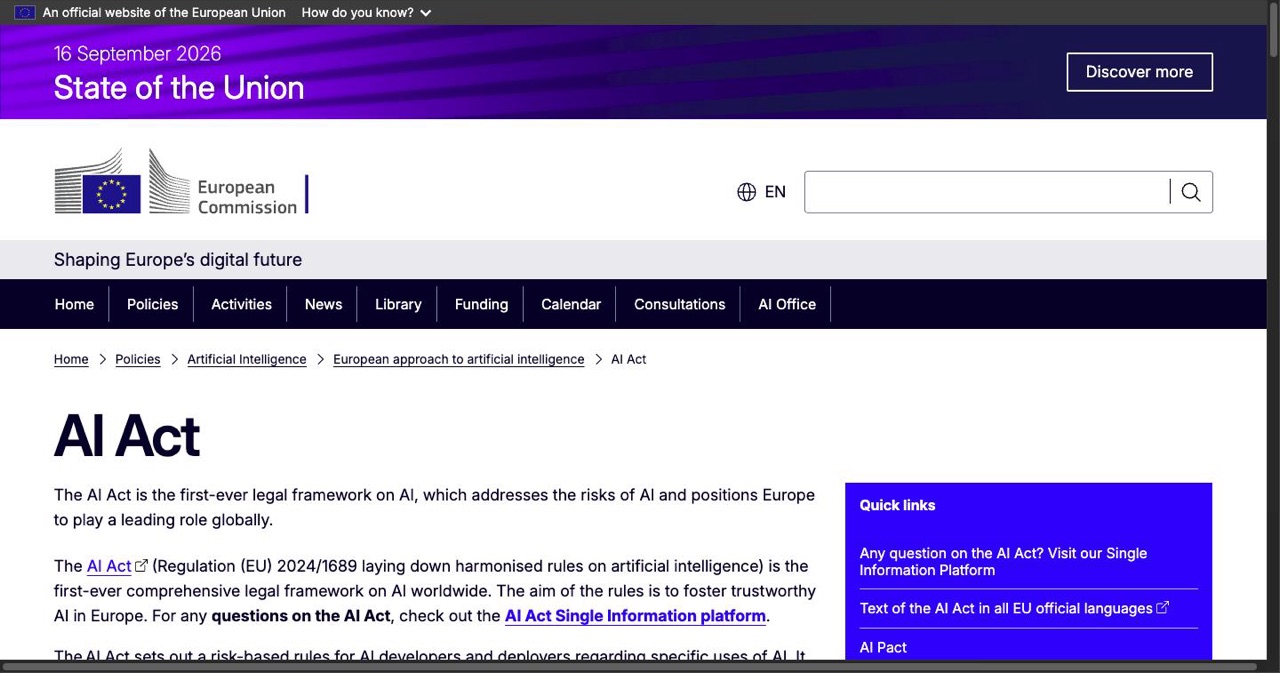
The EU AI Act is the world's first comprehensive legal framework for artificial intelligence, adopted in 2024 and rolling out in phases. It isn't a ban on building AI. It isn't an enterprise-only compliance problem. And it doesn't only apply to European companies.
Same extraterritorial logic as GDPR: if your SaaS is accessible to users in the EU — through a website, an app, an API — the Act applies to you. The regulator doesn't care where your servers are or where your LLC is incorporated. One user in Berlin means the whole framework applies.
The Act assigns obligations along two axes: your role in the AI supply chain and the risk level of your AI system. Both matter. Your role determines which obligations you carry. The risk level determines how heavy they are.
Provider vs. Deployer: Which Are You?
Under the AI Act, you're either a provider (you build the AI system) or a deployer (you integrate someone else's AI into your product).
Most SaaS founders building on top of OpenAI, Anthropic, or Mistral APIs are deployers. You're not training the model. You're integrating it into a product. That distinction is load-bearing: providers carry the heaviest compliance burden — risk management documentation, conformity assessments, EU database registration, CE marking for high-risk systems. Deployers have a narrower set of obligations.
"Narrower" doesn't mean nothing. The deployer obligations that land August 2 are exactly the ones most overlooked: transparency toward end users under Article 50. That's where most AI SaaS products need to focus right now.
The Four Risk Categories
The Act divides AI systems into four tiers. Your obligations scale with the tier.
| Risk Tier | What It Covers | Enforcement Status |
|---|---|---|
| Prohibited | Social scoring, behavioral manipulation, emotion recognition in workplaces/schools, untargeted facial scraping | Illegal since February 2, 2025 |
| High-risk | Healthcare, employment decisions, credit scoring, education, law enforcement, critical infrastructure | Deadline extended: Dec 2027 (Annex III) / Aug 2028 (Annex I) |
| Limited risk | Chatbots, deepfakes, AI-generated content | Article 50 applies August 2, 2026 |
| Minimal risk | Spam filters, recommendation engines, autocomplete, video games | No specific obligations |
The category most founders incorrectly dismiss: limited risk. If your product has any conversational AI feature — any chatbot, AI assistant, AI-generated text or image tool — you're in this tier, and Article 50 applies to you in 40 days.
Minimal risk is genuinely minimal. Content recommendations, search ranking, spam filtering: no specific obligations under the Act. The common fear that all AI features require the same compliance treatment isn't accurate. A lot of what's in AI SaaS products lives in the minimal-risk bucket.
What Article 50 Actually Requires (the Part That Affects Most SaaS)
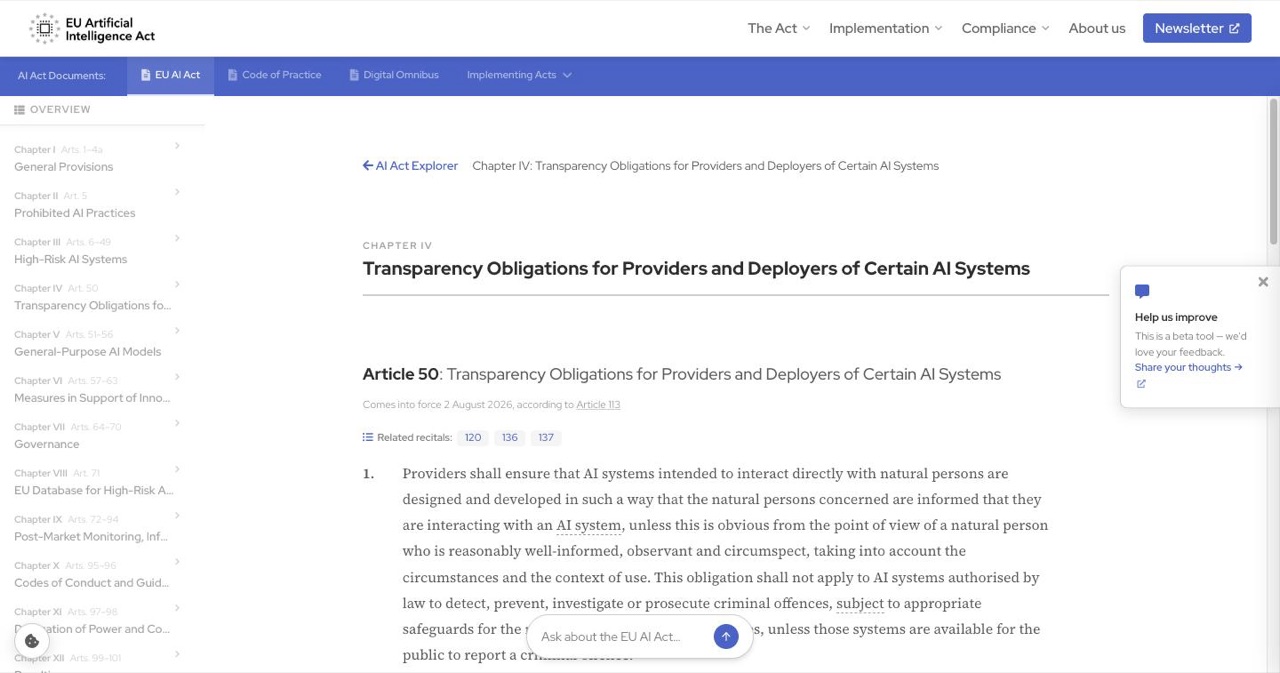
Article 50 is the provision that will touch the widest range of SaaS products. It has four specific requirements:
1. Chatbot disclosure — in the UI, not the ToS. If users interact with an AI system, you must inform them before or at the point of interaction. Not in a privacy policy. Not in a footnote. A visible UI element: "You're chatting with an AI." A buried clause in your terms doesn't count.
2. AI content labeling — machine-readable, not just visible. Content generated or substantially manipulated by AI (text, images, audio, video) must be labeled in both human-readable and machine-readable formats — meaning metadata or watermarking, not just a small disclaimer badge.
3. Public interest content labeling. If your AI generates text about current events, politics, or public affairs, that content must be marked as AI-produced.
4. Biometric feature disclosure. Any emotion recognition or biometric categorization system must disclose its use to affected individuals.
Most AI writing tools, customer support chatbots, and content generation products hit requirements 1 and 2. If you haven't added visible in-UI AI disclosure and started implementing machine-readable content labeling, that's the work to do before August 2.
One important nuance on timing: generative AI systems that existed before the Act passed get a transitional period until December 2026 to implement machine-readable watermarking on AI-generated content. The chatbot disclosure requirement has no such grace period. That one lands August 2, no exceptions.
What Got Extended in May 2026 (and What Didn't)
The EU Parliament passed a resolution in May 2026 extending compliance deadlines for the most burdensome high-risk AI requirements:
- Annex III systems (AI making decisions about employment, credit, education, insurance) — compliance extended to December 2, 2027
- Annex I systems (AI embedded in regulated products: medical devices, machinery, vehicles) — compliance extended to August 2, 2028
These extensions cover the heaviest obligations: detailed conformity assessments, quality management systems, post-market monitoring programs, technical documentation packages. If your SaaS touches these domains, you have more time than the original framework suggested.
What the extensions don't cover: Article 50 transparency. That lands August 2, on schedule. And the prohibited AI practices in Article 5 have been illegal since February 2025 — no extension was ever on the table for those.
If you're still running a system that resembles social scoring, behavioral manipulation targeting vulnerable users, or untargeted biometric data collection, the window for "we didn't know" closed 16 months ago.
The Fines (With the Actual Numbers)
The €35M headline gets cited constantly. Here's the full picture:
| Violation | Maximum Fine |
|---|---|
| Prohibited AI practices (Article 5) | €35M or 7% of global annual turnover |
| Most other violations, including Article 50 transparency | €15M or 3% of global annual turnover |
| Providing incorrect/misleading information to regulators | €7.5M or 1% of global annual turnover |
For a startup doing €1M ARR, a 3% Article 50 fine is €30,000. For a SaaS doing €5M ARR, it's €150,000. Real consequences, not enterprise-level extinction-event numbers.
What's more immediately dangerous than the fine: market withdrawal. National competent authorities can order your product pulled from EU markets for non-compliance. For any SaaS with meaningful European revenue, losing EU market access is a business continuity problem that towers over any fine calculation.
The Act instructs regulators to account for SME and startup interests — proportionality is built in. That's some comfort. But "proportionate" enforcement from a regulator is still enforcement. It's not a pass.
What to Do Before August 2
The practical sequence, ordered by urgency:
Step 1: Classify every AI feature. List what each feature does, who it affects, and what decisions it influences. Map each to a risk tier. Anything touching employment decisions, credit, or healthcare goes into a separate high-risk bucket — even if the deadline was extended, you want to know what's in that bucket.
Step 2: Check Article 5 first. Prohibited practices have been illegal since February 2025. Scan for any system that manipulates users via subliminal techniques, exploits age or disability vulnerabilities, or scores users on behavioral criteria for consequential decisions. These aren't "we'll fix it" items — they're "stop this now" items.
Step 3: Implement Article 50 disclosures in the UI. For every chatbot, assistant, or AI-powered interface: add visible disclosure that the user is interacting with AI. Update terms of service to include functional descriptions of your AI systems — not "we use machine learning" but "our platform uses a large language model to generate draft responses based on your input; these responses are machine-generated."
Step 4: Start on content labeling. If your product outputs AI-generated text, images, audio, or video, plan the machine-readable metadata or watermarking implementation. The December 2026 grace period buys you time on existing systems, but you need a documented implementation plan, not just a future intention.
Step 5: Appoint an EU representative. If your company has no EU establishment, Article 22 requires a legal representative in the EU. This is the most commonly skipped step by non-EU founders. It's also straightforward to fix.
Step 6: Document everything. What your AI does, how you tested it, how you monitor its performance, what risks you identified. The AI Act is, among other things, a documentation exercise. Clean documentation is your first line of defense in any regulatory inquiry.
For a full compliance workflow that covers EU AI Act alongside GDPR and SOC 2 in one structured process, the SaaS compliance checklist for 2026 lays out the 30-day certification path.
List Your AI SaaS on SaaSCity
Building an AI-powered product with compliance built in? That's worth showing off — and increasingly a differentiator when enterprise buyers comparison-shop.
SaaSCity.io is the directory for modern SaaS and AI tools. Get found by founders and buyers actively looking for what you're shipping.
- Free to list: Submit your product in under 2 minutes at /live/submit
- Earn dofollow backlinks: Every listing earns a permanent, indexed backlink from a high-authority domain. Our guide to domain rating covers why this compounds over time.
- 3D city map visibility: Your product gets a building in the SaaSCity interactive map — visible to high-intent buyers doing active research
- Compliance-aware discovery: Buyers sourcing AI tools are increasingly filtering for regulation-ready products. A SaaSCity listing signals you're building seriously.
What This Changes for Product Decisions
The EU AI Act isn't just a compliance checklist — it reshapes what's worth building.
The prohibited category closes real markets. Any SaaS that scored user behavior against social criteria, targeted vulnerable populations for manipulation, or enabled mass biometric collection without consent — those product categories are now structurally unavailable in the EU. This isn't ambiguous. It's in effect.
The high-risk category creates a compliance moat. Employment decision tools, credit scoring SaaS, educational assessment software — operating in these spaces in Europe now requires significant compliance infrastructure. For well-capitalized incumbents, manageable. For a solo founder, a genuine barrier to entry. Which cuts both ways: it's harder to enter, and harder to get displaced once you're in.
The limited-risk category rewards early movers. If your product already had clear AI disclosure and thoughtful data practices, you have days of work ahead. If it didn't, you have weeks. The gap between "thought about this" and "hadn't thought about it" is narrowing fast.
The minimum viable unit framework for SaaS applies here in a way its author didn't fully anticipate: compliance depth is now part of the build-vs-buy calculation for enterprise buyers. An EU-compliant AI tool with documentation is harder to justify rebuilding internally than a non-compliant one where the legal risk has been externalized to the buyer. Compliance isn't just a legal checkbox — it's a retention argument.
Enterprise procurement teams are already running this math. "Is this vendor AI Act compliant?" is showing up in RFPs. "We need your AI documentation before legal will approve this" is a real conversation founders are having. The buyers who are furthest along on their own AI Act readiness are the most demanding about vendor compliance.
The Part Nobody Talks About
August 2 isn't the finish line. It's the first gate.
National implementations are still diverging. Italy's version includes criminal liability provisions. Other member states will add their own layers on top of the EU baseline. High-risk enforcement is still coming in 2027 and 2028. The regulatory environment for AI is moving toward permanence, not resolution.
Founders who treated GDPR as a one-time checkbox exercise spent years playing catch-up as enforcement intensified and enterprise buyers started putting GDPR compliance on every vendor questionnaire. The ones who built data practices into their architecture early didn't have to retrofit anything — and found compliance turned into a sales advantage.
The EU AI Act is the same story, one chapter later. The work you do before August 2 isn't overhead. It's infrastructure for an AI-first product that operates in European markets without legal exposure. What you skip now becomes technical debt that costs more to fix under regulatory scrutiny than it would have cost to build right.
The question isn't whether the EU AI Act is worth taking seriously. It's whether you'd rather take it seriously on your timeline or a regulator's.
SaaSCity.io covers AI tools, SaaS compliance, and the products founders ship. Explore the SaaSCity directory to discover what's shipping right now — or list your own product.
Get your SaaS in front of founders
List your product on the SaaSCity live city map - a permanent listing, real discovery, and a backlink from a high-DR directory. Free to start; upgrade for a dofollow link and a building on the map.