Reviews
FreeBuff: The Free AI Coding Agent That's Making Paid Tools Look Overpriced
FreeBuff is a terminal AI coding agent by Codebuff (YC F24) co-founder James Grugett that launched in March 2026. Multi-agent architecture, DeepSeek V4 Pro, browser automation — and it's completely free with ad support. Here's the full breakdown.

Contents (10)
- Key Takeaways
- The Economics That Made a Free Coding Agent Possible
- What FreeBuff Is (And What Separates It from a Wrapper)
- Installing FreeBuff (It Really Is This Simple)
- The Models Running Under the Hood
- How FreeBuff Stacks Up Against Paid Alternatives
- The Real Limitations (No Glossing)
- A Practical First Session: How to Actually Evaluate It
- What's Coming Next
- The Bottom Line
Quick answer: FreeBuff is a free, ad-supported terminal coding agent from Codebuff (YC F24), built by co-founder James Grugett and launched in March 2026. You install it with npm install -g freebuff and run it in your project directory with no API key, config file, or credit card. It coordinates nine-plus specialized agents for file picking, planning, editing, review, browser automation, and web research, running DeepSeek V4 Pro as the primary coding model alongside DeepSeek V4 Flash, Gemini 3.1 Flash Lite, and MiniMax M3.
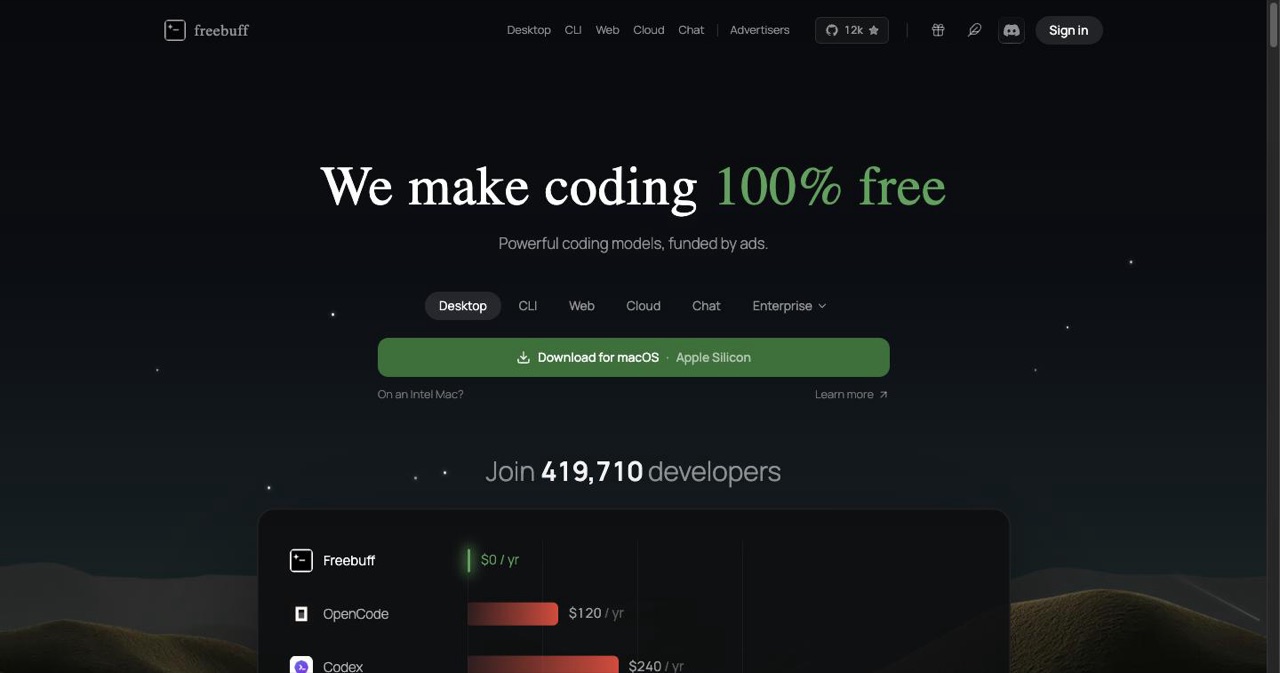
You're paying $20/month for an AI coding agent. FreeBuff does it for free.
Not "free trial." Not "freemium with a cap you'll hit in an afternoon." Free. No subscription, no API key, no credit card form to fill out. One terminal command and you're coding.
FreeBuff is a terminal AI coding agent built by James Grugett, co-founder of Codebuff (YC F24) and Manifold Markets. It launched in March 2026 and immediately picked a fight with every paid tool in the space. The pitch on its GitHub README is blunt: "5–10× speed up" over Claude Code. Multi-agent intelligence. Built-in web research and browser automation. Zero setup.
Bold claim. Let's find out if it holds.
Key Takeaways
- Free means ad-supported, not trial: No subscription, no API key, no credit card. The global launch in May 2026 gives every user 5 free hours per day on DeepSeek V4 Flash.
- Nine-plus specialized agents, not one model: File Picker, Planner, Editor, Reviewer, Browser Use, Web Research, and Code Reviewer each handle one narrow job.
- DeepSeek V4 Pro is the primary coding model: It scores 93.5% on LiveCodeBench and 67.9% on Terminal Bench 2.0, with DeepSeek V4 Flash, Gemini 3.1 Flash Lite, and MiniMax M3 handling lighter work.
- The benchmark is self-reported: Codebuff's internal evals put it ahead of Claude Code 61% to 53% across 175+ tasks, with no independent third-party verification yet.
- Install is three commands:
npm install -g freebuff, cd into a project, thenfreebuff. Aknowledge.mdfile in the project root carries context between sessions. - The China question is yours to answer: FreeBuff says it does not train on your code or retain your codebase, but DeepSeek V4 Pro is a Chinese model and regulated or NDA-bound work needs its own policy review.
- Economics behind it: Inference costs fell roughly 10x in a year while subscription prices stayed flat, and CLI ad clickthrough rates in 2026 run 4-7x higher than typical web display ads.
The Economics That Made a Free Coding Agent Possible
To understand why FreeBuff exists and actually works, you need a 60-second read on what changed in the AI model market.
Inference costs dropped roughly 10x in the past year. DeepSeek V4, Kimi K2, and MiniMax M3 brought coding-grade performance to under $1 per million tokens. That cost point makes the "pay us $20/month for model access" subscription model look less like a service and more like pure markup. Meanwhile, Claude Code, Cursor, and Codex held their subscription pricing flat.
The economics flipped because inference costs fell 10x while subscription pricing stayed flat. The general "agent in your terminal" and "app builder in your browser" tiers are now free by default.
Grugett moved early with a sharper insight than most: build an ad-supported CLI where developer-relevant ads perform well enough to cover infrastructure costs, then give the tool away. Devtool-relevant ads covering compute, hosting, and dev infrastructure match developer intent far better than typical consumer-internet ads. CLI ad clickthrough rates in 2026 are running 4–7x higher than typical web display ads, which makes the free-with-ads model genuinely sustainable.
The business model is coherent. That matters when you're evaluating whether a "free" tool will still exist in six months.
What FreeBuff Is (And What Separates It from a Wrapper)
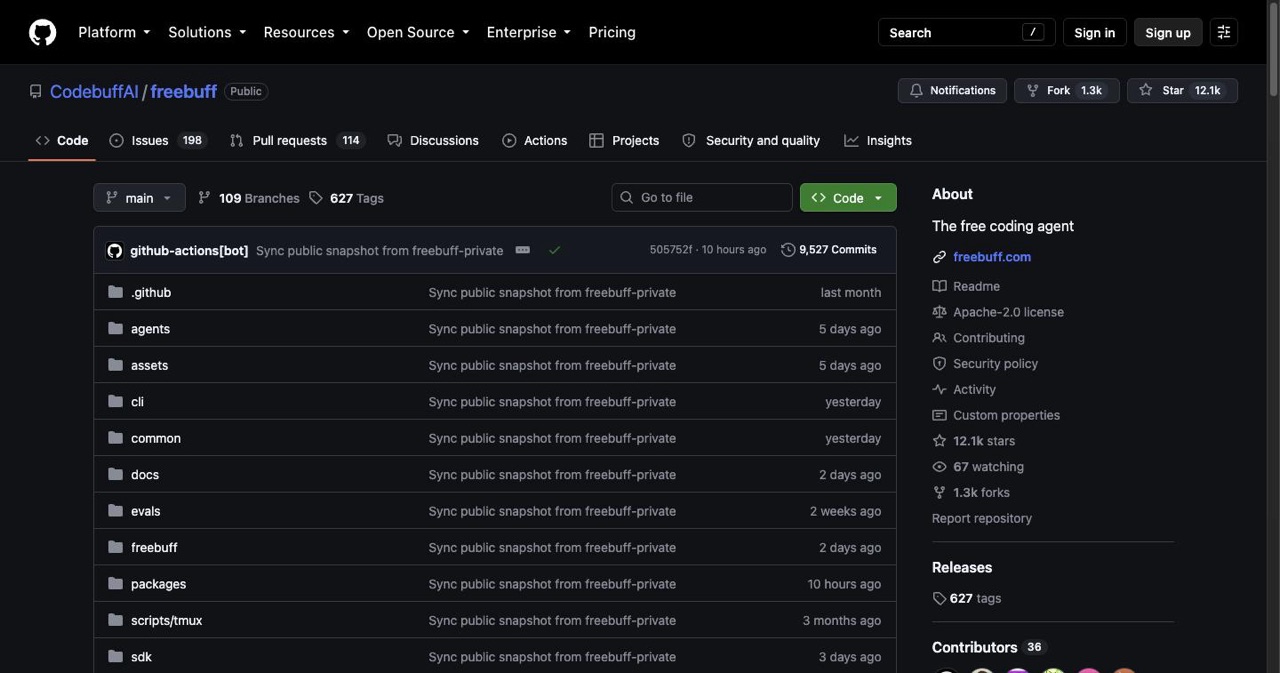
FreeBuff is the free, ad-supported variant of Codebuff, an open-source AI coding assistant that lives under the CodebuffAI GitHub organization.
Most AI coding tools send your prompt to one model and return an output. Codebuff and FreeBuff do something different: instead of using one model for everything, Codebuff coordinates specialized agents that work together to understand your project and make precise changes.
Here's what that actually means in practice. When you tell it to "add JWT authentication to my Express API," it doesn't start typing into a blank context window. It runs a coordinated sequence:
- File Picker Agent: Scans your codebase in ~2 seconds, maps the architecture, finds auth-adjacent files
- Planner Agent: Breaks the task into an ordered sequence of changes with dependencies mapped
- Editor Agent: Makes precise, targeted edits rather than rewriting entire files
- Reviewer Agent: Checks output for correctness before anything lands on disk
- Browser Use Agent: Spins up a real browser to test pages or verify behavior
- Web Research Agent: Searches the web when the task needs current documentation or context
- Code Reviewer: A dedicated pass for code quality issues, security gaps, obvious regressions
This multi-agent approach gives you better context understanding, more accurate edits, and fewer errors compared to single-model tools. Each agent is narrow and optimized for one job, which is partly why the speed claim holds up. It's not slower because it's doing more thinking; it's faster because the thinking is parallelized and specialized.
Installing FreeBuff (It Really Is This Simple)
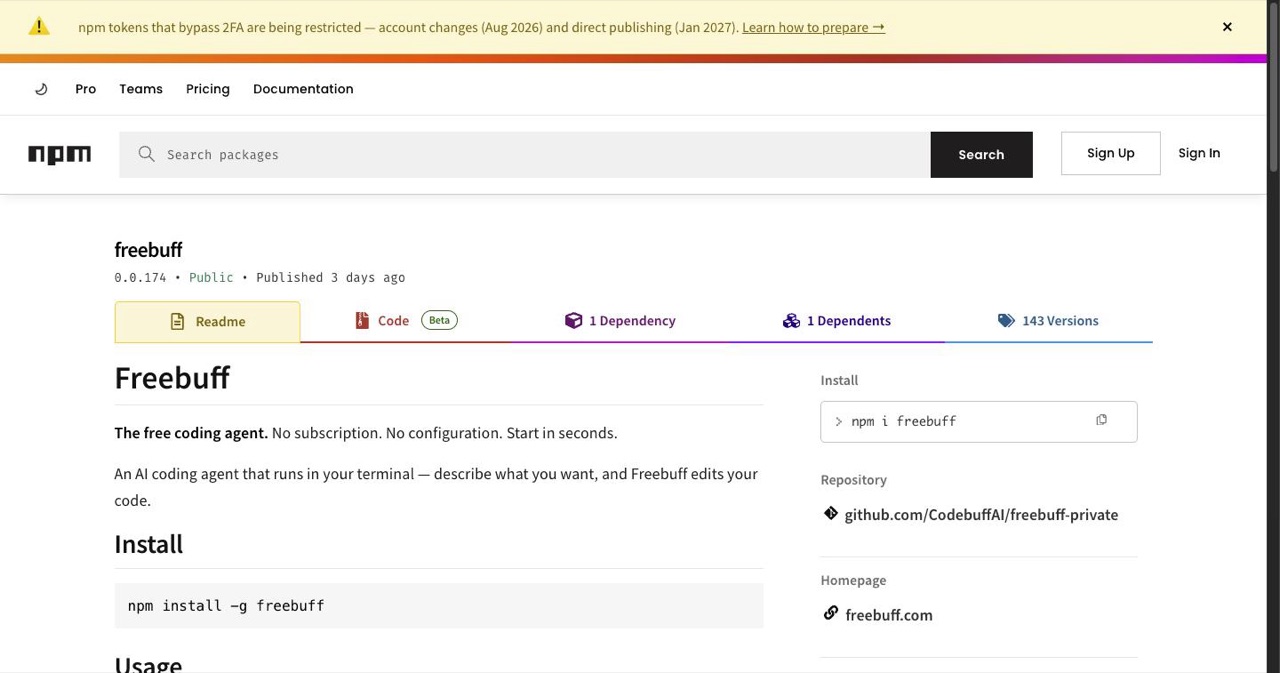
FreeBuff is designed with no modes and no configuration. It just works. The install is three commands:
npm install -g freebuff
cd your-project
freebuff
No config file. No .env. No API key to paste somewhere. You drop into a chat interface in your terminal with full visibility into your project.
Once you're past the basics, a few power-user shortcuts make a real difference:
@filename: Reference specific files directly in your prompt@AgentName: Explicitly invoke a specialist (e.g.,@BrowserUsefor browser automation)!commandor/bash: Run terminal commands mid-session without leaving/history: Resume previous conversations with context intactknowledge.md: A file in your project root that persists context about your codebase across sessions/theme:toggle: Light/dark mode, because terminal aesthetics matter to some people
There's also optional ChatGPT integration. Connect your existing ChatGPT subscription and you unlock GPT-5.4 for planning and deep reasoning on particularly hairy tasks. The base experience doesn't require it, but it's a useful ceiling for complex work.
The Models Running Under the Hood
FreeBuff runs different models for different jobs, which is where the speed story lives.
The primary coding model as of mid-2026 is DeepSeek V4 Pro, which scores 93.5% on LiveCodeBench and 67.9% on Terminal Bench 2.0, putting it competitive with frontier proprietary models at a fraction of the inference cost. For faster, lower-stakes tasks it drops to DeepSeek V4 Flash. File-finding and research tasks route to Gemini 3.1 Flash Lite, which prioritizes quick retrieval over deep reasoning. MiniMax M3 was integrated after its May 2026 launch with a free allocation of up to 4,000 steps per day.
The global launch in May 2026 opened FreeBuff to every country with 5 free hours per day on DeepSeek V4 Flash for every person in the world, with full model selection available in ad-supported markets.
On privacy: FreeBuff states it doesn't train on your code and doesn't retain your codebase between sessions. Worth noting clearly: DeepSeek V4 Pro is a Chinese model. If you're working with proprietary codebases, client code under NDA, or anything in a regulated industry, read DeepSeek's data policies independently before routing sensitive code through it. FreeBuff is transparent that it uses DeepSeek under the hood. The privacy call is yours to make, not theirs to make for you.
How FreeBuff Stacks Up Against Paid Alternatives
Here's the direct comparison, without the marketing gloss:
| Tool | Monthly Cost | Model Flexibility | Terminal-Native | Multi-Agent |
|---|---|---|---|---|
| FreeBuff | Free (ads) | Multiple OSS models | Yes | Yes (9+ agents) |
| Claude Code | ~$20–$100+ | Anthropic only | Yes | Single-model |
| Cursor | $15–$40 | Soft lock | No (IDE-based) | Limited |
| OpenAI Codex | $20+ | OpenAI only | Yes (CLI) | No |
| Lovable | $20–$99 | OpenAI | No (browser) | No |
The benchmark data is worth discussing directly: Codebuff beats Claude Code in their internal evals 61% to 53% across 175+ coding tasks sourced from open-source repositories. Those numbers come from Codebuff's own eval stack, which the team acknowledges openly. Independent third-party verification doesn't exist yet, so treat the percentage as directional signal rather than settled science.
The obvious caveat is that Codebuff's headline benchmark claims against Claude Code come from Codebuff's own eval stack, and the pricing story mixes free credits, ad-supported FreeBuff, and paid usage, so performance and cost marketing should be read with a skeptical engineer's eye.
What independent users consistently report, and what tracks with the architecture, is that the codebase indexing speed is genuinely fast, and the agent produces fewer "I changed 14 files and broke 3 things" outputs than single-model tools do.
The Real Limitations (No Glossing)
Every tool has real tradeoffs. Here are FreeBuff's:
Ads are in your CLI. Text-based, positioned not to interrupt your flow, but they exist. If that bothers you, it's a real objection.
Country availability isn't uniform. The global launch gives every user 5 free hours/day on DeepSeek V4 Flash. Full model selection and unlimited usage is tied to markets with sufficient ad revenue to justify it. Coverage is expanding, but check freebuff.com for your region's current access level.
DeepSeek data policies are your responsibility. The model is exceptional. The company is Chinese. For most side projects and open-source work, this is a non-issue. For regulated industries, enterprise code, or anything with contractual confidentiality requirements, check before you ship.
Benchmark claims are self-reported. The 61% vs 53% figure is meaningful but not independently verified. Don't buy a tool because of a number; buy it because the output works on your actual codebase.
It's terminal-first. If your entire workflow lives in a GUI IDE and you've never touched a terminal, the adjustment is real. FreeBuff runs inside VS Code's integrated terminal without friction, but it's still fundamentally a CLI product.
A Practical First Session: How to Actually Evaluate It
Don't waste time on toy examples. Here's the fastest path to a real verdict on whether FreeBuff fits your workflow:
Install on a real project. Pick something you're actively working on: not a hello-world repo, not something so critical that you can't absorb a mistake.
npm i -g freebuff
cd your-actual-project
freebuff
Pick a medium-stakes first task. A feature you've been putting off. A refactor you keep skipping. A test suite that doesn't exist yet. Something with known requirements that you'd normally spend two hours on.
Set up knowledge.md before you go deep. Drop a file in your project root with your stack, conventions, and any context the agent should know. This pays dividends immediately and compounds across sessions:
# Project Context
Stack: Next.js 15, PostgreSQL, Drizzle ORM, TypeScript strict mode
Auth: Clerk
Conventions: kebab-case filenames, named exports only
Known: /api/users has an N+1 query issue — don't touch it yet
Run /plan first on bigger tasks. Let the Planner Agent produce its plan, review it, push back on anything wrong, then approve. This is where the multi-agent approach earns its keep: you get a checkpoint before any file is touched.
Run /review before committing. The built-in reviewer runs a dedicated quality and security pass. It's not a substitute for proper code review, but it catches things. Consistently.
What's Coming Next
Freebuff Web is the in-browser full-stack app builder, positioned as a direct competitor to Lovable, Bolt, Replit, and Emergent. It's free. It's already live in early form and the gap between it and paid leaders is closing.
The custom agents SDK is the part teams with specialized workflows will find interesting. TypeScript generators that mix AI steps with programmatic control, spawn sub-agents, and branch on conditions. They let you build purpose-built agents for your specific project structure.
The broader argument the Freebuff team is making is that the "$20/month for access to a frontier coding model" tier of the market is structurally over. Per-seat AI pricing died because the unit economics never matched developer churn. Developers have heavy weeks shipping features and dead weeks in meetings, so users felt overcharged, churned, and the economics never closed. Free tier becomes the default. Paid tiers will exist for team features like audit logs and SSO, not for the agent itself.
That's a real prediction, and FreeBuff's current trajectory makes it look like a reasonable one. If you're building an AI SaaS or a micro SaaS, the shift toward free developer tooling changes your cost structure entirely. The tools you use daily are becoming free, so more budget goes toward the product itself.
The Bottom Line
If you're paying for Claude Code or Cursor on a solo project or a small team, you owe yourself two hours with FreeBuff before your next billing cycle. The install is three commands. The performance gap on everyday tasks is smaller than you'd expect. The cost difference is $20/month you could spend on something else.
If you're a student, indie developer, or anyone building side projects on nights and weekends: there's no longer a meaningful technical argument for paying subscription fees for AI coding help on non-sensitive code. This is the obvious choice.
npm install -g freebuff
Try it on something real. The three commands will tell you more than this article can.
FreeBuff is built by Codebuff (YC F24). James Grugett (@jahooma) is CEO. Source code lives at github.com/CodebuffAI/codebuff. Full docs and region availability at freebuff.com.
Get your SaaS in front of founders
List your product on the SaaSCity live city map - a permanent listing, real discovery, and a backlink from a high-DR directory. Free to start; upgrade for a dofollow link and a building on the map.