News
SellerClaw: The AI Ecommerce Agents Running Your Stores While You Sleep
SellerClaw deploys a coordinated team of AI agents — sourcing, listing, repricing, ads, fulfillment, support — across Shopify and eBay. Not a dashboard of recommendations. Agents that actually execute.

Contents (7)
Quick answer: SellerClaw is a supervisor-coordinated team of AI agents that runs ecommerce stores on Shopify and eBay. Specialized agents handle sourcing, listings, inventory, dynamic repricing, ads, fulfillment and support replies, and every action can be gated behind approval. Pricing is credit-based at 100 credits per dollar, from a free 500-credit tier to Max at $320 a month with SSO and self-hosting. It launched on Product Hunt on June 5, 2026 and reached number one daily with 605 upvotes.
Most ecommerce automation tools tell you what to do. SellerClaw will just do it.
That gap — between a dashboard full of recommendations and an agent that actually executes — is exactly where SellerClaw is operating. It launched on Product Hunt on June 5, 2026, hit #1 daily and #5 weekly with 605 upvotes, and the reception makes it clear: sellers have been waiting a long time for this specific product to exist.
SellerClaw is a team of AI ecommerce agents that runs your stores across channels. Product sourcing. Listing creation. Inventory management. Dynamic repricing. Ad management. Order fulfillment. Customer support replies. Not as separate point tools you have to wire together — as a single coordinated system you direct, and it handles the execution.
The founding premise comes from Artem Kosilov, SellerClaw's lead: "The real driving force of this industry is routine, simple work." Everyone building ecommerce software has chased the strategic layer — analytics dashboards, forecasting engines, growth reports. Nobody built proper agents for the 200 daily reprice decisions, the 40 customer support tickets, the listing optimization queue, and the ad bid micro-adjustments. That stack of unglamorous operational work is where most seller time actually goes. SellerClaw is built for that.
Key Takeaways
- Agents execute, not advise: A supervisor agent decomposes a goal and dispatches sourcing, store management and advertising agents that act through APIs, browser access and image generation.
- Approval is configurable: Every action can surface for sign-off, from full autonomy down to manual confirmation on each step.
- Credits, not seats: 100 credits equal $1. A full product listing is about 15 credits, a support reply about 2, and agent reasoning eats roughly 70% of a task's cost.
- Six plans: Free at $0 with 500 credits and one channel, up to Max at $320 for 40,000 credits, SSO and self-hosting. Growth at $36 is listed as most popular.
- Self-hosting cuts consumption 60%: Available at Max across Mac, Windows and Linux.
- SocialVault feeds sourcing: Real-time TikTok and Instagram trend data lets the sourcing agent draft listings before a manual operator spots the spike.
- Shopify and eBay only so far: Amazon is the top request in the Product Hunt comments, followed by Etsy, TikTok Shop and WooCommerce.
How the Multi-Agent Architecture Actually Works
This is the part most coverage of SellerClaw gets wrong by treating it as another automation tool.
Rule-based automation platforms — the kind that have dominated ecommerce ops for the last decade — are fast and cheap but fundamentally brittle. You configure a workflow: if inventory drops below X, trigger Y. If a competitor reprices, match it. When situations don't fit the configured rules, nothing happens or something wrong happens.
SellerClaw uses a supervisor-coordinated multi-agent architecture. The difference is that the agents can reason about goals and edge cases, not just match patterns against predefined triggers. Here's how a task actually runs:
- You direct the supervisor agent — "source trending home goods under $15 and list them on eBay with optimized titles"
- Supervisor decomposes the task — dispatches specialized agents for sourcing, store management, and advertising in parallel
- Specialized agents execute — using browser access for non-API supplier systems, image generation for product photos, platform APIs for store operations
- Every action surfaces for approval — visibility and sign-off requirements are configurable, from full autonomous to manual confirmation on every action
Tasks process through four internal stages: user request → agent reasoning (which consumes roughly 70% of credit cost) → tool execution via APIs, web browsing, and image generation → delivery with a transparent cost breakdown.
Model routing is one of the quieter smart decisions in the architecture: routine, repetitive tasks get routed to cheaper models while analytics and complex reasoning tasks use stronger ones. At volume, that keeps the unit economics reasonable without degrading output quality where it matters.
What each agent handles:
| Agent | Core responsibilities |
|---|---|
| Sourcing agent | Supplier discovery, product research, trend detection via SocialVault |
| Store management agent | Listings, inventory, dynamic pricing, fulfillment coordination |
| Advertising agent | Ad creation, bid optimization, performance monitoring |
| Supervisor agent | Task decomposition, coordination, user communication |
The SocialVault integration is worth calling out separately: it gives the sourcing agent real-time social media trend data. When a product category spikes on TikTok or Instagram, the sourcing agent identifies it, finds suppliers, and can have listings drafted before a manual operator would notice the movement. For sellers competing on trend velocity, that's a meaningful edge.
Pricing: Credits, Channels, and the Self-Hosting Angle
SellerClaw runs on a credit model. 100 credits = $1. A full product listing costs approximately 15 credits. A customer support reply costs approximately 2 credits. The dashboard shows credit consumption in real time — no surprise billing at month-end.
| Plan | Monthly | Credits | Channels | Notable |
|---|---|---|---|---|
| Free | $0 | 500 | 1 | No card required |
| Starter | $10 | 1,000 | 3 | |
| Growth | $36 | 4,000 | Unlimited | Most popular |
| Plus | $85 | 10,000 | Unlimited | + API access |
| Pro | $160 | 20,000 | Unlimited | + Dedicated onboarding |
| Max | $320 | 40,000 | Unlimited | + SSO, self-hosting |
The self-hosting option — available at Max tier across Mac, Windows, and Linux — is the detail most reviews skip over. Running SellerClaw on your own infrastructure drops credit consumption by roughly 60%. At the volumes where you'd be on a $320/month plan, that changes the math significantly: you're paying for model compute at near-cost rather than at SaaS margin. For operators moving serious SKU volume, the Max self-hosted path isn't the obvious first choice, but it's worth doing the arithmetic.
The Product Hunt Numbers in Context
605 upvotes, #1 daily, #5 weekly, 5.0 stars from early reviews.
Those numbers mean more than they would have a few years ago. The Product Hunt audience that posts in 2026 is more technically literate and more skeptical than the early adopter cohort was at the platform's peak. Getting to #1 daily now requires a product that developers and operators actually tested, not just one with a good tagline.
The critical feedback in the comments is consistent across reviewers: the primary ask is Amazon integration. The secondary ask is expanded marketplace coverage — Etsy, TikTok Shop, WooCommerce. Both of these are predictable requests for a product that launched with Shopify and eBay first. But notably, nobody is complaining the current integrations don't work. The demand is "this works, give me more platforms," which is a much healthier position than "this doesn't work as advertised."
One review specifically called out the autonomous architecture as "superior to manual automation platforms." That comparison is the right frame: people who've spent time with rule-based ecommerce automation are the ones most equipped to recognize what multi-agent AI store management actually changes.
List Your Ecommerce Tool on SaaSCity
Building AI agents for ecommerce? Shipping automation tools for sellers? Running a marketplace integration startup?
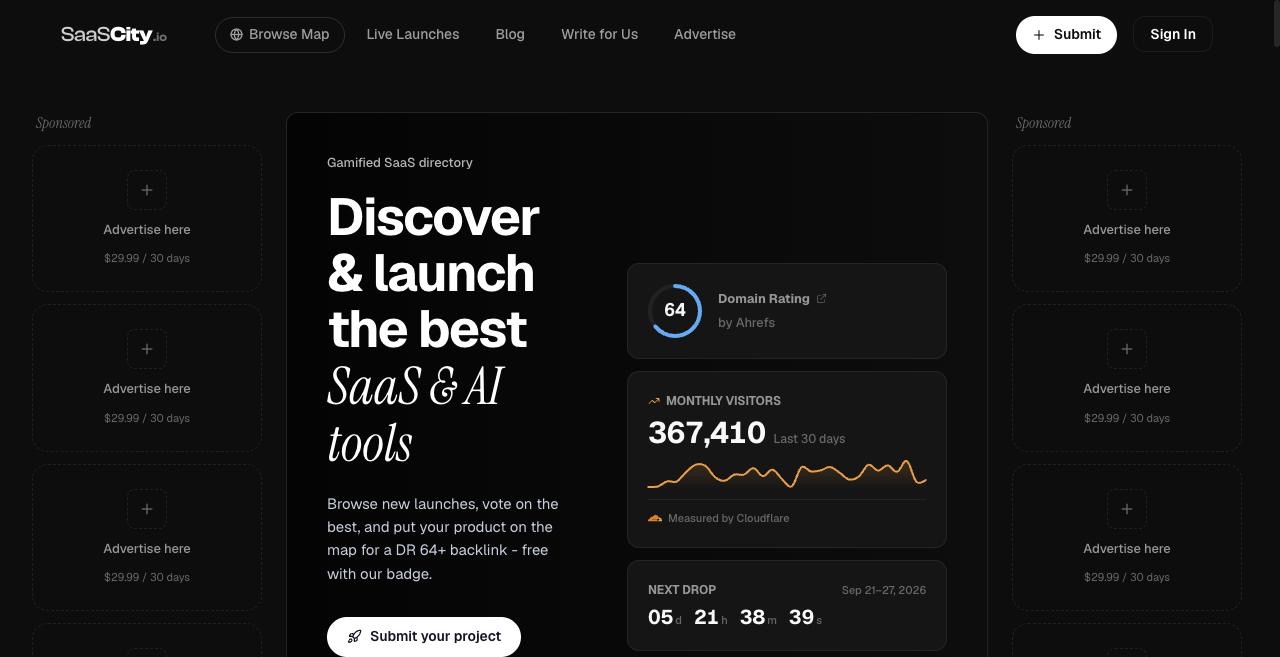
SaaSCity.io is the premier directory for SaaS and AI tools. Every listing isn't a flat static page — it's a building in an interactive 3D digital city, visible to founders, operators, and early adopters actively looking for what you've built.
- Free to list: Submit in under 2 minutes — no credit card, no catch.
- Earn dofollow backlinks: Every listing earns high-quality backlinks that compound your domain rating over time.
- 3D city map visibility: Your product appears in the SaaSCity engine — the most distinctive product directory in the space.
- Reach operators, not tourists: Our audience is builders and buyers actively evaluating tools.
What This Means for SaaS Builders
Three patterns worth tracking if you're building in or adjacent to ecommerce tooling.
1. The Agent Coordination Layer Is the New Middleware
The ecommerce software stack is mature. Shopify handles storefronts. Stripe handles payments. Klaviyo handles email. Every major category has winners. What's still primitive is the coordination layer — the thing that connects all of it and executes tasks across platforms in response to real-world signals without requiring a human to orchestrate each step.
SellerClaw is building that coordination layer. Not as a Zapier-style trigger-action workflow, but as an agent that reasons about goals — "grow eBay revenue 20% this month" — and decomposes them into actions across the tools it controls. That's a fundamentally different product category than ecommerce automation as the market has known it.
For anyone building SaaS tools right now, the question this raises is: what's the agent coordination equivalent in my vertical? The micro SaaS ideas actually worth building in mid-2026 keep pointing in the same direction — multi-channel management agents are appearing in real estate, content, and operations at the same time they're appearing in ecommerce. The category is expanding.
2. Routine Work Is the Biggest Opportunity
Kosilov's framing — "the real driving force of this industry is routine, simple work" — is one of the most actionable things any SaaS founder can internalize right now. The glamorous problem spaces are crowded. The tedious operational ones largely aren't.
A listing creation agent handling 50 SKUs a day isn't a flashy product. But 5,000 sellers on the Growth tier is $2.16M ARR with remarkably low churn — operators who've automated their ops workflows don't cancel. The market for "tedious ecommerce work that nobody wants to do manually" is large, underserved, and doesn't require winning a benchmark against OpenAI. This is the same pattern behind the boring SaaS ideas quietly printing $5K MRR: specific operational pain, specific paying customer, no flashy positioning required.
3. Self-Hosting Is a Distribution Strategy, Not Just a Feature
The Max tier's 60% credit reduction through self-hosting isn't purely a cost move — it's how SellerClaw converts high-volume sellers from SaaS customers into infrastructure operators. Sellers who embed SellerClaw into their own infrastructure build integrations, don't churn on pricing changes, and become internal champions. That path — from "tool" to "infrastructure" — is stickier than any loyalty program.
If you're building agent tools and haven't thought through a self-hosting path, SellerClaw's architecture is a useful case study in how to offer it without making it the default onboarding story.
The UGC angle is also worth watching: SellerClaw's SocialVault connects product sourcing to social media trends, which means sellers building multi-channel brands (Shopify + social commerce) can coordinate product drops around trend signals. For founders thinking about UGC-driven micro SaaS opportunities in 2026, this represents AI store management meeting content-market fit in real time.
The Underlying Bet
There's a transition underway in ecommerce that SellerClaw is positioned ahead of. Right now, multi-channel selling means logging into four dashboards, exporting CSVs, reconciling inventory manually, and running separate ad strategies for each platform. The median serious seller handles that with a combination of virtual assistants, point tools, and significant personal time.
The version of that operation five years from now — where a supervisor agent handles it while you set goals and approve edge cases — is either early-obvious or dangerously ahead of platform support. The limiting factor isn't AI capability; GPT-4o, Claude, and Gemini can all reason well enough to run a sourcing loop. The limiting factor is platform API access. Amazon is notoriously restrictive. eBay and Shopify are more open. If SellerClaw can lock in the open platforms and expand into Amazon before Amazon builds its own native agent layer, the moat is structural.
That's the tension to track — not whether AI agents can run ecommerce stores (SellerClaw is already demonstrating they can), but whether the platforms will grant the access required to let them run everything.
SaaSCity.io covers AI tools and ecommerce automation. Explore the SaaSCity directory to discover what's shipping right now — or list your own product.
Get your SaaS in front of founders
List your product on the SaaSCity live city map - a permanent listing, real discovery, and a backlink from a high-DR directory. Free to start; upgrade for a dofollow link and a building on the map.