Launch & Growth
9 Startup Directories for Finding Promising New Companies in 2026
A ranked guide to nine startup directories worth your time in 2026 — from SaaSCity's interactive city map to Product Hunt, Nick Launches, PeerPush, and BetaList — compared by audience fit, discovery model, and how long a listing keeps working.

Contents (6)
Quick answer: The nine startup directories worth using in 2026 are SaaSCity for ongoing SaaS and AI discovery through its interactive city map and permanent listing pages, Product Hunt for launch-day attention, Nick Launches for a weekly launch cycle plus a permanent dofollow backlink from a DR 72 domain, PeerPush for AI-assisted structured discovery, LaunchHive for maker-community networking, LaunchXact for curated indie SaaS, and BetaList for pre-launch validation, with Indie Hackers and the Y Combinator Startup Directory as research-focused honourable mentions.
Key Takeaways
- SaaSCity ranks first for ongoing discovery, with products shown as buildings on an interactive city map and permanent listing pages.
- Product Hunt still owns launch day but the attention curve drops steeply once the daily ranking resets.
- Nick Launches spans both jobs: a weekly cohort with 100+ launches and a permanent dofollow backlink from a DR 72 domain.
- PeerPush is built for machines too: machine-readable profiles plus API and MCP server access so AI assistants can query listings.
- BetaList is paid and editorially reviewed, which makes it the pre-launch validation pick rather than a buyer-research tool.
- Choose by job, not size: launch buzz, ongoing discovery, and early validation need different platforms.
- Measure real signals: track tagged links, qualified visits, signups, and investor conversations rather than impressions.
A strong SaaS can vanish from a launch feed in one day. A useful directory profile can keep bringing customers, partners, and investors for months.
Startup directories in 2026 include interactive SaaS maps, weekly launch queues, investor databases, and pre-launch sites. That variety makes raw traffic or backlink claims a poor way to compare them. Founders need to know where credible emerging SaaS companies actually appear — and where limited launch time will pay off.
This guide ranks nine startup directories and launch platforms by discovery quality, audience fit, freshness, and lasting value. For each platform we looked at its audience, listing type, search model, launch pace, profile lifespan, curation, product detail, and community activity. The list favors finding promising startups, not just boosting the biggest tech brands.
Quick summary: SaaSCity leads for ongoing SaaS discovery with its interactive city-map format and permanent listing pages. Product Hunt still owns launch-day buzz, Nick Launches pairs a weekly launch cycle with a strong permanent backlink, and BetaList remains the pick for pre-launch validation. The rest fill niche jobs: AI-assisted discovery (PeerPush), founder networking (LaunchHive), and curated indie SaaS browsing (LaunchXact).
Startup Directory Comparison
| Directory | Best for | Discovery model | Listing persistence | Audience |
|---|---|---|---|---|
| SaaSCity | Ongoing SaaS and AI product discovery | Interactive map, launches, votes, categories, and search | Permanent dedicated listing pages | SaaS founders, indie hackers, builders, and early adopters |
| Product Hunt | Launch-day attention and early-adopter feedback | Daily launches, votes, comments, categories, and rankings | Permanent product pages, with peak attention around launch | Makers, technologists, founders, investors, and early adopters |
| Nick Launches | Weekly launches with lasting SEO value | Weekly launch cycle, rankings, and permanent product pages | Permanent listing plus a permanent dofollow backlink | Builders, indie hackers, and early adopters |
| PeerPush | Human and AI-assisted product discovery | Structured profiles, search, rankings, updates, and community signals | Ongoing product listings | Builders, early adopters, AI users, and product researchers |
| LaunchHive | Maker-community launches and founder networking | Launch queue, rankings, community posts, and badges | Ongoing listings with launch-period emphasis | Indie makers, founders, builders, and early adopters |
| LaunchXact | Curated discovery of indie SaaS products | Curated collection, product pages, and early-adopter browsing | Continuous visibility after submission | Indie founders, builders, and early SaaS adopters |
| BetaList | Pre-launch and recently launched startups | Editorially reviewed startup timeline and profiles | Profile remains available, with strongest attention near featuring | Early adopters, startup enthusiasts, and founders |
What to know about startup directories in 2026
A startup directory is no longer a simple list of names and logos. Strong platforms now offer searchable profiles, launch records, founder details, category filters, and community signals. These details help buyers, investors, journalists, and AI systems judge whether a new company is worth tracking.
Your best choice depends on the job at hand. A launch-focused site can drive short-term attention, while an evergreen directory can support steady discovery and search visibility. Some platforms also help you gather feedback or study a crowded market.
Pick a directory based on your next goal, not its size.
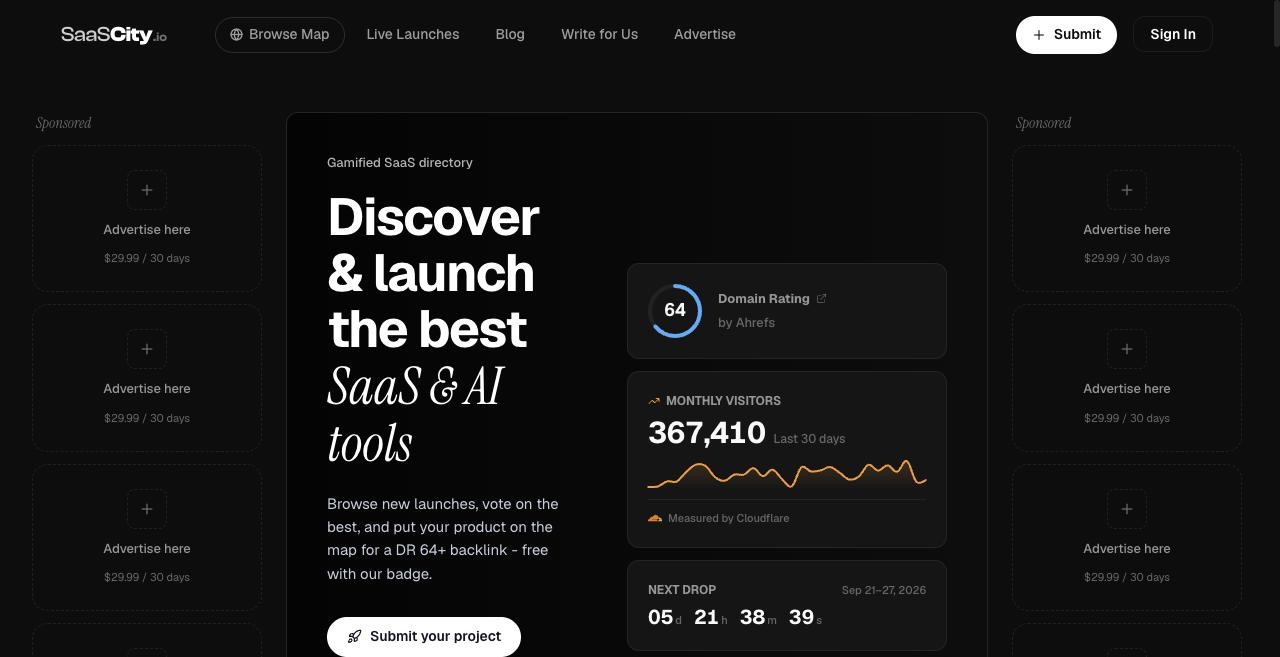
1. SaaSCity
SaaSCity makes SaaS and AI discovery feel less like scrolling a list. Products appear as buildings on an interactive city map, with permanent listing pages for ongoing discovery.
Highlights
- Browse launches, categories, votes, and leaderboards in one visual space.
- Founders can use its free listing and directory-submission guide to plan wider outreach.
Specs
- Best for: Ongoing SaaS and AI product discovery
- Audience: Founders, builders, indie hackers, and early adopters
- Listing persistence: Permanent dedicated pages
Pros
- More memorable than a standard directory card
- Built for launch visibility and evergreen discovery
Cons
- Smaller audience than Product Hunt
- Not a formal investor database
It ranks first for its focused SaaS audience and distinct discovery format.
2. Product Hunt
Product Hunt is the established launch platform for new tech products. It works best when you have a clear demo and can engage on launch day.
Highlights
- Daily rankings, votes, comments, reviews, and product hubs drive discovery.
- Its global tech community includes makers, investors, and early adopters.
- AI, developer, productivity, and consumer tools fit especially well.
Specs
- Best for: Launch-day attention and early feedback
- Discovery model: Daily launches, votes, comments, categories, rankings
- Listing persistence: Permanent pages, but peak attention is launch day
Pros
- Strong name recognition and social proof
Cons
- Heavy competition makes prep and live engagement vital
It ranks second for reach and launch support, but the attention curve drops steeply after launch day. If you want the wider field of options, see our Product Hunt alternatives guide.
3. Nick Launches
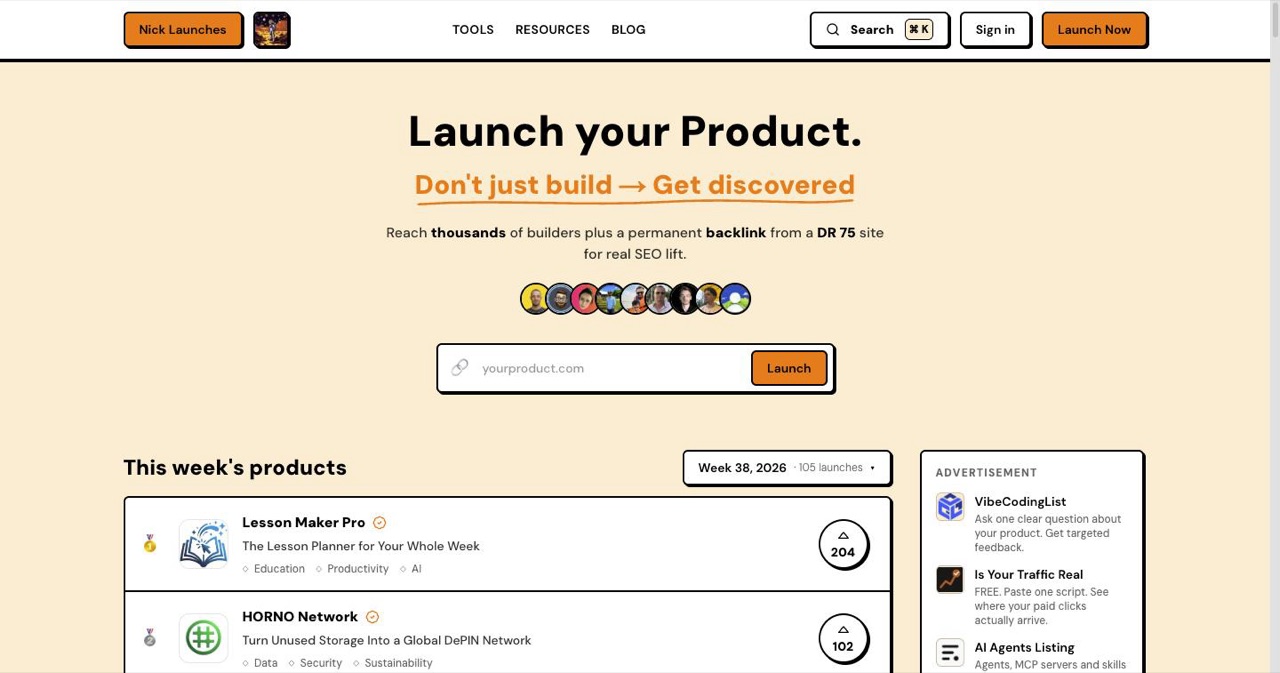
Nick Launches runs on a weekly launch cycle: submit your product, land in that week's cohort, and compete for the top of the ranking. Every product keeps a permanent listing page — and a permanent dofollow backlink from a DR 72 domain, which is the part that keeps paying off long after your launch week ends.
Highlights
- Weekly cohorts keep competition readable — you're ranked against that week's launches, not the entire internet.
- Free to submit, with a paid fast-lane if you want to launch immediately instead of waiting in the queue.
- The permanent DR 72 backlink gives every listing real SEO value on top of the discovery traffic.
Specs
- Best for: Weekly launch visibility with lasting SEO value
- Discovery model: Weekly launch cycle, rankings, and permanent product pages
- Audience: Builders, indie hackers, and early adopters
Pros
- One of the better link-value-per-effort ratios on this list
- Active weekly cohorts (100+ launches per week) mean the site stays fresh
Cons
- Younger platform with a smaller audience than Product Hunt
- Weekly ranking rewards products that show up with an engaged audience
It ranks third because it combines what launch platforms and evergreen directories each do well: a real launch moment plus a listing and backlink that don't expire. (Disclosure: Nick Launches is a SaaSCity sponsor — the ranking here reflects the same criteria applied to every platform on this list.)
4. PeerPush
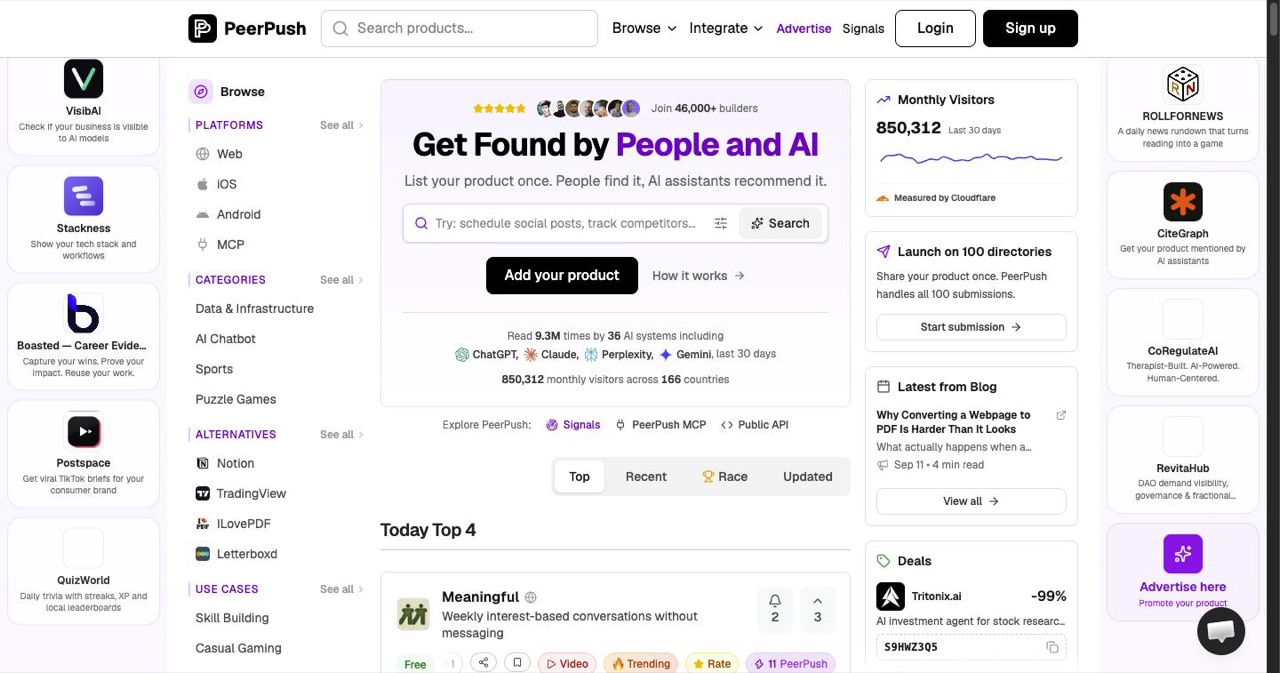
PeerPush is built for product discovery by people and AI assistants. Its structured profiles give emerging SaaS companies more context than a basic directory card.
Highlights
- Machine-readable profiles cover pricing, audiences, platforms, use cases, and alternatives.
- Product updates, community signals, API access, and an MCP server support ongoing discovery.
Specs
- Best for: Human and AI-assisted product discovery
- Discovery model: Structured search, rankings, updates, and community signals
- Audience: Builders, early adopters, AI users, and product researchers
Pros
- Free listing option and rich product context
- AI assistants can query its MCP tools directly
Cons
- Reach depends on accurate metadata and active participation
It ranks fourth because its AI-ready structure supports long-term discovery, though its community is narrower than Product Hunt's.
5. LaunchHive
LaunchHive mixes a product launch queue with a maker community. It suits founders who want discovery, peer support, and launch resources in one place.
Highlights
- Launch SaaS, apps, and indie businesses through a free or paid launch path.
- Use badge verification to move up the queue, then join community posts and backlink exchanges.
- Browse startup deals and acquisition listings alongside launches.
Specs
- Best for: Maker-community launches and founder networking
- Discovery model: Queue, rankings, posts, and badges
- Listing persistence: Ongoing profile with launch-period focus
Pros
- Free entry and more value than a one-day launch
Cons
- Badge and paid options can affect visibility; review link exchanges carefully
LaunchHive ranks fifth for its active participation loop, though its SaaS focus can get diluted by the broad mix of listings.
6. LaunchXact
LaunchXact is a curated discovery platform for indie SaaS products. It favors lasting product pages over a one-day leaderboard.
Highlights
- Curated positioning for solo founders and small SaaS teams
- Free AI landing-page readiness grader before submission
Specs
- Best for: Curated SaaS product discovery
- Discovery model: Product pages and early-adopter browsing
- Listing persistence: Continuous visibility
Pros
- Less dependent on launch-day ranking
- No forced discount positioning
Cons
- Smaller, still-growing ecosystem
- Not built for investor-grade research
It ranks sixth because its focused model suits emerging SaaS companies, but audience scale is still developing.
7. BetaList
BetaList targets upcoming and recently launched internet startups. It works best when you need early users, signups, and honest product feedback.
Highlights
- Built for pre-launch discovery and early-adopter feedback.
- Editorial review adds a useful quality filter.
- Featured profiles include direct site links.
Specs
- Best for: Pre-launch and recently launched startups
- Discovery model: Editorial timeline and profiles
- Audience: Early adopters, founders, and startup fans
Pros
- Strong fit for validation and first-user discovery
Cons
- All submissions are paid, and acceptance depends on clear positioning and design
- Your product needs its own domain and must meet BetaList's submission criteria
BetaList ranks seventh because it is focused and credible, but less useful for mature buyer research.
Honourable Mentions
These options work best for focused research rather than broad startup scouting. Use them when you need founder context or a view of funded company activity.
- Indie Hackers — strong for founder stories, build-in-public updates, and useful context on bootstrapped companies.
- Y Combinator Startup Directory — helpful for filtering funded companies by industry, with a large SaaS company group.
How to choose the right startup directory
Pick the directory based on the result you need, not its size.
- For ongoing SaaS discovery: Choose SaaSCity first. Its curated, gamified setup suits founders, buyers, and builders who want to keep finding tools beyond one launch day. PeerPush can also fit ongoing discovery.
- For launch buzz: Use Product Hunt or LaunchHive when a short burst of attention matters most. Nick Launches sits between the two jobs — a weekly launch moment plus a listing that keeps working.
- For early validation: BetaList is better suited to products still building an audience before launch.
- Check audience fit: A focused SaaS crowd beats a broad site with little interest in your category. Relevant visitors are more likely to sign up, reply, or share useful feedback.
- Choose evergreen value: A permanent profile can support repeated research and branded discovery. Launch pages often fade after the first spike.
- Bring proof: Submit a clear landing page, live product, screenshots, pricing context, and consistent company details.
For research, look past votes. Check updates, founder context, customer proof, category fit, and whether the company stays active. Track tagged links, qualified visits, signups, investor chats, and feedback — impressions alone are not success.
Find emerging SaaS tools or put your own product in front of early adopters: SaaSCity combines a curated directory with a gamified launchpad, helping founders earn visibility and helping buyers spot what is new.
Frequently Asked Questions
How can SaaSCity help my startup gain visibility in the SaaS market?
SaaSCity gives founders a focused listing, launch exposure, and community engagement. Its gamified format tends to earn more product views and interaction than a passive directory profile — and the listing page is permanent, so it keeps working long after launch week.
What are the best startup directories for SaaS founders in 2026?
Product Hunt remains useful for launch-day attention, SaaSCity suits ongoing SaaS discovery, and Nick Launches offers a weekly launch cycle with a permanent dofollow backlink from a DR 72 domain. Pick directories based on your audience, category fit, and the type of visibility you need.
How do I choose the right startup directory for my SaaS product?
Check whether your buyers actually use the site, review the listing rules, and study how similar products are presented. Favor directories that support clear positioning, real links, feedback, and lasting search visibility.
Should I submit to more than one startup directory?
Yes, but tailor each profile. Keep branding consistent, then adjust the pitch to match each audience. Track referral visits, signups, and feedback to see which listings actually earn attention.
Get your SaaS in front of founders
List your product on the SaaSCity live city map - a permanent listing, real discovery, and a backlink from a high-DR directory. Free to start; upgrade for a dofollow link and a building on the map.