News
Arc Browser Shuts Down December 22: The 'Novelty Tax' That Killed a Million-User Product (2026)
The Browser Company is killing Arc on December 22, 2026, and pushing its 1M+ weekly users into Dia instead. This is a free product that never found a business model, undone by the same quirky interface that made its fans love it, more than an AI story. SaaSCity runs a directory, so we read the wind-down like the product-strategy document it actually is.

Contents (7)
- The kill order: four dates, and why the sequence matters more than any one of them
- Every product rents a substrate, and the receipt eventually comes due
- The "novelty tax," in the company's own words
- What Arc users get pushed toward, and what doesn't come with them
- What a rename actually costs, and where a directory still helps
- The exit math: what $610 million actually bought
- A checklist, if you're the one holding the kill switch someday
A million weekly users, a devoted fanbase, a browser people wrote essays about, and on October 22, 2026, The Browser Company announced it's shutting the whole thing down: not selling it, not open-sourcing it, just turning it off on a fixed date, for good.
Quick answer: The Browser Company is sunsetting Arc, its browser with 1,000,000+ weekly users by its own claim, on December 22, 2026, pushing everyone toward Dia, the AI browser it built instead. The reason given is security maintenance, not an AI pivot: Arc was free, had no revenue model, and a May 2025 letter already called its interface a "novelty tax."
You're reading this on a directory's blog, so here's the honest framing up front: SaaSCity is a gamified startup directory with a live city map and a human actually looking at every listing before it goes live. We didn't build Arc, and we don't have inside information on The Browser Company. This is built off the company's own help center, its own May 2025 letter, and the release notes it shipped right up until the week it announced the sunset, because a free product with a million users shutting down over maintenance, not a failed feature, is exactly the kind of story worth reading slowly if you're running a SaaS of your own.
The kill order: four dates, and why the sequence matters more than any one of them
Arc doesn't disappear on one day. It disappears on a schedule, and the schedule itself is the part worth studying.
October 22, 2026: The Browser Company announces the sunset and freezes new Arc account creation immediately. TechCrunch had the story at 12:07 PM PDT that day, with 9to5Mac and Engadget covering it the same day.
November 23, 2026: Arc Search on iOS and Android keeps working as a plain browser, but AI features turn off, including the "Browse for Me" feature. Users can no longer sign in or sync tabs across devices. Arc for macOS and Windows starts surfacing sunset reminders inside the app.
December 15, 2026: Last day to request a copy of your account data, or ask The Browser Company to delete it outright. That's account details only (name, email, join date, a record of how you used the account), not your on-device browsing history, which the company never collected in the first place.
December 22, 2026: Arc for macOS and Windows stops working entirely. Every account deactivates. All Arc services turn off. Personal data gets deleted within 30 days, and per the company, it can't retrieve that data after that window closes. Arc Search for Android comes off the Google Play Store and off devices that already have it installed. Arc Search for iOS keeps running as a basic mobile browser with no account layer.
| Date | Stage | What happens |
|---|---|---|
| October 22, 2026 | Announcement + signup freeze | Sunset announced; no new Arc accounts can be created |
| November 23, 2026 | Feature degradation | Arc Search AI features (including "Browse for Me") turn off; no sign-in or tab sync; desktop app shows sunset reminders |
| December 15, 2026 | Data deadline | Last day to request a copy of your account data or ask for deletion |
| December 22, 2026 | Shutdown | Arc for macOS/Windows stops working, accounts deactivate, data deleted within 30 days, Arc Search pulled from Google Play |
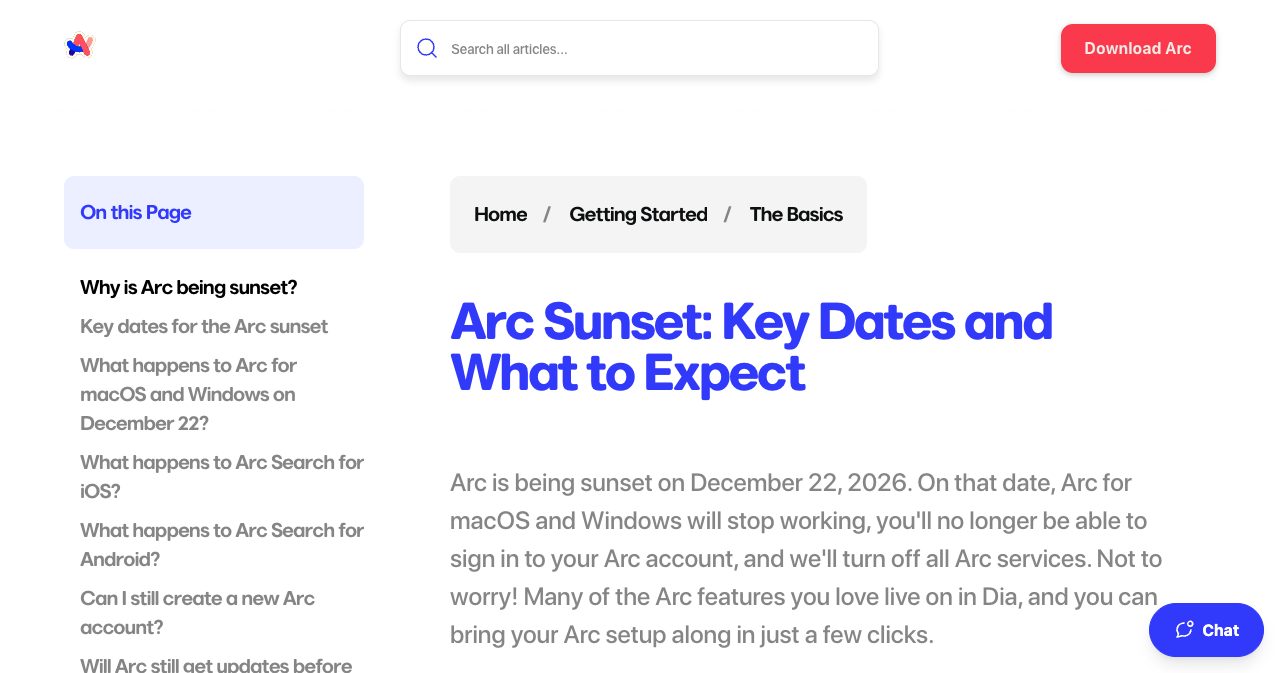
That sequence is the reusable artifact here, more than the dates themselves. Freeze new signups first, so you stop growing the problem. Degrade features second, so the product gets quieter before it gets dead. Give people a hard, named deadline to get their data out, published ahead of the kill date instead of announced on it. Only then, kill it, and say exactly what happens to the data and when. Per Arc's own help center article, "Arc Sunset: Key Dates and What to Expect," every step has a fixed date attached, not a vague "coming weeks." Most sunset notices you've read are worse than this one.
Every product rents a substrate, and the receipt eventually comes due
A browser is one of the most expensive products to keep alive, and it has nothing to do with AI hype: the cost comes from maintaining a security-critical engine you don't own.
Arc is built on Chromium, Google's open-source browser engine, and Chromium ships security patches on a near-weekly cadence. Skip too many of those and you're not running a quirky browser anymore, you're running an exploit waiting to be found. Look at Arc's own release notes from its last two weeks of life: v1.124.0 on October 15, 2026 shipped Chromium 143.0.7499.41, security and stability only. v1.170.0 on October 22, 2026, the same day as the sunset announcement, shipped Chromium 156.0.8078.48, again security fixes only, no features. Just upkeep, right up to the day they announced there'd be no more of it.
That's the company's own stated reason for the shutdown, quoted directly: "Our priority is to deliver best-in-class security for our members. Keeping a browser secure takes constant, dedicated work that is only increasing in the age of AI. Dia was built from the ground up to meet today's security standards, so that's where our engineering and security teams will focus moving forward."
Translate that to a normal SaaS and the substrate has a different name, but the bill works the same way. It's the framework major version you're three releases behind on. It's the auth provider that deprecates an API you built your login flow around. It's the model API whose pricing or rate limits shift under a feature you shipped two years ago. It's the app-store review policy that changes and suddenly your build fails until you rewrite a permissions flow nobody asked for. None of that work adds a feature. All of it is the cost of staying open for business, and it doesn't shrink just because your user growth has.
Arc's problem wasn't that Chromium got harder to maintain. It's that Arc was free, had no business model, and that maintenance bill kept arriving whether or not Arc was making money to pay it. A product that doesn't fund its own substrate is borrowing against a bill someone eventually has to pay, in engineering hours if not in cash. The Browser Company decided it wasn't worth paying twice: once for Arc's Chromium tax, once for Dia's.
The "novelty tax," in the company's own words
The security framing is the public reason. The real cause of death showed up seventeen months earlier, when The Browser Company admitted it out loud.
In a May 26, 2025 public letter titled "Letter to Arc members 2025," The Browser Company conceded that early adopters loved Arc's unconventional interface, but that the same complexity (the thing fans built entire YouTube channels around) carried what they called a "novelty tax" that limited mainstream adoption. Active feature development stopped around that point, without being announced, well before anyone outside the company knew Arc's clock had started running out.
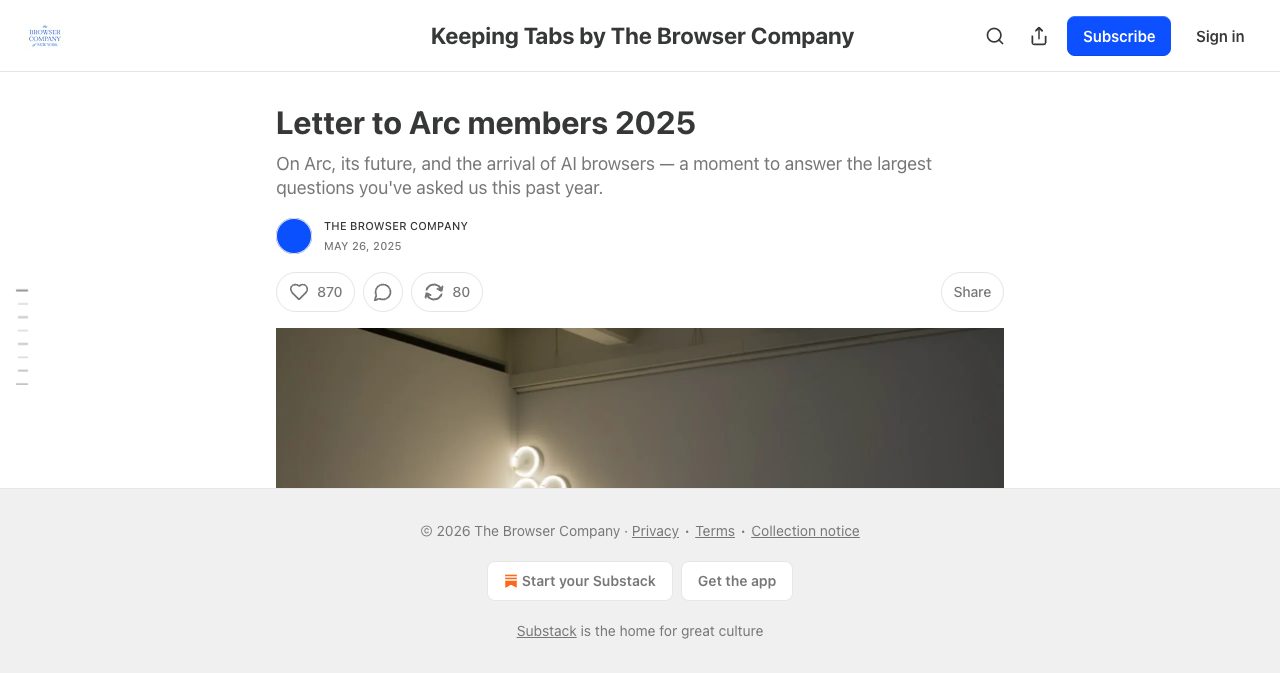
CEO Josh Miller's own line from that letter is the sharpest postmortem you'll read about a product that still had a devoted fanbase: "I would've stopped working on Arc a year earlier. Everything we ended up concluding — about growth, retention, how people actually used it — we had already seen in the data. We just didn't want to admit it. We knew. We were just in denial."
That's the trap, named plainly by the person who ran the company into it: a loud, loyal minority can make a product feel like it's winning long after the data says it's plateaued. Vertical tabs, Spaces, and Boosts (Arc's feature for restyling any website you visited) delighted the kind of user who'd spend an evening customizing a browser. Every one of those features added a decision to someone else's first ten minutes with the product, and first-ten-minutes friction is exactly what kills activation and retention for everyone who isn't already a fan. If you're building retention mechanics for a product with the same tension (power users who love the depth, everyone else who bounces at onboarding), our SaaS churn playbook is built around that exact fork: optimizing for your loudest 5% is a different job than optimizing for the other 95%, and you can't do both with the same onboarding flow.
What Arc users get pushed toward, and what doesn't come with them
The destination is Dia, the AI-first browser The Browser Company has been building since it wound down Arc development. It's free for macOS and Windows at diabrowser.com, and the pitch is blunt: "More than a browser. A better workday." AI is positioned as optional, not mandatory, which matters given what happened to Arc's own AI features in the interim shutdown phase.
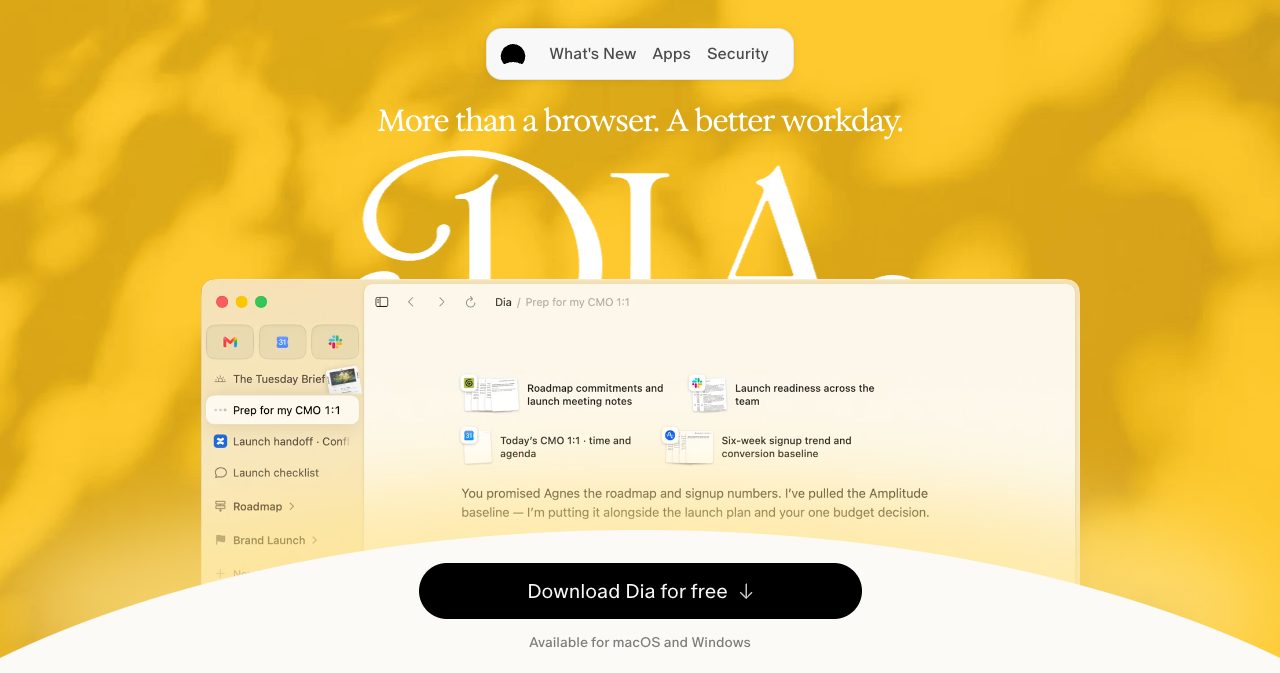
Per Arc's own "Move from Arc to Dia" migration guide, the plumbing mostly survives the move. Passwords, bookmarks, extensions, history and cookies import automatically, so you stay signed into the sites you were signed into. Spaces become Profiles you swipe between, with a choice of whether they share data. Folders become Pinned Tab Groups. GitHub Live Folders, which kept a folder of pull requests current, become Live Groups that do the same job under a new name. Vertical tabs live on as an optional sidebar layout rather than Arc's defining visual identity.
What doesn't survive is the part Arc's most devoted users are angriest about. Easels, Arc's built-in whiteboard-style notes feature, is gone. Boosts, the signature "restyle any website with your own CSS" feature, is gone, full stop, with nothing positioned as a replacement. And Dia imports no saved payment methods or autofill data from any browser, Arc included, so that's a manual re-entry job for everyone making the jump. Shipping migration tooling that moves the plumbing but drops the flourishes is a defensible call for a company trying to simplify, but it's worth being precise about: this is not a lossless move, and nobody should tell Arc's power users otherwise.
Open-sourcing Arc instead was reportedly never a live option. Miller has said previously, "While we'd love to open-source Arc someday, we can't do that meaningfully without also open-sourcing ADK. And ADK is still core to our company's value." ADK is the Arc Development Kit, the proprietary internal SDK that Arc runs on and that also powers Dia. Give away Arc's code and you're giving away Dia's engine too.
What a rename actually costs, and where a directory still helps
A rename costs distribution that no press release accounts for: every inbound link, every old review, every directory profile on the open web still points at "Arc" and arc.net. Dia starts close to zero on branded search, because nobody's been searching for it for three years. A rename or a successor product doesn't inherit the predecessor's distribution automatically. It has to go claim it.
This is the one honest place a listing site like SaaSCity fits into this story, and we'll keep it to a sentence, because this is a product-strategy piece, not a backlink pitch: directory listings and profiles are some of the few distribution assets that actually survive a rename, but only if someone goes back and re-claims them under the new name instead of assuming the old backlinks carry over. A free SaaSCity listing gets you a permanent page and a building on the live city map, and adding the badge to your own site earns a dofollow backlink plus a slot in the next Monday launch. That's not a fix for a rename's SEO hole. It's one of the few levers you actually control when the rest of your old brand's link equity stays stuck under a name you no longer use.
The exit math: what $610 million actually bought
On September 4, 2025, Atlassian agreed to acquire The Browser Company for $610 million in cash, with the company continuing to operate independently under Atlassian and keep building Dia. That's against $128 million the company had raised in total funding, including a $50 million round in March 2024 led by Pace Capital at a $550 million valuation. Atlassian CEO Mike Cannon-Brookes framed the deal as reimagining the browser for knowledge work in the AI era.
| Figure | Amount | Date / source |
|---|---|---|
| Total funding raised | $128 million | Through the company's funding history |
| Last private valuation | $550 million | March 2024, $50M round led by Pace Capital |
| Atlassian acquisition price | $610 million cash | Announced September 4, 2025 |
| Arc's weekly users at time of sunset | 1,000,000+ (company claim) | As of October 22, 2026 |
| Arc's reported revenue | None stated | Arc was free with no disclosed business model |
Run the numbers plainly, the same way we laid out Bending Spoons buying Miro for 90% below its 2022 valuation: $610 million cash against $128 million raised is a real, clean return for a company with a product that had no revenue model at all. That's not a fire sale and it's not a failure, and it shouldn't be written up as either. It's a sharp data point about what buyers actually pay for in 2025 and 2026.
What was Atlassian buying, exactly, for a product with 1M+ weekly users and zero ARR? Not Arc's revenue, because there wasn't any to buy. It bought the team, the Arc Development Kit that both Arc and Dia run on, and a claim on the part of the workday browsers are trying to own next: search, tabs, and now AI assistance sitting directly in the window where people already spend their time. That's a bet on engineering and positioning, not a multiple on recurring revenue, and it's worth knowing the difference before you read any acquisition price as a verdict on whether a product "worked."
A checklist, if you're the one holding the kill switch someday
Before you sunset anything with users attached to it, decide these in order, publicly if you can manage it:
- Does it still earn the maintenance it costs? Name the actual substrate tax (Chromium patches for a browser, a framework major for a web app, a model API's shifting terms for an AI feature) and be honest about whether the product's revenue, or its strategic value to something else you're building, still covers that bill.
- Who owns the migration path? Arc shipped a dedicated help center article and an import tool before the kill date, not after. If nobody on your team owns that deliverable by name, it won't exist when you need it.
- What's the export deadline, and is it before the kill date? December 15 for data requests, December 22 for the actual shutdown. A week's gap, publicly dated, beats "contact support before we turn it off" every time.
- What gets deleted, and when? Say exactly what category of data disappears (account details, in Arc's case) and what you never held in the first place (on-device browsing history). Vague deletion language just invites a worse assumption.
- What do you say, and in what order? Freeze growth first. Degrade features without fanfare second. Set the data deadline third. Only then pull the plug. Announcing the kill date and the freeze together, like Arc did, buys you a clean headline instead of a slow leak.
Arc didn't lose to AI, and The Browser Company didn't mismanage a beloved product in any way its own CEO hasn't already admitted to. "People love it" and "the business works" are two different questions, and Miller said plainly that the company knew the second answer long before it acted on it. If you're sitting on a product right now that your most vocal users adore and your retention data doesn't back up, Arc just showed you exactly how long you can put off answering that honestly, and exactly how public the bill gets when you finally do.
Get your SaaS in front of founders
List your product on the SaaSCity live city map - a permanent listing, real discovery, and a backlink from a high-DR directory. Free to start; upgrade for a dofollow link and a building on the map.