News
Mythos Model Alternatives From Asia Are Already Outscoring Claude on Benchmarks
While Anthropic's export ban drags into its third week, Sakana AI's Fugu Ultra scored 73.7 on SWE-Bench Pro versus Claude Opus 4.8's 69.2 — and China's 360 walked straight into the vulnerability-discovery market that Mythos owned.

Contents (7)
Quick answer: After the US directive of June 12, 2026 suspended Fable 5 and Claude Mythos 5 globally, two Asian labs shipped replacements within two weeks. Sakana AI's Fugu Ultra, a Tokyo-built multi-agent system, scores 73.7 on SWE-Bench Pro against Claude Opus 4.8's 69.2, plus 93.2 on LiveCodeBench and 95.5 on GPQA-D, priced at $5 in / $30 out per 1M tokens. China's 360 unveiled Tulongfeng for autonomous vulnerability discovery and Yitianzhen for cyber defense on June 24, 2026.
The US government pulled Anthropic's most powerful models on a Friday evening. By the following week, a Tokyo startup had shipped something that scored higher on SWE-Bench Pro — and a Chinese cybersecurity firm had walked straight into the vulnerability-discovery market that Mythos owned.
The ai export ban is two weeks old. The mythos model alternatives are already here.
Key Takeaways
- The ban was global: The June 12, 2026 directive suspended Fable 5 and Claude Mythos 5 for every user everywhere, because API caller nationality cannot be verified in real time at scale.
- Fugu Ultra leads on engineering: 73.7 on SWE-Bench Pro versus Claude Opus 4.8's 69.2, 93.2 on LiveCodeBench versus GPT-5.5's 85.3, and 50.0 on Humanity's Last Exam.
- Fugu is a system, not a model: It orchestrates specialized Thinker, Worker and Verifier agents via TRINITY and Conductor, two ICLR Spring 2026 papers, behind one API endpoint.
- Sakana's pricing is flat per task: Plans run $20 Standard, $100 Pro and $200 Max, and multi-agent tasks bill at the single highest-tier rate rather than stacking per model call.
- Europe is locked out for now: Sakana AI has suspended EU and EEA services pending a GDPR compliance review.
- 360 took the security slot: Tulongfeng automates vulnerability discovery and Yitianzhen automates cyber defense, both unveiled June 24, 2026, with no published benchmarks.
- Availability now outranks capability: Jurisdictional risk and a routing layer that swaps model backends matter more than picking the single highest-scoring model.
What the Ban Actually Took Off the Table
On June 12, the Trump administration issued a directive suspending access to Fable 5 and Claude Mythos 5 — for every user, everywhere on earth. The mechanism was blunt: you cannot verify API caller nationality in real time at scale, so Anthropic turned both models off globally. For every team that had built production pipelines around Fable 5 — at a company running a $47 billion annual run-rate as of May 2026 — there was suddenly no fallback and no timeline.
We've tracked how this unfolded, including the peculiar detail that Anthropic likely sped up Mythos 6's training using the compute freed by the suspension. Cold comfort if you need your pipeline running today.
What the ban created isn't an API outage. It's a credibility problem. If a government directive can take your core model offline with hours of notice, "we're building on Anthropic" is now a risk statement, not just a capability statement. Enterprise teams know this. The labs without US government entanglements know it too — and they moved fast.
Sakana Fugu: The Tokyo Model That Outscored Opus 4.8
Sakana AI was founded in 2023 by researchers who left Google to test a structurally different thesis. David Ha, Llion Jones — one of the eight authors on the original Attention Is All You Need paper — and Ren Ito, former Mercari and Stability AI executive, built the company in Tokyo around one idea: instead of training one bigger model, coordinate multiple smaller specialized ones.
Fugu is what that thesis looks like at frontier capability.
Calling it a "model" is technically imprecise. Fugu is a multi-agent system that presents as a single API endpoint. Two research papers from ICLR Spring 2026 underpin its architecture:
TRINITY — a lightweight evolved coordinator that assigns incoming tasks to specialized agents, giving each a role: Thinker, Worker, or Verifier. The orchestration runs across multiple turns, not a single pass.
Conductor — trained via reinforcement learning to discover natural-language coordination strategies. It doesn't follow a hand-designed workflow; it learned how to coordinate by optimizing for task outcomes.
The result is a system that can route a complex engineering problem to the right specialist, verify the output, and iterate — without human intervention. Sakana explicitly notes that Fable 5 and Mythos Preview are not available in Fugu's agent pool; both models were pulled before launch. The benchmarks reflect what's possible without Anthropic in the mix at all.
What the Numbers Say
| Benchmark | Fugu | Fugu Ultra | Claude Opus 4.8 | GPT-5.5 | Gemini 3.1 Pro |
|---|---|---|---|---|---|
| SWE-Bench Pro | 59.0 | 73.7 | 69.2 | — | — |
| LiveCodeBench | 92.9 | 93.2 | — | 85.3 | — |
| GPQA-D | 95.5 | 95.5 | — | — | 94.3 |
| Humanity's Last Exam | 47.2 | 50.0 | — | — | — |
Fugu Ultra at 73.7 on SWE-Bench Pro — a benchmark measuring autonomous software engineering — against Claude Opus 4.8's 69.2 isn't a marginal lead. For teams using AI to handle real codebases, that gap is the number that actually matters. On LiveCodeBench, Fugu edges GPT-5.5 by nearly eight points. On Humanity's Last Exam, 50.0 beats every published baseline in the comparison set.
Users report code reviews surfacing 20+ issues versus three from competing tools, and autonomous task completion stretching across nearly four hours of continuous work. Whether those anecdotes hold at scale depends on the use case — but they track with what you'd expect from a system that assigns a Verifier to check its own Thinker's output.
Pricing Structure
| Plan | Monthly | Notes |
|---|---|---|
| Standard | $20 | Lightweight use |
| Pro | $100 | 10× Standard allocation |
| Max | $200 | 30× Standard allocation |
| Fugu Ultra PAYG | $5 in / $30 out per 1M tokens | $10/$45 for contexts >272K |
One detail worth noting: for multi-agent tasks, Sakana applies the single highest-tier rate rather than stacking fees per model call. Cost predictability matters when you don't know upfront how many agent hops a task will require. For a full comparison against other frontier options, the AI agent coding token plans breakdown covers where Fugu sits in the market.
One constraint to flag: EU and EEA services are currently suspended pending GDPR compliance review. If your team is in Europe, that limits access right now.
360's Cybersecurity Models: Straight at Mythos Territory
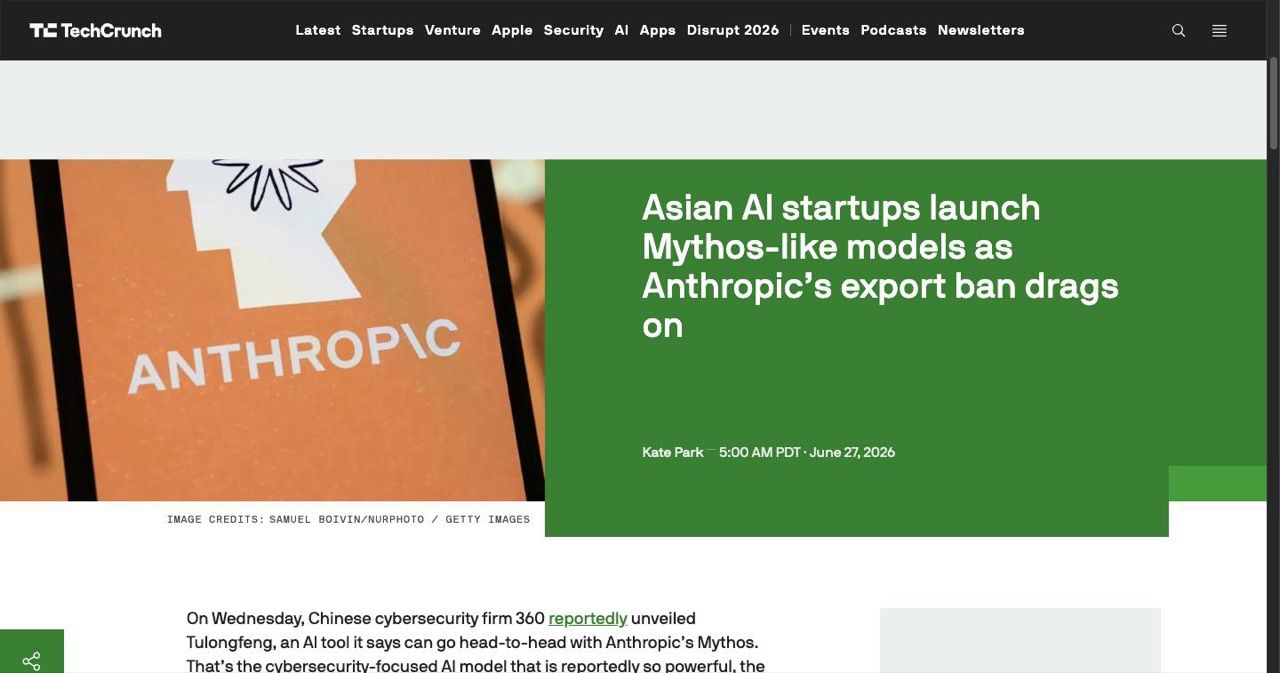
China's 360 — a cybersecurity firm founded by Zhou Hongyi — didn't try to build a general-purpose alternative. On June 24, the company unveiled two models aimed squarely at the use case that got Mythos restricted in the first place.
Tulongfeng automatically discovers software vulnerabilities. The capability description maps directly to what Anthropic demonstrated with Mythos Preview under Project Glasswing — the controlled program where vetted partners ran autonomous vulnerability discovery on their own infrastructure. Mythos found and exploited a 17-year-old FreeBSD RCE vulnerability without human intervention. Tulongfeng is positioned for the same work, from a Chinese firm, with no US export controls applying.
Yitianzhen automates cyber defense and incident response — the defensive complement to Tulongfeng's offensive discovery capability.
Neither model has published benchmarks comparable to Fugu's ICLR-backed papers. That's not the point. The significance is speed and positioning: the week after the ban entered its second week, a firm with deep security expertise shipped products filling the exact gap Mythos left. The direction isn't a coincidence, even if the timing is.
List Your AI Tool on SaaSCity
Building with Fugu, Tulongfeng, or any alternative model stack — your users are already looking for what you ship.
SaaSCity.io is the directory built for AI tools and developer products. Every listing earns a permanent, indexed page in the SaaSCity 3D city engine — visible to founders, engineers, and early adopters actively searching the space.
- Free to list: Takes under 2 minutes. No credit card.
- Earn dofollow backlinks: Indexed listings that compound your domain rating over time.
- 3D map placement: Your product appears as a building in the SaaSCity engine — a distinctive discovery surface for technical buyers.
- Reach the right audience: Not generic traffic — people who actually build and buy.
What This Means for SaaS AI Model Selection
The question used to be "which model is most capable?" For most teams in 2026, that's the wrong question.
Capability is now the table stakes. Availability is the differentiator.
The Fable 5 suspension hit enterprise teams that had done the technical evaluation, chosen the best model, built pipelines, and then watched access vanish for reasons entirely outside their control. David Ha put it directly: "Access to top models can disappear overnight." He was describing the general risk. He turned out to also be describing the week of his own launch.
This changes how saas ai model selection should work. A few things worth building into your framework:
Jurisdictional risk is a first-class variable. Models from US companies under US export control authority can be pulled by government directive. Models from Japanese or Chinese companies face different risk profiles — different, not absent. Sakana AI's EU suspension is a reminder that no provider is risk-free. You're managing a portfolio of different risks, not choosing a safe option.
Architecture flexibility compounds. Teams that abstracted their model calls behind a routing layer — one API, multiple model backends — pivoted during the Anthropic outage in hours. Teams hardcoded to a single provider endpoint are still finding workarounds. The open-weight model landscape now offers serious alternatives: MiniMax M3 and Kimi K2.7 from Moonshot AI both showed what's possible from Asian labs publishing openly — weights you could self-host on short notice if an API goes dark.
The benchmark story is shifting. Fugu Ultra outscoring Opus 4.8 on SWE-Bench Pro while being built in Tokyo on ICLR research reflects a structural trend, not an anomaly. Asian AI startups are publishing peer-reviewed architecture papers, shipping frontier numbers, and doing it without the US policy exposure that comes with Anthropic or OpenAI. These are live alternatives with production APIs — not experiments.
The pricing signals matter. Fugu Ultra at $5 input / $30 output per 1M tokens for a system that beats Opus 4.8 on engineering benchmarks is a real offer. That pricing exists partly because Sakana doesn't carry the cost structure of a San Francisco lab under government scrutiny.
Nobody Is Waiting
Ren Ito urged that "first priority should be to preserve access" for US allies. Zhou Hongyi unveiled Tulongfeng one week after the ban started. Anthropic trained Mythos 6 while Mythos 5 sat suspended.
The geopolitical reasoning behind the export ban was that Mythos-class capability is too dangerous to distribute broadly. The practical outcome is that equivalent capability — better on specific benchmarks — is now available from Tokyo, Beijing, and an expanding field of open weights that require no API call at all.
The ban didn't close the capability gap. It relocated it.
For SaaS builders, that means one thing: build as if any single model could disappear tomorrow. Not as a thought experiment — as infrastructure policy. The fallback you don't build before you need it is the one you build in a panic while your production systems are down.
The alternatives are already shipping. Some of them are already faster. One of them scored higher on the benchmark that matters most for engineering workloads.
SaaSCity.io covers AI model releases, developer tools, and what's shipping in the AI infrastructure space. Explore the SaaSCity directory to discover what's shipping right now — or list your own product.
Get your SaaS in front of founders
List your product on the SaaSCity live city map - a permanent listing, real discovery, and a backlink from a high-DR directory. Free to start; upgrade for a dofollow link and a building on the map.