News
Claude Sonnet 5: Anthropic's New Mid-Range Model and What It Means for SaaS Founders
Anthropic's new mid-tier model narrowly beat its own flagship on a real knowledge-work benchmark, and costs up to 60% less to run. Here's what changed in Claude Sonnet 5, what it costs, and what it means for anyone building on the API.

Contents (7)
Quick answer: Claude Sonnet 5 is Anthropic's mid-tier model, released June 30, 2026, and now the default for Free and Pro Claude users and available on the API as claude-sonnet-5. It is built for agentic execution: multi-step planning, browser and terminal use, and self-verification. It scores 63.2% on SWE-bench Pro, 80.4% on Terminal-Bench 2.1, and 1,618 on GDPval-AA v2, edging Opus 4.8's 1,615. Context is 1 million tokens. Introductory pricing runs $2 per million input tokens and $10 per million output through August 31, 2026, then $3/$15.
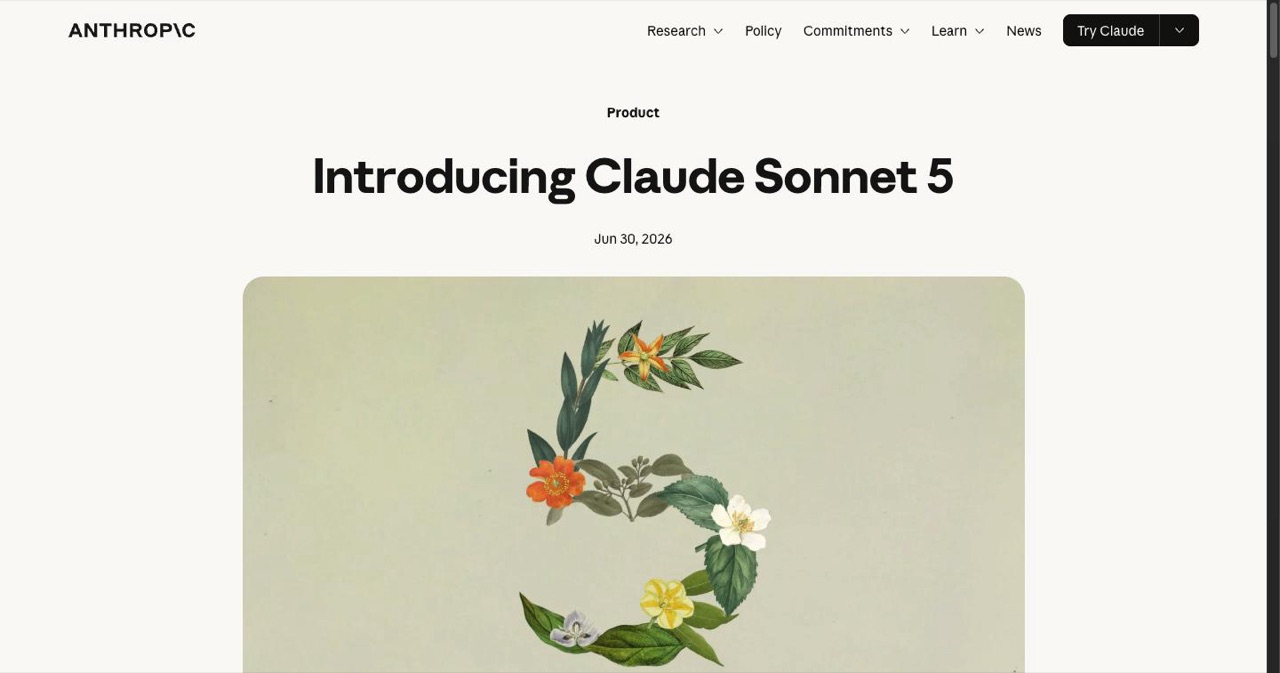
Anthropic's new mid-tier model just out-scored its own flagship on the benchmark that measures actual knowledge work, not a cherry-picked coding puzzle but the one that tracks whether a model can do real professional tasks end to end.
That's not a rounding error dressed up as a headline. On GDPval-AA v2, Claude Sonnet 5 scores 1,618 against Opus 4.8's 1,615, a model that costs up to 60% less to run edging out the one that charges $25 per million output tokens. It landed June 30, 2026, the same week OpenAI and Google both shipped their own cheaper, more agentic models. Anthropic is making a case that "which model" is about to stop being a strategic decision and start being a routing problem.
Key Takeaways
- Released June 30, 2026: Sonnet 5 replaces Sonnet 4.6 and is the default model for Free and Pro Claude users, plus Max, Team, and Enterprise.
- Beats Opus on knowledge work: GDPval-AA v2 puts Sonnet 5 at 1,618 against Opus 4.8's 1,615, and Humanity's Last Exam with tools is 57.4% vs 57.9%.
- Opus still wins hard coding: SWE-bench Pro is 63.2% for Sonnet 5 against 69.2% for Opus 4.8, a six-point gap.
- Terminal-Bench moved 13 points: Sonnet 4.6 scored 67.0% on Terminal-Bench 2.1; Sonnet 5 scores 80.4%.
- Intro pricing expires August 31, 2026: $2 per million input and $10 per million output, then $3/$15, which is what Sonnet 4.6 already cost.
- Effort level changes the math: Hacker News testers found the cost edge over Opus is clearest at low and medium reasoning effort and narrows at maximum effort.
- Safety posture: 1 million token context, lower rates of undesirable behavior than 4.6, reduced cybersecurity capability versus Opus, and real-time cyber safeguards on by default.
The Model Anthropic Wants Running by Default
Claude Sonnet 5 is now the default model for every Free and Pro Claude user, and it's available to Max, Team, and Enterprise customers too. On the API it's claude-sonnet-5. Anthropic built it around one job: agentic execution. It plans multi-step tasks, drives browsers and terminals, and, per Anthropic's own announcement, checks its own work without being told to. That last part matters more than it sounds. Self-verification is the difference between a model that hands you a plausible-looking answer and one that catches its own mistake before you see it.
It replaces Sonnet 4.6, which held the mid-tier slot since earlier this year. Every published benchmark moved in the same direction: up.
Where the Numbers Actually Moved
| Benchmark | Sonnet 4.6 | Sonnet 5 | Opus 4.8 |
|---|---|---|---|
| SWE-bench Pro | 58.1% | 63.2% | 69.2% |
| Terminal-Bench 2.1 | 67.0% | 80.4% | not reported |
| OSWorld-Verified | 78.5% | 81.2% | not reported |
| Humanity's Last Exam (tools) | 46.8% | 57.4% | 57.9% |
| GDPval-AA v2 | not reported | 1,618 | 1,615 |
(Numbers via MarkTechPost's benchmark breakdown.)
The Terminal-Bench jump is the one worth sitting with: 67% to 80.4% is a 13-point swing in a single model generation, on a benchmark that measures whether an agent can actually operate a command line, not just describe what it would do. SWE-bench Pro still shows Opus ahead by six points, so the "Sonnet is basically Opus now" take is only half true. On hard agentic coding, Opus 4.8 remains the stronger model. On knowledge work and general reasoning with tools, Sonnet 5 has closed the gap to a rounding error.
Context window sits at 1 million tokens. Anthropic also says Sonnet 5 shows lower rates of undesirable behavior than 4.6 and meaningfully reduced cybersecurity capability compared to Opus, with real-time cyber safeguards on by default. That's the kind of detail that matters if you're deploying agents with real tool access and don't want to think about it twice.
The Price Anthropic Set to Expire
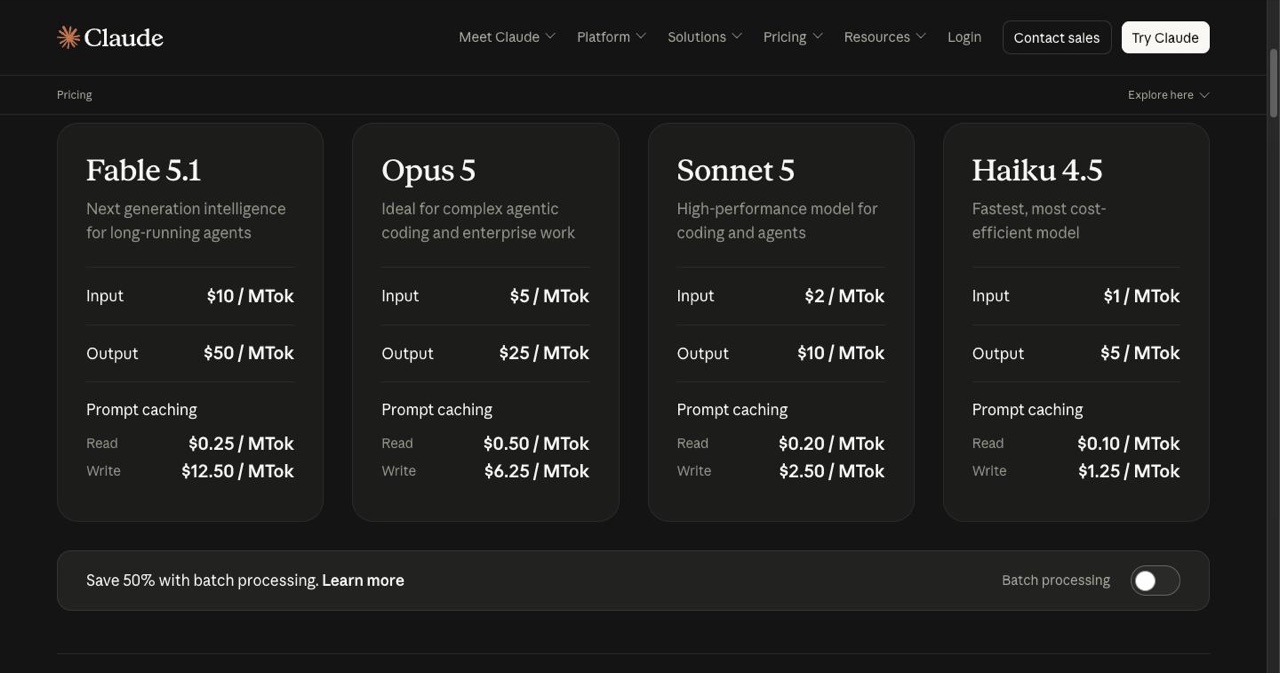
Here's the number that'll actually move your API bill: $2 per million input tokens, $10 per million output tokens, introductory pricing good through August 31, 2026. After that it steps up to $3/$15, which happens to be exactly what Sonnet 4.6 cost before this launch. You're getting a materially better model at the old price, with a two-month window where it's cheaper still.
| Model | Input (per 1M) | Output (per 1M) |
|---|---|---|
| Sonnet 5 (intro, through Aug 31) | $2.00 | $10.00 |
| Sonnet 5 (standard, from Sept 1) | $3.00 | $15.00 |
| Sonnet 4.6 | $3.00 | $15.00 |
| Opus 4.8 | $5.00 | $25.00 |
Anthropic is positioning Sonnet 5 as cheaper than GPT-5.5 and Gemini 3.1 Pro, while sitting above Gemini 3.5 Flash on price. That's a deliberate middle-of-the-pack play, not an attempt to win on cost alone. Anthropic wants Sonnet 5 to be the model you reach for when you'd otherwise default to a flagship out of habit.
The timing isn't a coincidence either. Sonnet 5 shipped days after OpenAI's GPT-5.6 Sol launched with its own three-tier pricing structure, and in the same stretch Google pushed Gemini 3.5 Flash with a similar cheap-and-agentic pitch. Three labs shipped within the same stretch, all making the same argument: agentic capability stopped being the differentiator, and price per agentic task took its place. That's what AI model pricing in 2026 actually looks like, mid-tier models racing to make the expensive flagship the exception instead of the default.
List Your AI Tool on SaaSCity
Building something on Sonnet 5, Opus 4.8, or any other model in the current lineup? Get it in front of the founders deciding what to build on next.
- Free with our badge — add the SaaSCity badge to your homepage and book a week in the free queue, or skip the queue with Quick Pass ($14.99)
- Dofollow backlinks — every approved listing earns a link back to your domain
- 3D city map visibility — a permanent, indexed spot inside the SaaSCity interactive map
- Submit your product at saascity.io/live/submit
What Changes for Anyone Building on the API
Your cost model from three weeks ago is already out of date. If you priced out Claude API costs against what Claude Code actually costs across its plan tiers, rerun the math. A model that beat Sonnet 4.6 on every benchmark now costs the same as 4.6 did, or less, through August. That price is already the floor, not a limited-time discount.
Effort level matters more than model name now. A Hacker News thread dissecting Sonnet 5 landed on a real nuance: the cost advantage over Opus is clearest at low and medium reasoning effort. Push Sonnet 5 to its highest effort setting to match Opus-level accuracy on a hard task, and the gap narrows enough that Opus at a lower effort setting can finish comparably priced work faster. If your routing logic picks a model once and stops thinking, you're leaving money on the table in one direction or the other.
Fully agentic isn't automatically better for every workflow. One early commenter flagged something worth taking seriously: a model tuned hard for autonomous, multi-step agentic work isn't guaranteed to be the best model for interactive, human-in-the-loop coding assistance. If your product is a copilot rather than an autonomous agent, don't assume the model built for the headline benchmark is the right pick for your actual usage pattern.
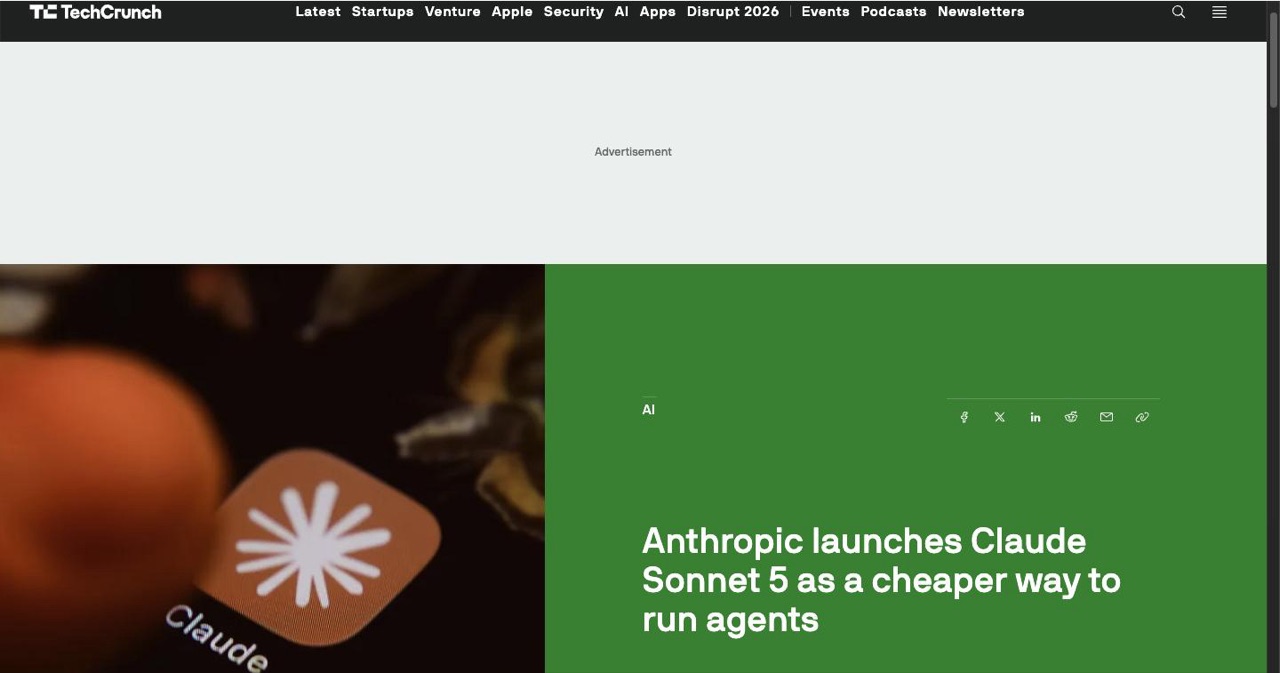
Real workloads back this up. Zapier engineer Daniel Shepard told TechCrunch that workflows which used to stall halfway now complete. "For day-to-day automation," he said, "it's a no-brainer." That's the practical bar for a mid-tier model: not benchmark supremacy, just doing the boring multi-step task correctly on the first pass, most of the time, without paying flagship rates to get there.
If you're running or building AI agent products, the economics keep shifting faster than any single model release. It's worth revisiting how you're thinking about token costs and tiered routing at least once a quarter, because "current pricing" has a shelf life measured in weeks this year.
The Benchmark Isn't the Point
Sonnet 5 beating Opus 4.8 on one benchmark isn't the real story. Anthropic shipped a mid-tier model good enough that "just use the flagship" stops being the safe default answer for a lot of teams.
That's a habit change, and habits outlast pricing pages. Six months from now, the interesting question won't be which model won which benchmark in June 2026. It'll be how many teams are still paying flagship prices for tasks a $2 model handles fine, because nobody went back and checked.
SaaSCity.io covers AI model releases and what they mean for builders. Explore the SaaSCity directory to discover what's shipping right now — or list your own product.
Get your SaaS in front of founders
List your product on the SaaSCity live city map - a permanent listing, real discovery, and a backlink from a high-DR directory. Free to start; upgrade for a dofollow link and a building on the map.
Founder resources
Related articles
Better Models, Worse Tools: Why Newer AI Models Are Breaking Your Agent Tool Calls
Anthropic's IPO Filing: $518 Billion in Commitments, 80 Pages of Risk, and What It Actually Means for SaaS Founders (2026)