News
GLM-5.3: Same Base Model, 50% Better at Coding — and a Cyber Capability Z.ai Didn't Plan For
Z.ai shipped GLM-5.3 today on the exact same 744B base as GLM-5.2. Every gain came from post-training alone: Terminal-Bench 3.0 jumped from 4.6 to 28.3, ExploitBench more than doubled, and the weights got delayed two weeks because the security skills grew faster than anyone intended.

Contents (12)
- Key Takeaways
- Where GLM-5.3 sits in the family
- The recipe: what Z.ai actually scaled
- The coding benchmarks
- Agentic results
- The part they didn't plan: emergent cyber capability
- Availability, pricing, and one breaking API change
- Ship it somewhere people can find it
- What this means for the field
- What I'd actually do this week
- The bottom line
- Advertise your product on SaaSCity
Quick answer: GLM-5.3 is Z.ai's coding and agentic model, released August 14, 2026 on the identical ~744B Mixture-of-Experts base as GLM-5.2 with roughly 40B active parameters and no new pretraining. Every gain came from scaled post-training on long-horizon RL environments: Terminal-Bench 3.0 rose from 4.6 to 28.3, SWE-Marathon v1.1 from 19.4 to 42.5, and ExploitBench from 24.4 to 54.4. Z.ai held the open weights roughly two weeks, targeting August 28, because the cyber capability grew further than planned.
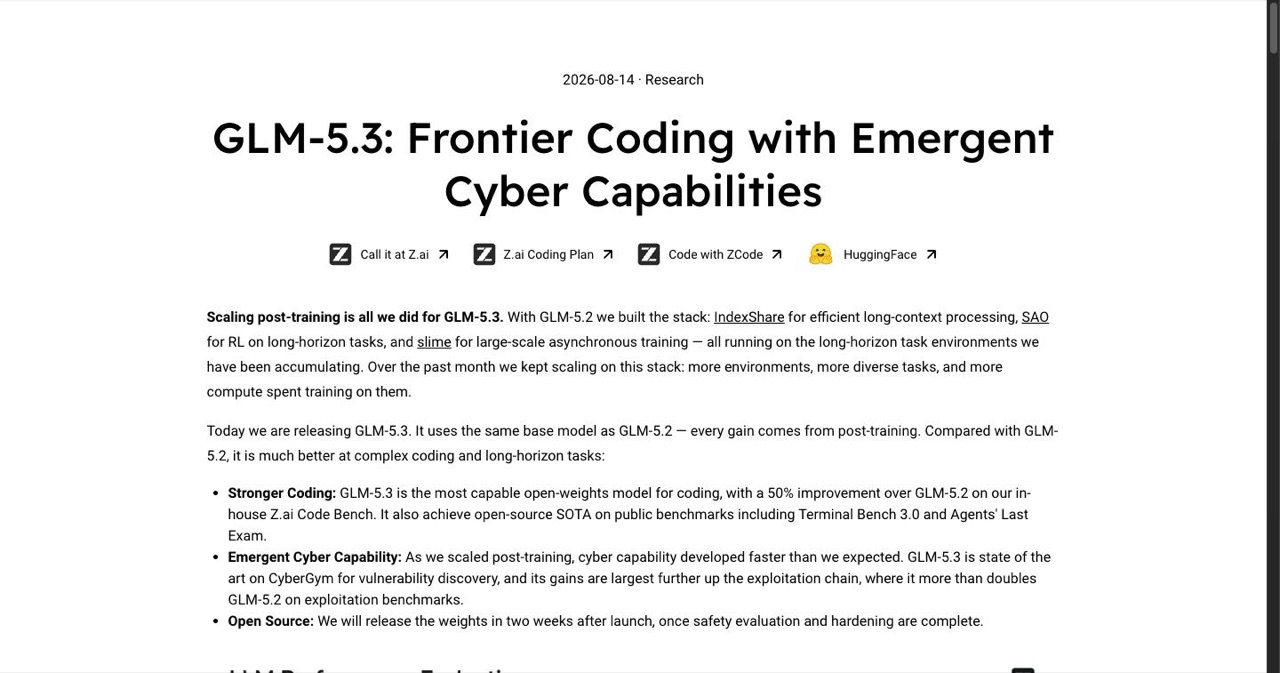
Z.ai shipped GLM-5.3 on August 14, 2026, and the headline number is not the benchmark. It's the base model: the same ~744B Mixture-of-Experts checkpoint that powered GLM-5.2, roughly 40B active parameters, no new pretraining run. Everything that improved, improved after the base was frozen.
On Terminal-Bench 3.0 — the hardest terminal-agent suite currently in circulation — GLM-5.2 scored 4.6. GLM-5.3 scores 28.3. That is not a tuning delta. That is a model that was previously incapable of the task category becoming capable of it, without a single additional pretraining FLOP.
The second thing Z.ai announced is stranger, and it's why you can't download the weights today. The team added vulnerability-discovery data to the post-training mix expecting modestly better bug-finding. What came out was a model that reasons across multi-stage exploitation chains — and the weights are now held roughly two weeks for safety hardening, targeted around August 28. The official Z.ai thread framed it as "Built to Code. Ready for Cyber Defense," which is a considerably more loaded tagline than any open-weights lab has used this year.
For anyone shipping software with agents, the practical thesis is this: the bottleneck moved from pretraining scale to training-environment quality, and GLM-5.3 is the cleanest public evidence of it so far.
Key Takeaways
- Same base, no new pretraining: GLM-5.3 runs on the identical ~744B MoE checkpoint as GLM-5.2, roughly 40B active parameters, with every gain coming from post-training.
- Long-horizon tasks improved most: Terminal-Bench 3.0 went 4.6 to 28.3 and SWE-Marathon v1.1 went 19.4 to 42.5, while short-horizon suites moved only single digits.
- Token efficiency is the commercial claim: Z.ai reports 31.4% completion at ~50k output tokens versus Claude Opus 4.8's 29.5% at ~120k on its private Code Bench.
- Weights delayed for cyber capability: ExploitBench more than doubled to 54.4 and ExploitGym went from 29 to 105 tasks in two hours, so weights were held about two weeks, targeting August 28, 2026.
- The real-world vulnerability haul: 2,436 vulnerabilities across 269 open-source projects, 1,097 rated critical or high, with an average age of 26.6 years undetected and the oldest dating to roughly 1981.
- Thinking is always on now:
thinking.type: "disabled"is gone. Three effort levels remain,low,highandmax, defaulting tomax, which breaks integrations that disabled reasoning. - slime is the durable contribution: Z.ai's open-source asynchronous RL framework, Megatron for training and SGLang for rollout, got over 2.3x throughput on long-horizon coding RL.
- Downloadable is not laptop-runnable: A ~744B MoE with 40B active needs multi-GPU servers even quantized, so self-hosting GLM-5.3 is a cluster conversation.
Where GLM-5.3 sits in the family
Z.ai — formerly Zhipu AI, the Tsinghua-affiliated lab behind the original ChatGLM — has been iterating on roughly a two-month cadence:
- GLM-5 (February 2026): 744B MoE, ~40B active. The release where the pitch shifted from "vibe coding" to agentic engineering.
- GLM-5.1 (April 2026): long-horizon focus, autonomous sessions pushed toward the eight-hour mark.
- GLM-5.2 (June 2026): first genuinely lossless 1M-token context, the IndexShare sparse-attention architecture, open-source coding SOTA at release, MIT-licensed weights.
- GLM-5.3 (August 14, 2026): same base as 5.2, post-training only.
That lineage matters for reading today's numbers correctly. GLM-5.2 was already the model people pointed at when arguing that open weights had caught up — it beat GPT-5.5 on SWE-bench Pro and hallucinated at roughly a third the rate, which we covered in detail in the GPT-5.5 vs GLM-5.2 benchmark breakdown. GLM-5.3 is not a new claim to relevance. It's an argument that the same checkpoint had a lot more headroom than anyone was extracting.
The competitive set is crowded in a way it wasn't twelve months ago. Open weights: Kimi K3 and Qwen3.8-Max, DeepSeek V4, MiniMax M3. Closed frontier: GPT-5.6 Sol, Claude Fable 5 and Mythos. GLM's differentiator has consistently been bilingual EN/ZH strength, parameter efficiency, and the fact that you can eventually host it yourself.
The recipe: what Z.ai actually scaled
The technical stack carried straight over from GLM-5.2. Nothing here is new architecture:
IndexShare — the sparse attention scheme that makes 1M-token context economically viable rather than theoretically available. GLM-5.3 inherits the same solid 1M window, with max output around 128k.
SAO — Z.ai's RL method for long-horizon tasks with context compaction, so an agent working a multi-hour job doesn't lose the thread when the window fills.
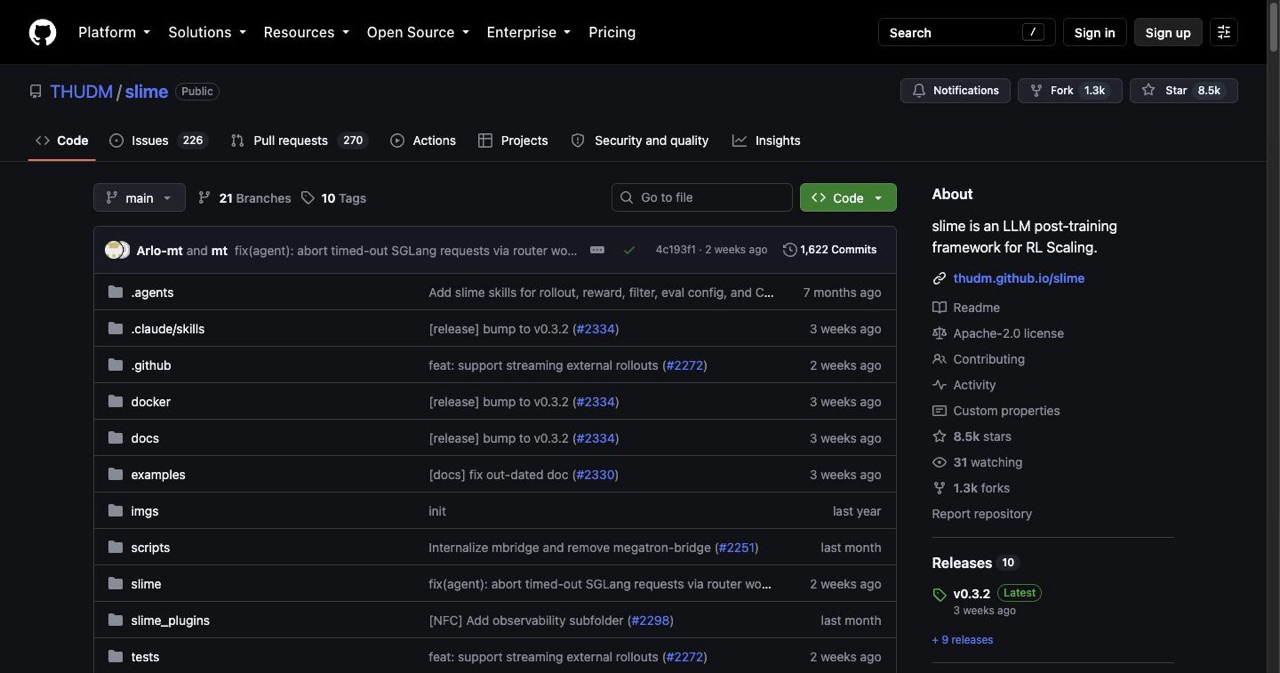
slime — the open-source asynchronous RL framework (GitHub), Megatron for training and SGLang for rollout. This is the part the wider community can actually use today, and it's arguably the more durable contribution than the model itself.
What got scaled was the environments. Z.ai's stated goal was tasks that mimic real professional engineering work — the multi-day, senior-engineer kind, not the leetcode kind. Their flagship example is full ML infrastructure optimization: give the agent a cluster, documentation, a codebase and an experiment suite, and grade it on measurable end-to-end speedup. Not "did you write the function," but "did the thing get faster."
The generation pipeline is worth understanding because it's the actual moat:
- Research agents synthesize candidate tasks from observed real work patterns.
- Judge agents verify each task is genuinely solvable before it enters the pool.
- Verifiers are synthesized without reference solutions, so the model can't pattern-match its way to a reward.
- Reward signals are binary and deliberately shortcut-resistant.
Humans are still in the loop, but progressively less of it. On the systems side, slime got >2.3× throughput on long-horizon coding RL, training-rollout consistency tightened to logprob differences around 1e-7, plus multi-teacher OPD support and hierarchical caching.
The philosophy Z.ai keeps repeating is "taking ownership of substantial work end-to-end" — training the model to own an outcome rather than execute a step. That's the same shift we've been tracking in tooling, from harness engineering at OpenAI to Spotify's Xirp: the scaffolding around the model became the product surface, and now it's becoming the training surface too.
The coding benchmarks
All figures below are vendor-reported from Z.ai's launch post. Methodology footnotes live there; treat them as directional until weights ship and third parties can replicate.
| Benchmark | GLM-5.2 | GLM-5.3 | Notable comparison |
|---|---|---|---|
| Terminal-Bench 2.1 | 81.0 | 88.2 | Kimi K3 88.3, GPT-5.6 Sol 88.8 |
| Terminal-Bench 3.0 | 4.6 | 28.3 | Opus 4.8 21.1, Fable 5 33.7, GPT-5.6 Sol 34.6 |
| DeepSWE v1.1 | 46.2 | 66.9 | — |
| NL2Repo | 48.9 | 58.0 | — |
| FrontierSWE | 67.5 | 78.1 | — |
| SWE-Marathon v1.1 | 19.4 | 42.5 | — |
| PostTrainBench | 31.7 | 39.8 | — |
Terminal-Bench 3.0 is the number people will quote, and rightly — 4.6 to 28.3 is a capability that didn't exist becoming one that does, and it's open-source SOTA on that suite. But look at SWE-Marathon: 19.4 to 42.5, more than doubling on the suite explicitly designed around marathon-length engineering work. The pattern across the whole table is monotonic. The longer and messier the task, the larger the improvement. Short-horizon suites moved single digits; long-horizon suites moved 2–6×.
Then there's the in-house Z.ai Code Bench, built from realistic local dev environments and pitched as contamination-resistant. Roughly 50% relative improvement overall, but the token numbers are the interesting part:
| Setting | Completion | Output tokens |
|---|---|---|
| GLM-5.2 (Max) | 23.4% | ~96k |
| GLM-5.3 (High) | 31.4% | ~50k |
| GLM-5.3 (Max) | 34.5% | ~75k |
| Claude Opus 4.8 | 29.5% | ~120k |
| Claude Fable 5 | 39.5% | — |
GLM-5.3 at High effort beats Opus 4.8 on completion while spending roughly 40% of the output tokens. That is the claim with the clearest commercial consequence, and it's the one I'd test first on real work — because if it holds, it changes the arithmetic we walked through in tokenomics for agentic software engineering and in the plan-by-plan math on AI agent coding token plans. Completion rate per dollar, not completion rate, is the number that decides whether an agent feature has a viable unit economy.
Two honest caveats. Fable 5 still leads at 39.5%, so this is a gap-closing release rather than a lead-taking one. And Code Bench is private, which means the most flattering number in the announcement is the one nobody outside Z.ai can check.
Agentic results
| Benchmark | GLM-5.2 | GLM-5.3 | Note |
|---|---|---|---|
| Toolathlon Verified | 59.9 | 73.0 | — |
| AutomationBench | 26.2 | 48.2 | ~85% relative gain |
| Agents' Last Exam (ALE-CLI) | 23.8 | 28.5 | open-weights SOTA |
| HLE with tools | 54.7 | 62.5 | — |
| GDPval-AA v2 | 1508 | 1769 | ahead of Fable 5 (1743), GPT-5.6 Sol (1730) |
GDPval-AA v2 is the one with the least vendor gravity on it — 44 occupations, economically-grounded task set, and GLM-5.3 comes out ahead of both closed frontier models listed. Take that with the usual caution about any single aggregate score, but it's the strongest data point in the release for "this is genuinely frontier-adjacent, not just open-weights-frontier."
Early independent hands-on reports circulating on X and YouTube cluster around the same observations: strong frontend work, noticeably better 3D and game-dev output, improved spatial reasoning, high cache-hit rates in agent loops. That last one is a cost lever people underrate — it's the same reason prompt structure discipline keeps mattering more than model choice for a lot of production workloads.
The part they didn't plan: emergent cyber capability
Here's the section that makes this release different from every other model launch this quarter.
Z.ai added vulnerability-discovery data and environments to post-training with a modest goal: better isolated bug-finding. Find the buffer overflow, flag the injection, done. Instead the capability compounded. The model started chaining stages — discovery into validation into exploitation — which is a qualitatively different thing from spotting a bad memcpy.
| Benchmark | GLM-5.2 | GLM-5.3 | Comparison |
|---|---|---|---|
| CyberGym (white-box vuln ID + validation) | 77.2% | 84.5% | SOTA; Mythos 5 83.8, GPT-5.6 Sol 83.6 |
| ExploitBench | 24.4 | 54.4 | more than doubled |
| ExploitGym (2h / 6h, time-normalized) | 29 / 39 | 105 / 130 tasks | closed models still lead (~181–247) |
The real-world transfer is where this stops being a benchmark story. Since GLM-5.2, Z.ai has been running collaborations with Chinese security teams, and reports 2,436 vulnerabilities found across 269 open-source projects — kernels, operating systems, browsers, infrastructure, protocol implementations. 1,097 rated critical or high severity. The oldest bug in the set dates to roughly 1981, and the average age of a discovered vulnerability is 26.6 years undetected.
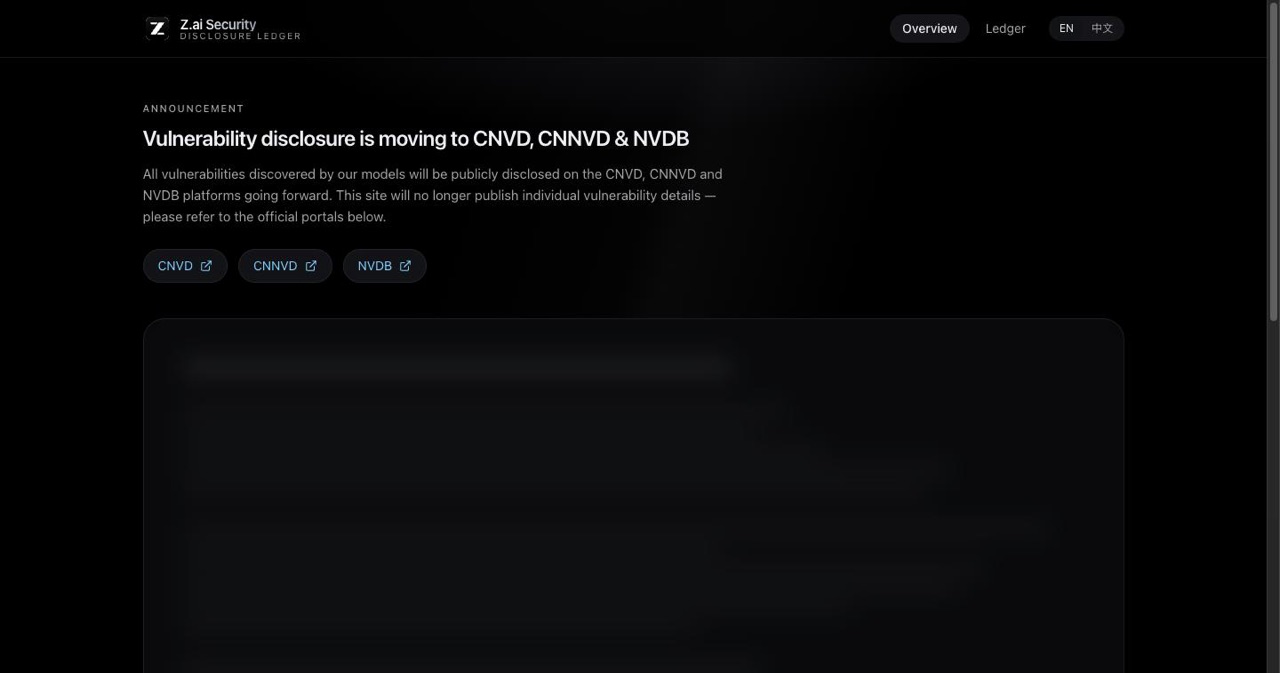
Those numbers deserve a moment. Twenty-six years of human review, fuzzing, and static analysis on widely-deployed open-source code, and a post-training run on an existing base model surfaced them at scale. Z.ai maintains a public ledger at cvd.z.ai: 53 disclosed so far, 2,383 still under coordinated-disclosure embargo.
The dual-use framing is unavoidable and Z.ai doesn't dodge it. Their own data shows the largest gains sit higher in the exploitation chain — precisely where the gap to closed models had been widest, and precisely the capability that's hardest to argue is purely defensive. Hence the explicit two-week hold on weights, which as far as I can tell is the first time a major open-weights lab has publicly delayed a release specifically over emergent security capability rather than general safety boilerplate.
If you ship software, the near-term consequence is simple and not theoretical: the cost of finding bugs in your dependencies just dropped for everyone, including people who don't file CVEs. Our pre-launch security checklist for vibe-coded startups covers the five checks that catch most of what actually happens to small apps — and the case for running them this month rather than next quarter got materially stronger today.
Availability, pricing, and one breaking API change
Today: full rollout to all GLM Coding Plan subscribers (Lite, Pro, Max, Team) plus the ZCode tool. A handful of launch partners are offering GLM-5.3-powered services under safeguards.
~August 28: API access and open weights, after safety hardening. Prior GLM releases shipped MIT-licensed; expect the same, but it isn't formally confirmed for 5.3.
Context: solid 1M tokens inherited from 5.2, max output ~128k.
The breaking change worth reading twice: thinking is now always enabled. There are three effort levels — low, high, max, defaulting to max, with max recommended for coding. thinking.type: "disabled" is gone. If you have integration code that explicitly disables reasoning to control latency or cost, it will need updating before you point it at 5.3. Check the docs for the current parameter shape.
Pricing is expected to land at GLM-5.2/5.1 levels, which have historically been aggressive relative to closed frontier. Confirm on z.ai before you model it — that's the number most likely to have moved by the time you read this.
Ship it somewhere people can find it
Quick interruption, because it's the same lesson every one of these launches teaches: Z.ai's benchmark table is excellent, and it's not why 15,000 people saw it. Distribution is. The model is the easy part now — the code is cheap, the attention isn't.
SaaSCity is a directory built as a live city map, where every product is a building people click through rather than a row in a table nobody scrolls. You can submit your product for free and be on the map this week; paid plans carry a dofollow link and permanent placement. If you're planning a launch sequence rather than a single launch day, our Product Hunt alternatives guide maps the other surfaces worth hitting in the same seven days.
And if what you actually need is Domain Rating rather than launch-day noise, the 0-to-30 DR playbook is the method written out week by week, how to increase your Ahrefs DR explains what genuinely moves it, and the Domain Rating checker tells you where you're starting in about ten seconds.
What this means for the field
Post-training is the primary lever now. For two years the reflex answer to "how do we get a better model" was "train a bigger one." GLM-5.3 is a controlled experiment against that reflex — identical base, frozen weights, and a 6× jump on the hardest agentic suite. Once a base model is strong enough, the returns have moved to the quality and quantity of training environments. That's a very different capital structure: environments are engineering work, not a datacenter.
slime being open-source amplifies this. The framework that produced these gains is public. Labs and serious teams that couldn't dream of a frontier pretraining run can absolutely build task environments and run long-horizon RL. Expect the open-weights field to get noisier, faster.
Open weights keep eating the reliability argument. The case for self-hosting was never purely about cost. It's continuity — an argument that got very concrete when the Fable 5 shutdown showed how quickly proprietary API access can evaporate for reasons that have nothing to do with your product. A near-frontier coder you can download and pin is a hedge with a price you can calculate. The same logic that pushes teams toward self-hosting their infrastructure applies one layer up.
But "open weights" doesn't mean "on your laptop." A ~744B MoE with 40B active needs real hardware even quantized. For actual local development, smaller models in the 20–70B range remain the pragmatic pick. GLM-5.3 self-hosting is a cluster conversation.
The cyber question is now a release-policy question. An open-weights model that meaningfully advances multi-stage exploitation is a genuinely hard case: publishing it accelerates defenders who are structurally under-resourced, and attackers who are not. Z.ai's answer — ship the product, delay the weights, publish a disclosure ledger — is more considered than "release and see." It is also, unavoidably, a two-week head start rather than a solution. Whatever the right policy turns out to be, this release is where the argument stops being hypothetical.
Timing is not an accident. This lands days after DeepSeek V4 Pro's GA, in the middle of the tightest open-model release cadence the field has seen. Competitive pressure between Chinese open labs is currently producing more capability per quarter than anything else in the ecosystem.
What I'd actually do this week
Don't rewrite your stack on a vendor benchmark. Independent verification is two weeks out. One headline suite is private. That's not an accusation — it's the standard epistemic position for any launch-day model post, including the enthusiastic ones.
Do run a token-efficiency test. The 31.4%-at-50k-tokens versus 29.5%-at-120k comparison is the claim with real money attached. Take five representative tasks from your own backlog, run them on your current agent and on GLM-5.3 via the Coding Plan, and compare completion per dollar rather than completion. That's a two-hour experiment with a possibly large answer.
Do keep your context portable. Whatever wins this quarter won't win next quarter — that's been true for eight straight quarters. Keep your project knowledge in plain markdown you own rather than one vendor's config format, use subagents and routing to send cheap work to cheap models, and treat model choice as a routing decision instead of an identity.
Do patch your dependencies. 2,436 vulnerabilities across 269 projects, 1,097 critical or high, most of them still under embargo. Some fraction of those are in your lockfile.
The bottom line
GLM-5.3 isn't an architecture story. It's proof that a frozen base model had a great deal more to give than anyone was extracting, and that the way to extract it is disciplined, expensive, carefully-verified training environments that look like real work instead of puzzles.
For builders, the immediate read is: a stronger open coding agent is available today through the Coding Plan, and a highly capable open model is roughly two weeks out — with the caveat that "open" here means downloadable, not runnable on your MacBook.
For the field, the read is bigger. The bottleneck has moved from pretraining scale to environment quality. Environments are engineering, engineering is reproducible, and slime is on GitHub. That's a much more level playing field than the one we had in February — and, as GLM-5.3's unplanned cyber capability demonstrates, a considerably less predictable one.
Sources: Z.ai launch post, Z.ai security disclosure ledger, slime on GitHub, Z.ai on Hugging Face, @Zai_org on X, Terminal-Bench, CyberGym.
— n1.ghosty, SaaSCity
Advertise your product on SaaSCity
SaaSCity is a startup directory built as an interactive city — your product gets a building on the map, a permanent SEO-indexed page, and a dofollow link on every plan. Free listings need our badge and wait their turn in the weekly queue; Quick Pass ($14.99) skips it and goes live within 24 hours.
Submit your startup → · Check your Domain Rating → · How to raise your DR →
Get your SaaS in front of founders
List your product on the SaaSCity live city map - a permanent listing, real discovery, and a backlink from a high-DR directory. Free to start; upgrade for a dofollow link and a building on the map.