Build with AI
Spotify Launched Xirp: One Place to Run Claude Code, Codex and Gemini CLI at the Same Time
Spotify open-beta'd the internal tool 1,300 of its engineers use to run coding agents side by side — every session in its own git worktree, vendor-neutral by design. Here's what it actually does, what it doesn't, and which parts a solo builder can copy for free.

Contents (9)
Quick answer: Xirp is a macOS desktop app from Spotify, opened to public beta on August 10, 2026, for running AI coding agent sessions across multiple projects at once. It supports Claude Code, OpenAI Codex and Gemini CLI, gives every session its own git worktree so agents stop colliding on the same repo, and keeps persistent terminals so state survives switching. More than 1,300 Spotify engineers use it across 36,000+ internal sessions. It is invite-gated, macOS only, and not open source.
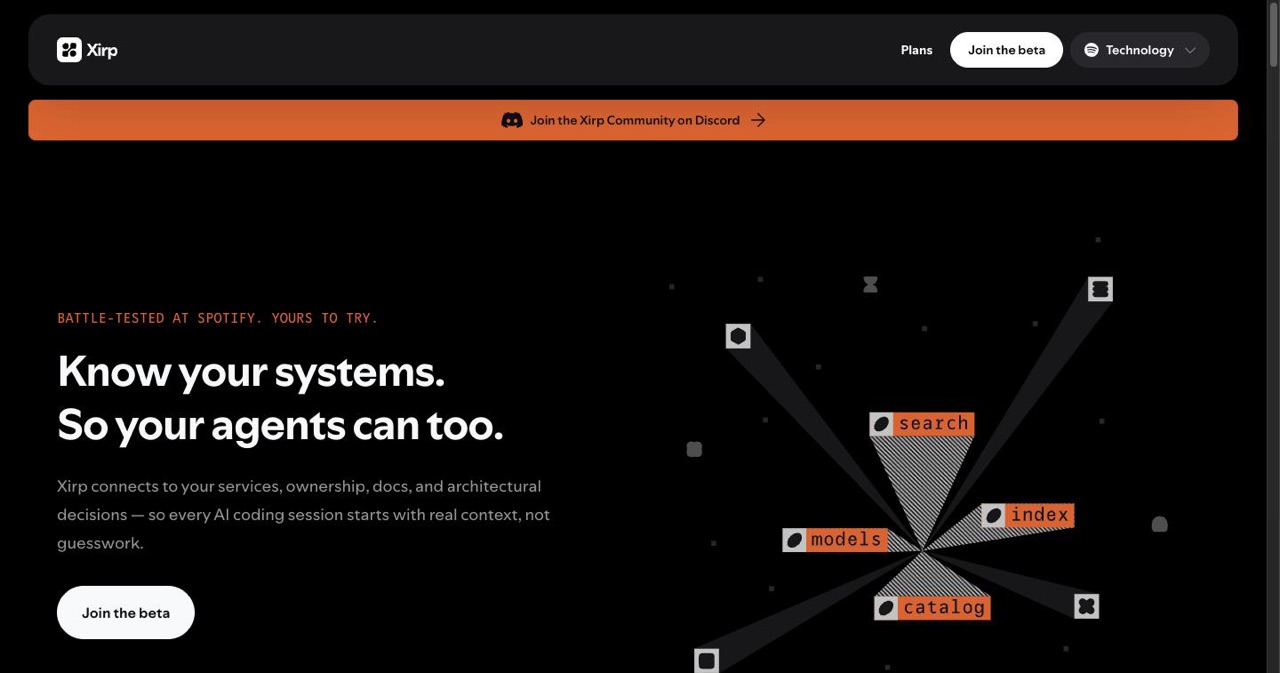
On August 10, 2026, Spotify Engineering posted that it was opening Xirp to public beta: a "vendor-neutral agentic development environment," one surface for managing agent sessions across Claude Code, OpenAI Codex and Gemini CLI. 1,300+ Spotify engineers already use it. It has handled 36,000+ agent sessions internally. The post did about 1.2M views inside a day, with a bookmark-to-like ratio that reads as developers saving this for Monday morning rather than idle scrolling.
The interesting thing is not that a music company shipped a dev tool. Spotify has done that before, and Backstage ended up as the default answer to "we have too many microservices and nobody knows who owns what." The interesting thing is what the tool is for. Xirp exists because running one coding agent is a workflow, and running forty is an organizational problem — and almost nobody has been building for the second case.
Key Takeaways
- One worktree per session: Every agent session gets its own git working tree, which is what makes 50+ concurrent sessions on one repo tenable instead of chaotic.
- Three agents, one surface: Claude Code, OpenAI Codex and Gemini CLI each run in a persistent terminal you can switch away from and return to.
- Internal scale before launch: 1,300+ Spotify engineers and 36,000+ agent sessions, with adoption described as organic rather than mandated.
- Not a replacement: Spotify's docs state Xirp replaces neither your coding agent nor your source control, and you still authenticate and configure each agent through its native CLI.
- Not open source: Backstage is open source, Portal is the commercial product on it, and Xirp is the desktop app on top under preview terms.
- Portal is the real pitch: Connected to Portal, sessions boot with catalog, ownership, dependency and prior-session context, and transcripts flow back. Beta access includes a Portal instance.
- The missing number is cost: Spotify reports cost efficiencies without a baseline, and there were no independent reviews at launch.
The problem it was built for
The accompanying blog post, What we've learned scaling AI coding agents at Spotify, is by Tyson Singer, Spotify's SVP of Technology and Platforms. It's more honest about the mess than launch posts usually are.
The progression it describes will be familiar if you've been running agents seriously for six months. First you have one agent in one terminal. Then two. Then you're running parallel sessions across repos and branches, and non-engineers on your team are running them too, and something breaks that isn't the code.
Singer names it directly: "Context accumulated in one session but was needed in another. Institutional knowledge fragmented into individual configurations—CLAUDE.md files, bespoke MCP setups."
That's the whole diagnosis. Every useful thing you learn about your codebase gets written into a local file that only you and your agent can see. The engineer next to you rediscovers it next week, burns tokens doing so, and writes it into their local file. Multiply by a few hundred engineers and you have an expensive machine for re-learning things you already knew.
Singer's parallel is the obvious one: a decade ago, microservice sprawl produced the same failure, and the answer was Backstage — one catalog for ownership, dependencies and architecture. AI agents added a new axis to the same old problem. Same shape, new dimension.
And the framing at the top is the part I'd underline for anyone making tooling decisions right now: "The real challenge is no longer velocity alone. It is ensuring teams have the flexibility to adopt whatever maximizes value at any given moment." Adoption is settled. What's left is not getting locked in while the models change under you every eight weeks.
What Xirp actually is
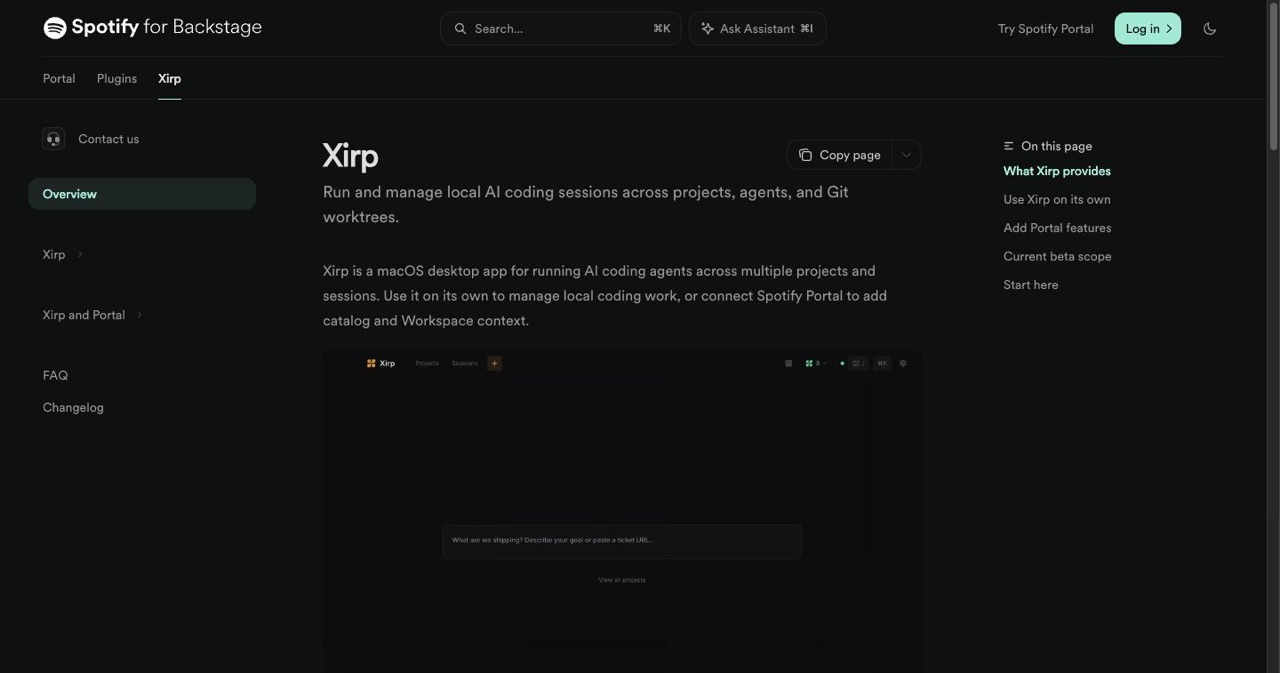
Stripped of the launch language, per the docs:
A macOS desktop app for running coding agents across multiple projects and sessions. Beta, invite-gated, features subject to change.
Parallel sessions with persistent terminals. Claude Code, Codex and Gemini CLI each get a terminal that keeps its state. Switch away, come back, it's where you left it.
One git worktree per session. This is the load-bearing feature and the least glamorous one. Every session gets its own working tree, so dozens of agents can operate on the same repo concurrently without stepping on each other's files. Spotify says this is what makes coordinating 50+ parallel sessions tenable instead of chaotic. If you've ever had two agents fight over the same branch, you already know why this matters more than the dashboard does.
A unified control surface. Terminals, git changes, files, rules, skills, session status, grid layouts. One window instead of eleven.
Vendor neutrality. "Switch tools mid-project, and the full working state carries over." Route by price and performance — including self-hosted open models — without rebuilding your environment when a new one lands.
Now the parts the launch post is quieter about. Xirp does not replace your coding agent and does not replace source control; you still authenticate and configure each agent through its native CLI. It's macOS only. And it is not open source, despite a few confident claims to the contrary on launch day. Backstage is open source. Portal is the commercial product built on it. Xirp is the desktop app on top of that, under preview terms.
Portal is the actual pitch
Standalone Xirp is a solid multi-session runner. Connected to Spotify Portal, it turns into something else, and this is where the strategy is.
"Every agent session initializes with organizational context drawn from your software catalog." Your agent starts a task already knowing which service it's touching, who owns it, what depends on it, which architectural decisions are already settled, and what previous sessions did. It stops guessing at things your organization already wrote down.
The flow runs both directions. Session transcripts and metadata go back into Portal, so there's a record of what was done, by whom (or by which agent), and where to pick it up. Singer's line: "Work becomes interchangeable across the team. Duplicate effort is eliminated." Add a marketplace for skills, rules, plugins and MCP configs, plus documentation generated from sessions instead of written after them, and the pitch is that knowledge compounds instead of scattering.
His closing claim is the thesis: "Organizations that compound their engineering knowledge into shared, structured systems will capture full value of AI-assisted development."
That is a good argument. It also has a dependency worth stating plainly: it only works if your organization actually maintains a structured catalog. Companies with a well-groomed Backstage instance get a multiplier. Companies whose catalog is 40% stale entries get agents confidently briefed on things that stopped being true in March. The tool doesn't create the context. It distributes whatever context you already have, accurate or not.
Beta access includes a Portal instance. That tells you which half Spotify is selling.
The numbers, and what they're worth
1,300+ engineers, 36,000+ sessions, 50+ concurrent sessions coordinated, adoption described as organic rather than mandated. Reported wins are faster context switching, cost efficiency and less rework.
Organic adoption is the number I'd weight highest. Internal tools that spread without a mandate are usually solving something real, because nobody adopts extra software for fun. But every figure here is Spotify measuring Spotify. There are no independent reviews yet — it launched today. What's missing is the cost data: 36,000 sessions at 50-way parallelism is a large token bill, and "cost efficiencies" without a baseline is a claim, not a result. If you're evaluating this for a team, that's the question to bring to the beta. We wrote up the shape of that spend in tokenomics for agentic engineering and the plan-by-plan math in the best AI agent coding token plans.
What a solo builder should take from this
Most people reading this don't have 1,300 engineers or a software catalog. Three parts of Xirp still transfer, and all three are free.
One worktree per agent. You don't need a desktop app for this. git worktree add ../feature-x feature-x gives an agent its own directory on its own branch, and two agents stop fighting over your working tree. This is the single highest-leverage change for anyone running more than one session, and it costs you a command.
Get your context out of one tool's config. Spotify's fragmentation problem is your portability problem at a smaller scale. If everything your agents know lives in one vendor's format, switching models means rewriting it. Keep the knowledge in plain markdown you own — our CLAUDE.md templates are a decent starting shape — and treat tool-specific files as thin wrappers over it. When the next model ships, and it will, you move in an afternoon.
Route work by price, not by loyalty. Vendor neutrality is not a philosophy, it's cost control. Cheap mechanical work goes to a cheap model, hard reasoning goes to an expensive one. That's the same argument behind subagents and agent teams, and behind harness engineering: the scaffolding around the agent is the real work. If you want the context layer without the desktop app, MCP servers cover a surprising amount of the same ground.
What people said
The replies split the way you'd expect. Genuine enthusiasm for vendor neutrality and parallel sessions from people who have clearly felt the pain. Jokes about the name. Requests for "Xirp Wrapped," which was inevitable and which Spotify should probably just ship. Comparisons to existing multi-agent terminals like cmux. Reliability jokes, because it's Spotify. A few "so it's vibe coded" replies.
The substantive questions were better: how does it handle overlapping or outdated tool metadata, how robust is shared context when the catalog is wrong, and is it open source (no). AI newsletters amplified the 36k sessions number within hours. Overall read: people treated it as a practical answer to a real problem rather than a hype cycle, which is not the default reception for launch-day tooling in 2026.
Why it matters
Two years of AI coding discourse was about generation speed. This is the first big-company product that's about orchestration and institutional memory instead — which is what you build once speed stops being the constraint and coordination becomes it.
The Backstage precedent is the reason to pay attention. An internal tool solving an internal problem became the category default because the problem turned out to be everyone's. Multi-agent orchestration is at that exact stage now: everybody's improvising, nobody's standardized, and the first credible shape tends to stick.
The open questions are real, though. Governance of agent sessions at scale. Cost control when 50 agents run at once. The security surface of piping organizational context into third-party model providers. And the mild irony of an agent-agnostic tool that pulls you toward one company's developer portal — vendor-neutral at the model layer, considerably less so at the platform layer.
Still: a macOS beta from a music company just made the strongest public argument yet that context and orchestration are infrastructure, not conveniences. Try the beta at xirp.spotify.com, read Singer's post, check the docs before you commit a team to it.
Building with agents? Ship the thing publicly.
The reason Spotify's internal tool became news is that they put it in front of people. Same rule applies to whatever you're building with your fleet of agents: the code isn't the hard part anymore, distribution is.
SaaSCity is a live city map where every listing is a building people actually browse — not a dead directory grid. You can submit your product free with our badge — you book a week in the launch queue — or take Quick Pass to be on the map within 24 hours. Every plan carries a dofollow link. If you're planning a launch sequence rather than a single launch day, our Product Hunt alternatives guide covers the other 40+ surfaces worth hitting the same week.
And if what you actually need is Domain Rating rather than launch buzz, how to increase your Ahrefs DR explains what genuinely moves it, the 0-to-30 DR playbook writes the method out week by week, and the Domain Rating checker tells you where you're starting in about ten seconds.
Get your SaaS in front of founders
List your product on the SaaSCity live city map - a permanent listing, real discovery, and a backlink from a high-DR directory. Free to start; upgrade for a dofollow link and a building on the map.