Reviews
CleverCrow: Community-Funded AI Coding Agents for Open Source Maintainers
CleverCrow lets communities pool small pledges to fund AI agents that close GitHub issues — with maintainers approving every step. Here's how it works, what HN said, and what it signals for OSS funding in 2026.

Contents (9)
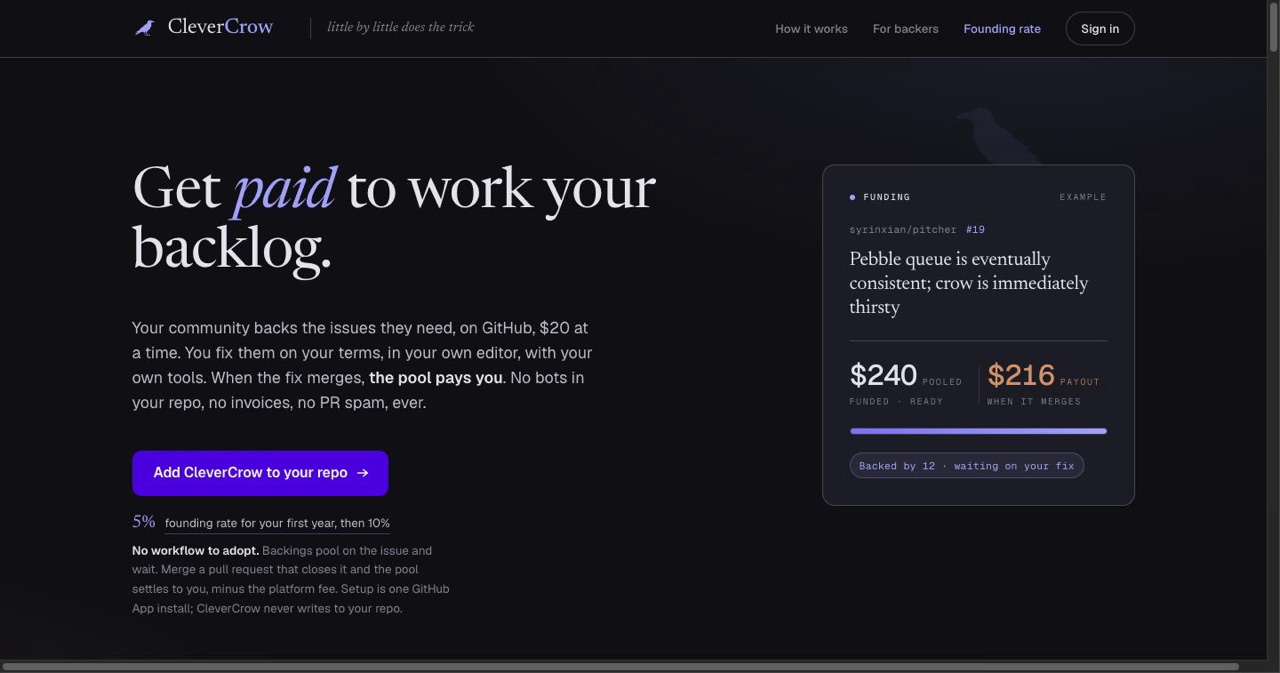
Quick answer: CleverCrow is a funding platform where a community pools small pledges against specific GitHub issues and an AI coding agent, running on Claude, attempts the fix under maintainer control. Backers pledge, the maintainer presses Start, the agent drafts a plan in a credential-less sandbox for approval, codes on an isolated agent/* branch, and opens a draft PR with up to five revision rounds. Nothing auto-merges, unused funds return to backers, and maintainers get five free dry-runs. CleverCrow takes a 20% platform fee plus token costs.
Your most-starred repo has 200 open issues. You haven't touched 40 of them in over a year. Not because you don't care — because you're not paid to care.
That's the maintainer trap. The community depends on you. The community won't pay you. And the gap between "someone should fix this" and "someone actually fixing this" stays permanently open.
CleverCrow is a new platform built around a specific bet: AI agents for open source are now capable enough that community pledges can fund issue fixes, with maintainers steering every step and nothing landing in your repo until you approve it. It launched in 2026 to a Show HN discussion titled "give tokens to your favorite projects" — a phrase that undersells the technical architecture and oversells nothing.
Here's what it actually does.
Key Takeaways
- Issue-level pledging, not donations: Backers fund a specific GitHub issue, or a whole repo, with small pledges that only debit once the maintainer presses Start.
- Plan approval before any code: The agent drafts its implementation plan in a credential-less sandbox with no git access or push rights, and the maintainer approves it first.
- Isolated execution path: Implementation happens on an
agent/*branch with CI runs, and a separate service handles diff application and PR creation. - Five revision rounds, no auto-merge: The maintainer reviews the draft PR and can push back up to five times; nothing lands without approval.
- Runs on Claude: CleverCrow uses Claude API tokens directly for the agent's work.
- Economics under debate: The 20% platform fee plus token costs drew criticism on Hacker News, mainly that leftover funds return to backers instead of the maintainer who did the review work. Founder Zack said the model is not final.
- Known friction: Login gating blocks browsing projects without an account, and the platform closes backlogs rather than solving maintainer compensation.
The OSS Funding Problem Is More Specific Than You Think
The standard take on open source sustainability is broad: maintainers burn out, companies extract value without contributing back, and a handful of GitHub Sponsors pages prop up software the entire industry depends on. All of that is true. And all of that has been true for fifteen years, with no structural fix in sight.
CleverCrow isn't trying to fix OSS maintainer compensation. It's solving a narrower problem: a community cares deeply about specific issues, a maintainer wants those issues closed, and no efficient mechanism exists to connect the two without someone donating their weekend.
GitHub bounty platforms have existed in various forms — Bountysource, IssueHunt, Gitcoin — since the early 2010s. They all stalled on the same execution problem: who writes the actual code? Either the bounty goes unclaimed because no contributor wants to scope a fix for $80, or someone submits a PR that misses the point entirely and the maintainer spends more time rejecting it than they would have writing it themselves.
What changed in 2026 is that the execution step is no longer exclusively a human problem. AI agents can handle a real slice of well-defined, scoped issues. CleverCrow builds the funding marketplace around that capability.
What CleverCrow Is
CleverCrow connects three parties: backers who want specific issues resolved, maintainers who own the codebase, and AI agents that do the coding work. The platform is built by Zack (@zhubert on HN) and sits at a genuinely interesting intersection of OSS funding infrastructure and the current wave of autonomous coding agents.
The underlying agent runs on Claude — CleverCrow uses Claude API tokens directly, which fits the broader pattern of Claude becoming the default engine for agentic coding workflows in 2026. If you've tracked the AI agent token pricing landscape, this isn't surprising. Claude's context handling and instruction-following on ambiguous codebases makes it a natural fit for a system where the agent has to read unfamiliar code, form a plan, and operate without human hand-holding on every step.
The business model is minimal: CleverCrow takes a platform fee (currently 20% — Zack acknowledged in the HN thread this is too high and plans to revise it) plus token costs as the agent runs. Unused funds return to backers automatically. Maintainers get five free dry-runs before any community funding needs to be involved.
How It Works: Five Stages From Pledge to Merged PR
Stage 1 — Funding Pool
A backer visits a GitHub repo connected to CleverCrow and pledges against a specific issue. The pledges are designed to be small — a few dollars, not hundreds. Other backers who care about the same issue add to the pool. Nothing debits until the maintainer presses Start.
This matters structurally: no single backer is making a large bet on an uncertain outcome. The risk is distributed across everyone who wants the issue closed, which means the economics work even for repos without a large, organized sponsor base.
Backers can also pledge against a whole repo to cover every issue — effectively becoming a standing contributor to the project's issue velocity rather than a targeted funder of one ticket.
Stage 2 — Plan Approval Gate
The agent doesn't go straight to code. It first drafts an implementation plan inside a credential-less sandbox — no git access, no push rights, no tokens, no path into your actual repo. The maintainer reviews and approves (or rejects) the approach before a single line of code is written.
This is the design decision that earned the most genuine praise in the HN thread. Any maintainer who's received a well-intentioned but architecturally wrong PR from an automated tool will immediately understand why this gate exists. The agent can't surprise you because it can't touch anything before you've seen the plan.
Stage 3 — Implementation on an Isolated Branch
Once the plan is approved, the agent codes on an isolated agent/* branch and runs CI tests. A separate service handles the diff application and PR creation — the agent itself has no direct path to your production branch. The sandbox architecture isn't decorative; it's the core safety mechanism that makes the whole flow trustworthy enough for a maintainer to hand over a codebase they've spent years on.
Stage 4 — Review with Feedback Rounds
The maintainer reviews the draft PR. Up to five revision rounds are available — push back, request changes, point out what the agent missed. The maintainer controls every iteration. Nothing merges automatically.
Stage 5 — Settlement and Refunds
Code ships on the maintainer's terms. Unspent funds automatically return to backers' wallets. Platform fee and token costs settle. The issue gets closed. That's the full loop.
What HN Actually Said
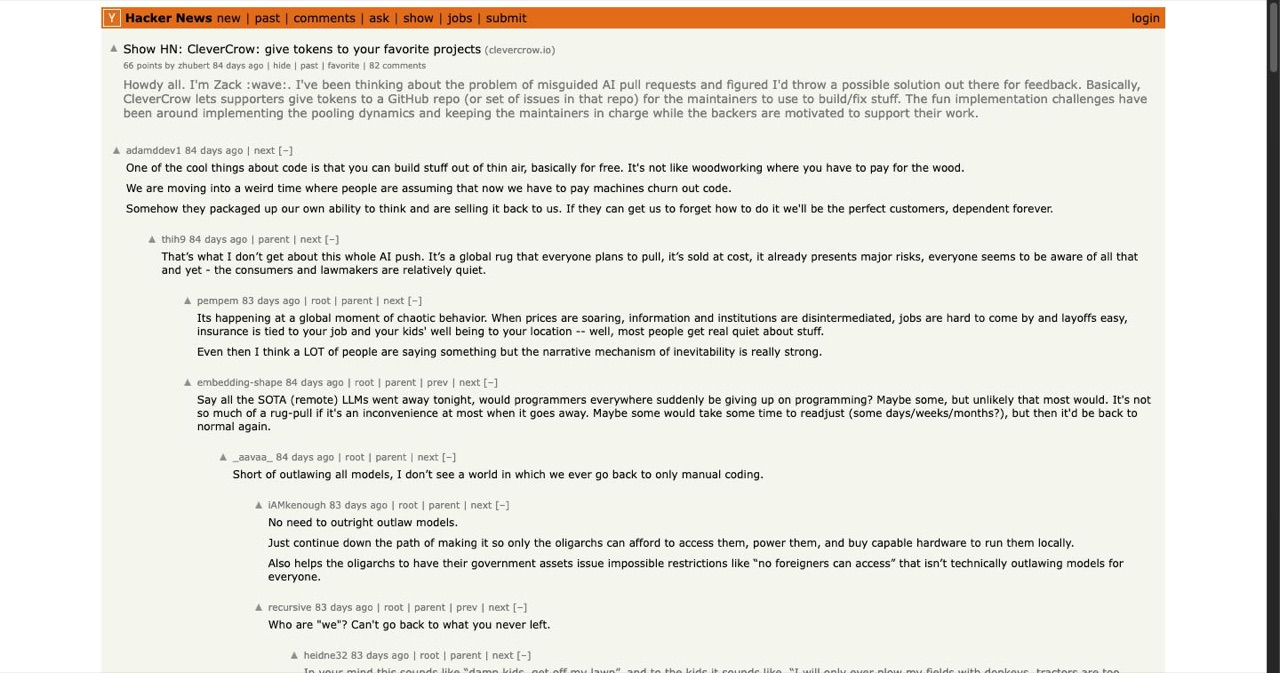
The Show HN discussion surfaced the real friction, which is worth reading directly.
The sharpest criticism: the platform gets paid, and the maintainer gets more unpaid work. If the agent finishes the job without spending the full pool, unused tokens go back to backers — not to the maintainer who just spent time reviewing plans, steering five revision rounds, and testing the output. Multiple commenters made the same point: when a merge happens successfully, leftover funds should route to the maintainer, not back to the people who already got what they paid for.
Zack responded to this directly and acknowledged the economics aren't final. That's the right founder response — not defensive, not dismissive, just honest that the model is still being shaped.
The alternative question: why not just GitHub Sponsors or direct donations? The CleverCrow counter-argument is embedded in the model — donation flows don't connect funding to specific outcomes. A backer wants this bug fixed, not "general support for a project I appreciate." Issue-level pledging is a different contract. Whether that distinction is meaningful enough to drive behavior at scale is the real market test.
What people appreciated: the sandbox architecture, the absence of auto-merging AI PRs, and the maintainer-in-control framing. For the segment of maintainers who've closed a PR submitted by an automated tool because it fundamentally misunderstood the codebase, CleverCrow's approval gates are a real differentiator.
The Real Limitations
Maintainers are still working. Review an implementation plan, steer five revision rounds on a complex AI diff, test the output — that's real time. Whether the tradeoff is worth it depends entirely on the issue. A clear, reproducible bug with an obvious fix runs through the system cleanly. An architectural decision or a feature requiring deep project context will hit the revision ceiling before the output is usable.
20% platform fee is aggressive. Zack said he'd adjust it. At time of writing, he hasn't yet. Token costs on top of that cut further into the economics. Watch for changes here — if CleverCrow wants broad maintainer adoption, the fee structure needs to be closer to payment processor margins, not platform rake.
Login gating kills discoverability. You can't browse what projects are on CleverCrow without an account. That's a friction point for potential backers who want to explore before pledging. Reducing this barrier matters for the network-effects play that makes a funding marketplace viable.
Maintainer compensation is still unsolved. CleverCrow closes issue backlogs via community-funded compute. That's a real service. It is not the same thing as financial sustainability for the people keeping critical infrastructure alive. These are adjacent problems, not the same problem. Don't confuse them.
What It Means for SaaS Builders
If you're building a SaaS on top of open source dependencies — which is most of us — CleverCrow represents a shift worth tracking.
Dependencies that block you: When a critical open source library has a reproducible bug that's stalling your roadmap, you used to have three options: fork it, wait indefinitely, or contribute a fix. Community-funded AI agents add a fourth: pledge against the issue, back the run, and let the agent try. The cost is small. The ceiling on agent capability is real. But for well-scoped bugs in mature codebases, this is genuinely cheaper than a custom fork.
Your own open source tools: If you're maintaining a library, SDK, or framework — even one you built to support a SaaS product — CleverCrow gives your community a channel for expressing what they want fixed in the most useful form possible: funded compute, not feature requests. For indie developers navigating the growing AI coding agent ecosystem, the trend is pointing toward community-driven access to compute becoming a standard category, not a niche experiment.
The platform risk: GitHub already has GitHub Sponsors. The issue-level funding model is an obvious adjacent feature for them to build natively. The standalone platforms that survive this eventual gravitational pull will be the ones that built enough network effects — many backers, many maintainers, issue-level pledge discovery across repos — before GitHub closes the gap. That's not a death sentence for CleverCrow, but it's the timeline that matters.
The signal CleverCrow sends, regardless of whether it captures the market, is that AI agents for open source is now a real product category. The execution step — write the code, pass CI, generate a reviewable diff — is cheap enough to fund via micro-pledges. That wasn't true three years ago.
List Your Open Source SaaS on SaaSCity
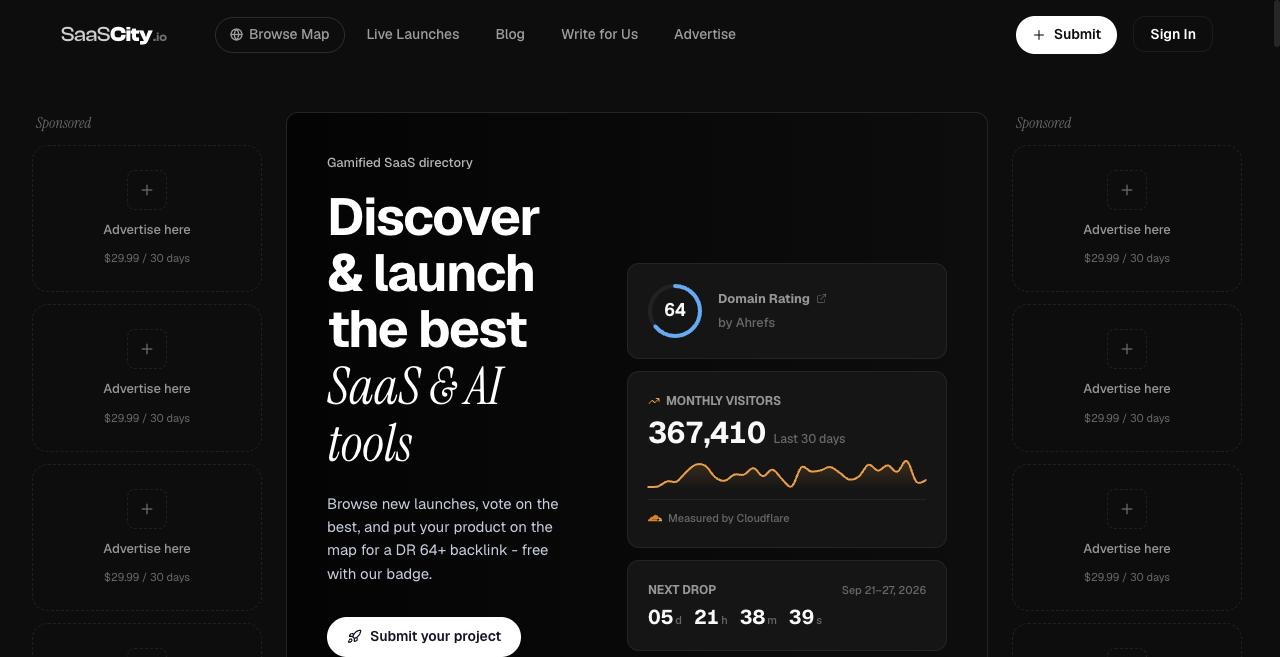
If you're shipping an open source tool, a developer library, or an OSS-backed product, the people who should find you are actively looking on SaaSCity.
SaaSCity.io is the directory where founders and engineers discover what's shipping. Your project isn't a static page — it lives as a building in a live interactive 3D city map, visible to every founder browsing the feed.
- Free to list: Two-minute submission at saascity.io/live/submit — no gatekeeping, no review queue
- Dofollow backlinks: Every listing earns a real, SEO-moving backlink to your project
- 3D city visibility: Show up in the live city feed alongside every other product launching right now
- Builder-first audience: The people browsing SaaSCity are engineers and founders, not passive readers
Where This Goes
CleverCrow is early. The economics need work — the 20% fee, the maintainer-doesn't-get-paid gap, the login gating. The founder is responsive and the architecture is sound. Those are the conditions that improve.
The deeper question isn't whether CleverCrow specifically wins. It's whether the model holds: communities pooling small amounts to fund AI execution on specific issues, with humans steering and approving at every step. The answer is probably yes for the right class of issues. The question is how big that class turns out to be.
There are millions of repos with issue backlogs no human team will ever fully close. Community-funded AI agents won't make open source financially sustainable. But they might make it more maintainable — and for the people running those repos on nights and weekends, that's not a small thing.
The five free dry-runs cost nothing. If you're maintaining something with a real backlog, that's the right place to start.
SaaSCity.io covers developer tools and open-source funding models. Explore the SaaSCity directory to discover what's shipping right now — or list your own product.
Get your SaaS in front of founders
List your product on the SaaSCity live city map - a permanent listing, real discovery, and a backlink from a high-DR directory. Free to start; upgrade for a dofollow link and a building on the map.