Developer Tools
Epic Games Just Open-Sourced Lore: The Free Perforce Alternative Studios Have Waited Decades For
On June 17 2026 at State of Unreal, Epic open-sourced Lore — an MIT-licensed, Rust-written version control system built for game-scale binaries. Not a Git extension. Not Perforce repainted. Here's the architecture, the honest pre-1.0 status, and who should actually care.

Contents (11)
- Key Takeaways
- Game Development's Version Control Compromise
- What Lore Is — and Where It Came From
- The Architecture: Why It Actually Works
- List Your Game Studio or Dev Tool on SaaSCity
- What the Developer and Artist Experience Looks Like
- Lore vs. Git LFS vs. Perforce Helix Core
- Honest Status Check
- Community Reaction and Early Ecosystem
- Who Should Actually Pay Attention to This
- The Bottom Line
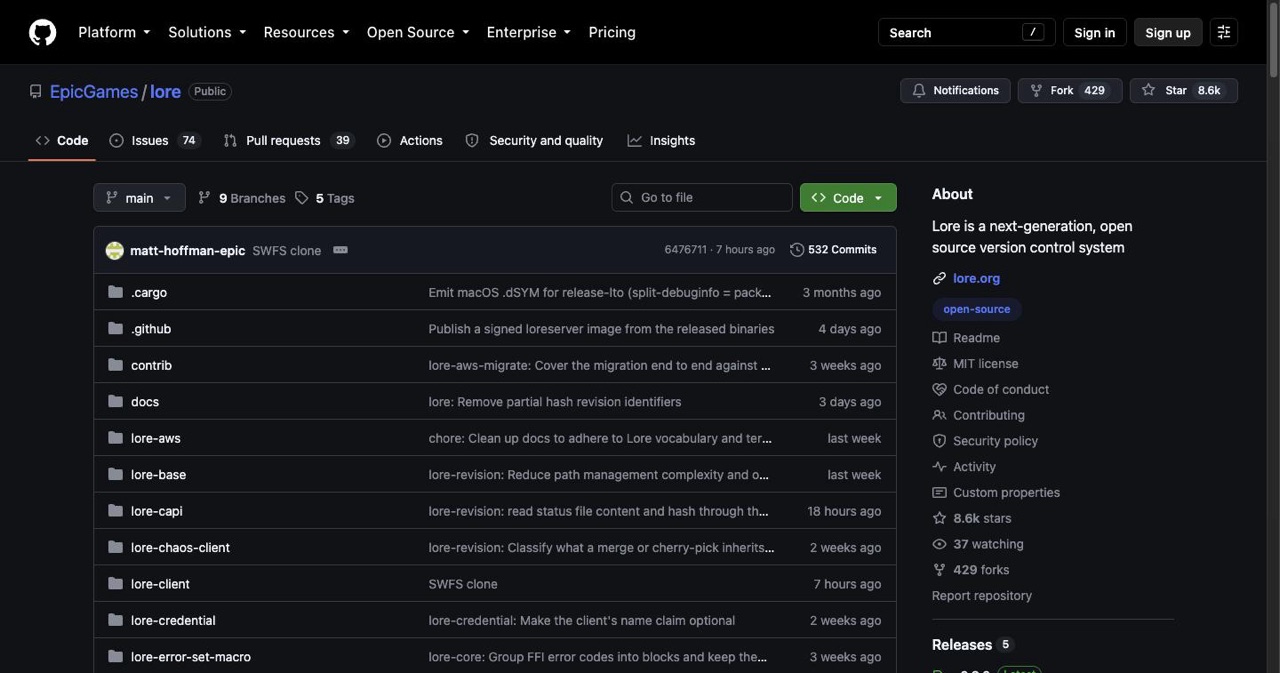
Quick answer: Lore is Epic Games' version control system, open-sourced under the MIT license on June 17, 2026 at State of Unreal in Chicago. Written in Rust, it is centralized and content-addressed, hashing every object with BLAKE3 and modeling repository state as Merkle trees over an immutable revision chain. FastCDC chunking gives fragment-level deduplication across multi-gigabyte binaries, and working copies stay sparse by fetching on demand. Lore started inside Epic as Unreal Revision Control, the VCS behind UEFN, and currently sits at v0.8.3.
That 4 GB texture? Git chokes on it. Perforce handles it fine — and charges you per seat for the privilege.
That trade-off has defined game development version control for 25 years. On June 17, 2026, at State of Unreal / Unreal Fest Chicago, Epic Games changed the terms. They open-sourced Lore — an MIT-licensed, Rust-written version control system built from the ground up for exactly this problem. Not a Git extension. Not Perforce with a new paint job. Something architecturally different.
The GitHub repo crossed 2,850+ stars within hours of launch. The Hacker News thread hit 1,200+ points and 600+ comments in under a day. The reaction wasn't just excitement — it was relief.
Key Takeaways
- MIT-licensed and open-spec: Epic released Lore under MIT with a public specification, against Perforce Helix Core's proprietary protocol and per-seat pricing.
- BLAKE3 content addressing: Every object is stored and referenced by its BLAKE3 hash, so identical content across files, branches, or projects is stored exactly once.
- FastCDC chunking: Files over a threshold split into variable chunks up to 256 KiB, so updating a 1.5 GB audio file re-uploads only the changed pieces.
- Local everyday operations: Staging, committing, branching, and diffing all run locally; the server is the durable source of truth for history and access control.
- Six SDKs at launch: C/C++, Rust, JavaScript, C#, Python, and Go, all built on a canonical C API.
- Advisory locking today: File locking is advisory for now, with scalable enforced locking on the near-term roadmap alongside VS Code and Unreal Editor plugins.
- Pre-1.0 at v0.8.3: Interfaces, on-disk formats, and APIs may still change, and the open-source build cannot yet talk to the UEFN build pending the Zstandard migration.
Game Development's Version Control Compromise
Every tools engineer at a studio already knows the pain. Version control in game development has always meant picking which problem you can live with.
Git is elegant, distributed, and free. For code, it's the right call. But tell Git to manage a 2 GB Unreal level file, a 300 MB audio export, or a daily update to a Houdini simulation cache, and it starts sweating. Git LFS tries to patch the gap — it offloads large binary files to remote storage — but it's bolted on. Deduplication is weak. Partial clones have sharp edges. Binary merge behavior is essentially non-existent. If two artists touch the same .uasset, you're resolving that conflict manually.
Perforce sits at the other end. It handles binaries well — studios trust it — and it does work. But Perforce comes with per-seat licensing costs that put it out of reach for smaller teams, a proprietary wire protocol that forecloses third-party tooling, frequent server round-trips that slow down daily operations, and an administrative overhead that at many studios means someone's entire job is just keeping it alive.
The official Lore documentation puts it plainly: "No existing system was designed for the combination of constraints that large game and entertainment projects require: arbitrary content types, multi-axis scale, multi-tenant safety, and a fully open specification and license."
Epic wrote that knowing they were one of Perforce's largest customers. They built Lore because they were tired of their own compromise. If you're an indie team weighing the cost of paid tooling against building with a zero-cost developer toolkit, this is the kind of release that quietly resets your budget.
What Lore Is — and Where It Came From
Lore didn't start as a public project. It began internally at Epic as Unreal Revision Control, the version control system built into UEFN (Unreal Editor for Fortnite). Fortnite creators have been versioning their islands with it. Internal Epic teams have been adopting it gradually. It also now backs the UEFN cook pipeline, eliminating redundant data transfers and cutting down the time between publishing a change and it going live.
The one-sentence technical definition: Lore is a centralized, content-addressed version control system that represents repository state as Merkle trees and an immutable revision chain, optimized for binary-first storage, deduplication, and sparse/on-demand data hydration at scale.
That's dense. The important part is the combination: Git's structural elegance, Perforce's binary practicality, and none of either's licensing costs.
In May 2026, Epic filed a trademark for "Lore" covering downloadable software platforms for revision control. The direction was already clear; the trademark formalized it.
The Architecture: Why It Actually Works
Content-Addressed Storage with BLAKE3
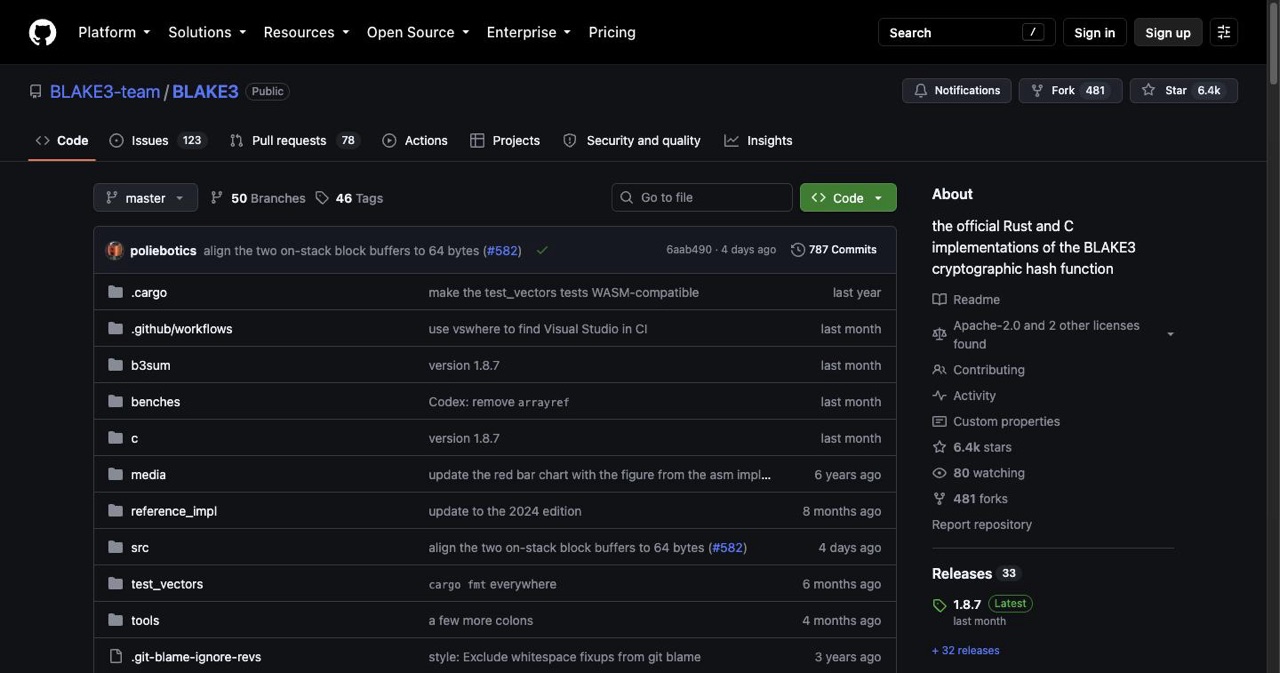
Every piece of data in Lore is stored and referenced by its BLAKE3 cryptographic hash. BLAKE3 is faster than SHA-256 on long inputs, naturally parallelizable across CPU cores, and structured internally as a Merkle tree. For a version control system working with multi-gigabyte binary files, that parallelism matters.
The practical effects are immediate: identical content — across files, branches, or even different projects — is stored exactly once. Any tampering with history changes the hash and gets caught. Caches can hold content anywhere in the pipeline without consistency headaches.
Merkle Trees + Immutable Revision Chain
The entire repository state at any point in time is a Merkle tree. Each revision's hash is derived from its parent's hash plus the current data hashes. Change one texture, and only the path up the tree from that file needs updating. Everything else is shared across revisions.
This structural sharing is what makes lightweight branching genuinely cheap. Branches are mutable pointers — no data gets duplicated when you create one.
FastCDC Chunking for Large Binaries
This is the real differentiator for asset-heavy projects. Files larger than a threshold are split into variable-size chunks (up to 256 KiB each) using FastCDC content-defined chunking. When you update a 1.5 GB audio file, only the changed chunks re-upload. Need a specific byte range inside a large level file? You don't pull down the whole thing.
This is how Lore achieves genuine fragment-level deduplication across multi-gigabyte binaries — something that neither Git LFS nor Perforce delivers natively at this granularity.
Sparse, Lazy Working Copies
Working copies in Lore only materialize the files you actually need. Everything else is fetched on demand from the server. Multiple working trees can share a local cache, so even on a repository with terabytes of historical assets, your local workspace stays manageable.
No Network Latency for Everyday Operations
Staging, committing, branching, diffing — all local. The server is the durable source of truth for history and access control, but it's not involved in your moment-to-moment workflow. This is the part of Git's DVCS model that actually works, applied to a system designed for centralized binary-heavy repos.
List Your Game Studio or Dev Tool on SaaSCity
Building a tool, plugin, or service in the Lore / Unreal ecosystem — a VS Code extension, a CI integration, an artist-facing client? You need to get it in front of the developers who will actually use it.
SaaSCity.io is the premier directory for developer tools and modern software products. List your project and it doesn't just get a static page — your product is visualized as a building in our interactive 3D digital city.
- 📈 Increase Domain Rating: Earn valuable dofollow backlinks that move your SEO.
- 🚀 Find Early Adopters: Reach a community of founders, engineers, and tooling buyers.
- 🆓 100% Free to List: Submit your project in under 2 minutes.
Submit your project today and start growing your user base.
What the Developer and Artist Experience Looks Like
For developers, Lore's CLI covers everything: full-parity access to every feature, intuitive commands, free branching. For artists, the critical feature is file locking. Lore currently supports advisory file locking — you can mark a file as checked out — which is essential for non-mergeable binary assets where simultaneous edits create irreversible conflicts. Scalable enforced locking (the kind Perforce does well) is on the near-term roadmap.
SDK support at launch: C/C++, Rust, JavaScript, C#, Python, and Go. The canonical API is in C; everything else builds on it. Epic designed this as a foundation to extend, not just a tool to use — much like the open-source boilerplates and platforms we compared in 2026, the point is to give builders an extensible base, not a sealed box.
Getting started takes minutes:
# Install and spin up a local demo server
curl -fsSL https://raw.githubusercontent.com/EpicGames/lore/main/scripts/install.sh | bash -s -- --demo

# Create a repository and commit
lore repository create my-game
lore stage .
lore commit -m "First commit"
No configuration file required to try it locally. One executable, one command.
Lore vs. Git LFS vs. Perforce Helix Core
| Git + LFS | Perforce Helix Core | Lore | |
|---|---|---|---|
| Binary file handling | Bolted-on, poor dedup | Excellent | Native chunks + fragment dedup |
| Sparse checkout | Experimental | Good (server-heavy) | Sparse by construction |
| Offline work | Excellent | Awkward | Excellent (local ops) |
| Branching | Lightweight | Good | Lightweight + free |
| File locking | None | Enforced | Advisory (enforced on roadmap) |
| License | Free (OSS) | Expensive, proprietary | Free (MIT) |
| Protocol | Open / LFS complexity | Proprietary | Open spec + rich APIs |
| Normal ops latency | None | Server round-trips | None |
The consensus from Hacker News and r/gamedev is consistent: Lore is positioning itself as a Perforce competitor, not a Git replacement. If your team runs a pure-code repo on Git, stay there. If you're managing mixed code and large binary assets — especially in Unreal Engine — this deserves a serious look. (If you're still deciding where your own infrastructure should live, our breakdown of self-hosting alternatives to Vercel and Supabase walks the same own-it-vs-rent-it trade-off.)
Honest Status Check
Lore is at v0.8.3. It's pre-1.0, and Epic is transparent about what that means: interfaces, on-disk formats, and APIs may change before the stable release. The project page is explicit: "Lore is pre-1.0 and under active development."
One notable gap right now: Lore is the built-in VCS for UEFN, but the open-source version and the UEFN build can't yet communicate with each other. The UEFN build uses a proprietary compression format that can't ship with the open-source project. Epic is actively migrating UEFN to the same open format (Zstandard) used by the OSS release. That gap will close — it's the top item on the compatibility roadmap.
Roadmap highlights (2026–2027):
- UEFN ↔ OSS compatibility via Zstandard migration (in progress)
- VS Code plugin, Unreal Editor plugin
- Enforced scalable file locking
- Virtual File System (VFS) support
- Open-source desktop client
- Web client with code review capabilities
- Edge caching instances and advanced server topologies
For teams already on UEFN and internal Epic workflows: production use is live. For new projects at teams comfortable with pre-1.0 software: worth evaluating. As a drop-in replacement for an existing Perforce installation on a large live game: wait for 1.0, or at minimum the enforced file locking milestone.
Community Reaction and Early Ecosystem
The Hacker News thread was unusually active for a dev tooling announcement — 1,200+ points, 600+ comments in 24 hours. Game developers and tools engineers both showed up. The technical design choices got real scrutiny, not just hype. The dominant reaction was less "wow, a new VCS" and more "finally, someone took this seriously."
Skepticism exists too. A thread on Lobsters raised questions about design documentation quality. Some developers noted Perforce's hold on the industry rests not just on licensing but on years of pipeline integration and trained staff. Switching isn't a command.
On the tooling side: Anchorpoint announced Lore support. ReviewBoard is exploring integration. The six-language SDK launch signals that Epic wants third-party builders in from the start, not as an afterthought — exactly the kind of ecosystem moment that rewards anyone shipping early, the same way the agentic AI tooling wave rewarded the first movers who built on open foundations.
Who Should Actually Pay Attention to This
Game studios on Unreal Engine — even if migration isn't on the table today, the existence of a technically credible free alternative changes your negotiating position with Perforce. Use that.
UEFN creators — you're already using it under the hood. The cook pipeline improvements landing with the Zstandard migration will directly reduce your publish-to-playable time.
Pipeline and tools engineers — Lore's API-first design (canonical C API, six language bindings, open specification) is a real foundation to build on. Custom workflows, tighter CI/CD integration, artist-facing tooling — the surface is there. If you do ship something on top of it, get it listed where buyers look: our complete guide to SaaS directory submissions covers how to turn a launch into distribution.
Anyone dealing with large binary collaborative data at scale — VFX studios, AI training dataset teams, simulation engineers. Fragment-level deduplication for multi-gigabyte files has value far outside game development. Epic built this for games; the problem it solves is not exclusive to games.
The Bottom Line
Epic built Lore because Git and Perforce together weren't good enough for Fortnite. That's a legitimately high internal bar. Now they've open-sourced the result under MIT, with a public specification, six SDK languages at launch, and a roadmap that reads like a serious long-term commitment.
It's not a complete production replacement for every existing Perforce workflow today. The UEFN compatibility gap is real. Enforced file locking is still coming. Migration tooling takes time to mature.
But for the first time in game development, there's a modern, free, openly extensible answer to the question studios have been asking for two decades: "What do we version control our code and 50 GB asset library with — together?"
That's worth paying attention to.
Try it yourself:
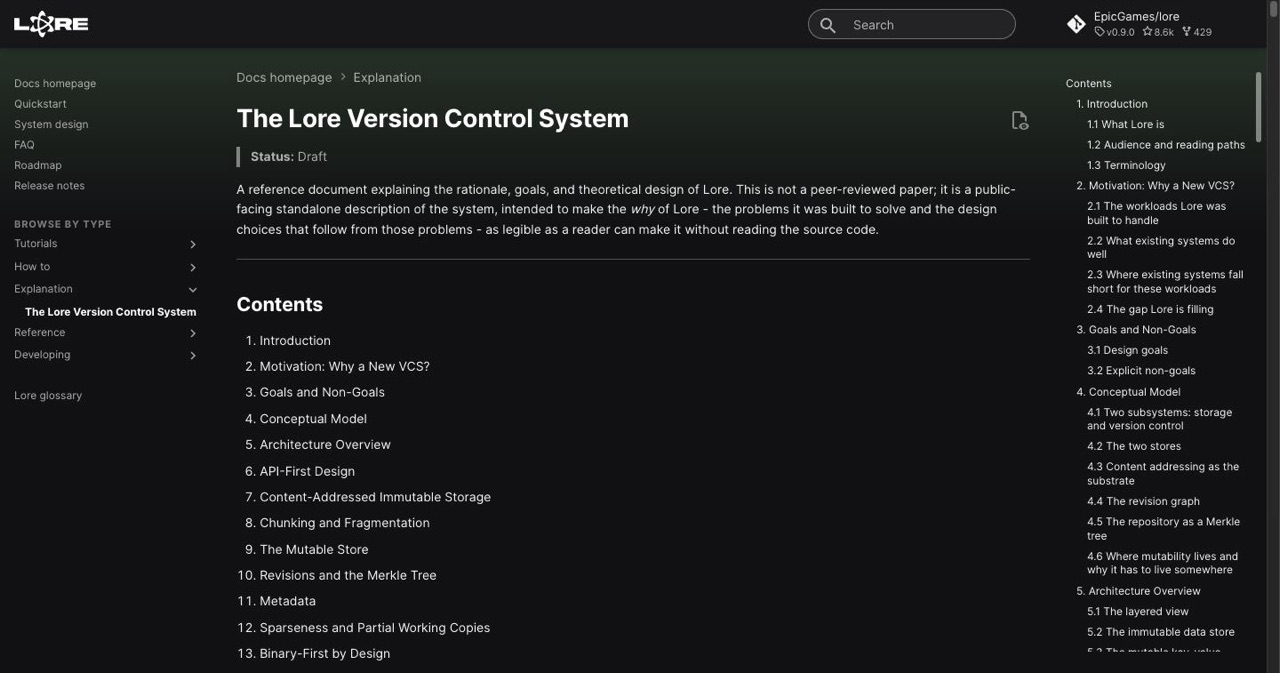
- Quickstart and docs: lore.org
- Source code: github.com/EpicGames/lore
- System design deep-dive: epicgames.github.io/lore/explanation/system-design
- Community: Discord link in the GitHub README
If you've ever submitted a Perforce support ticket at 2 AM, star the repo. It's for you.
SaaSCity.io covers developer tools, open-source releases, and the startup ecosystem. Shipping a tool, plugin, or studio service? List it on the SaaSCity directory to get found and earn high-quality dofollow backlinks.
Get your SaaS in front of founders
List your product on the SaaSCity live city map - a permanent listing, real discovery, and a backlink from a high-DR directory. Free to start; upgrade for a dofollow link and a building on the map.