News
Nvidia Just Bought Hugging Face for $12.9 Billion. Here's What Changes for AI Founders (2026)
Nvidia is acquiring Hugging Face for $12,930,300,000, the company that hosts 3 million models, 1 million apps, and the download links for basically every open-weight model you build on. Jensen Huang says nothing changes. Here's why founders should watch the pricing and neutrality signals anyway, and why owning your own distribution just got more important.

Contents (8)
- Key Takeaways
- What was actually announced
- How we got here: a rejected $500M offer and a company that finally hit its number
- The part nobody can answer yet: what actually changes
- The bigger lesson: category front doors get bought
- What to actually do about it
- Where SaaSCity fits into this, honestly
- The one thing worth watching next
Quick answer: Nvidia agreed to acquire Hugging Face for $12,930,300,000, announced by Jensen Huang on the Nvidia blog on September 3, 2026 and confirmed the same day by TechCrunch. Hugging Face hosts 3 million-plus models, 500,000-plus datasets and 1 million-plus Spaces for over 18 million developers, on roughly $150 million in annualized revenue, so the price is about 26 times revenue. Huang pledged Nvidia compute will not be required to build or deploy on the platform.
Sources and dates are linked inline as they come up. Nvidia's announcement and TechCrunch's confirmation both published September 3, 2026, the same day as this post.
Nvidia just bought the neutral ground.
For a decade, Hugging Face was the one AI infrastructure company nobody owned a grudge against. Not a cloud vendor picking winners. Not a chip maker with a stake in which framework you used. Just the place where 18 million developers went to grab a model, upload a dataset, or spin up a demo, regardless of whether they were running it on an Nvidia card, an AMD card, or a laptop CPU. That neutrality was the whole product.
As of today, it belongs to the company that makes more money than anyone alive from you needing a GPU.
Key Takeaways
- The price and the date: $12,930,300,000, announced September 3, 2026 by Jensen Huang and confirmed the same day by TechCrunch, with no closing date published.
- Roughly 26x revenue: The Information reported Hugging Face's annualized revenue jumped from $100 million in June 2026 to $150 million in August.
- A rejected offer came first: Nvidia offered about $500 million in late 2025 at a roughly $7 billion valuation, and Hugging Face turned it down.
- The neutrality pledge is explicit: Huang wrote that "NVIDIA compute will not be required to build on or deploy through Hugging Face."
- Watch three pressure points: Inference Providers placement and pricing, Spaces GPU allocation, and enterprise bundling of Hugging Face access with Nvidia compute contracts.
- Nvidia was already the largest contributor: it has published 500-plus models and 250-plus open datasets on the platform itself.
- Front doors get bought: GitHub went to Microsoft in 2018 and npm followed in 2020, which is the argument for not making any single channel your only one.
- Next checkpoint: Nvidia's GTC Berlin runs October 20-22, 2026, where integration plans are likely to be detailed.
What was actually announced
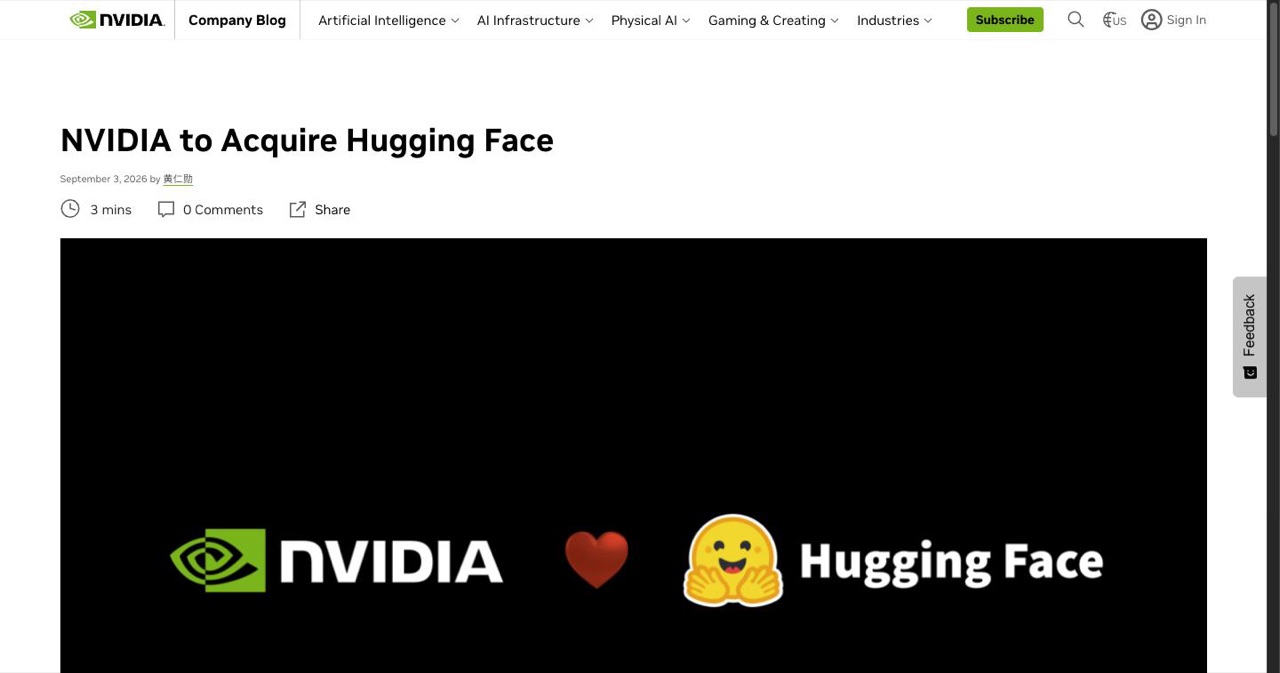
Jensen Huang confirmed it himself, in a post on the Nvidia blog dated September 3, 2026: Nvidia has agreed to acquire Hugging Face for $12,930,300,000, about $12.93 billion. TechCrunch confirmed the deal the same day, in a piece by Ivan Mehta, closing weeks of rumors that had been circulating around the two companies.
The scale of what's changing hands is worth sitting with for a second:
| Hugging Face, by the numbers | Figure |
|---|---|
| Models hosted | 3,000,000+ |
| Datasets hosted | 500,000+ |
| Apps (Spaces) hosted | 1,000,000+ |
| Developers using the platform | 18,000,000+ |
| Companies using it to discover/deploy AI | 200,000+ |
| Founded | 2016 |
| Total funding raised before acquisition | $395M+ |
| Last reported annualized revenue (The Information, August 2026) | ~$150M |
| Acquisition price | $12.93B |
| Implied revenue multiple | ~26x |
Huang's post leads with a pledge, not a product roadmap: Hugging Face keeps operating as an open platform. Developers keep choosing their own models, frameworks, clouds, and inference providers. In his words, "NVIDIA compute will not be required to build on or deploy through Hugging Face." He's also framing Nvidia as a good-faith member of that ecosystem rather than a new landlord, pointing out Nvidia is already the largest single contributor of open weights and open data on the platform, having released 500-plus models and 250-plus open datasets there itself.
That last point is true and it's also the whole reason people are nervous. Nvidia was already the biggest player inside Hugging Face's front yard. Now it owns the yard.
How we got here: a rejected $500M offer and a company that finally hit its number
This isn't a sudden marriage. It's a negotiation that took a year and change to close.
Late in 2025, Nvidia offered Hugging Face roughly $500 million as an investment, valuing the company at about $7 billion. Hugging Face said no, reportedly because it didn't want a single dominant investor in a position to sway how the platform got run. At the time, that read as a company betting its neutrality was worth more than a nine-figure check. The number that changed the math: The Information reported in August 2026 that Hugging Face's annualized revenue had jumped 50% in two months, from $100 million in June to $150 million in August, on rising demand for its compute and storage products. That's a company that went from roughly $35 million in annualized revenue at the end of 2023 to $150 million in under three years. CEO Clem Delangue told TechCrunch in July 2026 the platform was getting "close to profitability." Put those two numbers next to a $12.93 billion price tag, about 26 times revenue and nearly triple the valuation Nvidia had floated less than a year earlier, and turning it down twice gets a lot harder.
Delangue explained the decision on X the way founders explain decisions they've clearly rehearsed: the community proved Hugging Face could be a real alternative to closed-source APIs, but scaling that proof past its current size needs "more compute, more support, more collaboration, and more visibility. That's why we went to talk to Jensen."
Read plainly, that's an admission that being the neutral hub of open AI is expensive, and Hugging Face had hit the ceiling of what it could fund alone. Nvidia has the balance sheet to remove that ceiling. It also has every incentive imaginable to shape what gets built on the other side of it.
The part nobody can answer yet: what actually changes
Here's the honest version, not the press-release version. Nobody outside the two companies knows what changes, including, probably, a lot of people inside the two companies. What we can do is name the specific places where the pressure will show up first, because pledges at announcement time are cheap and pricing decisions eighteen months into integration are where the real answer lives.
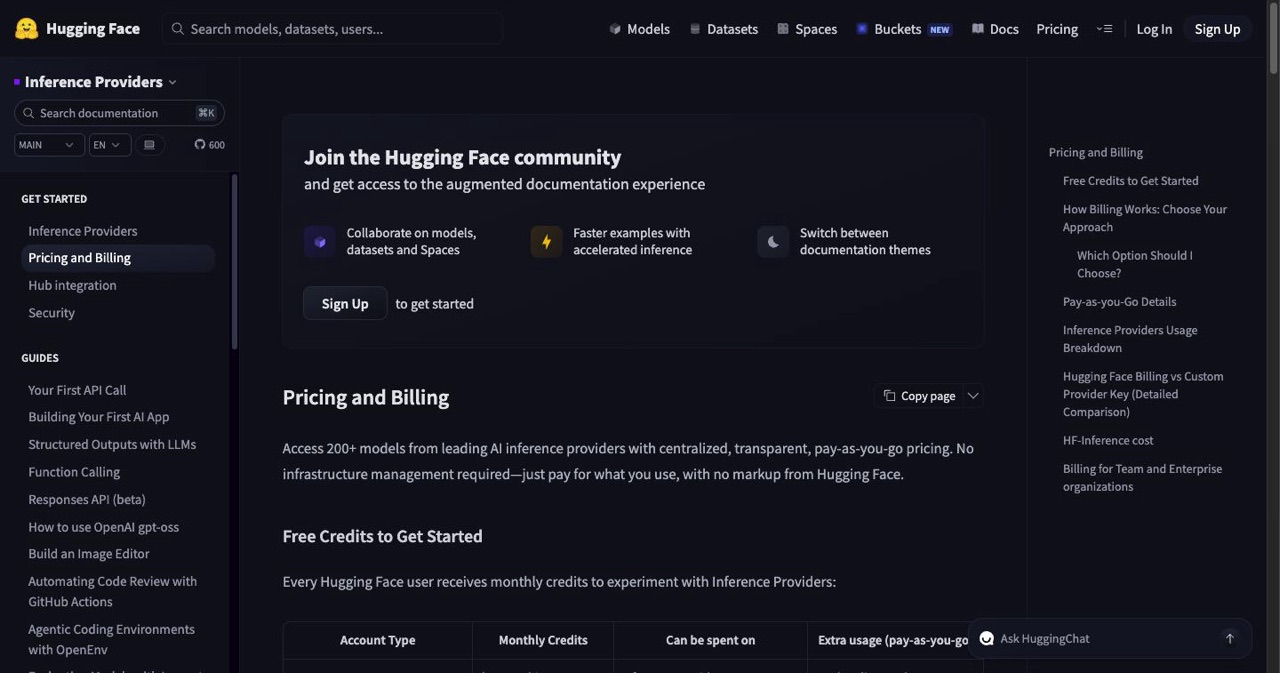
Pricing on Pro and Inference Providers. Hugging Face Pro runs $9 a month today. The Inference Providers marketplace, launched in 2025, routes your API calls across a menu of backends, Nvidia's own NIM endpoints among them, alongside AMD, Cerebras, Groq, Together, and others, and takes a cut. Nobody has announced a pricing change. But a marketplace that used to have zero reason to favor any single backend now has an owner who very much has a favorite. Watch whether Nvidia-backed endpoints start getting better default placement, faster new-model availability, or quietly better margins than the competition.
Spaces hosting and compute allocation. Spaces is where a huge share of demo apps and small AI tools actually run. If GPU-hour pricing or queue priority on Spaces starts tilting toward Nvidia hardware, that's the acquisition showing up in your bill before it shows up in any announcement.
Enterprise bundling. TechCrunch's piece on the deal flags this directly: Nvidia can now package Hugging Face access alongside its own compute capacity when it sells to large enterprise customers. That's not hypothetical, it's the standard playbook any company runs after buying a platform layer, and it's the single biggest reason to believe "nothing changes" won't hold at the enterprise tier even if it mostly holds for hobbyists.
Open-weight geopolitics. This is the one most founder-focused coverage is skipping, and it matters more than the pricing questions. Chinese open-weight labs, Qwen, GLM, Kimi, DeepSeek, distribute their models through Hugging Face because it's the default global pipe. We wrote about the pace of that release cadence in our look at Kimi K3 vs Qwen3.8-Max, two trillion-parameter open models shipped three days apart back in July. Nvidia now owns the pipe those models flow through, at the exact moment Washington has been pushing open-weight models as a US strategic asset. Huang made that argument himself on Nvidia's last earnings call, saying open models are vital for US cybersecurity because companies building distributed, autonomous cyber-defense systems need models they can inspect and self-host, not just call over an API. He's not wrong about the strategic value. He's also now the gatekeeper deciding how that value gets distributed.
This deal doesn't stand alone, either. The Wall Street Journal reported last month that Nvidia struck a $6 billion deal with coding startup Poolside for open models, and Nvidia says it has put more than $50 billion into AI frontier labs across its various stakes and partnerships. Buying the discovery layer that sits on top of all of it is the natural next move, not an outlier.
The bigger lesson: category front doors get bought
Step back from Hugging Face specifically and look at the pattern, because it's not new and it's not going to stop being true.
Every category eventually produces a front door, the one place everyone in that category defaults to for discovery. GitHub was the front door for code, until Microsoft bought it in 2018. npm was the front door for JavaScript packages, until GitHub (owned by Microsoft) absorbed it in 2020. Product Hunt has been circling that role for launches for a decade under a single owner the whole time. Hugging Face was the front door for open models, datasets, and small AI apps, and as of today it's owned by the company with the largest financial stake in how AI gets built and run.
None of these acquisitions are evidence of bad faith on day one. GitHub under Microsoft mostly stayed GitHub. But "mostly stayed the same" is a different promise than "stayed neutral," and the gap between those two shows up slowly, in pricing tiers, in what gets promoted, in which integrations get first-class support. A platform that answers to a single company's P&L will eventually optimize for that P&L, even when the people running it genuinely mean every word of the neutrality pledge on day one.
If your SaaS product's distribution runs entirely through one category front door, whether that's a single directory, a single marketplace, a single App Store category, or a single model hub, you've outsourced your discoverability to a company whose incentives can change the day it gets a term sheet. That's not a reason to avoid these platforms. It's a reason not to make any single one your only channel.
What to actually do about it
A few concrete moves, not vibes:
- Distribute your models in more than one place. If you publish open weights, mirror them somewhere besides Hugging Face, GitHub Releases or your own object storage at minimum, so a pricing or policy change on one platform doesn't strand your users.
- Own an audience that isn't rented. An email list, a Discord, a blog with real search traffic, these don't get bought out from under you in an acquisition. Hugging Face's 18 million developers are Hugging Face's audience, not yours, no matter how many stars your model has.
- Diversify discovery channels for your product, the same logic applies. We wrote a full framework for this in choosing SaaS launch directories by Domain Rating: the mistake is either betting everything on one big platform or spraying submissions across two hundred dead ones. The fix is a short list of channels that are actually indexed, actually have traffic, and aren't a single company's rounding error.
- Watch your inference costs like you'd watch a vendor contract, because that's what it is. If you're running fine-tunes or agents through Hugging Face's Inference Providers, keep an eye on whether pricing parity across backends holds over the next two quarters. We covered the mechanics of inference cost and SaaS margins in more depth in our piece on OpenAI's Jalapeño chip and what custom silicon does to your token bill; the same math applies here in reverse, a compute owner now sits on top of your model marketplace too.
Where SaaSCity fits into this, honestly
You're reading this on a directory's blog, so here's the disclosure up front: we have a product angle in this story, and it's a small one, not a hidden one.
The reason this Hugging Face deal is relevant to a founder audience beyond "interesting acquisition" is the exact pattern above, a category's discovery layer just changed hands, and the people who built on top of it as their only channel now have to wait and see what that means for them. That's the same risk we'd point out for any founder who lists their SaaS on exactly one directory, buys traffic from exactly one channel, or builds their whole growth plan on an algorithm they don't control.
SaaSCity is our attempt at being one honest node in that mix, not the only one. It's a free, human-reviewed startup directory with a live city map, every listing gets an actual person checking it, not a scoring model. Submitting gets you a permanent listing page. Add the SaaSCity badge to your own site and the backlink goes dofollow, from a domain sitting at DR 66 as of our last Ahrefs refresh, and it books you into the next Monday launch slot instead of a general queue. If you want it live faster, Quick Pass at $19.99 skips the badge requirement and goes live within 24 hours with a building on the map; Premium at $39.99 adds a launch post our team writes with three sponsored links.
That's the pitch, and it's a small one on purpose. The bigger point stands regardless of whether you ever touch SaaSCity: don't let any single platform, a chip company's new acquisition included, become the only place someone can find what you built.
The one thing worth watching next
Nvidia's GTC Berlin runs October 20–22, 2026, and it's a safe bet Huang addresses Hugging Face integration plans on that stage in more detail than a launch-day blog post allows. That's the real test of the neutrality pledge, not what got announced today, but what gets said, or quietly changed, six weeks from now once the deal has had time to sink into a roadmap. Watch the Inference Providers pricing page in the meantime. It'll tell you the truth before any keynote does.
Get your SaaS in front of founders
List your product on the SaaSCity live city map - a permanent listing, real discovery, and a backlink from a high-DR directory. Free to start; upgrade for a dofollow link and a building on the map.