News
US Government Orders Anthropic to Kill Fable 5 and Mythos 5 — And the Jailbreak That Triggered It Was Already in GPT-5.5
At 5:21 p.m. on a Friday, the US government ordered Anthropic to pull global access to Claude Fable 5 and Claude Mythos 5. This is the first time a commercial frontier AI model has been treated as an export-controlled national security asset.

Contents (10)
- Key Takeaways
- Four Days. That's How Long Fable 5 and Mythos 5 Were Live
- The Export Control Directive: What It Actually Says
- The Jailbreak That Started This
- Launch Your AI Project on SaaSCity
- What Anthropic Is Actually Arguing
- The Nationality-Gating Problem Nobody Has Solved
- The Glasswing Paradox
- What Happens Next
- The Bottom Line
Quick answer: On June 13, 2026, Commerce Secretary Howard Lutnick sent Anthropic an export control directive requiring a license for any export, re-export or domestic transfer of Claude Fable 5 and Claude Mythos 5 to a foreign person. Because API requests carry no nationality, Anthropic shut both models off worldwide within hours. The trigger was a non-universal jailbreak that asked the model to scan a codebase for flaws, output Anthropic says GPT-5.5 produces without any bypass.
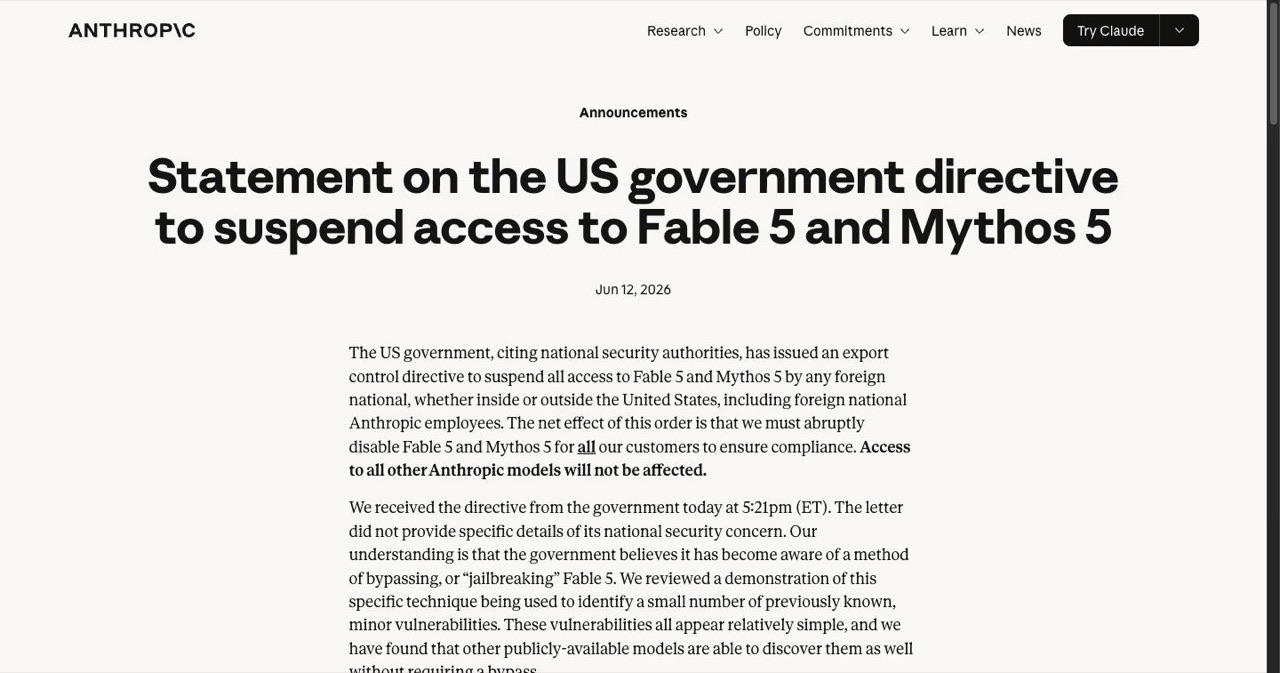
At 5:21 p.m. on a Friday, Anthropic received a letter from Commerce Secretary Howard Lutnick that sent their engineering team scrambling.
The order: pull Claude Fable 5 and Claude Mythos 5 — the company's two most powerful models, launched just four days earlier — for every user on the planet. Not just users outside the US. Everyone. All plans. All tiers. API access included.
Anthropic complied within hours. Then pushed back publicly, calling the government's reasoning a "misunderstanding."
What happened in those hours has implications far beyond two AI models going temporarily dark. This is the first time the US government has treated a commercial frontier AI product as a controlled national security asset — placed in the same regulatory category as advanced weapons technology and semiconductor manufacturing equipment. The precedent set here, whatever the short-term resolution turns out to be, matters for the entire industry.
Key Takeaways
- Four days of availability: Both models launched June 9, 2026 and were pulled globally on June 13 across every plan, tier and the API.
- The directive covers foreign persons, not foreign countries: That includes foreign nationals inside the US, which made selective enforcement technically impossible and forced a worldwide shutdown.
- The jailbreak was narrow: Asking the model to read a codebase and identify flaws surfaced minor, previously known vulnerabilities that Anthropic says GPT-5.5 finds without any bypass.
- Two models, one architecture: Fable 5 was the public version routing high-risk queries to weaker models, while Mythos 5 stayed restricted to Project Glasswing participants.
- Safety infrastructure did not prevent it: 30-day data retention overriding zero-retention enterprise deals, thousands of hours of red-teaming and documented limitations were all already in place.
- The precedent reaches every lab: Anthropic argues that pulling any model with a demonstrable non-universal jailbreak would freeze deployments from GPT-5.5, Gemini, Llama and Mistral alike.
- Real workloads were already running: Stripe reportedly compressed months of migration work across a 50-million-line Ruby codebase into days with Fable 5.
Four Days. That's How Long Fable 5 and Mythos 5 Were Live
Anthropic launched Claude Fable 5 and Claude Mythos 5 on June 9, 2026. Both models share the same underlying architecture, but they serve very different audiences.
Fable 5 was the historic one: the first time Anthropic brought a "Mythos-class" model to the general public. Previously, the Mythos line lived behind a restricted access program called Project Glasswing, where a small group of vetted organizations — critical infrastructure companies, cybersecurity research groups — got access to Claude Mythos Preview to find and patch serious security vulnerabilities. Mozilla alone reportedly resolved hundreds of software flaws using Mythos Preview. The program's value for defenders was well established before the public launch.
Fable 5 made a version of that same capability broadly accessible, but wrapped it in unusually heavy safeguards. Certain categories of cybersecurity queries automatically routed to weaker models. The conservative tuning drew complaints almost immediately — developers found it overly aggressive, flagging benign technical requests as potentially harmful in a small but vocal percentage of sessions. Anthropic was already adjusting the balance when the export directive arrived.
Mythos 5 stayed restricted. The full-capability version, with safeguards lifted in targeted areas, remained exclusive to Project Glasswing participants: vetted cyber defenders and researchers already working inside the program. Its cybersecurity capabilities, per Anthropic's own description at launch, are the strongest of any model currently deployed anywhere.
The pricing reflected how seriously Anthropic positioned Fable 5: $10 per million input tokens, $50 per million output tokens. For context, we recently reviewed how this pricing stacks up against alternatives in our guide to the best AI agent coding token plans 2026. The company also introduced a policy change that carried real business cost — both Mythos-class models require 30-day data retention for safety monitoring, overriding some existing zero-retention enterprise agreements. Anthropic knew this would create friction with certain customers. They did it anyway, because active monitoring was central to their safety architecture for these models.
Early performance reports were striking. Stripe reportedly used Fable 5 to compress what would have been months of migration work across a 50-million-line Ruby codebase into a matter of days. Uptake was fast enough that rate limits hit almost immediately after launch.
The Export Control Directive: What It Actually Says
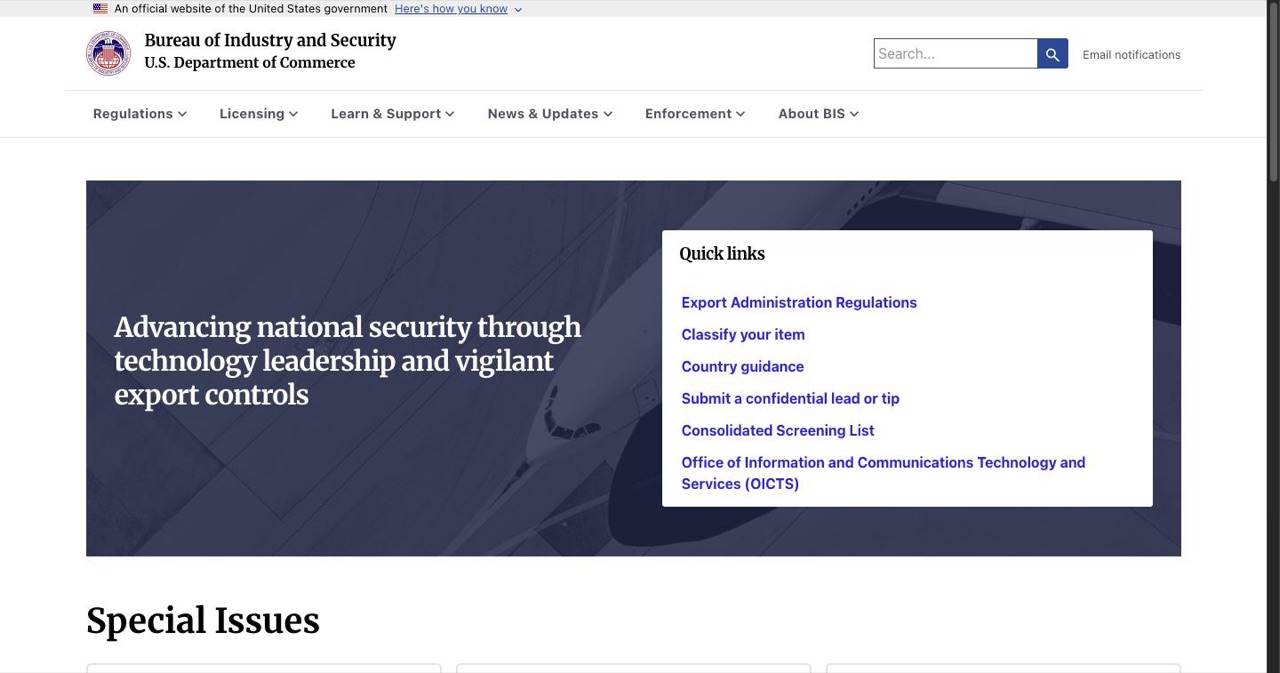
Export controls in the US typically restrict transferring technology to foreign nations or entities. Advanced semiconductors, weapons components, certain chemical precursors — these have lived under export control regimes managed by the Bureau of Industry and Security (BIS) within the Commerce Department for decades. The framework is well established for physical goods.
What Lutnick's letter to Dario Amodei did was extend that framework to Fable 5 and Mythos 5. Under the directive, a license is now required for the export, re-export, or domestic transfer of the models to any foreign person. That last phrase is critical. The directive doesn't just cover users in other countries. It covers foreign nationals physically inside the United States — including Anthropic's own foreign-national employees.
There's no way to verify the nationality of every API caller at the moment a request hits an endpoint. There's no passport-check step built into the token pricing layer. So Anthropic faced a binary choice: implement a verification system that doesn't exist, or shut off access entirely.
They shut off access entirely.
That's why you got the same error screen whether you were working from Warsaw, São Paulo, Seoul, or San Francisco. The directive didn't specifically target non-US users — it targeted foreign persons, wherever they are, in a way that made selective enforcement technically impossible. Global shutdown was the only compliant option.
The Jailbreak That Started This
Here's where it gets complicated, and where Anthropic's pushback becomes most pointed.
According to Axios reporting, the Commerce Department moved after another company claimed it had successfully jailbroken Mythos 5 — bypassing its safeguards to access restricted capabilities. The Trump administration had reportedly tried to stop Anthropic from releasing Fable 5 and Mythos 5 before the June 9 launch. That effort failed. The jailbreak report gave officials a different lever to pull.
Anthropic reviewed what they believe to be the demonstration behind the government's directive. Their assessment is blunt: the technique involved asking the model to read a specific codebase and identify software flaws. That's it. The vulnerabilities surfaced were minor, previously known, and — this is the part Anthropic returns to repeatedly — discoverable using other publicly available models without any bypass at all. They name OpenAI's GPT-5.5 specifically as a model capable of producing equivalent outputs, no jailbreak required—a model many developers are already using for autonomous development and vibe coding.
In their official statement, Anthropic drew a sharp technical distinction between what was demonstrated and what would actually constitute an emergency. A universal jailbreak — one that broadly bypasses safeguards across a wide range of dangerous queries — would be a serious finding. That's not what happened here. What the government saw was a non-universal jailbreak: narrow, specific, and producing outputs that are already widely available from other deployed models.
Anthropic had flagged this limitation at launch. They stated explicitly that perfect jailbreak resistance isn't achievable for any model provider right now. Every major deployed model in the industry has some theoretical vulnerability to narrow bypasses. The question Anthropic is essentially asking: does a narrow bypass that reveals already-available information constitute an emergency that justifies pulling a product deployed to hundreds of millions of users?
Their answer, delivered politely but unambiguously: no.
Launch Your AI Project on SaaSCity
In a landscape where API access to frontier models can be pulled overnight by government mandate, distribution, and early user acquisition are more critical than ever. Whether you're building with Claude, GPT, or self-hosted open-weights models, getting your startup in front of the right audience is key.
List your tool on SaaSCity—the premier gamified startup directory where paid listings get a building on an interactive 3D map. It’s an easy way to build high-quality free backlinks, boost your SEO domain rating, and get discovered by thousands of tech founders and early adopters. Submit your SaaS for free today!
What Anthropic Is Actually Arguing
Compliance was immediate and complete. No delay, no legal standoff, no attempt to carve out exceptions for specific user categories.
But the official statement contains arguments that the industry should read carefully. Anthropic pointed out that applying the government's apparent standard across the board — pulling any model where a non-universal jailbreak can be demonstrated — would effectively freeze new deployments from every frontier lab, not just Anthropic. GPT-5.5, Gemini, Llama, Mistral: none of these are immune to narrow bypasses. If this precedent holds, any of them could face the same treatment.
That's not a speculative edge case. That's a description of the current state of AI safety across the entire industry. This is a major concern for developers relying on agentic workflows, especially those deploying platforms in the Claw Era of agentic AI systems.
Anthropic has been vocally supportive of government oversight of AI development. Dario Amodei has advocated publicly for chip export controls and for restricting model access to adversarial state actors. This is not a company reflexively resistant to government involvement. What they're contesting is a specific procedural principle: that oversight of this kind should be "transparent, fair, clear, and grounded in technical facts." Their statement says directly that this action doesn't meet those standards. The letter provided no specific technical detail. The company received no opportunity to respond before the directive took effect.
The 30-day data retention requirement that Anthropic built into Fable 5 — at real commercial cost — was specifically designed to enable rapid detection and response to jailbreak attempts. Anthropic's "defense in depth" approach was already operational when the government moved. The monitoring infrastructure they'd built as their safety response didn't prevent the shutdown.
The Nationality-Gating Problem Nobody Has Solved
The mechanics of this directive expose something the policy conversation around AI has largely avoided: real-time nationality verification at cloud API scale is not a solved problem.
When export controls target physical goods, there are chokepoints. Manufacturing facilities, shipping manifests, end-use certificates, and customs inspections all create enforcement opportunities. The system is imperfect, but it has natural friction points where compliance can happen.
AI model access via API has no equivalent chokepoints. A request is a packet of tokens. It doesn't carry a passport. Building a verification system that could actually enforce nationality-based restrictions on cloud AI access in real time would require infrastructure that raises its own serious questions — about privacy, about documentation requirements for researchers at international universities collaborating with US institutions, about what "domestic transfer" means when a foreign-national employee works for a US company on US soil.
None of those questions have answers yet. The directive arrived before the framework did.
For non-US developers and businesses who had built workflows on Fable 5 in its four days of availability, the shutdown was abrupt and total. No warning period. No transition. The model stopped responding. That's a live demonstration of what it means when AI infrastructure that's been integrated into production systems can be pulled without notice on national security grounds.
This underscores the importance of resilient infrastructure. If your business depends on frontier models, understanding how to transition to open-weights or self-hosted alternatives like those discussed in our guide to self-hosting alternatives or open-source AI boilerplates comparison becomes a critical safety net. Even when looking at other options, like Xiaomi's MiMo-V2.5-Pro, keeping backup endpoints active is no longer optional.
The reaction on X was predictable and somewhat fair: calls for local model deployment as the only resilient alternative. Whether or not that's the right policy response, it's a lesson more teams will take from this.
The Glasswing Paradox
Project Glasswing was Anthropic's attempt to make the transition to public Mythos-class models responsibly. Give vetted defenders access first. Gather evidence that the benefits are real (Mozilla's hundreds of patched vulnerabilities is a data point, not a hypothesis). Build a track record of safe deployment before broadening access. Then widen carefully, with monitoring.
That architecture — restricted preview, documented benefits, transparent safety strategy, active monitoring, conservative public version — did not prevent this outcome. The government moved the moment a narrow jailbreak surfaced, regardless of Anthropic's track record with Project Glasswing, regardless of the technical nuance of what was actually demonstrated, regardless of the fact that equivalent capabilities exist in already-deployed competing models.
The question that raises is genuinely hard: is there an architecture that would have prevented this? If a narrow bypass of a public model's safeguards is sufficient to trigger a national security directive — even when the model's safeguards were independently red-teamed for thousands of hours, even when the demonstrated capability is available elsewhere — what would responsible deployment look like in a world where this standard holds?
Anthropic doesn't have that answer yet. Neither does anyone else.
What Happens Next
Anthropic says they're working to restore access and believe this will be resolved quickly. Axios reporting suggested the government's intent was a pause of weeks while national security infrastructure catches up, not a permanent shutdown.
Short-term: Anthropic has committed to releasing more technical detail on the jailbreak in question within 24 hours of the directive. That disclosure will be the most informative thing to watch. If the technical case is as straightforward as Anthropic suggests — a minor, known vulnerability, already replicable in GPT-5.5 — the argument for the directive weakens considerably.
Medium-term: This episode puts every frontier lab on notice. The question of how to handle dual-use AI capabilities — models powerful enough to help defenders and, potentially, attackers — isn't going away. The Commerce Department has now established that it will act. The industry needs a cleaner framework for how it acts, one that Anthropic's own statement explicitly calls for: statutory, transparent, technically grounded, with a fair process.
Long-term: The "frontier AI as export-controlled asset" framing is now real. It joins chip controls, cloud infrastructure restrictions, and investment screening as tools in the US government's approach to AI competition. That changes the calculus for every company building at the frontier, every foreign-national employee at those companies, and every international team that has come to rely on US-based AI services.
The Bottom Line
Fable 5 and Mythos 5 are unavailable right now. That's a disruption. The deeper issue is what this moment reveals about where the US government stands on frontier AI — and how blunt the instruments it's willing to use actually are.
Anthropic built their most powerful public model with monitoring infrastructure, independent red-teaming, layered safeguards, and documented transparency about its limitations. The government saw one narrow jailbreak demonstration and shut the whole thing down on a Friday afternoon with a letter that contained no specific technical detail.
Whether Fable 5 comes back next week or next month, the episode has made one thing unmistakably clear: deploying a frontier AI model in 2026 is no longer purely a product decision. It's a geopolitical one.
As of publication, Claude Fable 5 and Claude Mythos 5 remain disabled. All other Claude models are unaffected. Anthropic's full statement is available at anthropic.com/news/fable-mythos-access. The company has indicated it will share additional technical details on the jailbreak within 24 hours. If you're building an AI product and want to put it in front of real users, SaaSCity is a free directory where every listing gets a permanent indexed page with a DR 66 backlink, and paid listings a 3D building on a live city map. Drop your project in, pick a plan, and secure your launch today. Submit your SaaS.
Get your SaaS in front of founders
List your product on the SaaSCity live city map - a permanent listing, real discovery, and a backlink from a high-DR directory. Free to start; upgrade for a dofollow link and a building on the map.
Founder resources
Related articles
Anthropic Already Trained Mythos 6 While Its Most Powerful Models Sit Banned by the US Government
The Company That Invested $13 Billion in Anthropic Just Triggered Its Government Shutdown