SaaS Business
10 Profitable Micro SaaS Ideas for Content Creators in 2026: AI Tools for Repurposing and Automation
Most people building SaaS in 2026 are thinking too big. The real money lies in boring, specific, small tools that solve one painful problem so well that creators happily pay $29–$99 a month.


Contents (14)
- Key Takeaways
- Table of Contents
- 1. AI-Powered Content Repurposer
- 2. Automated Video Script Generator
- 3. Intelligent Thumbnail Creator
- 4. Podcast-to-Text Automation Tool
- 5. Social Media Scheduling Optimizer
- 6. Newsletter Compilation Assistant
- 7. Trend-Driven Content Ideator
- 8. AI SEO Content Optimizer
- 9. Faceless Video Automation Builder
- 10. Multi-Platform Content Adapter
- Conclusion
- FAQs
Quick answer: The ten most profitable micro SaaS ideas for content creators in 2026 are an AI content repurposer that turns one blog post into tweets, LinkedIn posts and scripts, an automated video script generator, an intelligent thumbnail creator, a podcast-to-text automation tool, a social scheduling optimizer, a newsletter compilation assistant, a trend-driven content ideator, an AI SEO optimizer that preserves voice, a faceless video automation builder, and a multi-platform content adapter. Subscriptions run $9 to $99 per month, with 200 users at $49 reaching $9,800 MRR.

Key Takeaways
- Start with the repurposer: The AI-Powered Content Repurposer has the highest demand and the easiest validation path on Reddit and IndieHackers.
- Niche down for the moat: A general repurposer is saturated; one built for B2B founders or health coaches is not.
- Brand voice is the differentiator: Letting creators upload five past posts so the tool matches their tone is a feature most competitors skip.
- Proof creators pay: Clickpilot, a thumbnail A/B testing tool, reached $1,600 MRR in five months.
- Recurring pain means recurring revenue: Over 5 million active podcasts each need repurposing every single episode.
- No-code covers the build: Make, n8n, Claude, OpenAI, Whisper and ElevenLabs get an MVP live in under six weeks.
- Realistic math: 200 paying users at $49 per month is $9,800 MRR, achievable within 12 months for a focused founder.
Most people building SaaS in 2026 are thinking too big. The real money? It's in the boring, specific, small tools that solve one painful problem so well that creators happily pay $29–$99 a month without blinking.
That's the micro SaaS thesis. And right now, content creators are the single most underserved market for it.
Think about what a typical creator does every week: record a podcast, write a newsletter, film a YouTube video, post on LinkedIn, and somehow keep TikTok fed. That's not a content strategy. That's a second job. The core problem is that manual repurposing is tedious. Creators have long-form content that could become dozens of social posts, but turning it into that is brutally time-consuming.
Micro SaaS solves this. Small, focused software. Niche audience. Recurring subscriptions. No VC needed. (For ideas beyond the creator niche, see 10 micro SaaS ideas worth building in June 2026.)
Micro-SaaS is no longer a stepping stone. It is a strategy. With no-code tools, open AI APIs, and the creator economy still expanding, a single person can ship a $10K/month tool in under three months. The SaaS market is projected to hit $465 billion by end of 2026, and the gap between what big platforms offer and what individual creators actually need has never been wider.
Here are 10 micro SaaS ideas built for that gap.
Table of Contents
- AI-Powered Content Repurposer
- Automated Video Script Generator
- Intelligent Thumbnail Creator
- Podcast-to-Text Automation Tool
- Social Media Scheduling Optimizer
- Newsletter Compilation Assistant
- Trend-Driven Content Ideator
- AI SEO Content Optimizer
- Faceless Video Automation Builder
- Multi-Platform Content Adapter
1. AI-Powered Content Repurposer
The idea: Upload a blog post or YouTube video. Get 10 tweets, 5 LinkedIn posts, a newsletter draft, and a short-form video script, all platform-optimized, automatically.
This is the most validated idea on this list. Creators constantly struggle with distribution and marketing their content. Repurposing multiplies the ROI of every single piece of content. The pain is real, the willingness to pay is real, and the build complexity is manageable.
Why it's profitable: Existing tools like Repurpose.io are broad. The opportunity is going vertical: build a repurposer specifically for health creators, finance educators, or B2B founders. Niche positioning means less competition and higher perceived value.
How to build it: Start with a Make or n8n workflow connecting to OpenAI or Claude's API. Accept URL or text input. Generate outputs per platform character limits and best practices. Ship an MVP in 3–6 weeks.
Revenue model: Tiered subscriptions: $29/month basic (5 repurposes/month), $99/month pro (unlimited). Target 200 paying users and you're at $6,000–$20,000 MRR.
Unique angle: Add a "brand voice" layer. Let creators upload 5 of their past posts, and the tool matches their tone. That's a moat most competitors ignore.
2. Automated Video Script Generator
The idea: Input a topic or keyword. Get 10 ready-to-film short-form video scripts with hooks, B-roll cues, and captions baked in, optimized for YouTube Shorts, TikTok, or Reels.
The faceless YouTube channel trend is not slowing down. The "Podcast Golden Nugget Extractor" concept (automatically finding the most emotional 30 seconds of an interview) hints at how powerful automated script pulling already is. A dedicated script generator takes this further.
Why it's profitable: Affiliate marketers, educators, and anonymous content farms all need volume. Speed is the value. If your tool cuts script time from 2 hours to 10 minutes, $19/month is a no-brainer.
How to build it: Use Claude for scripting (it handles structure and tone well). Add ElevenLabs integration for voiceover previews. Output scripts in a CapCut-importable format.
Revenue model: $19/month for 50 scripts, $49/month for unlimited. Optional one-time "bulk pack" for $100 to attract affiliate marketers.
3. Intelligent Thumbnail Creator
The idea: Paste a YouTube title or video script. The tool generates 5 thumbnail concepts with text overlays, color palettes, and emotion cues, ready to customize in Canva or export directly.
Thumbnails drive click-through rates. A 1% CTR improvement on a 100K-view video is meaningful money. Yet most thumbnail tools are either too generic or too expensive (custom designers).
Why it's profitable: Clickpilot, a thumbnail A/B testing tool, hit $1,600 MRR in just 5 months. Proof that creators will pay for thumbnail-specific tools. A generator with trend-aware prompting (pulling from trending thumbnails in a niche) is the next logical step.
How to build it: Integrate Leonardo AI or DALL-E for generation. Use a simple scraper to pull trending thumbnails from a given YouTube category and feed them as style references. Ship a web app with no-code or a lightweight React front-end.
Revenue model: $9/month for 30 generations. Simple, low-friction entry point with high retention because creators need thumbnails constantly.
4. Podcast-to-Text Automation Tool
The idea: Upload a podcast episode. Get a full transcript, a 3-paragraph blog post, 5 social captions, and a short video highlight reel with captions, all within minutes.
There are over 5 million active podcasts globally. Most podcasters are one-person operations. They record for an hour and then spend another two to three hours repurposing that content manually. That's the exact pain point this tool kills.
Why it's profitable: The problem is recurring: every episode needs repurposing. That means monthly retention is near-guaranteed if the tool works well.
How to build it: Whisper API for transcription. Claude or GPT-4o for summarization and derivative content. Auto-generate quote images using a Canva-style API. Keep the UI dead simple: upload, wait, download.
Revenue model: $29/month for 4 episodes (weekly podcast), $49/month for unlimited. Pair with newsletter tool integrations (Beehiiv, ConvertKit) to charge premium.
5. Social Media Scheduling Optimizer
The idea: A scheduling tool that doesn't just post. It tells you when to post based on your audience's historical engagement, then adapts your caption for each platform automatically.
Buffer and Hootsuite already exist. But they're built for social media managers at agencies, not solo creators. They're overbuilt, overpriced, and the AI suggestions feel generic.
Why it's profitable: This is a subscription business with extremely high retention. Once a creator plugs in their accounts and sees better engagement, they don't leave.
How to build it: Use platform APIs (Meta, LinkedIn, X) for scheduling. Pull engagement data per time slot. Run a basic regression or use a lightweight LLM to suggest optimal times. Add a caption adapter that rewrites posts for each platform's norms.
Revenue model: $29/month. Position against Buffer's $18/month plan by leading with AI-native features and creator-first UX.
6. Newsletter Compilation Assistant
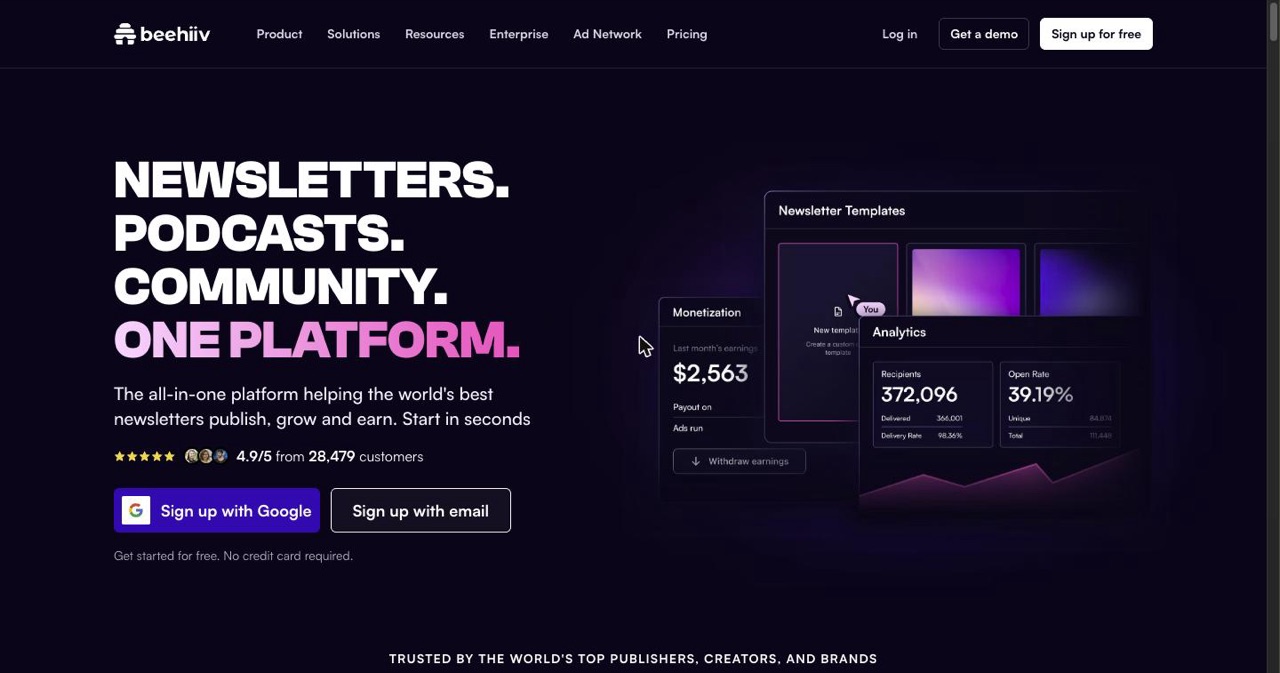
The idea: Connect your RSS feeds, X bookmarks, and newsletter subscriptions. The tool compiles the best content each week, writes short summaries in your voice, and formats a ready-to-send newsletter draft.
Newsletter creators spend hours reading, curating, and formatting. This tool compresses that to 20 minutes of editing.
Why it's profitable: Newsletter writing is exploding. Beehiiv reported record creator signups in 2025. But the curation and compilation step is still brutally manual.
How to build it: RSS aggregation with n8n. Claude API for summarization with a "brand voice" fine-tuning layer. Output a formatted draft in HTML or Markdown compatible with Beehiiv and ConvertKit.
Revenue model: $19/month. Upsell to $49/month for a "trend integration" tier that automatically surfaces viral posts in the creator's niche.
7. Trend-Driven Content Ideator
The idea: Input your niche. Get 20 content ideas every Monday morning, sourced from trending Reddit threads, X posts, and search spikes, with headlines, hooks, and angle suggestions already written.
Most creators grind through content ideation. They refresh Twitter, browse Reddit subreddits, and check Google Trends manually. That's 2–3 hours a week of research that a tool can do in 30 seconds.
Why it's profitable: The best micro SaaS in 2026 doesn't shout about being AI-powered. It simply works. Users want a button that fixes the problem, not a prompt interface. A "Monday content brief" delivered automatically is exactly that.
How to build it: Scrape subreddits and X trending topics via API. Cluster by niche using embeddings. Generate angle suggestions with Claude. Deliver via email or a simple dashboard.
Revenue model: $9/month. High volume, low friction. Target creators in specific niches (personal finance, fitness, B2B) for faster community-based growth.
8. AI SEO Content Optimizer
The idea: Paste a blog draft. The tool scores it against the top 10 ranking pages for your target keyword, highlights gaps, suggests internal link anchors, and rewrites weak headlines, without touching your voice.
The key word there: without touching your voice. Most SEO tools feel like they're optimizing for robots. This one optimizes for rankings while keeping the human writing intact.
Why it's profitable: Bloggers, affiliate marketers, and content-led SaaS companies all need this. AI SEO tools now analyze SERPs, competitor strategies, and user intent in seconds, providing data-driven recommendations that improve rankings faster. Build a lightweight version of that for indie creators.
How to build it: SERP analysis via SerpAPI or DataForSEO. Keyword extraction with NLP. Claude for headline and structure suggestions. Score output as a simple "Readiness" dashboard.
Revenue model: $29/month. Compete with Surfer SEO ($99/month) by targeting solo bloggers who need 80% of the functionality at 30% of the price.
9. Faceless Video Automation Builder
The idea: Enter a topic. The tool writes the script, generates a voiceover, sources royalty-free stock footage, adds captions and background music, and exports a finished video ready to upload.
One button. Full video.
Why it's profitable: Faceless YouTube channels are a real, documented income strategy. The bottleneck isn't ideas. It's production time. A tool that eliminates the production step entirely is worth real money.
How to build it: Claude for scripting. ElevenLabs for voiceover. Pexels or Pixabay API for stock footage. CapCut API or a ffmpeg pipeline for assembly. Output an MP4. The tech stack is complex but each piece is a well-documented API.
Revenue model: $49/month. Position as "your video editor that never sleeps." Target affiliate marketers running multiple channels. They'll pay for volume.
10. Multi-Platform Content Adapter
The idea: Upload one piece of content: video, blog, or audio. The tool automatically resizes, reformats, rewrites captions, and publishes across YouTube, Instagram, TikTok, LinkedIn, and X with platform-native formatting for each.
This is the final boss of content repurposing. Not just reformatting. Actually adapting. A LinkedIn post and a TikTok caption for the same content should feel completely different. This tool knows that.
Why it's profitable: Multi-platform creators are the fastest-growing creator segment. Creator economy infrastructure, including backend SaaS for audience analytics, subscription management, and brand collaboration workflows, is one of the strongest vertical SaaS opportunities heading into 2026. The multi-platform adapter is the content layer of that infrastructure.
How to build it: Platform-specific API integrations (YouTube Data API, Meta Graph API, LinkedIn API). An LLM layer that holds platform "personas" and adapts content accordingly. Auto-scheduling on publish.
Revenue model: $99/month pro tier with engagement prediction features. Target creators with 10K+ audiences who are already posting on multiple platforms manually.
Conclusion
Here's the pattern across all 10 ideas: they each solve one specific, recurring pain point for creators who are already spending money on tools.
That's the micro SaaS playbook. Not building something that might be useful. Building something for people who are actively searching for it right now, and either cobbling together imperfect workarounds or paying too much for bloated platforms that do 10 things poorly.
The tools are cheaper, the market is bigger, and acceptance of niche software is at an all-time high. You don't need a technical co-founder. You don't need VC money. You need to pick one idea, validate it by talking to 20 creators this week, and ship a basic MVP in 30 days.
The best idea to start with? The AI-Powered Content Repurposer. Highest demand, clearest pain point, easiest to validate on IndieHackers and Reddit.
Which of these would you actually pay for? Drop your answer in the comments. It might just become someone's next product.
FAQs
What makes a micro SaaS profitable in 2026? Three things: it solves a recurring problem (not a one-time one), it has a clear niche audience you can reach, and it automates something that costs creators real time. Subscriptions at $29–$99/month with strong retention will generate meaningful MRR without needing thousands of customers.
How do I build these AI tools without coding? Make, n8n, and Bubble handle most of the plumbing. AI APIs from Anthropic (Claude) and OpenAI provide the intelligence layer. ElevenLabs handles audio. You can build a working MVP for most of these ideas in under 6 weeks with no-code tools.
Are these ideas too saturated to enter? Most aren't, especially when you niche down. A general content repurposer is saturated. A repurposer built specifically for B2B founders or health coaches is not. Niche positioning is the moat.
What's the best first idea to build? Start with the Content Repurposer or the Podcast-to-Text tool. Both have clear, validated demand (you can find people complaining about these problems on Reddit right now), manageable build complexity, and an obvious subscription model.
How much can I realistically earn? With 200 paying users at $49/month, that's $9,800 MRR. Totally achievable within 12 months for a focused founder. At scale or with a higher price point, $15K–$30K/month is realistic. It's not get-rich-quick, but it's genuinely buildable.
Get your SaaS in front of founders
List your product on the SaaSCity live city map - a permanent listing, real discovery, and a backlink from a high-DR directory. Free to start; upgrade for a dofollow link and a building on the map.