News
Gemini 4 Carbon: Benchmarks, Price and When You Can Actually Use It
Gemini 4 Carbon tops the Artificial Analysis Intelligence Index, yet only vetted cyber defenders can use it. What it scores, costs and when you get it.

Contents (16)
- Gemini 4 Carbon at a glance
- What is Gemini 4 Carbon?
- How Google went from Argon to Carbon in four weeks
- Gemini 4 Carbon benchmarks: Google's table, row by row
- What do independent leaderboards say about Gemini 4 Carbon?
- How should you read Google's benchmark numbers?
- How good is Gemini 4 Carbon at cybersecurity?
- Is Gemini 4 Carbon safer than Argon?
- How much does Gemini 4 Carbon cost?
- Who can use Gemini 4 Carbon, and when?
- What Google has not said yet
- How to get ready for Gemini 4 Carbon
- Gemini 4 Carbon vs Claude Opus 5.5 vs GPT-6 Astra: which should you build on?
- What Carbon means if you run a SaaS
- FAQ
- Sources
Quick answer: Gemini 4 Carbon is Google DeepMind's newest frontier model, announced on October 28, 2026. It scores 59 on the Artificial Analysis Intelligence Index v5, the top score, and posts state-of-the-art results on the cybersecurity benchmarks Google reported. You probably cannot use it yet: access starts with a subset of cyber defenders in Google's Fairwind Program. It will launch at $2 per million input tokens and $10 per million output tokens, rising to $4 and $20 after an introductory period.
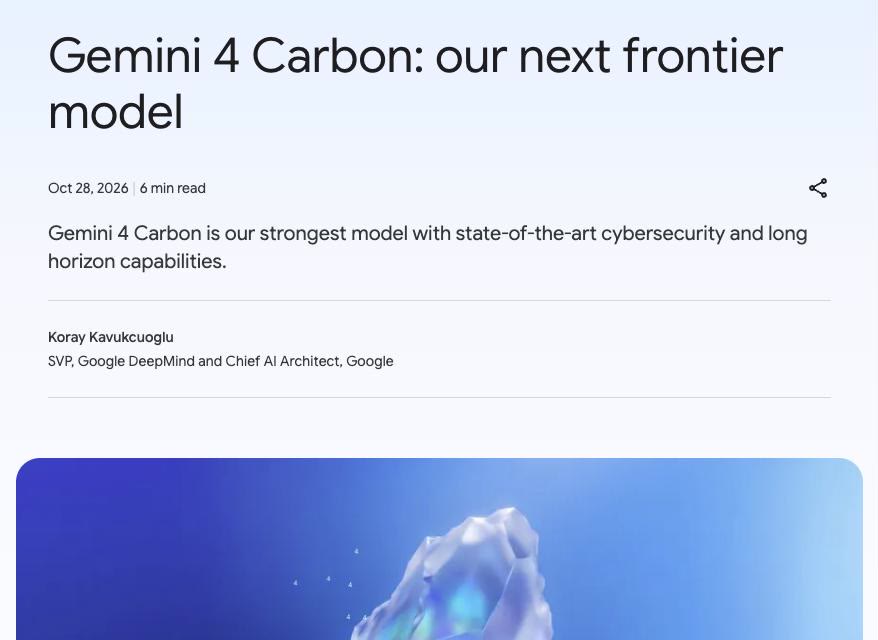
Carbon landed two weeks after Gemini 4 Argon became generally available, and four weeks after Argon was first announced. That pace is the story Google wants told. The more useful story, if you build on these models, sits in the details: which benchmarks Google picked, which competitors it left out of its table, what the independent leaderboards said on the same day, and what Carbon will cost once the discount ends.
I have not used Carbon. Outside Google, only a first group of cyber defenders and a few evaluation labs have. This post reads Google's announcement, its evaluation methodology and the Fairwind Program page, then checks the claims against Artificial Analysis, Vals AI and WebDev Arena. Every screenshot below was taken in Chrome on October 28, 2026.
Gemini 4 Carbon at a glance
| Question | Answer as of October 28, 2026 |
|---|---|
| What it is | Google DeepMind's newest frontier model, successor to Gemini 4 Argon |
| Announced | October 28, 2026, on Google's blog and the @Google account on X |
| Headline score | 59 on the Artificial Analysis Intelligence Index v5, ranked #1 |
| Built for | Long-horizon agentic work, coding and cybersecurity defense |
| Who can use it | A subset of cyber defenders in the Fairwind Program |
| Public API | None yet, and no model ID in the Gemini API release notes |
| Introductory price | $2 input and $10 output per million tokens, cached input 95% off |
| Standard price | $4 input and $20 output per million tokens after the introductory period |
| Context window | 1M tokens, per Artificial Analysis |
| Inputs and outputs | Text, image, video and speech in, text out |
What is Gemini 4 Carbon?
Gemini 4 Carbon is the second frontier model in Google's Gemini 4 generation and, by Google's own description, its strongest. Koray Kavukcuoglu, SVP at Google DeepMind and Google's Chief AI Architect, announced it with two claims up front: the top score on the newly updated Artificial Analysis Intelligence Index, and state-of-the-art results in cybersecurity and long-horizon tasks.
The long-horizon part is the design brief. Google says it built Carbon for sustained agentic workflows, the kind of engineering job where an agent has to keep working through failed attempts before it can hand back an answer. Its example is root-causing and patching subtle bugs across large codebases and low-level systems, and it says internal teams have watched Carbon keep at such tasks for days.
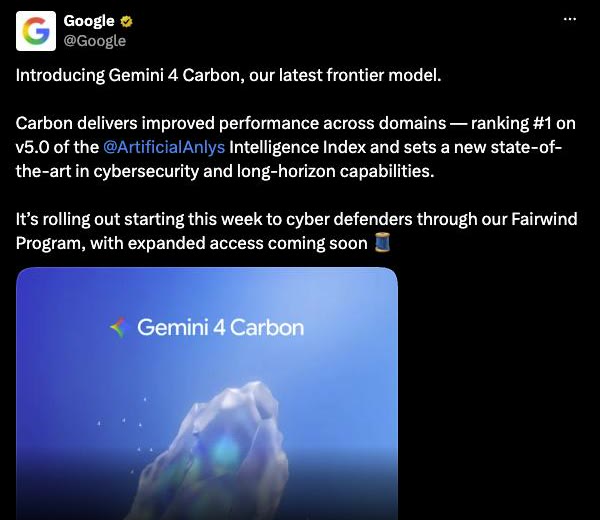
Google also says it worked on coding, agentic and scientific tasks, full-stack web development and multimodal understanding, based on user feedback. On safety, the pitch is behavior under pressure: fewer shortcuts, fewer invented claims, and more questions to the user when information is missing. Whether the numbers back that up gets its own section below.
The name follows the elemental scheme Google started with Argon. On October 9, 2026, Business Insider reported that Google staff were testing a Gemini 4 build called Carbon on Jetski, the company's internal coding platform, and that one developer found its coding comparable to Claude Opus 5.5. The same report said an internal build called Barium-B was the one that shipped as Argon. That Opus comparison was one employee's impression. The independent coding numbers published on launch day put Carbon close to Opus 5.5, and still behind it.
How Google went from Argon to Carbon in four weeks
The Gemini 4 rollout has moved quickly, and the dates explain why Carbon's access looks the way it does:
- September 2, 2026: Google launches the Fairwind Program, with Gemini 3.8 Flash Cyber and its CodeMender security agent.
- September 30, 2026: Google announces Gemini 4 Argon, at first for Fairwind partners only.
- October 9, 2026: Business Insider reports internal testing of a Gemini 4 build called Carbon.
- October 13, 2026: Argon becomes generally available in the Gemini API as
gemini-4-argon. - October 27, 2026: Artificial Analysis launches version 5 of its Intelligence Index, with Claude Opus 5.5 on top at 58. Vals AI updates its Vals Index the same day, with Carbon already listed.
- October 28, 2026: Google announces Carbon and starts the Fairwind rollout.
Argon took 13 days to go from a defenders-only announcement to general availability. Google has promised nothing similar for Carbon, but it is the only precedent there is.
Gemini 4 Carbon benchmarks: Google's table, row by row
Google published one table comparing Carbon with Gemini 4 Argon, GPT-6 Astra, Claude Opus 5.5 and Claude Fable 5.1 on 17 benchmarks. Carbon has the best score in 15 of the 17 rows.
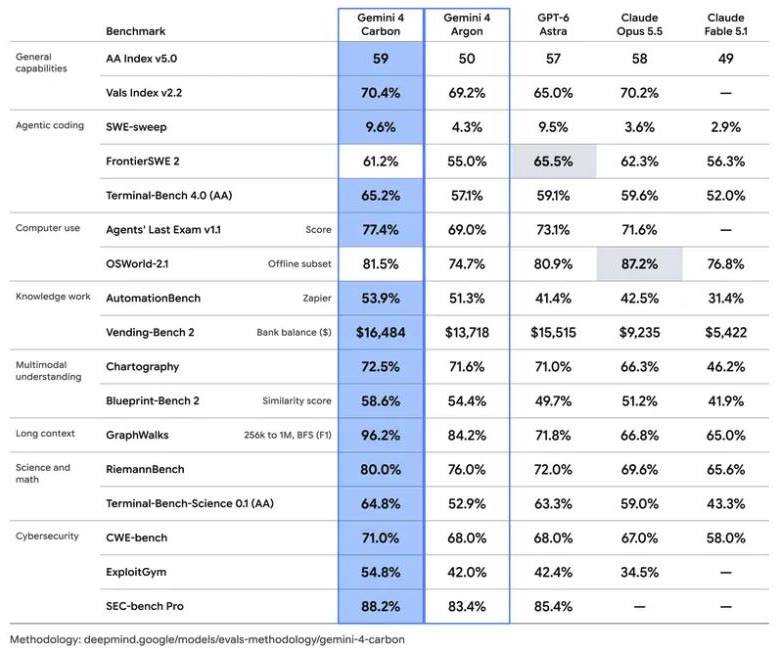
These are the rows that matter most if you build software on top of a model:
| Benchmark | What it tests | Carbon | Argon | GPT-6 Astra | Claude Opus 5.5 |
|---|---|---|---|---|---|
| AA Index v5.0 | Overall intelligence | 59 | 50 | 57 | 58 |
| Vals Index v2.2 | Finance, legal, tax and coding work | 70.4% | 69.2% | 65.0% | 70.2% |
| FrontierSWE 2 | Agentic software engineering | 61.2% | 55.0% | 65.5% | 62.3% |
| Terminal-Bench 4.0 (AA) | Coding in a terminal | 65.2% | 57.1% | 59.1% | 59.6% |
| OSWorld-2.1 | Desktop computer use, offline subset | 81.5% | 74.7% | 80.9% | 87.2% |
| AutomationBench | Zapier business workflows | 53.9% | 51.3% | 41.4% | 42.5% |
| Vending-Bench 2 | Simulated vending business, final bank balance | $16,484 | $13,718 | $15,515 | $9,235 |
| GraphWalks 256k to 1M | Long-context reasoning | 96.2% | 84.2% | 71.8% | 66.8% |
| SEC-bench Pro | Finding vulnerabilities | 88.2% | 83.4% | 85.4% | not reported |
| ExploitGym | Proving a flaw is exploitable | 54.8% | 42.0% | 42.4% | 34.5% |
| CWE-bench | Patching the root cause | 71.0% | 68.0% | 68.0% | 67.0% |
The two rows Carbon loses are both in categories founders care about. On FrontierSWE 2, an agentic coding benchmark, GPT-6 Astra is 4.3 points ahead and Claude Opus 5.5 is 1.1 points ahead. On OSWorld-2.1, which tests operating a desktop from screenshots, Opus 5.5 leads by 5.7 points.
Some of the wins are close enough to call ties. SWE-sweep is 9.6% against GPT-6 Astra's 9.5%, and the Vals Index row is 70.4% against Opus 5.5's 70.2%. The large gaps are elsewhere: long context, where Carbon's 96.2% on GraphWalks is 12 points over Argon and almost 30 over Opus 5.5, and the three security benchmarks.
Compared with its own predecessor, Carbon improves on every row. The biggest jumps over Argon are on ExploitGym (12.8 points), GraphWalks (12 points), Terminal-Bench-Science (11.9 points) and the Artificial Analysis index (9 points). Google announced those gains two weeks after Argon's general release, at the same price.
What do independent leaderboards say about Gemini 4 Carbon?
A table a vendor builds about itself is a starting point. Three outside leaderboards published Carbon numbers on or before launch day. They mostly agree with Google, with a few corrections worth knowing.
Artificial Analysis: first overall, second on coding agents
Artificial Analysis confirms the headline. Carbon scores 59 on its Intelligence Index v5, one point ahead of Claude Opus 5.5 (58) and two ahead of GPT-6 Astra (57), with Argon at 50. AA's write-up says Carbon leads four of the index's nine evaluations: HLE-Diamond, Terminal-Bench-Science, AA-Omniscience and AutomationBench-AA.
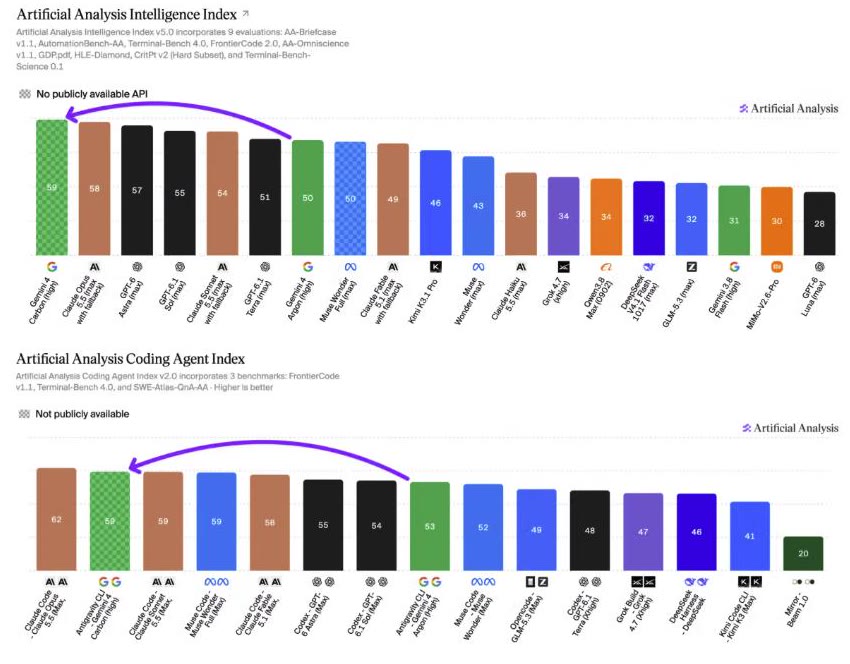
The same article is more direct about coding. On AA's Coding Agent Index, which runs each model inside an agent harness, Carbon in Google's Antigravity CLI scores 59, three points behind Claude Code with Opus 5.5 at 62. AA ranks it second, although Claude Code with Sonnet 5.5 and Meta's Muse Code with Muse Wonder Full also round to 59 on the chart. AA calls the result a standout for Google, which has historically trailed in this area. It is still second place.
Knowledge work tells a similar story. On AA-Briefcase, the agentic knowledge work test, Carbon gains 126 Elo over Argon to reach 1609, but trails Grok 4.7 (1638), Muse Wonder (1659) and Kimi K3.1 Pro (1678).
One more caution about the headline number. Index v5 launched on October 27, the day before Carbon, with two new benchmarks and three upgraded ones, and 60% of it now uses private test sets or held-out answers. Compare models only within the same index version.
Vals AI: second, behind a model Google left out
The Vals Index v2.2 ranks Carbon second. As of October 27, 2026, Claude Sonnet 5.5 leads at 70.85%, Carbon follows at 70.36% and Claude Opus 5.5 is third at 70.18%. Carbon tops the Vals row in Google's table because Sonnet 5.5 is not one of the table's columns.
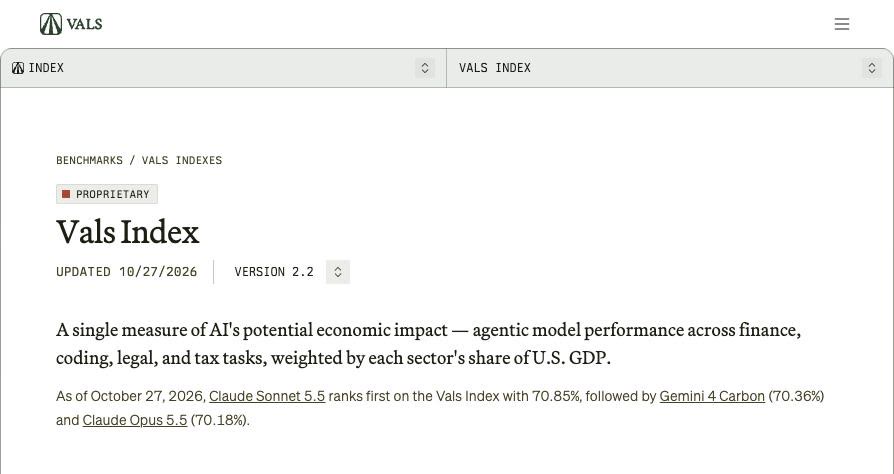
That is a choice of comparison set, and it matters because Sonnet sits below Opus in Anthropic's lineup. The same thing happens on Terminal-Bench 4.0: AA's v5 launch article names Kimi K3.1 Pro the leader at 67%, above the 65.2% Google reports for Carbon, and Kimi is not in Google's table either.
WebDev Arena: fourth, and provisional
Google says Carbon gained 89 Elo points on WebDev Arena to reach fourth place at 1769. The live board on October 28 showed 1768, plus or minus 15, behind Claude Opus 5.5 (1810), GPT-6 Astra (1773) and Claude Sonnet 5.5 in xHigh mode (1770). Arena marks the score as based on pre-release testing, so it may move once public votes come in.
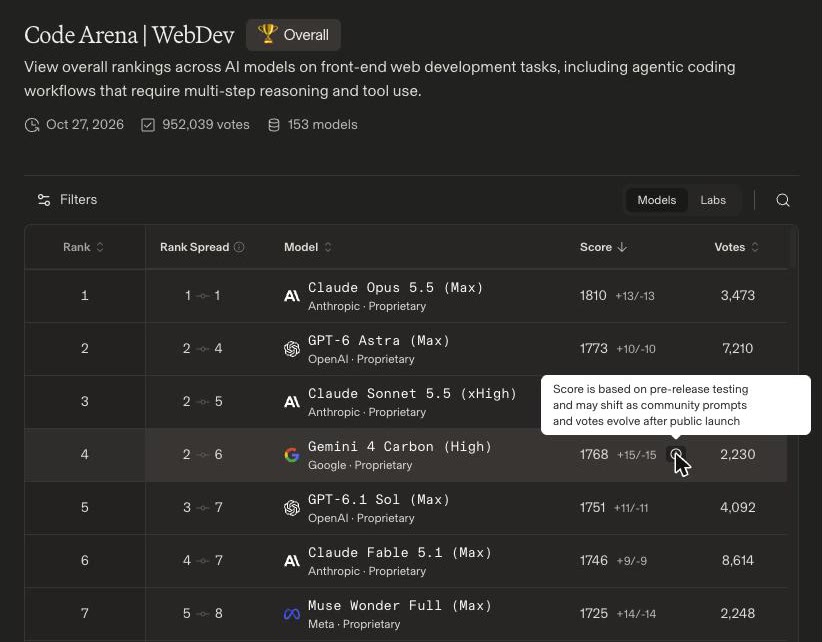
Carbon's rank spread runs from 2 to 6, so statistically it sits in the same band as GPT-6 Astra and Sonnet 5.5, and clearly behind Opus 5.5 for front-end work.
How should you read Google's benchmark numbers?
Google's evaluation document is short, and it is worth reading before you quote any figure from the table. Five details change how much weight the numbers can carry:
- Competitor scores are mostly self-reported. Google ran Gemini models through the Gemini API at the highest thinking settings and took most numbers for other labs from those labs' own reports, at maximum reasoning where available.
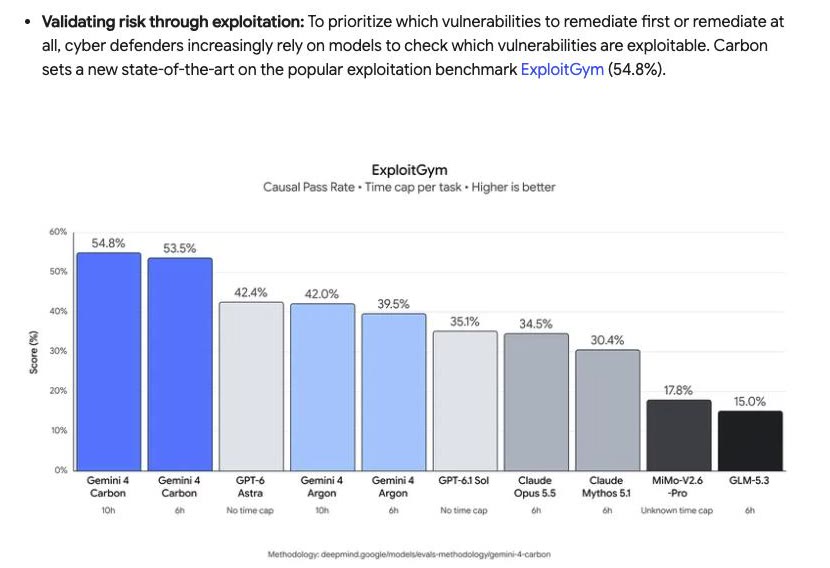
- ExploitGym used a longer clock. The 54.8% headline comes from a 10-hour limit per task. At the default 6 hours, Carbon scores 53.5%, still well ahead of Claude Opus 5.5's 34.5% at six hours and GPT-6 Astra's 42.4% with no time cap.
- OSWorld takes the best of three runs. Google's OSWorld-2.1 scores for Carbon and Argon are the maximum over three runs on an 82-task offline subset. Competitor scores come from their published evaluations.
- SEC-bench Pro is one split. The 88.2% is pass@1 on the 183-task May 2026 JavaScript engine split, averaged over three attempts, in Google's Antigravity harness.
- Some rows are Google-run for everyone. Google computed GraphWalks for all models itself, and it ran SWE-sweep for Carbon with a mini-swe-agent harness while taking competitor numbers from the public leaderboard.
All of that is normal for a launch table. Where the independent leaderboards overlap with Google's rows, trust them first.
How good is Gemini 4 Carbon at cybersecurity?
Cybersecurity is where Carbon's lead is widest, and it is the reason access starts with defenders. Google frames the results around the defense lifecycle: find the vulnerability, prove it can be exploited, then fix the root cause. All three external benchmarks were run without guardrails.
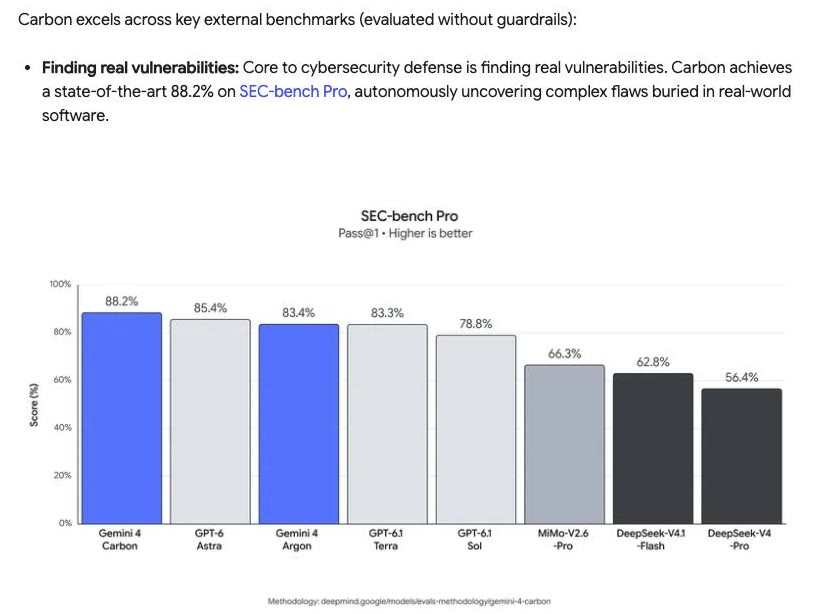
Finding vulnerabilities. On SEC-bench Pro, Carbon scores 88.2%, ahead of GPT-6 Astra (85.4%), Argon (83.4%) and GPT-6.1 Terra (83.3%). No Claude model appears on this chart.
Proving exploitability. ExploitGym checks whether a model can write an exploit that captures a target flag through the intended vulnerability, with an LLM judge confirming the route. Carbon reaches 54.8% with a 10-hour limit and 53.5% with 6 hours. The best non-Google model, GPT-6 Astra, scores 42.4%, and Claude Opus 5.5 scores 34.5%.
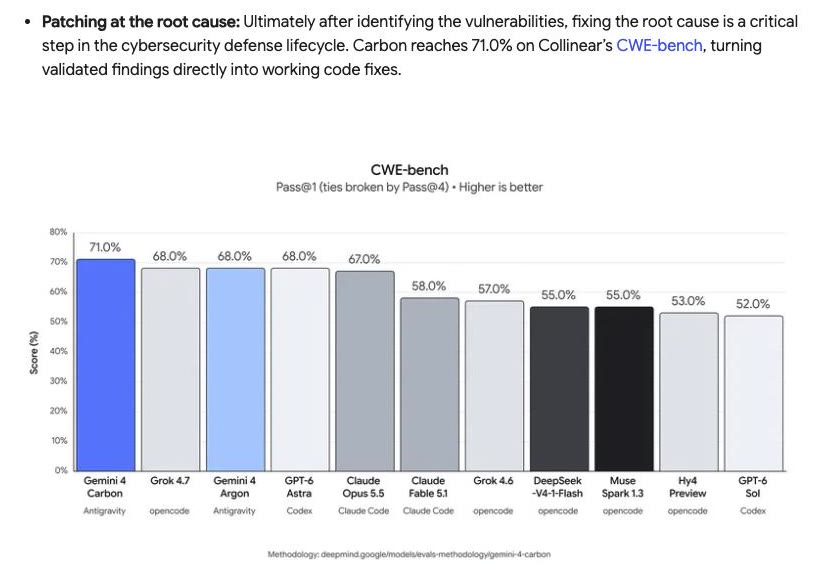
Patching the root cause. On Collinear AI's CWE-bench, ranked by pass@1 with ties broken by pass@4, Carbon reaches 71.0%. Three models tie at 68.0%: Grok 4.7, Gemini 4 Argon and GPT-6 Astra. Claude Opus 5.5 scores 67.0%.
Google adds three reports from the field. Internally, Carbon more than doubles Argon's success rate at generating secure code. Google's Chrome team found Carbon more than 10 times better than another lab's large frontier model at producing high-quality patches, without naming the lab. And Wiz, which Google's post calls its leading cloud security platform, sees Carbon leading the web penetration testing benchmarks behind its Scan for Good initiative.
For a SaaS team, the interesting question is where this capability ends up. Fairwind's priority list includes core technology platforms, the companies whose libraries and cloud services sit under most SaaS stacks. If Carbon finds and patches flaws in those foundations first, you benefit without ever calling the model. The other side of it: a model this good at exploitation is exactly why Google gates it, and why small apps can no longer treat security as a later problem. Our coverage of exposed Ollama endpoints and the PHP2Shell remote code execution bug shows how fast attackers already move.
Is Gemini 4 Carbon safer than Argon?
Google says Carbon keeps Argon's safety stack (model training, real-time misuse defenses, prompt-injection resilience and chain-of-thought monitoring) and adds alignment training for complex or high-pressure tasks. The reported changes, all from Google's internal testing unless noted:
- Successful cheating on Terminal-Bench 4.0 fell to 0.0%, and attempts to cheat fell to 0.4%, while accuracy went up.
- High-severity misalignment alerts in live coding with Google's own teams dropped by almost 80%.
- Unsupported claims fell by about half compared with Argon.
- Overreach, doing more than the task asked, fell 26%. Under-service, doing less, fell 29%.
- When information is missing, Carbon retrieves sources and flags discrepancies to the user before it acts.
- On Gray Swan's Indirect Prompt Injection benchmark, attack success fell from Argon's 0.7% to 0.0%.
Gray Swan's benchmark is external, and Google's chart reports the attack success rate after 15 attempts per attack. At that setting, Claude Opus 5.5 and Claude Fable 5.1 sit at 1.0%, GPT-6 Astra at 8.5% and GPT-6.1 Sol at 8.6%.
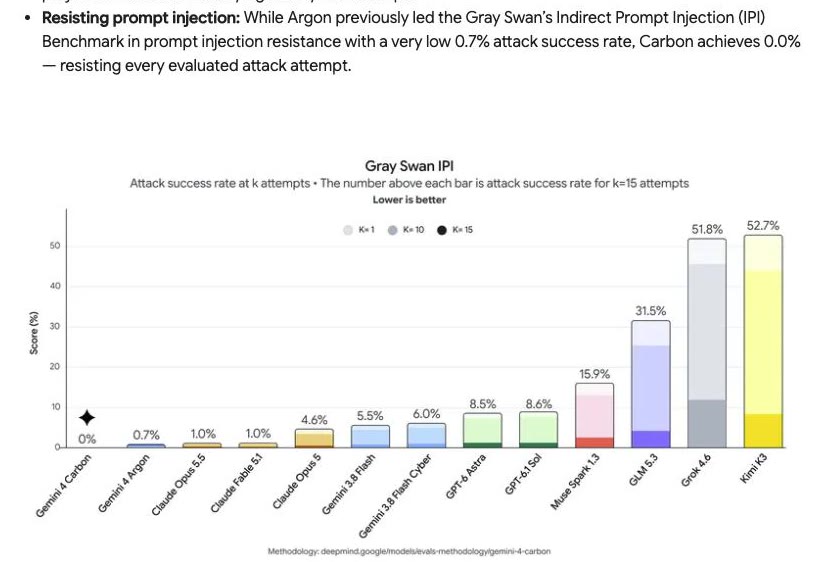
Prompt injection matters the moment you point a model at content you do not control: support tickets, scraped pages, uploaded files. A 0% score on one benchmark does not make injection impossible. Keep agent tools sandboxed and require a human approval for any action that sends data out.
The honesty claim gets a mixed read from outside. Artificial Analysis found Carbon's accuracy on AA-Omniscience v1.1 up 10 points over Argon to 58%, and its overall Omniscience score of 54 is the top score on that test. Its hallucination rate on the same test rose from Argon's 4% to 11%, though. That is still the second lowest AA has measured, far below the 50% it records for both Claude Opus 5.5 and GPT-6 Astra. Google's internal count of unsupported claims and AA's hallucination rate measure different things, so both results can hold at once.
How much does Gemini 4 Carbon cost?
Gemini 4 Carbon launches at the same introductory price as Gemini 4 Argon. A footnote in Google's post sets the price that applies afterwards:
| Token type | Introductory price | Standard price |
|---|---|---|
| Input | $2.00 per 1M tokens | $4.00 per 1M tokens |
| Output | $10.00 per 1M tokens | $20.00 per 1M tokens |
| Cached input | $0.10 per 1M tokens (95% off) | $0.20 per 1M tokens (95% off) |
Google gives no end date for the introductory price, and Artificial Analysis describes it as a 50% launch discount with no confirmed end. AA prices everything at the standard rate, which is also the safer number to plan with.
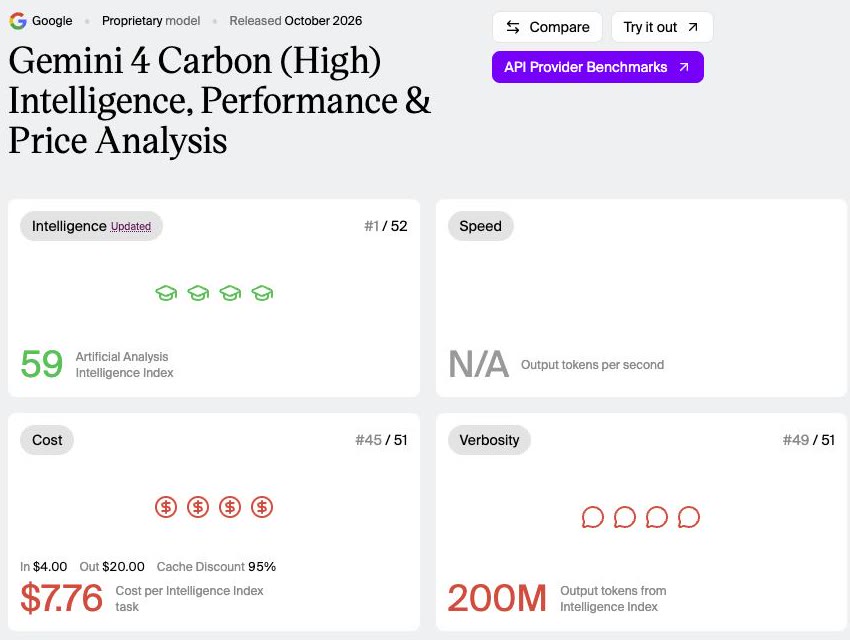
Token prices alone do not tell you what a task costs, because models differ in how much they write. AA's cost per Intelligence Index task folds that in:
| Model | AA Intelligence Index v5 | Cost per index task, standard pricing |
|---|---|---|
| Gemini 4 Carbon (high) | 59 | $7.76 |
| Claude Opus 5.5 (max) | 58 | $10.04 |
| GPT-6 Astra (max) | 57 | $6.24 |
| GPT-6.1 Sol (max) | 55 | $1.27 |
| Claude Fable 5.1 (max) | 49 | $13.04 |
Carbon costs about 23% less per task than Opus 5.5 for a slightly higher score, partly because it writes about 29% fewer output tokens per task (123k against 173k). It costs about 1.2 times as much as GPT-6 Astra. GPT-6.1 Sol scores four points lower at about a sixth of Carbon's cost per task, and for many production apps that is the trade to look at first.
During the introductory period every price component is half the standard rate, so the same token mix would cost about $3.88 per task. That is my arithmetic, not AA's. If you price your own product on that number, you are pricing on a discount with no end date.
AA's model page also ranks Carbon 49th of 51 for verbosity, at 200 million output tokens to run the whole index. Per task it writes less than Opus 5.5, but it still writes a lot, and output tokens are the expensive ones. Measure your own workload before trusting any per-task estimate, ours included.
Who can use Gemini 4 Carbon, and when?
Right now, only cyber defenders that Google admits through the Fairwind Program. Google says it will start with a subset of defenders this week, phase in more trusted partners, and bring Carbon to developers, businesses and consumers "as soon as possible", after more feedback and guardrail work. It also says it is taking part in the U.S. government's voluntary process for pre-release model testing.
Fairwind launched on September 2, 2026. Its page lists more than 650 partners and three priority groups: governments and national cyber authorities, critical infrastructure operators in healthcare, telecommunications, energy and finance, and core technology platforms. Google runs background checks on applicants' security history and record of ethical operations.
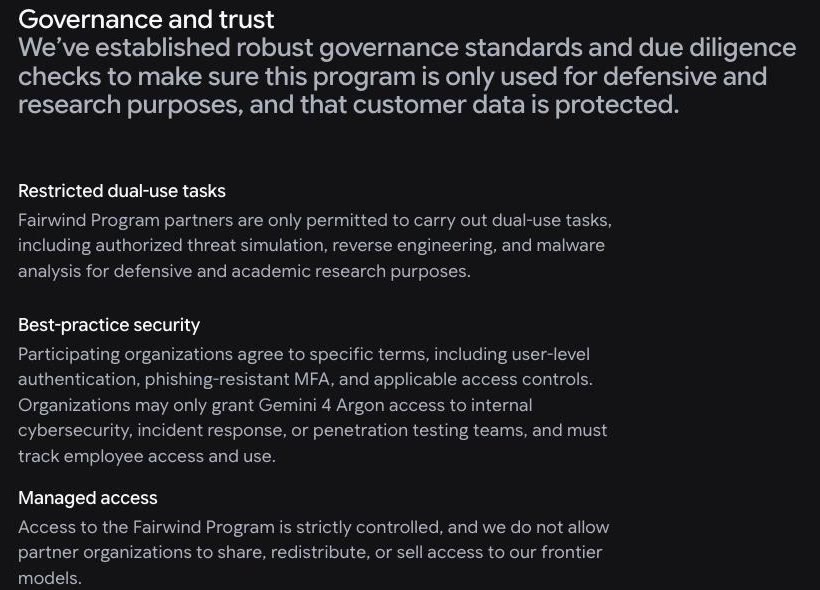
The rules are strict. Partners may run only permitted dual-use work, such as authorized threat simulation, reverse engineering and malware analysis for defense or academic research, and creating malware is banned. They must use user-level authentication and phishing-resistant MFA, give access only to internal cybersecurity, incident response or penetration testing teams, track who uses it, and never share, redistribute or sell access. When I checked on October 28, the Fairwind page still described Argon as the program's model, so expect it to change as Carbon rolls out.
If your organization is not eligible, Google points you to CodeMender with publicly available models and its other AI Threat Defense products. For everyone else, the practical route is Gemini 4 Argon, generally available in the Gemini API since October 13.
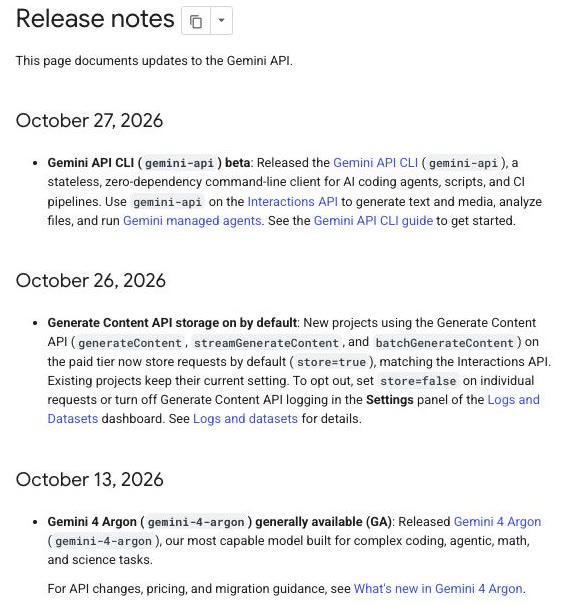
As for a date, Google has not given one. Argon went from a defenders-only announcement on September 30 to general availability on October 13. If Carbon followed the same path, it would reach the API around November 10. That is an extrapolation from a single precedent, and Google has committed to no date.
What Google has not said yet
Several things a developer needs before shipping on Carbon are missing from the announcement:
- An API model ID, and whether Carbon replaces Argon or sits next to it.
- A context window and output limit from Google itself. The 1M-token context comes from Artificial Analysis.
- When the introductory price ends.
- Rate limits, regions, and whether Carbon reaches the Gemini app's free tier.
- A Carbon model card. The announcement links no Carbon-specific safety document and points instead to the Safety and Security report Google published with Argon.
Until those exist, treat every Carbon integration plan as provisional.
How to get ready for Gemini 4 Carbon
You cannot call Carbon yet, but you can make the eventual switch cheap and measurable:
- Check whether you qualify for Fairwind. Fairwind prioritizes governments and national cyber authorities, critical infrastructure operators and core technology platforms. If your organization fits, apply through the form on deepmind.google/fairwind-program.
- Build on Gemini 4 Argon today. Use
gemini-4-argonin the Gemini API, generally available since October 13, 2026 at the same $2 and $10 introductory price Carbon will launch at. - Keep the model ID in configuration. Read the model name from an environment variable or a config file, so that moving to Carbon is a one-line change you can roll back.
- Budget at standard pricing. Plan costs at $4 per million input tokens and $20 per million output tokens. The introductory discount has no published end date.
- Measure output tokens on your own tasks. Log tokens per task for a fixed set of real prompts. Artificial Analysis found Carbon verbose, so your cost depends on how many tokens it writes for your work.
- Watch the Gemini API release notes. Carbon gets an API model ID when Google adds it to the Gemini API release notes. Run your evaluation set against it before moving production traffic.
Gemini 4 Carbon vs Claude Opus 5.5 vs GPT-6 Astra: which should you build on?
Nobody outside Fairwind can build on Carbon this week, so this is a planning question. Going by the numbers published so far:
| If your product mostly does | Strongest published result | Runner-up |
|---|---|---|
| Reasoning and knowledge work overall | Gemini 4 Carbon, AA index 59 | Claude Opus 5.5, 58 |
| Coding agents in a harness | Claude Opus 5.5 in Claude Code, 62 | Gemini 4 Carbon in Antigravity CLI, 59 |
| Front-end and web app generation | Claude Opus 5.5, WebDev Arena 1810 | GPT-6 Astra, 1773 |
| Desktop computer use | Claude Opus 5.5, OSWorld-2.1 87.2% | Gemini 4 Carbon, 81.5% |
| Security research and patching | Gemini 4 Carbon on SEC-bench Pro, ExploitGym and CWE-bench | GPT-6 Astra |
| Very long context, 256k to 1M tokens | Gemini 4 Carbon, GraphWalks 96.2% | Gemini 4 Argon, 84.2% |
| Lowest cost near the top | GPT-6.1 Sol, index 55 at $1.27 per AA task | GPT-6 Astra, index 57 at $6.24 |
My read: if you already run on Gemini 4 Argon, Carbon looks like a straight upgrade at the same price, and the main work is re-checking cost, since the price stays put while token use can change. If your coding agents run on Claude Opus 5.5, the published numbers give you no reason to move. If you are cost-sensitive, the most interesting model on these charts is GPT-6.1 Sol, which sits within four points of the top for a fraction of the price.
Two more practical points. Gemini's long-context lead is large and held across Argon and Carbon, although Google ran GraphWalks for every model itself, so document-heavy products should test it on their own files. And launch-day benchmarks move: the Arena score is provisional, and AA's index changed the day before the launch. For a longer take on picking models without chasing every release, see our piece on model fatigue, and for what cheaper tiers do to margins, the Claude Haiku 5.5 breakdown.
What Carbon means if you run a SaaS
Frontier access now arrives in stages. Argon and Carbon both went to defenders first, and Carbon's public date is open. If a feature on your roadmap depends on a model the day it is announced, plan for a wait, and make sure the feature still works on the model you can call today.
The model behind your product will change every few weeks. The customers who know your product's name, and the pages that describe it, carry over from one model to the next. AI assistants already answer "which tool should I use" questions by reading structured pages about products, and directory listings are among the easiest pages for them to parse: name, category, pricing and description in one place. If you are launching an AI product this month, you can list it on SaaSCity for free. Quick Pass ($19.99) skips the free queue and adds priority human review within 24 hours and a building on the city map.
FAQ
What is Gemini 4 Carbon?
Gemini 4 Carbon is Google DeepMind's newest frontier model, announced on October 28, 2026. Google calls it its strongest model, built for long-horizon agentic work such as root-causing and patching subtle bugs across large codebases, with state-of-the-art cybersecurity results. It follows Gemini 4 Argon, which became generally available in the Gemini API on October 13, 2026.
When was Gemini 4 Carbon released?
Google announced Gemini 4 Carbon on October 28, 2026, in a blog post by Koray Kavukcuoglu and a thread from the @Google account on X posted at about 17:03 UTC. The announcement is not a general release. Access starts that week with a subset of cyber defenders in the Fairwind Program, and Google has not published a date for anyone else.
Can I use Gemini 4 Carbon right now?
Only if your organization is in Google's Fairwind Program and is among the first cyber defenders Google admits. As of October 28, 2026, Carbon is not in the Gemini app, Google AI Studio or the public Gemini API, and the API release notes list no Carbon model ID. Google says developers, businesses and consumers will get it as soon as possible.
How much does Gemini 4 Carbon cost?
Google set the same introductory price as Gemini 4 Argon: $2 per million input tokens and $10 per million output tokens, with cached input at 95% off ($0.10 per million). After the introductory period, the price becomes $4 for input and $20 for output per million tokens. Google has not said when the introductory period ends.
Is Gemini 4 Carbon better than Claude Opus 5.5?
On overall benchmarks it is slightly ahead: 59 against 58 on the Artificial Analysis Intelligence Index v5. On coding agents it is behind: Artificial Analysis scores Carbon in Antigravity CLI at 59 and Claude Code with Opus 5.5 at 62, and Opus 5.5 also leads WebDev Arena and OSWorld-2.1. Carbon leads clearly on the cybersecurity benchmarks Google reported.
How does Gemini 4 Carbon compare with GPT-6 Astra?
Carbon scores 59 on the Artificial Analysis Intelligence Index against 57 for GPT-6 Astra, and leads it on SEC-bench Pro (88.2% vs 85.4%), ExploitGym (54.8% vs 42.4%) and CWE-bench (71.0% vs 68.0%) in Google's table. GPT-6 Astra still leads FrontierSWE 2 (65.5% vs 61.2%) and ranks above Carbon on WebDev Arena, 1773 to 1768.
What is the difference between Gemini 4 Carbon and Gemini 4 Argon?
Carbon is the stronger successor. In Google's own table it gains nine points on the Artificial Analysis Intelligence Index (59 vs 50), 12.8 points on ExploitGym and 12 points on the GraphWalks long-context test. Argon is available today in the Gemini API as gemini-4-argon, while Carbon is limited to Fairwind defenders. Both launch at the same introductory price.
What did Gemini 4 Carbon score on the Artificial Analysis Intelligence Index?
59, the top score on version 5.0 of the index, which Artificial Analysis launched on October 27, 2026. Claude Opus 5.5 is second at 58 and GPT-6 Astra third at 57. Carbon leads four of the nine evaluations in the index: HLE-Diamond, Terminal-Bench-Science, AA-Omniscience and AutomationBench-AA. Scores from earlier index versions are not comparable.
What is Google's Fairwind Program?
Fairwind is Google DeepMind's gated program that gives vetted defenders early access to its most capable cyber models. It launched on September 2, 2026 and lists more than 650 partners. Priority goes to governments and national cyber authorities, critical infrastructure operators and core technology platforms, under rules such as phishing-resistant MFA and access limited to security teams.
How good is Gemini 4 Carbon at cybersecurity?
Google reports state-of-the-art results across the defense lifecycle, measured without guardrails: 88.2% on SEC-bench Pro for finding vulnerabilities, 54.8% on ExploitGym for proving they are exploitable, and 71.0% on CWE-bench for patching them. Google's Chrome team also reported Carbon was more than 10 times better than another lab's large frontier model at generating high-quality patches.
Does Gemini 4 Carbon hallucinate less than other models?
Mostly yes, with a caveat. Google says Carbon makes about half as many unsupported claims as Argon in internal tests. Artificial Analysis measured an 11% hallucination rate on AA-Omniscience v1.1, the second lowest of any model it tracks and far below the 50% it recorded for Claude Opus 5.5 and GPT-6 Astra, but higher than Argon's 4%.
What is Gemini 4 Carbon's context window?
Artificial Analysis lists a 1 million token context window for Gemini 4 Carbon, with text, image, video and speech input and text output. Google's announcement does not give a context or output limit, so treat the Artificial Analysis listing as the best available figure until Google publishes Carbon's model card or API documentation.
Is there a Gemini 4 Carbon API model ID?
Not yet. As of October 28, 2026, the Gemini API release notes have no Carbon entry, and Artificial Analysis marks the model as having no publicly available API. The closest model you can call today is gemini-4-argon, generally available since October 13, 2026 at the same introductory price.
Should SaaS founders switch to Gemini 4 Carbon?
You cannot switch yet, so the useful work is preparation. Build and test on gemini-4-argon, keep the model ID in configuration, budget at the $4 and $20 standard price rather than the discount, and measure output tokens on your own tasks. When Carbon reaches the API, run your own evaluation before moving any production traffic.
Sources
- Gemini 4 Carbon: our next frontier model (Google, October 28, 2026)
- Introducing Gemini 4 Carbon (@Google on X, October 28, 2026)
- Gemini 4 Carbon model evaluation: approach, methodology and results (Google DeepMind, PDF)
- Fairwind Program (Google DeepMind)
- Introducing Gemini 4 Argon (Google)
- Gemini API release notes (Google AI for Developers)
- Gemini 4 Carbon is the new #1 on the Artificial Analysis Intelligence Index v5 (Artificial Analysis, October 28, 2026)
- Gemini 4 Carbon (High) model page (Artificial Analysis)
- Announcing Artificial Analysis Intelligence Index v5 (Artificial Analysis, October 27, 2026)
- Vals Index v2.2 (Vals AI, updated October 27, 2026)
- WebDev Arena leaderboard (Arena)
- SEC-bench, ExploitGym and CWE-bench
- Scan for Good (Wiz)
- Google launches two Gemini 3.8 models with cutting-edge reasoning capabilities (SiliconANGLE, September 2, 2026)
- Google Staff Test New Gemini 4 'Carbon' Build on Jetski (AI Weekly, summarizing Business Insider, October 9, 2026)
Screenshots were taken in Chrome on October 28, 2026 from Google's announcement, the @Google post on X, the Fairwind Program page, the Gemini API release notes, Artificial Analysis, Vals AI and WebDev Arena. Leaderboards move daily, so check them before you quote a rank.
Get your SaaS in front of founders
List your product on the SaaSCity live city map - a permanent listing, real discovery, and a backlink from a high-DR directory. Free to start; upgrade for a dofollow link and a building on the map.