Launch & Growth
Google Play Split Its Fee in Two - and a 12-Year Indie Dev Just Walked Away (2026)
On September 24, 2026, the solo developer behind the 12-year-old Android app Conversations pulled his paid listing from Google Play, calling out automated review rejections and non-existent human support. His exit landed in the same quarter Google split its cut into separate service and billing fees, exposing the shifting economics of mobile distribution. If you want sustainable software discovery without handing over a quarter of your revenue to a closed gatekeeper, platforms like SaaSCity show a different path.

Contents (9)
- The breaking point: bots, bans, and two-week review queues
- The developer reaction: paying a monopoly tax for zero customer service
- The 2026 fee restructuring: service fees and billing fees separated
- Legal pressure: how Epic v. Google forced the gates open
- What a 15 to 30 percent cut actually buys in 2026
- Distribution without the platform tax: how directories fit in
- The indie developer escape routes: surviving outside Google Play
- The gatekeeper audit: five questions before launching on any store
- Software sovereignty in an era of automated gatekeepers
Quick answer: On September 24, 2026, open-source developer Daniel Gultsch ended paid distribution for his Android messaging app Conversations on Google Play after twelve and a half years, shifting primary distribution to F-Droid. Despite paying Google over 1,000 EUR annually in store commissions, Gultsch faced arbitrary app removals, an automated review queue that held critical security patches for fourteen days, and an inability to contact human support. The breakup arrives alongside Google's June 30, 2026 fee restructuring, which split its commission into a service fee plus a 5 percent billing fee across the EEA, UK, and US. With US external-link fee reporting taking effect on October 1, 2026, indie developers are reconsidering whether closed app stores still justify their cost.
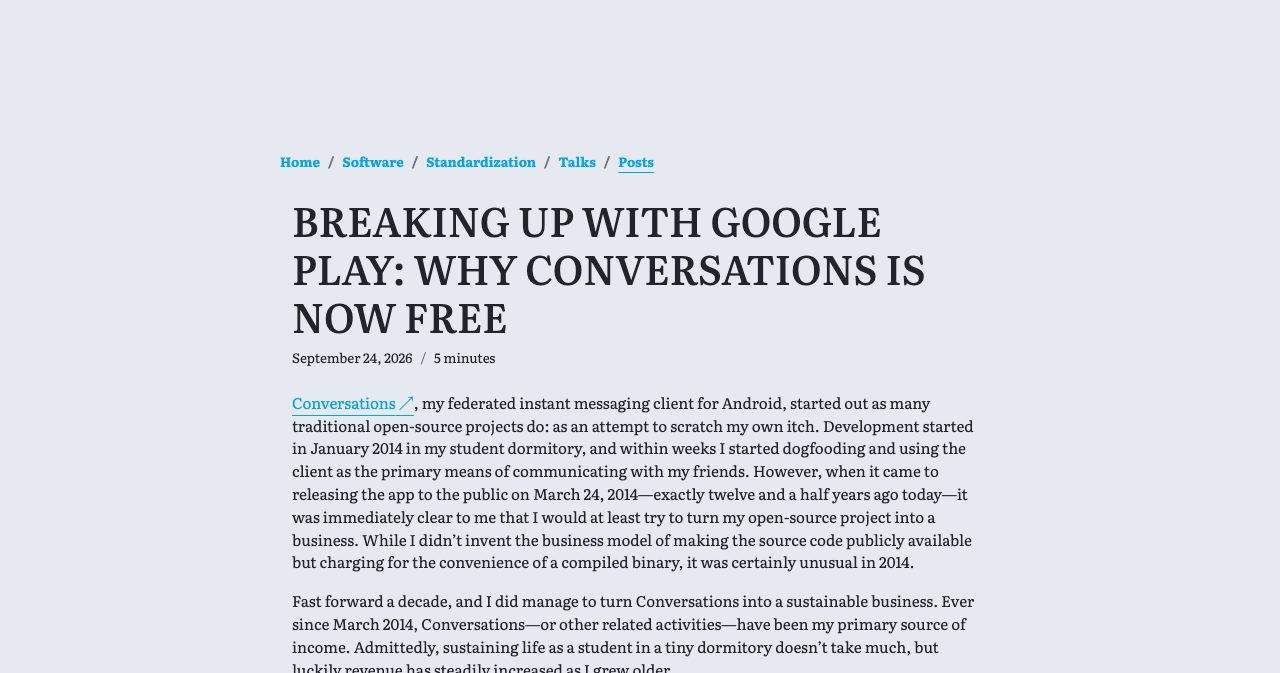
Paying Google one thousand euros a year could not buy Daniel Gultsch a five-minute conversation with a human being.
For twelve and a half years, Gultsch maintained Conversations, an open-source Jabber/XMPP messaging client for Android. He launched the application on March 24, 2014, under a simple commercial model: the source code stayed free on Codeberg, while the pre-compiled binary cost a few dollars on the Google Play Store.
That single paid listing covered his living expenses. Play Store sales paid his rent, funded his development hardware, and gave him a stable livelihood as an independent open-source maintainer. In exchange, Google collected 15 percent of every transaction under its reduced tier for small developers. That commission totaled more than 1,000 EUR every year, an amount equal to roughly 1.5 times his annual broadband bill, or the yearly depreciation of the laptop he used to write the code.
On September 24, 2026, Gultsch walked away. He published a breakup letter titled Daniel Gultsch's post, stripped the price tag from his Google Play listing, and directed his users to download the app through F-Droid instead.
His exit reflects a broader shift across independent software development. In the very same quarter, Google restructured its Play Store cut into two separate fees, court orders forced third-party app stores directly onto Google Play, and solo founders realized that paying platform fees buys automated rejection forms instead of developer support.
An honest disclosure before examining the platform economics: you are reading this analysis on a directory's blog. SaaSCity is a gamified startup directory with a live city map and human editorial review. Every week, our team reviews applications submitted by solo founders looking for visibility. We see the friction developers experience when platform algorithms decide whether their business survives the week. When you build on a closed storefront, distribution comes bundled with a private tax code and an algorithmic gatekeeper.
The breaking point: bots, bans, and two-week review queues
Gultsch's decision to leave was not prompted by a sudden spike in fees. His frustration accumulated through years of dealing with an automated review apparatus that grew progressively more dysfunctional.
In his public essay, Gultsch described an environment where app updates were rejected repeatedly for incomprehensible reasons. Conversations was removed from Google Play twice. In one instance, Google accused him of uploading users' contact lists without consent. The accusation was factually untrue, yet Google provided no technical justification, no packet logs, and no reference to any specific commit in the codebase. Gultsch had to scramble to prove his innocence to an automated intake form while his income stream vanished from search results.
By September 2026, the review pipeline had deteriorated further. At the time Gultsch published his farewell, an update for Conversations had been sitting in Google's review queue for fourteen days without resolution.
The delay exposed a systemic flaw in Google's submission pipeline: Google Play makes no distinction between a routine cosmetic update and an urgent security patch. When an open-source communication app discovers a cryptographic flaw or a remote vulnerability, the developer cannot push a hotfix directly to users. The fix sits in the same backlog as mobile games and ad-laden utility apps. As Gultsch wrote, delaying security updates by days or weeks is outright dangerous for software handling private end-to-end encrypted messaging.
Reaching a human reviewer to explain the emergency proved impossible. Developers are routed to automated ticket handlers and outsourced review teams operating on strict time quotas. Gultsch described the experience as going up against artificial intelligence bots and click workers who copy and paste canned policy citations without reading the developer's explanations.
Review times slowed down noticeably over the past twelve months. Gultsch attributed part of that backlog to an avalanche of generative AI software flooding the Play Store. Low-effort apps assembled from cookie-cutter templates have overwhelmed Google's automated scanners and human triage staff alike. Legitimate developers maintaining decade-old applications are left waiting in line behind automated spam.
Gultsch experienced the cost of platform abuse earlier in the summer with his second Android project, Quicksy. Quicksy used phone numbers for contact discovery on top of the XMPP protocol. By July 2026, automated networks began exploiting the service for industrial-scale SMS pumping fraud, generating thousands of fake signups to fleece telecom routing fees. As reported in the This Week in F-Droid report on July 16, 2026, Gultsch had to close Quicksy registrations permanently because defending against telecom fraud without platform support consumed too many resources.
The reason Gultsch could finally leave Google Play in September 2026 came down to financial independence. Over the past few years, his funding shifted from retail app purchases to institutional grants. He secured research grants from the NLnet grant program and multi-year funding under the European Commission's MobiFree project. With stable funding guaranteed through the end of 2029, his economic dependence on Google Play Store revenue ended.
His conclusion was blunt: "Fortunately, I'm no longer economically dependent on Google Play Store revenue. Google doesn't deserve me and my money anymore. I'm done. Fuck the gatekeepers."
Primary distribution for Conversations now lives on F-Droid, where users can install the Conversations package on F-Droid. Unlike Google Play binaries, the F-Droid build is compiled reproducibly from the public Conversations repository on Codeberg and signed with Gultsch's personal signing key.
The developer reaction: paying a monopoly tax for zero customer service
When Gultsch's essay hit Hacker News on September 26, 2026, the discussion gained over 630 points and roughly 250 comments within thirty-six hours. The comments mirrored the sentiment across the indie developer ecosystem.
Founders on Hacker News largely looked past the 15 percent commission rate. Developers understand that payment gateways, hosting infrastructure, and distribution networks cost money. Stripe charges 2.9 percent plus 30 cents per transaction, and few developers complain about it. What enraged founders was the total absence of customer support in exchange for that 15 to 30 percent cut.
Paying more than 1,000 EUR every year to a platform that refuses to provide an email address for a human support representative feels predatory. Developers compared Google's stance to a municipal utility that bills you every month, shuts off your water on an algorithmic suspicion, and requires you to submit three appeal tickets to an automated bot before restoring service.
In web software, a developer who experiences a technical issue can inspect server logs, contact their payment processor, and push a hotfix to production in five minutes. In mobile app stores, a developer can follow every written guideline for a decade and wake up to find their developer account terminated with no explanation. For founders building bootstrapped businesses, that level of existential platform risk is becoming untenable. Many are turning to alternative distribution channels and examining platforms for SaaS founders to get visibility in 2026 rather than betting their companies on mobile app store algorithms.
The 2026 fee restructuring: service fees and billing fees separated
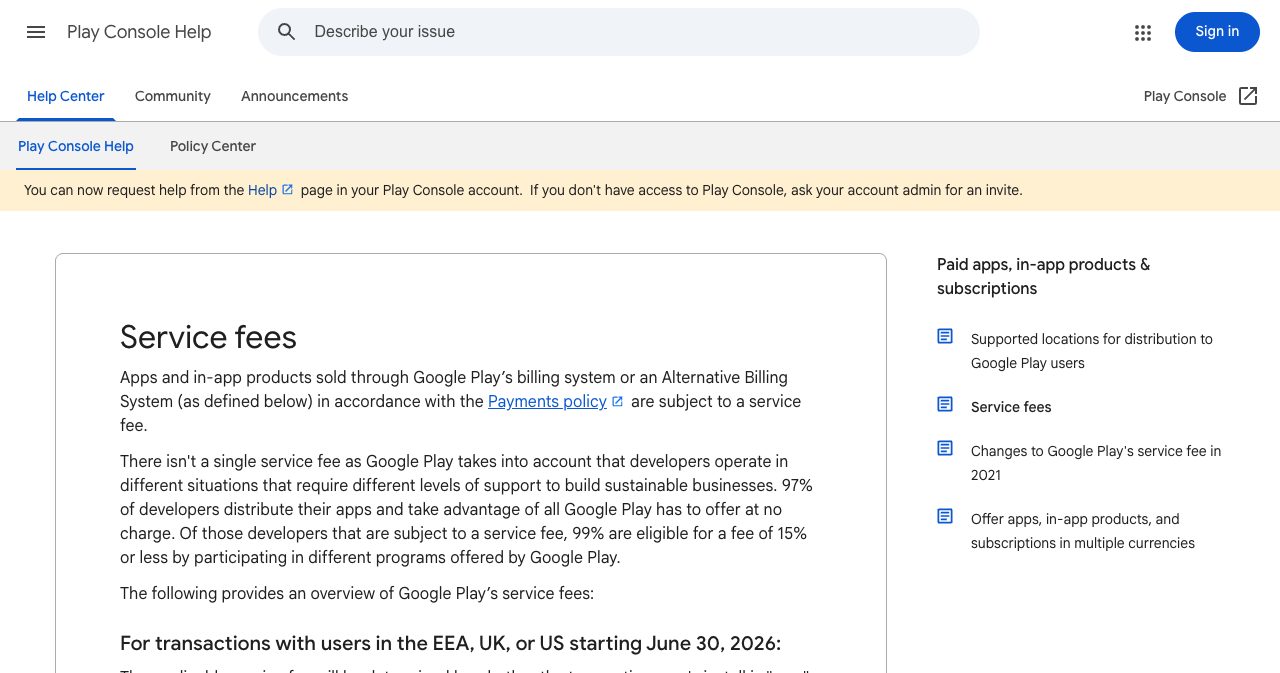
Gultsch's departure coincided with the biggest overhaul of Google Play's commercial terms in five years.
On March 4, 2026, Google announced a restructured fee system designed to address regulatory mandates across Western markets. The model went live on June 30, 2026, for transactions involving users located in the European Economic Area (EEA), the United Kingdom, and the United States.
Instead of charging a single flat commission, Google split its platform take into two separate components:
- A Service Fee, which covers app distribution, discoverability, Google Play Protect scanning, and developer console tooling.
- A separate 5 percent Billing Fee, which applies whenever a transaction processes through Google Play's proprietary in-app billing system.
The resulting rate depends on whether the user is purchasing a subscription, buying a paid app or in-app consumable, whether the install is new or historical, and whether the developer participates in Google's promotional programs.
Here is the exact breakdown according to the Google Play Console Help on service fees:
| Transaction Category | Service Fee (EEA, UK, US) | Play Billing Fee | Total Fee with Play Billing | Fee with External Web Link |
|---|---|---|---|---|
| First $1M USD annual earnings tier | 10% | 5% | 15% | 10% |
| Auto-renewing subscriptions | 10% | 5% | 15% | 10% |
| Standard new installs (one-time purchases, paid apps) | 20% | 5% | 25% | 20% |
| Existing installs (installed before region rollout date) | 25% | 5% | 30% | 25% |
| Apps Experience / Games Level Up programs (new installs) | 15% | 5% | 20% | 15% |
| Apps Experience / Games Level Up programs (existing installs) | 20% | 5% | 25% | 20% |
A standard paid application like Conversations, purchased as a one-time binary download by a new user after June 30, 2026, triggers a 20 percent service fee plus a 5 percent billing fee, for an effective 25 percent toll. If that user first installed the app before June 30, the transaction sits at 25 percent plus 5 percent, hitting the traditional 30 percent ceiling.
Developers who enroll in Google's reduced-tier program pay a 10 percent service fee plus 5 percent billing fee on their first $1 million in annual revenue, matching the 15 percent total Gultsch paid.
Google defends this pricing vigorously. In public statements and developer documentation, Google emphasizes that 97 percent of developers with apps on Google Play pay no service fees because they distribute free software. Among the 3 percent of developers who charge for apps or digital goods, Google states that 99 percent qualify for a total fee rate of 15 percent or less through the $1M tier or subscription discounts.
Those defenses ring hollow to solo developers who experience the operational reality. Even at 15 percent, a solo developer generating $100,000 in gross revenue sends $15,000 every year to Google. In return, they receive no dedicated account representative, no service-level agreement on review turnaround, and no guarantee that an automated scanner will not pull their listing overnight.
A critical milestone lands on October 1, 2026, four days after Gultsch's departure. Under the Google Play Console Help documentation on transaction reporting, US developers participating in the external content links and alternative billing programs must start submitting monthly transaction reports and remitting service fees directly to Google. For many founders who hoped external links would offer an easy escape from platform commissions, the administrative overhead of monthly accounting and audit compliance makes Google's program feel like a second tax department.
Legal pressure: how Epic v. Google forced the gates open
Google did not split its fee structure out of goodwill. The June 2026 overhaul was forced by years of antitrust litigation.
The turning point arrived on September 12, 2025, when the US Ninth Circuit Court of Appeals upheld the district court's nationwide injunction in the Epic Games v. Google antitrust case. The injunction took full effect on October 29, 2025, fundamentally altering what Google could legally enforce on Android devices.
The court order established several binding rules:
- Google cannot prohibit developers from informing users about cheaper pricing available on the web or outside Google Play.
- Google cannot ban developers from including clickable links within their applications directing users to external payment gateways, under rules detailed in the external web link program guidelines.
- The court capped external web link fees at 20 percent for non-Play Billing new installs.
- Google is barred from charging fees for direct APK downloads distributed from independent developer websites, provided the download was not initiated from a link inside a Play-installed application.
The court also mandated that Google allow competing third-party app stores to be distributed inside Google Play itself. Google implemented this on July 22, 2026, as reported by The Verge and MacRumors. Under this program, third-party app stores pay an annual registration fee of $5,000 to access Google Play distribution APIs. Applications submitted to Google Play are automatically shared into third-party store catalogs unless the developer explicitly unchecks an opt-out toggle in their Play Console dashboard.
These legal changes transformed the risk calculation for indie developers. Two years ago, leaving Google Play meant vanishing from the Android ecosystem entirely. In late 2026, third-party distribution, web-first checkout, and direct APK side-loading are legally protected and technically easier than ever.
What a 15 to 30 percent cut actually buys in 2026
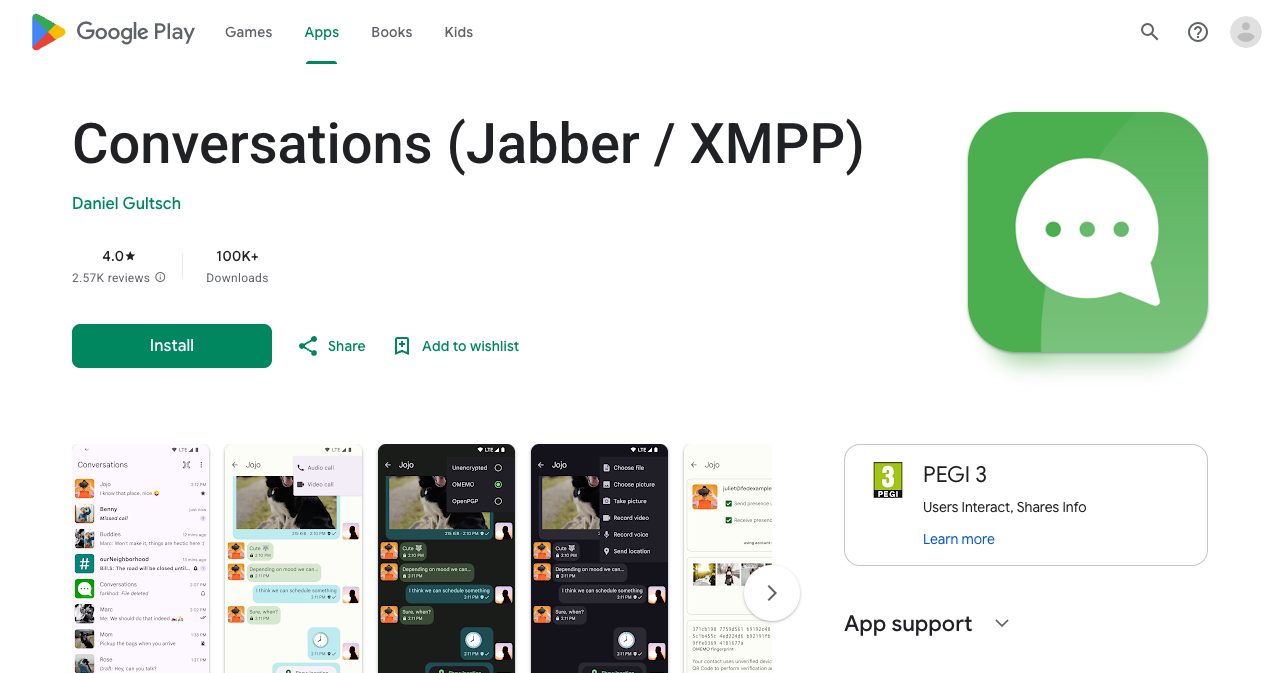
Visit the Google Play Store listing today, and you will see a listing with 4.0 stars, 2.57 thousand reviews, and more than 100,000 installs. The price tag is gone; the button reads "Install" for zero dollars. The app remains in the store as an unmonetized shell, directing users to the project's Codeberg repository and F-Droid package.
Gultsch's listing highlights the central question every software founder must answer: what does a platform commission actually purchase in 2026?
The store provides undeniable advantages:
- Frictionless billing: Google Play Billing converts users with a fingerprint tap, supported by saved credit cards and carrier billing across dozens of currencies.
- Automatic background updates: Delta updates download silently while devices charge, keeping user devices current without manual intervention.
- Immediate trust: Mainstream Android users recognize the Play Store badge and trust that downloaded apps will not install device-level malware.
- Broad search reach: The Play Store handles hundreds of millions of discovery searches every day.
The problem lies in what the commission does not buy:
- It does not buy human support: When an automated scanner issues a false positive, paying customers and multi-year developers receive the same generic email templates.
- It does not buy timely security reviews: An emergency patch addressing an active zero-day vulnerability waits in the same queue as an ad-network update for a casual game.
- It does not protect against copycats: The Play Store remains saturated with copycat apps, trademark squatters, and AI-generated utility clones that outrank original software by buying ads on branded keywords.
- It does not guarantee account safety: A single compliance misunderstanding or an automated cross-account association can terminate a developer's entire portfolio without appeal.
When founders compare this trade-off to web distribution, the gap becomes glaring. A founder launching a SaaS tool pays 2.9 percent plus 30 cents per transaction to Stripe. In exchange, they get total control over their deployment cycle, immediate hotfix rollouts, and direct contact with their customers. If you are launching a mobile application, exploring curated platforms in guides like the best directories for mobile apps in 2026 offers early install volume without surrendering your business to a single store's terms.
Distribution without the platform tax: how directories fit in
For developers stepping back from native mobile app stores, the hardest problem to solve is discovery. Google Play and Apple's App Store charge significant commissions precisely because they control the search box on billions of pocket computers.
When indie developers build web software, developer tools, or APIs, they avoid store commissions entirely. Hosting costs have dropped, payment gateways charge single-digit percentages, and modern browsers support Progressive Web Apps with offline caching and push notifications.
The missing link is getting eyes on the product. Building a great tool on an independent domain solves nothing if no one knows it exists.
This is where curated software directories enter the picture. On SaaSCity, indie hackers and SaaS founders list their products for human review. Unlike algorithmic store queues that rely on automated scrapers, every submission on SaaSCity is inspected by a person who verifies what the software does.
SaaSCity operates on a model that treats software discovery as an open ecosystem rather than a walled garden:
- Free permanent listing: Every approved product receives an indexed profile page and a dedicated 3D building on a live, interactive city map browsed by founders, engineers, and early adopters.
- Built-in launch schedule: By embedding the SaaSCity badge on your product's website, your listing earns a dofollow backlink from a domain with a Domain Rating between 47 and 56 at the last Ahrefs crawl, while securing a scheduled slot in an upcoming Monday launch cohort.
- Transparent fast-tracking: Founders on tight launch deadlines can purchase Quick Pass for $19.99 to go live within 24 hours without adding a badge, or choose Premium for $99.99 to receive a written editorial launch article with three dofollow links.
The commercial contrast with app stores is clear. A directory charges a modest one-time fee for expedited review or editorial content, then takes zero percent of your software sales. You retain 100 percent of your customer revenue, process payments through your own Stripe account, and communicate directly with your users.
For developers who want to scale their audience, combining directory listings with targeted launch strategies from our guide on platforms for SaaS founders to get visibility in 2026 creates diversified traffic that no single platform algorithm can wipe out.
The indie developer escape routes: surviving outside Google Play
Walking away from Google Play is easier said than done if your livelihood depends on mobile downloads. Gultsch succeeded because he spent years preparing alternative infrastructure and diversified funding. For developers looking to reduce their platform exposure in 2026, four proven routes have emerged.
Route 1: F-Droid and reproducible builds
F-Droid has matured from a niche open-source repository into a reliable, secure distribution channel. When you publish an app on F-Droid, the build server pulls your source code directly from your public repository, builds the APK in an isolated container, and publishes the cryptographic hash.
This reproducible build process guarantees that the binary users download contains no hidden telemetry or tracker libraries. By maintaining your own signing keys, you ensure that you can sign and distribute updates independently if a repository ever encounters downtime.
Route 2: Direct APK distribution with self-hosted updaters
Modern Android devices no longer present terrifying full-screen warnings when users install an APK from a browser. Users must still grant permission to the browser to install unknown apps, but once approved, the installation flow is straightforward.
Developers are pairing direct APK distribution with open-source update libraries that check a self-hosted endpoint for new releases. When a new version is compiled, the app notifies the user and downloads the delta patch directly. To maintain your own release infrastructure, read our guide on self-hosting alternatives to Vercel and Supabase in 2026 to manage storage buckets, release metadata, and API backends on independent virtual servers.
Route 3: Web-first billing with external link entitlements
If you must remain on Google Play to capture search volume, take advantage of the post-Epic legal environment. Implement external web links that direct users to create an account and pay on your website via Stripe or Lemon Squeezy.
By moving your payment relationship to the web, you establish direct contact with your subscribers. If Google ever flags your application or suspends your listing, your subscription revenue continues uninterrupted because your customer records, billing tokens, and credit card profiles reside on your web servers, not in Google Play Console.
Route 4: Grants, sponsorships, and institutional funding
Retail app sales represent only one way to fund open-source software. The European Union, non-profit foundations, and privacy-focused consortiums actively distribute capital to maintain critical digital infrastructure.
Organizations like the NLnet grant foundation, the Next Generation Internet initiative, and the MobiFree project provide grant funding without demanding equity, user data, or intellectual property rights. For utility software, communication tools, and developer libraries, public interest grants can replace store sales with stable, multi-year budgets.
The gatekeeper audit: five questions before launching on any store
Before you build your product roadmap around a mobile app store, run your architecture through this five-point audit:
- Who controls your signing keys? If you opt into Google Play App Signing, Google holds the master key that signs the APKs installed on user devices. If Google terminates your account, you cannot distribute updates to those users under the same package name. Keep your private upload and signing keys on offline hardware.
- Can you deploy an emergency security patch in under an hour? If your application handles sensitive data or financial transactions, calculate the risk of an exploit waiting two weeks in an automated review queue. If you cannot bypass the store to patch an active flaw, your platform architecture is dangerous.
- What happens if your store account is closed tomorrow? If an automated bot suspends your developer account on an unverified compliance flag, does your company have cash reserves and independent user channels to survive the appeals process? If the answer is no, your business is a feature of Google Play, not an independent company.
- Do your users have an identity outside the app store? Ensure that users register with an email address or independent cryptographic key pair. Never rely exclusively on Google Play Billing tokens or Google Sign-In as your sole user database.
- Where do your new users come from? If more than 80 percent of your signups come from app store search, you are entirely dependent on Google's ranking algorithms. Diversify your traffic across independent directories, search-optimized web pages, and developer communities.
Software sovereignty in an era of automated gatekeepers
Daniel Gultsch spent twelve and a half years playing by Google's rules. He built a high-quality, open-source communication tool, maintained an active listing, paid his taxes, and handed over more than a thousand euros every year to Google. In return, he received automated rejections, two wrongful removals, and a two-week queue for emergency patches.
His breakup letter is a wake-up call for indie software creators. Platform fees that once seemed reasonable for global distribution feel exorbitant when platform operators replace human engineering support with algorithmic black boxes.
The tools to build and distribute software independently now exist. Fast mobile web browsers, open-source repositories, reproducible builds, and human-curated directories give founders viable alternatives to the store tax. Durable software businesses in 2026 are built by founders who own their code, control their private signing keys, and keep their distribution channels open.
Get your SaaS in front of founders
List your product on the SaaSCity live city map - a permanent listing, real discovery, and a backlink from a high-DR directory. Free to start; upgrade for a dofollow link and a building on the map.