Launch & Growth
Platforms for SaaS Founders to Get Visibility in 2026: The Four Channels That Do the Work
A founder submitted to 180 directories and got nine signups. The fix wasn't more hustle. In 2026 four channel types do almost all of the visibility work for SaaS founders: launch directories like SaaSCity and Product Hunt, a short list of review sites, LinkedIn, and AI answer engines. Here's what each costs, what it returns, and the order to run them in.

Contents (9)
- Key Takeaways
- The four channels at a glance
- Launch platforms: the biggest spike you'll ever get
- Directories: the slow-burn channel most founders skip
- LinkedIn: the 2026 distribution machine
- AI answer engines: the new front door
- Platforms for SaaS founders to get visibility: the real sequence
- Questions founders ask about visibility platforms
- Where to start this week
Quick answer: Four channel types produce almost all SaaS visibility in 2026. Launch directories: SaaSCity for a permanent page and a dofollow backlink (free with the badge, $19.99 Quick Pass, $39.99 Premium), Product Hunt for a one-day spike that costs $200 to $2,000 in prep. Discovery and review sites: G2, Capterra, GetApp, SaaSWorthy, plus Futurepedia or Toolify for AI products. LinkedIn, where newsletters now trigger push, email and an in-feed banner. And AI answer engines like ChatGPT and Perplexity, which you reach by being listed and by publishing cited comparison pages.
Last updated: September 2, 2026. Prices and platform features below were checked at time of writing and move fast in this space, so verify anything you plan to pay for.
A founder I know spent a weekend in January submitting her product to 180 directories. Total signups from the whole batch: nine. The problem wasn't hustle. She was working the wrong platforms for SaaS founders to get visibility, in the wrong order, and paying real money for most of them.
Here's the contrarian part: in 2026, being everywhere is worse than being somewhere. Four channel types do almost all of the work. Launch directories like SaaSCity and Product Hunt. Review and discovery sites such as G2, Capterra, and Futurepedia. LinkedIn. And AI answer engines. A 2026 SaaS promotion roundup from Santana Torres Tikać on LinkedIn backs roughly that ordering, and it matches what I've watched work for small teams.
The strangest shift is that buyers now ask ChatGPT, Perplexity, Claude and Gemini things like "best invoicing tool for freelancers" before they ever open Google. Whoever gets cited in the answer gets the trial. So a chunk of your visibility work is now about existing in the right places, structurally, so the models can find and recommend you.
Full disclosure before we start: you're reading this on one of those platforms. SaaSCity is a launch directory built for exactly the problem in the first paragraph, a founder with a finished product and nobody looking at it. I'll tell you where it fits and, just as important, where it doesn't. Let's go through each channel with real numbers, because most coverage in this space stays vague, and vague doesn't help you pick a Tuesday to launch.
Key Takeaways
- Twelve beats two hundred: A founder who submitted to 180 directories got nine signups; stopping at ten or twelve quality listings is the better use of the same weekend.
- SaaSCity and Product Hunt do opposite jobs: SaaSCity gives a permanent page and dofollow link in about ten minutes, Product Hunt gives a one-day spike estimated at 5,000 to 20,000 visitors for a top-5 launch.
- Product Hunt's cost is prep, not fees: Listing is free with a $29/month paid tier, while assets and launch-day promotion run roughly $200 to $2,000.
- Directories feed the models: G2, Capterra, GetApp, Trustpilot, SaaSWorthy, Futurepedia and Toolify are where ChatGPT and Perplexity learn which products exist in a category.
- LinkedIn is the strongest free owned channel: Newsletters trigger push notifications, email and an in-feed banner, and March 2026 feed ranking uses LLM-based recommenders, but it takes six months of two to three posts a week.
- GEO levers are measurable: The Princeton GEO study found citing sources raised generative-engine visibility about 40 percent, statistics about 37 percent, and expert quotes about 30 percent, while keyword stuffing lowered it.
- Realistic first-100 math: 20 to 40 customers from launches and directories in weeks 1 to 8, 20 to 30 from LinkedIn and your network, the rest from search and word of mouth in months 3 to 6.
The four channels at a glance
If you only read one table, read this one. Everything below is the argument behind it.
| Channel | Cost to start | Time to first result | What it's best at | Shelf life |
|---|---|---|---|---|
| Launch directories (SaaSCity, Product Hunt, a few alternatives) | Free, $200 to $2,000 in prep for a Product Hunt day | 24 hours to one week | A permanent page and dofollow link on SaaSCity, one big spike of software-curious visitors on Product Hunt | Days for the spike, years for the page |
| Review and discovery sites (G2, Capterra, Futurepedia, Toolify) | Free for the ones that matter | 1 to 4 months | Buyers who compare tools, plus the data AI models learn from | Years, as long as the page exists |
| LinkedIn (posts and a newsletter) | Free, 30 minutes a day | 6 to 12 weeks | An owned audience of your actual buyers | Compounds for as long as you keep posting |
| AI answer engines (ChatGPT, Perplexity, Gemini, Claude) | Free to influence, $39 to $100/month to measure | 2 to 6 months | Being the tool named when a buyer asks for a recommendation | Ongoing, re-evaluated every model update |
Notice what's missing. Paid ads, cold email, a podcast tour, the third social account. Those can work later, once you know your message. They're a bad first bet for a founder with a weekend and a few hundred dollars.
Launch platforms: the biggest spike you'll ever get
Two platforms belong in this category for a bootstrapped founder, and they do opposite jobs. SaaSCity gives you the permanent asset: a listing page that ranks, a dofollow link, a Monday launch slot that isn't a lottery, and, on a paid plan, a building on a city map that other builders browse and vote on every week. Product Hunt gives you the one-day spike. You want both, and if you can only prepare one properly this month, start with SaaSCity, because it takes ten minutes and keeps working while you get the Product Hunt assets right.
Product Hunt is still the main stage for B2B SaaS in 2026, and still the most famous of the platforms for SaaS founders to get visibility. One guide from Guillaume Duhan on Medium estimates a top-5 launch can drive 5,000 to 20,000 visitors in 24 hours. Treat that as a third-party estimate, not gospel, but the shape is right: nothing else puts that many software-curious people in front of your homepage in a single day.
Product Hunt itself is free. AutoSaaSLaunch's 2026 cost breakdown confirms there's no fee to create an account, submit a product, or climb the rankings. The real cost hides in the prep. The same source pegs supporting expenses at roughly $200 to $2,000 for assets, promotion, and launch-day hustle. That's a fair range. Between a decent hero image, a launch video, and paying a friend with an audience to amplify, you'll burn a few hundred dollars even doing it lean.
What actually separates a strong launch from a forgettable one? Watching dozens of these, three things keep showing up:
- A product someone can demo in 60 seconds, with a working free tier. If the visitor has to book a call to see it, the spike is wasted.
- A maker with a real network, meaning a few hundred people who'll upvote at 12:01 AM Pacific because they know you, not because you spammed them.
- Assets that don't look like a weekend job: a 45-second demo video, five fresh screenshots, a first comment that tells the origin story properly.
Miss two of those three and delay a month. A mediocre launch on a crowded Tuesday pulls 300 visits and a bruised ego. If you want the full pre-launch sequence, including the four post-launch weeks that decide retention, we wrote it up in tips for launching a new SaaS product.
People keep asking whether Product Hunt is dying. No. It's saturated. Free to launch, $29/month paid tier if you want extras, and heavy competition means results vary wildly. It's one channel, not a strategy.
The alternatives worth knowing
The menu of platforms for SaaS founders to get visibility has never been bigger, or messier. RankInPublic, ScrollLaunch, LaunchHive, and IndieHunt all position themselves as Product Hunt alternatives, with some emphasizing permanent pages, weekly leaderboards, or SEO backlinks instead of a single frantic day. Pricing varies: IndieHunt lists a premium launch at $10, and a 2026 review from revuo.ai notes Product Hunt itself has moved to a freemium model with a $29/month paid tier. We keep a running, DR-sorted list of these in our Product Hunt alternatives guide, with a longer write-up of 20+ launch platforms that actually drive users.
The catch with the new wave is quality control. Some of these sites are genuine communities. Others are ghost towns with a leaderboard bolted on, and a few are pure pay-to-rank schemes. We covered one particularly wild example on this site: the .lol bidding directory frenzy of August 2026, where Outbid.lol pulled $21k and 200k visitors with a pure pay-to-rank leaderboard, and within 48 hours dozens of clones appeared. Fun to watch, mostly a bad place to spend a small founder's budget. If you're going to pay for visibility, pay where there are actual humans browsing.
A quick filter that saves afternoons: before you submit anywhere new, run the domain through a Domain Rating checker and open the site in a private window. If the DR is under 10 and the front page is a leaderboard with no comments, no categories, and no way to search, it's a billboard, not a platform.
Directories: the slow-burn channel most founders skip
Launches spike. Directories drip.
Start with SaaSCity
SaaSCity is the first directory I'd claim, and not only because it's ours. It's a gamified directory and launch map for SaaS and AI tools: builders discover new products on a live city map, vote on favorites, and early-stage founders get visibility alongside a permanent listing page with a link back to their project. That last part matters more than it sounds. Directory listings get pruned, sites die, but a permanent page with a link back to your domain keeps paying off in search for as long as it exists.
The plain facts, so you can decide without reading a sales page:
- Free listing. Submitting takes a few minutes. Every listing gets a permanent page and goes through a human editorial review before it's public; the paid plans add a building on the map.
- Dofollow backlink. On the free plan the link becomes dofollow once you add the SaaSCity badge to your site, which also books you into the next Monday launch instead of the general queue. Quick Pass at $19.99 skips the badge and goes live within 24 hours. Premium at $39.99 adds a launch post the team writes.
- Agent-friendly. If you'd rather not fill a form, the free SaaSCity MCP server lets Claude Code or any MCP client draft and submit the listing for you. That's also a small tell about where directories are going: the ones worth being on are the ones machines can read as easily as humans.
Where it doesn't fit: if your buyers are enterprise procurement teams who only trust G2 reviews, SaaSCity gets you found by builders and search engines, not by a CIO. Claim it anyway for the link, then go earn the reviews.
Then the review giants
Several 2026 directory roundups still recommend a core set for sustained discovery: G2, Capterra, GetApp, Trustpilot, SaaSWorthy, Futurepedia, and Toolify. Real buyers filter and compare there, which matters on its own. There's a second, less obvious reason directories keep showing up on every list of platforms for SaaS founders to get visibility, though: they feed the AI models. When someone asks ChatGPT for "alternatives to Calendly," the model leans heavily on directory data, comparison pages, and review sites. A product with zero directory footprint is nearly impossible for an answer engine to recommend with confidence.
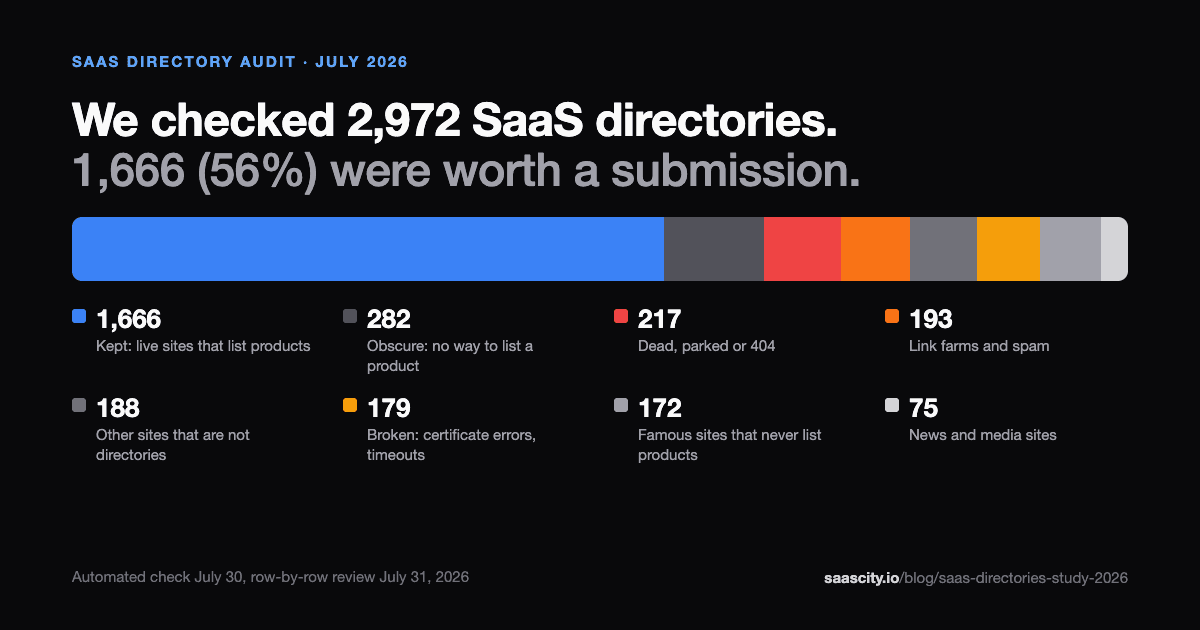
Here's where I have a genuine opinion: most founders waste weeks submitting to 200 directories that send nothing. We wrote a whole piece on filtering the 2,000+ options down using Domain Rating, because most directories don't move your rankings or send traffic at all. Pick a dozen or so. Quality over spray. If you want the pre-filtered version, the best SaaS directories list and the high-DR directories list are the two I'd start from.
The late-2026 directory scene keeps shifting, too. New platforms ship monthly, and there are now meta-lists indexing the meta-lists. Check Domain Rating and actual traffic before you commit an afternoon to any of them.
LinkedIn: the 2026 distribution machine
LinkedIn quietly became the best free visibility channel for B2B SaaS founders, and 2026 made it stronger. According to an analysis from 1KReach, LinkedIn newsletters now trigger push notifications, email delivery, and an in-feed banner for each edition. That's distribution you'd pay real money for on any other platform.
LinkedIn's own newsroom said in March 2026 that it was improving feed ranking using generative recommenders and LLMs to better understand content and member interests. Translation from marketing-speak: the feed is getting better at surfacing niche expertise to the right people, even if you have 800 followers instead of 80,000.
What works, concretely:
- Build-in-public posts with numbers. "MRR went from $400 to $1,900 in six weeks, here's what broke" beats any ad.
- A weekly newsletter edition. The 2026 distribution boost means each one works harder than it did two years ago.
- Commenting on posts from your target customers' ecosystem for 15 minutes a day. Boring, effective.
- Reposting your launch and directory milestones as stories. "We got listed, here's what the review flagged" is content. The listing itself is not.
The trade-off is that it's slow, and it punishes quitters. Of all the free platforms for SaaS founders to get visibility, this is the least forgiving. Post for three weeks then vanish, you get nothing. Commit to six months of two or three posts a week and it becomes your best owned channel.
If your buyers are developers rather than managers, swap some of that LinkedIn time for Reddit. The mechanics are different and the wrong post gets you banned, so read the subreddits that actually convert before you post anything.
AI answer engines: the new front door
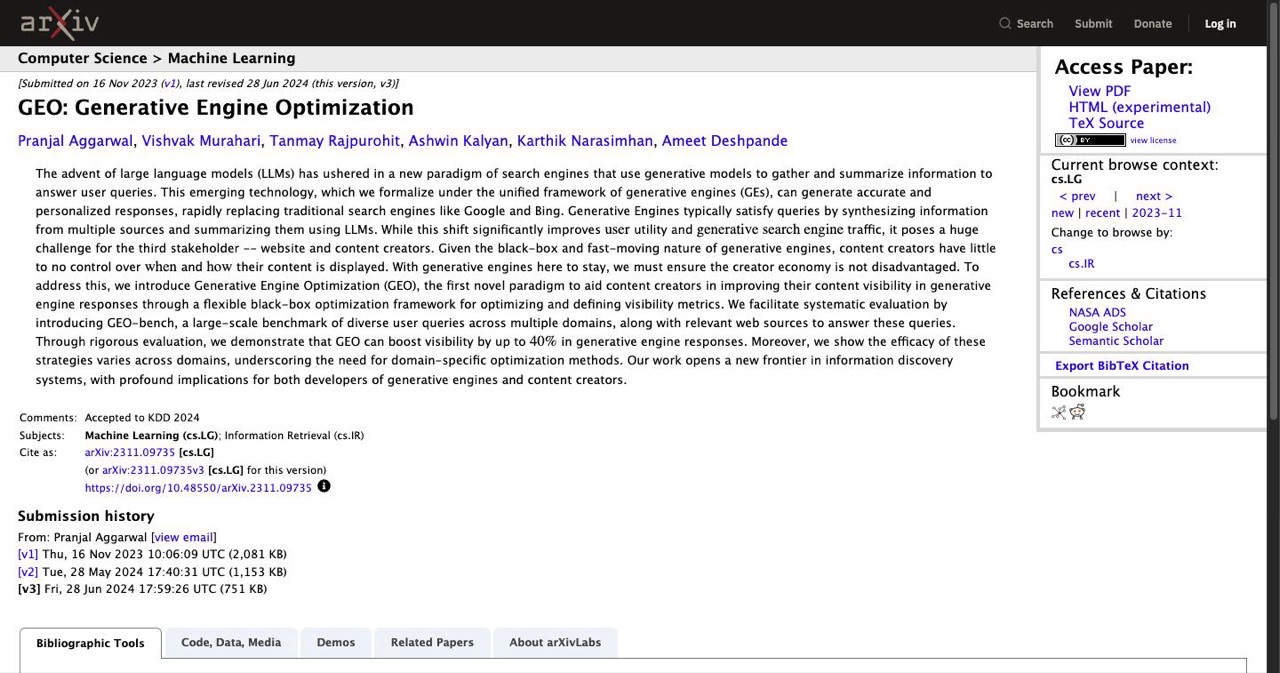
This is the newest of the platforms for SaaS founders to get visibility, and the one most coverage now obsesses over, because it's real. SaaS buyers are researchers, and they've moved a chunk of their research into AI chat. When someone asks Perplexity for "best project management tool for remote teams" or asks ChatGPT for "Notion alternatives for startups," the model names specific products and often cites sources. Get cited, get the click. Get skipped, and your competitor eats that demand.
Two things worth knowing before you spend a dollar here. First, Google's own guidance for AI Overviews says there is no special markup or file that gets you in. Its AI features run on the same ranking systems as regular search, so the boring fundamentals still decide it. Second, the other engines behave differently. The Princeton GEO study measured what moves visibility in generative engines: citing sources raised it about 40 percent, adding statistics about 37 percent, and adding expert quotes about 30 percent. Keyword stuffing lowered it. So the same page that reads well to a person is the page the models pick.
So how do you show up? Three levers:
- Be listed where models learn. Directories, comparison sites, review platforms, well-structured "alternatives" pages. Models favor sources that already rank and are richly structured. Third-party mentions carry more weight than your own homepage, which is the quiet reason the directory section above matters twice.
- Publish comparison and alternatives content on your own site. Models love pulling from pages that directly answer "X vs Y" questions. Give each one a dated stat, a named source, and a table. The full GEO playbook covers the technical side: llms.txt, schema, crawler access.
- Measure it. You can't improve what you don't track, and 2026 monitoring tools now have real entry pricing: Semrush's AI visibility tracking starts at a $99/month add-on, Peec AI runs about $100/month, and GrackerAI starts at $39/month, according to a Nobori.ai roundup. GrackerAI's entry tier is the sane starting point for a bootstrapped founder. Don't buy Semrush just for this if you're pre-revenue. Or do it by hand: pick 20 buyer queries, run them through ChatGPT and Perplexity once a month, log who gets named.
One caution: AI visibility is noisy right now. Answers vary by session, by model version, by phrasing. Track trends over weeks, not single data points, or you'll chase ghosts.
Watch where the money flows, too. We covered Cloudflare's x402 experiment with pay-per-crawl edge payments, which hints at a near future where AI agents pay publishers directly for structured product data. Early days. But if recommendation traffic becomes transactional, the structured listings you built for directories get more valuable, not less.
Platforms for SaaS founders to get visibility: the real sequence
I'd love to hand you a clean week-by-week plan. Real launches don't cooperate. The order below keeps producing results, with the honest caveat that you'll run half of it out of sequence, and mostly that's fine.
Six weeks out: the unglamorous part. Claim your directory profiles while you build. SaaSCity first, because the page and the link start working the day it's approved. Then G2, Capterra, Futurepedia or Toolify if you're an AI product, SaaSWorthy, plus a handful of newer launch platforms with permanent pages. Get your comparison content live early too, because AI models and Google both need time to index it. If you're on the free plan somewhere that needs a badge, add it now so the dofollow link is live before launch week.
Launch week: the loud part. Product Hunt on a Tuesday or Wednesday, two or three secondary platforms the same week so the momentum stacks, daily LinkedIn posts, an email to your list. Make launch day work twice by having a fallback offer for visitors who don't convert on day one.
Weeks two through twelve: the part everyone quits during. It feels like nothing is happening. Keep posting on LinkedIn three times a week. Chase reviews from early users on G2 and Capterra, because ten honest reviews beat fifty directory listings. Run monthly checks on what AI engines say when asked about your category. Double down on SEO content around the queries your buyers actually type.
Don't expect the platforms for SaaS founders to get visibility to perform on schedule, either. Some launches pop early and decay inside a fortnight. A G2 listing can sit dormant for four months, then start sending qualified traffic out of nowhere. The realistic first-100-customer math looks like this:
| Source | Customers (of the first 100) | When |
|---|---|---|
| Launch and directory wave | 20 to 40 | Weeks 1 to 8 |
| LinkedIn and personal network | 20 to 30 | Weeks 2 to 16 |
| Search, AI answers, word of mouth | The rest | Months 3 to 6 |
Visibility platforms create awareness. Conversion still happens on your site, your onboarding, and your follow-up. The zero-budget version of that whole funnel is in how to get your first 100 users.
Around month four, you'll finally know which channel pulls for your specific product. For most bootstrapped B2B SaaS it's a mix of SEO content and LinkedIn, with directories humming in the background sending qualified stragglers. Spend accordingly, and kill what isn't working.
Questions founders ask about visibility platforms
What are the best platforms for SaaS founders to get visibility in 2026? Four channel types: launch platforms (SaaSCity for a permanent page and a dofollow link, Product Hunt for the one-day spike), a short list of discovery directories (G2, Capterra, Futurepedia or Toolify for AI products, SaaSWorthy), LinkedIn as an owned channel, and AI answer engines like ChatGPT and Perplexity, which you reach indirectly by being listed and by publishing comparison content. Being on all 200 directories is worse than being on the right dozen.
How much does it cost to launch on Product Hunt in 2026? Product Hunt is free to create an account, submit a product, and rank. It added a $29/month paid tier for extras. The real cost is preparation: a demo video, fresh screenshots, and launch-day promotion typically run $200 to $2,000 depending on how much you outsource. Done lean, expect a few hundred dollars.
Do directory listings still send traffic to SaaS products? Most don't, which is why you should stop at ten or twelve. SaaSCity, G2, Capterra, GetApp, and the AI-tool directories still send qualified visitors, and every real listing also feeds the AI models that buyers now ask for recommendations. A product with zero directory footprint is nearly impossible for ChatGPT or Perplexity to recommend with confidence.
How do I get my SaaS recommended by ChatGPT and Perplexity? Be listed where the models learn: directories, review sites, comparison pages, well-structured alternatives lists. Publish your own "X vs Y" and "alternatives to X" pages with specific numbers and cited sources. Then track the answers monthly, because they vary by session and model version. The Princeton GEO study found that citing sources and adding statistics boost AI visibility by 30 to 40 percent.
Is LinkedIn worth it for SaaS founders? Yes, and in 2026 it is the strongest free owned channel for B2B SaaS. Newsletters now trigger push notifications, email delivery, and an in-feed banner for every edition, and the feed ranking was rebuilt with LLM-based recommenders to surface niche expertise to the right people. It only works if you post two or three times a week for at least six months.
How long does it take to get visibility for a new SaaS product? Plan on three to six months to see which channel pulls for your product. A launch spikes for a day or two and decays inside a fortnight. Directory listings can sit dormant for months and then start sending traffic. LinkedIn compounds slowly.
Is SaaSCity free to list on? Yes. The free plan gives you a permanent page and a dofollow backlink once you add the badge to your site. Quick Pass ($19.99) skips the badge and goes live within 24 hours with a building on the city map. Premium ($39.99) adds a launch post written by the team. An AI agent can submit for you through the free MCP server.
Where to start this week
Open a spreadsheet. List SaaSCity and Product Hunt at the top, then seven directories, including G2, Capterra, and Futurepedia. Submit to SaaSCity today, since it's the one that takes ten minutes. Draft your comparison page for your top two competitors. Block 30 minutes daily for LinkedIn. Pick a launch date six weeks out and work backwards.
Then do the harder thing: cut everything else. The directory at #47 on some listicle, the third social account, the podcast tour you keep postponing. Every hour there is an hour stolen from the platforms for SaaS founders to get visibility that actually produce. Stop spreading. Pick your Tuesday.
Get your SaaS in front of founders
List your product on the SaaSCity live city map - a permanent listing, real discovery, and a backlink from a high-DR directory. Free to start; upgrade for a dofollow link and a building on the map.