Launch & Growth
The .lol Bidding Directory Frenzy of August 2026: Payluck, Outbid & the New Wave of Pay-to-Rank Launch Platforms
Outbid.lol pulled $21k and 200k visitors with a pure pay-to-rank leaderboard, and within 48 hours dozens of .lol clones, reverse auctions, map-conquest boards and directories-of-directories followed. Here's every site in the wave, how bidding vs luck models work, and whether founders should spend a dollar on any of them.

Contents (10)
Quick answer: A bidding directory is a startup listing site where rank is set by how much you pay. Outbid.lol launched at 11:08 PM CEST on August 19, 2026 with a $2 minimum bid and self-reported $21,499 and 200,000 visitors in 24 hours. Dozens of .lol clones followed inside 48 hours, including Payluck.lol's random-coupon pricing, lowbid.lol's lowest-unique-bid auction, warmap.lol's country map and lastspot.lol's decaying 100 spots.
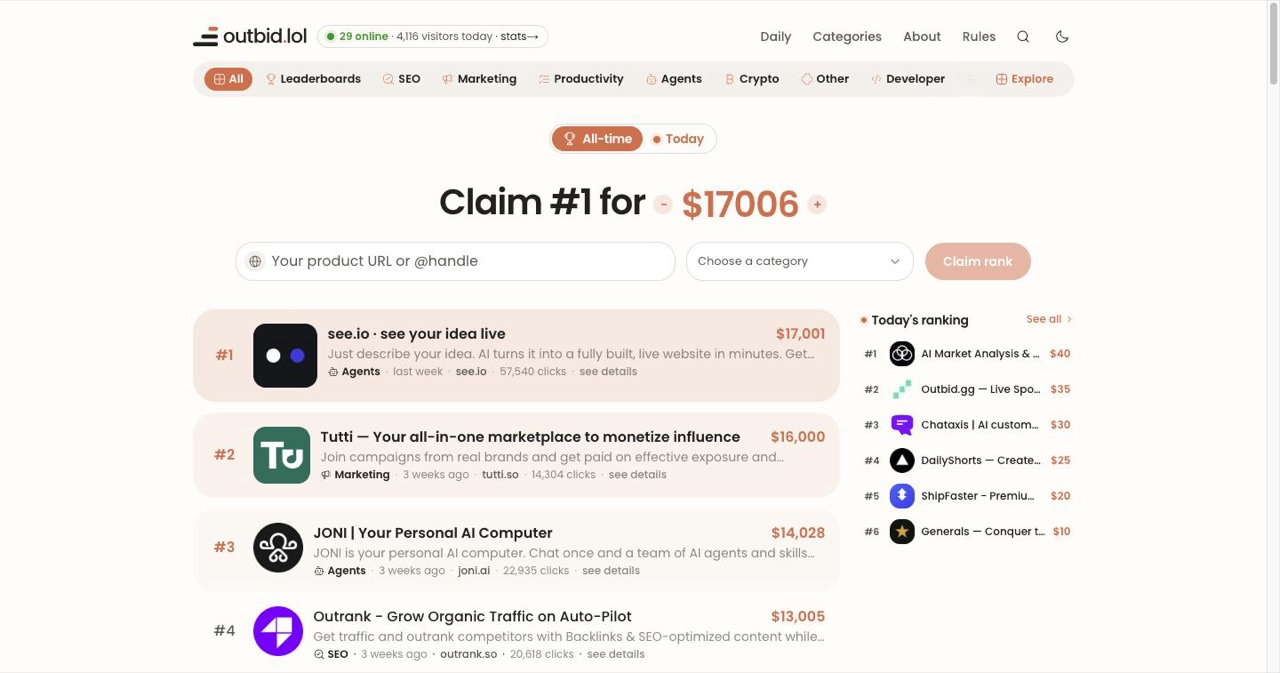
All numbers in this post are snapshots from August 19–22, 2026. Bids, boards, and DR values on these sites change by the hour, and new boards were still launching while this was being written. Last checked: August 22, 2026.
At 11:08 PM CEST on August 19, 2026, a German indie hacker shipped a website he had built in three hours. It had one feature: pay money, rank higher. Twenty-four hours later he had reportedly made $21,499, served 200,000 visitors, broken his analytics provider, and turned down a $100,000 acquisition offer. By the next morning, at least a dozen clones existed, most of them on 99-cent .lol domains, and one of them had replaced bidding with a slot machine.
Two days later that dozen is dozens, with reverse auctions, world maps, decaying slots, and directories whose only content is ranking the other directories.
This is the story of the .lol bidding directory frenzy: what launched, how each model works, and what any of it is actually worth to a founder deciding where to spend launch budget. The short version on that last question: entry bids are cheap, the traffic during the viral window was real, and almost none of these links will matter in six months. If you want a listing that still exists next year, a directory like SaaSCity — the #1 startup directory with a live city map, permanent listing pages, and real editorial review — is where the durable value sits. But the frenzy itself is worth understanding, because it says a lot about where launch platforms are going.
Key Takeaways
- Outbid.lol started it. Jonathan Wilke of supastarter built it in about three hours and launched it on August 19, 2026; the mechanic is a public leaderboard sorted by bid, $2 minimum, whole dollars only.
- The money was real. $21,499 self-reported in 24 hours, and The Index read the operator's own revenue endpoint at $139,058 on August 22.
- Three models emerged. Pure bidding (Outbid, GrowU), luck-based fixed boards (Payluck's $9.95 list price with a random coupon that locks forever), and free listing plus paid rank (Bidboard).
- The clones mutated fast. Reverse auctions at lowbid.lol, country conquest at warmap.lol, 5%-per-day decay at lastspot.lol, and meta-boards like biddirectory.lol that rank the other bid boards.
- .lol was a price decision. First-year registrations went as low as $0.99 in August 2026 and new .lol registrations reportedly passed 1,000 a day mid-month.
- The SEO case is weak. These are brand-new domains, and a public board stating what a link cost is a legible paid-link footprint under Google's spam policies.
- Spend like it is an experiment. Entry bids run $5 to $50, traffic concentrates almost entirely in the original board, and outbid.lol's per-listing click counter appears to reset on the clock hour.
The Spark: Outbid.lol and the 24-Hour Explosion
Outbid.lol is the work of Jonathan Wilke, the indie hacker behind the supastarter boilerplate. He launched it at 11:08 PM CEST on August 19, 2026 — 21:08 UTC, timestamped by his own "we're live" post — after roughly three hours of building. (An earlier version of this post dated the launch to August 20; the timeline below is corrected against the post timestamps.)
The mechanics are radically simple:
- It's a pure pay-to-rank leaderboard. The highest bid holds #1; every other listing slots in by amount.
- Minimum bid is $2, whole dollars only.
- You can list a product URL or just an X handle.
- Ties break in favor of the older entry.
That's the whole product. No review, no categories, no editorial anything. Your money is your ranking, displayed publicly next to your name.
The self-reported results from the first 24 hours, several of which were corroborated by third-party scrapes of the public board:
| Metric (first 24h) | Figure |
|---|---|
| Revenue | $21,499 |
| Visitors | 200,000+ |
| Highest single bid | $10,000 (higher on some later snapshots) |
| New X followers | 1,500+ |
| Acquisition offer | $100,000 unsolicited, declined |
| Direct clones within hours | 3–10+ (dozens by Aug 22) |
Public scrapes of the board put total standing bids in the tens of thousands of dollars, with top spots pulling thousands of clicks during the peak. Wilke's analytics provider briefly fell over under the load.
One distinction is worth pinning down, because most coverage of this wave blurs it: standing bids on the visible board are not lifetime revenue. The board shows what is currently committed to the spots on display. Realized gross is everything ever paid, including every bid that has since been outbid and every spot that has since rolled over. The gap between the two is large and it only widens as the board churns.
By August 22 the board had escalated rather than cooled. The #1 spot passed $13,000 at points, after earlier peaks reported in the $10,000–$12,500 range, and cumulative revenue kept climbing far past the first-day figure as bidding continued — third-party coverage put outbid.lol near $100,000 inside 48 hours, and The Index, a tracker that polls the operator's own /api/revenue endpoint hourly, read realized gross at $132,940 on the morning of August 22 and $139,058 later the same day. Those are reads of the operator's counter, not an audited number, but they are timestamped and reproducible, which is more than the screenshots offer. Visitor claims across creator updates and third-party scrapes range from the high hundreds of thousands into the millions over the first two days, which is a wide enough spread that the honest read is "a lot, and unverified." Click traffic for ranked sites is real but uneven: some spots reported hundreds of visitors, others near-silence at the same bid level. The $100,000 acquisition offer was still declined.
Why did it go viral when a hundred quieter launch platforms didn't? Three ingredients stacked: the mechanic takes five seconds to understand, the money is displayed in public, and every founder scrolling the board feels the same itch — for $2 I could be on there. Public spending plus a live leaderboard is an engagement loop that Product Hunt's upvote model never had. It's the million-dollar-homepage playbook compressed into a ranking table.
Why Everything Landed on .lol
The TLD choice wasn't an accident, and then it became a bandwagon.
First-year .lol registrations were going for as little as $0.99 at some registrars in August 2026, and availability was wide open — nearly any short, punchy name you wanted was free to take. Mid-month, registrations reportedly passed 1,000 new .lol domains per day.
The cultural fit did the rest. "lol" signals exactly what these sites are: fast, funny, low-stakes experiments that don't take themselves seriously. A pay-to-rank leaderboard on a .com would read as cynical. On a .lol it reads as a game.
Once outbid.lol hit, builders raced the namespace: bidboard.lol, bidding.lol, biddirectory.lol, payluck.lol, growu.lol, rankbid.lol, tweetbid.lol, outdo.lol, outoutbid.lol, and more registered within hours of each other. The trend ate itself almost immediately — some of the new .lol sites are meta-directories whose only content is ranking the other bidding sites by bid amount.
The Directories, One by One
Here's the full comparison, followed by what's actually distinct about each site.
| Directory | Launched | Model | DR / status | Pricing | Link type | Key notes |
|---|---|---|---|---|---|---|
| outbid.lol | Aug 19, 2026 | Pure bidding | Brand-new domain | $2 minimum bid | Varies by snapshot | The original; $21,499 in 24h self-reported, six figures by day three |
| payluck.lol | ~Aug 20–21, 2026 | Luck-based pricing | Brand-new domain | $9.95 list, random coupon locks final price | Verify live | Boards of 50; lock when full, next board costs more |
| growu.lol | Aug 21, 2026 | Classic bidding | Brand-new, low traffic | Bid-based | Verify live | Straight clone of the model |
| biddirectory.lol | Aug 2026 | Meta: ranks bid sites by bid | Brand-new | Bid-based | Verify live | By Damon Chen; directory of bidding directories |
| bidding.lol | Aug 2026 | Meta ranking | Brand-new | Bid-based | Verify live | Same self-referential idea |
| bidboard.lol | Aug 2026 | Free listing + paid rank | Brand-new | Free list; pay only to move up | Dofollow on free listing | Money buys rank, not the link — the SEO-safer twist |
| whatlaunched.today | 2026 | Daily/weekly launch board | DR ~56 per TrustMRR | Free + paid | Verify live | More traditional; fresh products daily, permanent listings |
| daniellaunches.com | Announced ~Jul 2026 | Indie launch platform | Early stage | TBD | Verify live | SEO emphasis: permanent pages, long-tail assets |
| iqode.com | Jan 2026 | Curated free directory | Claimed DR 51+ at launch | Free | Promised dofollow | Classic curated model for SaaS tools and agencies |
| SaaSGrave Launches | Aug 2026 | Tiny launchpad | Very early | TBD | Verify live | Side project from the SaaS Graveyard founder; see @SaasGrave on X |
A few of these deserve more than a table row.
Payluck.lol: the slot machine variant
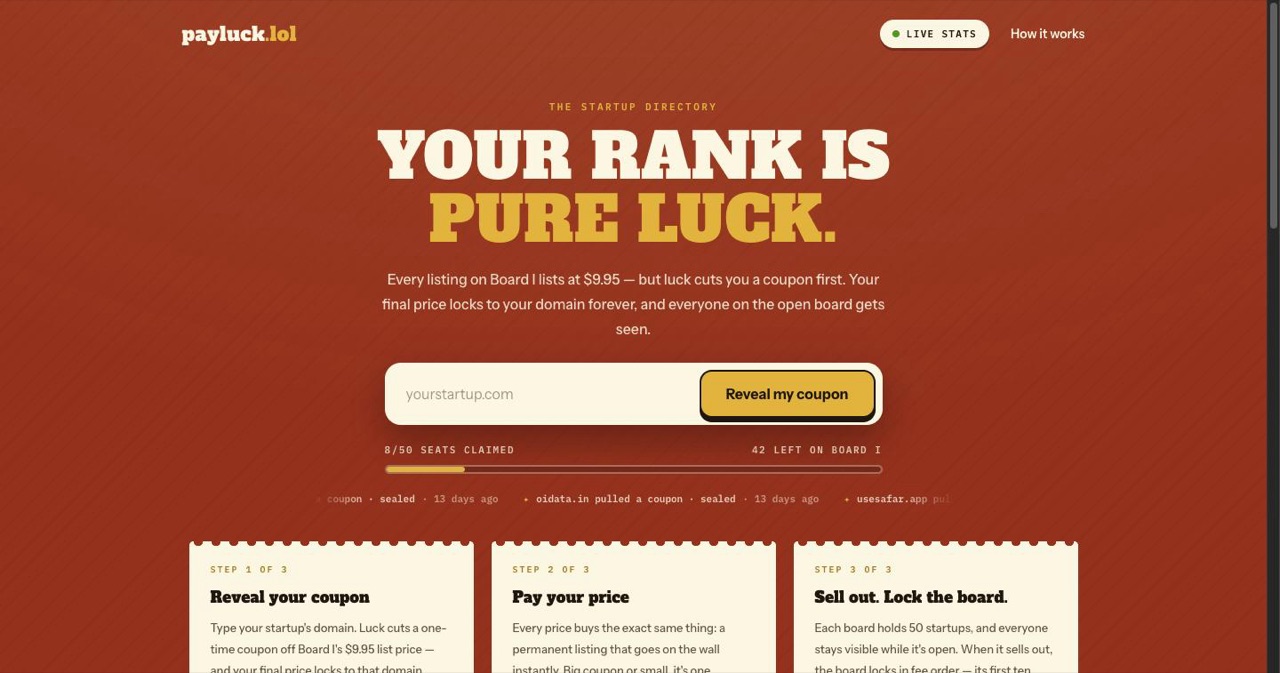
Payluck.lol is the purest "luck" mutation of the trend, and the most interesting design in the wave. Every listing carries a $9.95 list price, but before you pay, you reveal a random coupon — and whatever discount you draw locks to your domain forever. Listings fill boards of 50. When a board fills, it locks, and the next board opens at a higher list price.
That structure removes the money war entirely. Nobody can outbid you, because there's no bidding; your position is a seat on a numbered board, and your price is whatever the wheel gave you. It swaps FOMO-by-wallet for FOMO-by-scarcity, and it gives broke indie hackers the same shot at a cheap seat as a funded startup. At the time of writing, Board I sat at 4 of 50 seats claimed — genuinely day-one early.
Bidboard.lol: the SEO-safe twist
Bidboard.lol runs the hybrid worth noting: the listing itself is free and comes with a dofollow link, and money only buys position on the visible leaderboard. That distinction matters more than it looks. When the link is free and payment only affects display order, the paid-link problem largely evaporates — which, as we'll get to, is the biggest question hanging over the pure-bidding sites.
The meta layer
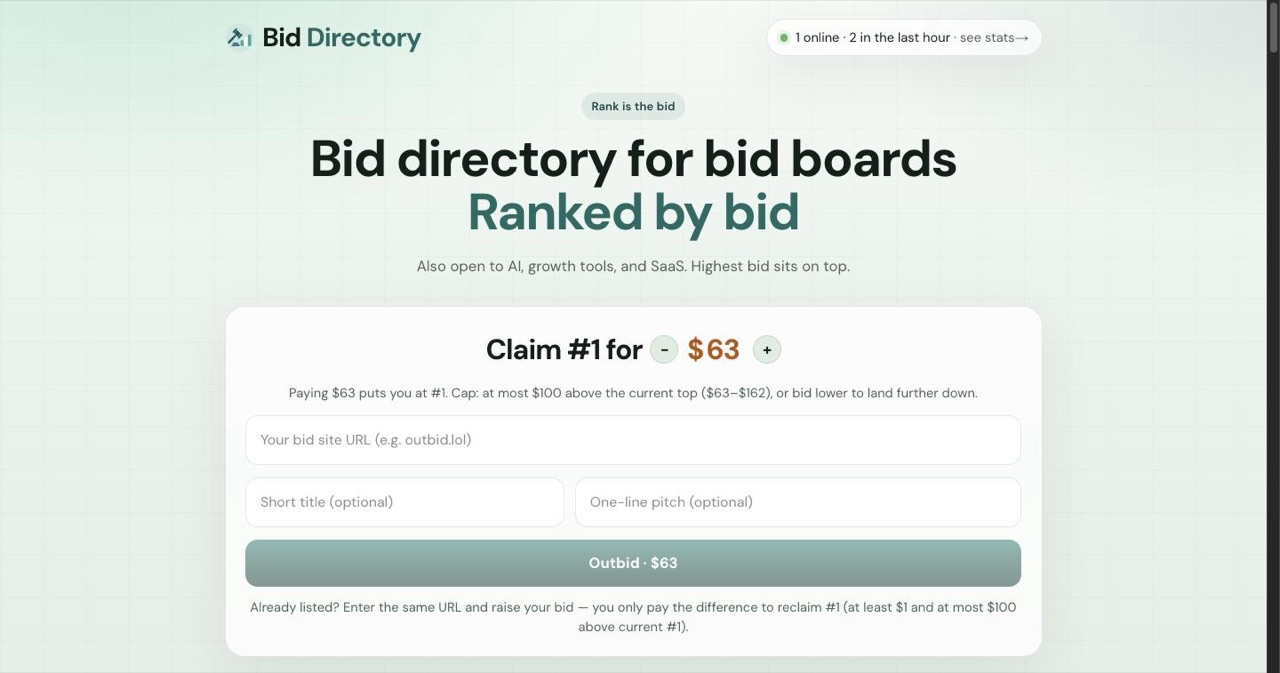
BidDirectory.lol, created by Damon Chen, is a directory of bidding sites, ranked by bid. Bidding.lol does the same. Within 48 hours the trend was already self-referential: sites bidding for rank on sites that rank sites by bid. If you wanted a single image of August 2026 indie hacking, that's it.
The adjacent traditionalists
Not everything in the wave is a leaderboard. What Launched Today is a daily launch board with permanent listings and a TrustMRR-reported DR around 56 — young but climbing, and closer to a classic directory. iQode launched back in January 2026 as a free curated directory claiming DR 51+, with quick submissions and a promised dofollow link. DanielLaunches and SaaSGrave Launches are both early-stage indie launchpads riding the same energy with more conventional models.
For completeness, the same first 48 hours also produced outbids.lol, rankbid.lol, tweetbid.lol, xbid.lol, dontbid.lol, and the non-.lol sibling topspot.so, among others. Nobody has an exhaustive list, including the people building them — the next section covers how much further this went.
The Clone Cascade: Aug 20 to Aug 22
Launch night's "three copycats already" was the low-water mark. Within 48 hours there were dozens, and the interesting thing is how quickly they stopped being clones. The first wave copied the mechanic verbatim. The second wave started mutating it — inverting the auction, bolting it to a map, adding decay, or pointing it at the clones themselves.
Here are the freshest boards circulating on X and on the bid directories, most of them launched between August 20 and 22:
| Site | Twist | How it works |
|---|---|---|
| lowbid.lol | Reverse auction | Lowest unique bid takes the top spot. Round one opens as cheap as ₹669 (about $7); the first 20 spots reveal after 24 hours. Frugal-by-design, India-flavoured. |
| biddirectory.lol | Meta | A directory of bid boards, ranked by bid. Actively listing dozens of clones. Sometimes referenced alongside bidding.lol, which does the same job. |
| warmap.lol | Territory | Companies bid to conquer countries on a world map. Brazil, Indonesia and Indian regions went for small money early. Heavily promoted. |
| lastspot.lol | Scarcity + decay | Hard cap of 100 spots, and position value decays 5% per day. Also runs an "Outbid & friends" list of rival boards. |
| rankbid.lol | Straight clone | Higher bid, better position. Promptly got a copycat of its own; the copier has been copied. |
| topapp.lol | Vertical | App Store–style ranking for mobile apps. One of the earlier inspired variants, still circulating. |
| pitchpit.lol | Head-to-head | Pits two companies against each other and lets visitors pick the winner. You pay for your place in the matchups, not the outcome. |
| puremoney.lol | Straight clone | No twist advertised. Shipped fast, which was the point. |
| hypeladder.lol | Community wars | Aimed at Twitch and community audiences rather than SaaS founders. |
| undercut.lol | Dutch auction | Inverted pricing mechanics, listed on the bid directories alongside outoutbid.lol, which exists to outbid the outbidders. |
That is not the list, just a readable slice of it. Also in circulation: topx.lol, vibewar.lol (a battlefield for vibecoded apps), tweetbid.lol, xbid.lol and xme.lol for X profiles, dontbid.lol, payluck.lol, uprank.lol, bidanything.lol, whosetheboss.lol, claimrank.lol, watchbid.lol, takeone.lol, overbid.lol, outrank.lol, spots.lol, bidwall.lol, bidfast.lol, aistartups.lol, bidking.lol, plus regional editions, vertical spinoffs, Chrome extensions and at least one memecoin. Several skip .lol entirely and run the same mechanic on whatever domain was free.
There are now kit products too — Bidkit-style templates that sell you a working board for a one-time fee. The clone wave has a supply chain.
Why .lol became the punchline
One site did this to an entire TLD. Before August 19, .lol was a novelty extension nobody had a use for. Two days later "every .lol is a pay-to-list board now" was a running joke on X, and registering one read as a declaration of what you were building. Cheap first-year pricing made it frictionless; outbid.lol made it legible.
The differentiation scramble
Once a mechanic is three hours of work, the only defensible thing is the twist. What builders reached for, roughly in order of cleverness:
- Inverting the auction. Lowest unique bid (lowbid.lol) or Dutch-style undercutting, which removes the rich-founder advantage that makes pure bidding feel rigged.
- Adding a board to the board. Maps, matchups, ladders. Position becomes a place or an opponent instead of a row number.
- Time pressure. Fixed slot counts and daily decay (lastspot.lol) manufacture the urgency that a pure leaderboard only has while it is trending.
- Honesty as a feature. A few boards publish real click counts per listing, which is the one differentiator a founder should actually care about.
- Niching down. Apps, tweets, X handles, countries, Twitch communities, vibecoded tools. Smaller pond, but the audience is legible.
The economics nobody posts about
The screenshots on X are all from the original. Most clones capture a rounding error of its volume, because the mechanic was never the moat — Wilke's distribution was. A few of the sharper twists pulled a few hundred dollars in their first day. Many pulled nothing and will quietly stop being paid for. First-mover advantage in an attention auction is close to total: the board everyone screenshots is the board everyone bids on.
That is the part worth internalising before you spend. You are not buying a spot on "a bidding directory," you are buying a spot on one specific board with one specific traffic curve, and the curve for clone number forty is flat.
The circle closes
Within 48 hours the trend was ranking itself. BidDirectory.lol ranks bid boards by bid. LastSpot.lol maintains an "Outbid & friends" list. Boards are now bidding for placement on boards that rank boards, which is either the perfect summary of August 2026 indie hacking or a warning label, depending on your mood.
What survives
Reasonable bet: the original, plus a handful with a real twist or a real niche, plus whichever one adds retention features before the X hype rotates to the next thing. Pure clones are already getting called out for shipping zero originality, and a board with no bids is just a dead page with a payment button. Watch for decay mechanics, honest click reporting, and anything that gives listers a reason to come back after the payment clears. Those are the survival signals. Everything else is a screenshot.
Bidding vs. Luck vs. Hybrid
Three models emerged from the frenzy, and they trade off very differently for a founder:
Pure bidding (Outbid, GrowU, BidDirectory): highest bidder wins, continuously. Traffic potential is highest during viral windows, but cost is unbounded — anyone can outbid you five minutes after you pay, and your $50 spot can be page-three by dinner.
Luck-based (Payluck): random coupon, locked price, limited board. Cost is capped and known before you commit, position can't be bought away from you, but traffic depends entirely on whether the site itself gets attention.
Hybrid free + paid rank (Bidboard): the free permanent dofollow listing is the floor; money only moves you up. Lowest risk of the three by a wide margin.
| Factor | Pure bidding | Luck-based | Hybrid free+rank |
|---|---|---|---|
| Cost predictability | Poor — endless outbid wars | Good — price locks once | Excellent — free floor |
| Traffic potential | Highest (during hype) | Moderate | Moderate |
| SEO value | Weak; paid-link risk | Weak; young domain | Best of the three |
| Competition intensity | Brutal | None after lock | Optional |
| Link longevity | Unclear | Unclear | Permanent (claimed) |
The SEO Reality Check
Now the uncomfortable part. Nearly every site above is a domain registered this month. DR under 10 or under 20 at birth, no ranking pages, no organic traffic of their own. The pitch for getting in early is real but speculative: young directories can climb fast — Nick Launches went from DR 0 to 72 in roughly three months — but for every climber there are fifty domains that will be parked pages by Christmas.
Two more caveats before you spend anything:
Dofollow status varies and changes. Several of these sites don't clearly state whether listings are dofollow, and a maker can flip the attribute site-wide in one commit. Verify the live HTML before counting any of it as a backlink. Our free dofollow directories list only includes sites we've actually checked.
Pure pay-to-rank flirts with link-scheme territory. Google's spam policies treat links bought for ranking purposes as manipulation, and SpamBrain got another upgrade this week. A public board that says "this link cost $400" is about the most legible paid-link footprint imaginable. Free-listing and badge-based models are much safer ground. If your goal is authority rather than clicks, the boring route still wins: see how to increase your domain rating for what actually compounds.
Treat the .lol wave as short-term traffic plus a small early-equity lottery ticket. Don't treat it as link building.
Should You Participate? A Practical Playbook
It can make sense if you're pre-launch or just-launched, you need any visibility at all, and you have genuine experiment budget — the common entry range is $5–$50. It also works as a cheap message test: real strangers clicking your link tell you things your landing page analytics can't.
If you're in, do it deliberately:
- Start with the free and luck variants. Payluck's coupon reveal costs nothing to try, and Bidboard's free listing is a free listing. Exhaust those before bidding wars.
- Bid on the board people are looking at. Traffic concentrates almost entirely in the original. A $5 spot on a clone with no audience is worse value than nothing, because it also costs you the time to set it up.
- Watch effective cost-per-click, not rank — but don't trust the click counter naively. During the viral window some spots delivered very cheap clicks; others bought a vanity position on a board nobody scrolled. The public boards let you estimate traffic before you pay, with two traps in the way. First, outbid.lol's per-listing click counter appears to reset on the clock hour: The Index reports 30 decreases across 10 hosts and 217 samples, every one of them between minute :00 and :04 and none mid-hour. A CPC computed off that number therefore depends on how far into the hour you happened to look, so sample the same listing at several points in an hour before you believe any figure. Second, a high click count is not proof the board delivered those clicks — The Index found near-zero correlation between the highest-CTR listings' click rate and the site's own concurrent traffic, which is what you would expect if those advertisers were driving their own audience to their own listing. Bid on the board's traffic, not on someone else's promotion of their own row.
- Track referrals and conversions. Tag your URLs. A $10 bid that brings 300 visitors and zero signups told you something important about your messaging, not just the directory.
- Keep a submission spreadsheet. Site, date, price paid, link type, traffic received. When half these domains die, you'll want to know which links vanished. Our complete guide to SaaS directory submissions has the fuller tracking system.
Red flags worth respecting: sites that vanish for hours at a time, terms that hold the link hostage to a perpetual badge, and boards with big bids but no visible traffic.
And keep the parallel track running. Hype directories are a garnish, not the meal. The durable stack is still the established platforms — SaaSCity first for a permanent, reviewed listing with a real dofollow path, then the classics covered in our Product Hunt alternatives guide and the free directories that give real backlinks. We keep a live DR-ranked directory list precisely so you can tell a climbing domain from a dead one.
What This Trend Actually Signals
Strip the memes off and the frenzy demonstrates something real: an indie maker can now ship and monetize a launch platform in an evening. Three hours from idea to a product that made $21,499 in a day and six figures in three. The stack got that fast, and the audience — thousands of founders hungry for any distribution edge — got that liquid.
Public money plus a live ranking is a proven engagement loop now, and cheap playful TLDs will keep fueling experiments like this. It also demonstrated how fast a mechanic gets commoditised: three hours to build the original, 48 hours until templates were on sale and the twists had run through reverse auctions, maps, decay and self-reference. Expect hybrids next: luck plus bidding, free dofollow floors with paid boosts, AI-ranked boards. Most clones will fade within weeks. The handful that add actual curation or build lasting SEO value might survive, climb, and become the boring incumbents someone else's viral weekend disrupts in 2028.
The Bottom Line
The August 19–21 .lol frenzy is build-in-public in its purest form: attention priced openly, sometimes by auction, sometimes by slot machine. If you want to play, visit the boards today — they change hourly — set a hard budget, and measure the clicks. Then put your permanent listing somewhere that will still exist when the frenzy is a screenshot in someone's retrospective thread.
Attention has always been the scarcest resource in launching a product. These directories didn't change that. They just put a price tag on it — and occasionally made the price random.
Get your SaaS in front of founders
List your product on the SaaSCity live city map - a permanent listing, real discovery, and a backlink from a high-DR directory. Free to start; upgrade for a dofollow link and a building on the map.