Build with AI
Has Claude Opus 5.5 Been Nerfed? Inside the First Benchmark Built to Prove It (2026)
Six days after Claude Opus 5.5 shipped, an open-source harness called livenerf reached the Hacker News front page attempting to answer the question founders argue about every cycle: does a frontier model quietly degrade after launch? Here is what six days of daily determinism runs actually reveal about model drift, token shrinkage, and vendor risk. If you run a SaaS company on third-party model weights, you are building on a moving foundation, which is why owning your distribution on SaaSCity matters more than trusting a model card.

Contents (8)
- The September 29 Pattern Interrupt: Enter Livenerf
- The Panel: Why 97% of Benchmark Questions Cannot Measure Drift
- Hermetic Testing and Pure-Function Graders
- Validation, Positive Controls, and Instrument Blind Spots
- What the Data Shows Today: Baseline Reality Check
- The Historical Pattern: Why Quality Dips Are Usually Infrastructure Bugs
- The SaaS Builder's Playbook: How to Build Your Own Drift Monitor
- Rented Intelligence and the Value of Distribution
Your automated test suite started spitting red errors at 6:00 a.m., your customer support agent is hallucinating JSON syntax, and the provider status page glows green with "All Systems Operational."
Every developer shipping AI features knows the feeling. For three years, the industry traded arguments over whether frontier models quietly degrade after release. Founders swear unit tests pass on launch day and break by week three. Developers post screen recordings of failing code completions. Frontier labs publish official denials insisting weights never changed. The debate stayed stuck in vibes against vibes: nobody kept a clean day-zero baseline to measure against.
That changed on September 29, 2026. Six days after Anthropic rolled out Claude Opus 5.5, an independent developer published an open-source test harness called livenerf to the front page of Hacker News. Built on an evaluation framework from the UK government and published as an append-only public log, it is the first serious attempt to turn the "nerfed model" dispute into hard statistics.
You are reading this on a directory's blog, so let's be upfront about what SaaSCity is: SaaSCity is a gamified startup directory with a live city map and human editorial review. The free listing page comes with a building on the map; adding the SaaSCity badge to your site earns a dofollow backlink and a Monday launch slot. If you need speed, Quick Pass is $19.99 and goes live within 24 hours. Premium is $99.99 and adds a written launch post with three dofollow links. Our Domain Rating sits between 47 and 56 at the latest Ahrefs refresh. Hundreds of SaaS products listed on SaaSCity rent model weights from Anthropic and OpenAI. When an upstream model shifts, your product shifts with it.
Here is what livenerf actually measures, what six days of data reveal, and why the real culprit behind model degradation is rarely a downgraded set of weights.
The September 29 Pattern Interrupt: Enter Livenerf
Anthropic shipped Claude Opus 5.5 on September 22, 2026. We covered the launch specifications in our guide to GPT-6 Sol, Luna, and Claude Opus 5.5. Within 72 hours, familiar complaints surfaced on developer forums: completions felt sluggish, refactoring failed edge cases, and reasoning felt truncated.
On September 29, 2026, GitHub user "ninjahawk" published livenerf, described as: "A long-running, deterministic-as-possible benchmark for detecting whether a frontier model gets quietly worse after launch." The repo hit the Hacker News front page the same day with 718 points and 280 comments, reaching 631 stars and 8 forks by September 30.
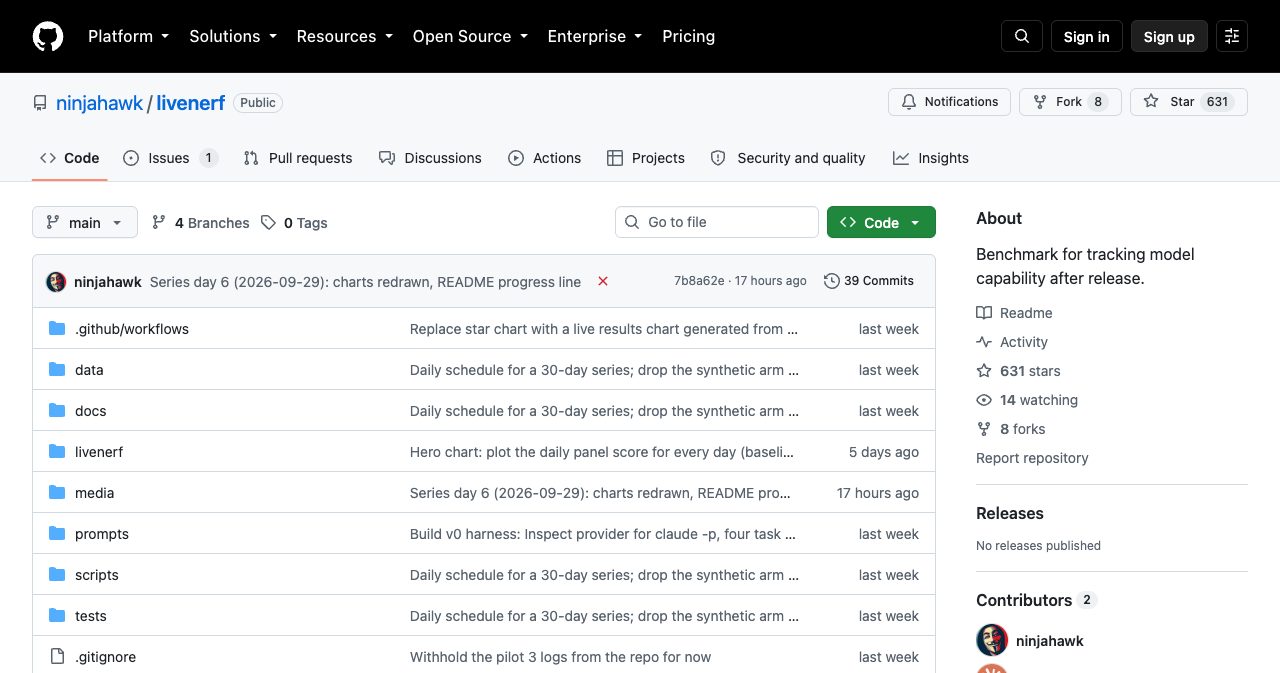
The series started September 24, 2026 at 22:10 UTC—roughly 2.5 days after Opus 5.5 launched. It runs daily for 30 consecutive days: Days 1 to 10 form the baseline, followed by two 10-day evaluation windows (Days 11 to 20, and Days 21 to 30). Because the methodology requires two consecutive 10-day windows before declaring a trend, the first results row lands after Day 20, and the earliest possible verdict arrives around October 24, 2026.
As of September 29, 2026, livenerf had collected 6 of its 30 daily runs (6 of the 10 baseline days), with zero missed. All 6 days ran 90 full samples on harness commit hash 461391b6fce64167 using pinned Claude Code binary 2.1.280. Day 5 ran with the budget guard overridden once, an operational deviation logged in the commit log.
The Panel: Why 97% of Benchmark Questions Cannot Measure Drift
Detecting whether a model dropped three percentage points across an arbitrary benchmark is difficult. If a question is too easy, Opus 5.5 solves it every time. If a question is impossible, it fails every time. In both cases, the question produces zero signal on drift.
Ninjahawk screened 2,336 difficult questions from GPQA Diamond, MMLU-Pro, competition math, and AIME 2025–26 with 4 samples each on Opus 5.5. Opus 5.5 solved roughly 93% on initial tries, and exactly 97% of questions were static—either 4/4 or 0/4. Ninjahawk dropped those static questions and isolated the 78 questions where Opus 5.5 was "sometimes right." Those 78 form the active panel.
| Metric / Component | Specification | Operational Detail |
|---|---|---|
| Question Pool | 2,336 items | GPQA Diamond, MMLU-Pro, competition math, AIME 2025–26 |
| Screening Filter | 4 samples/item | Tested on baseline Claude Opus 5.5 |
| Static Elimination | 97.0% | Dropped questions answered 0/4 or 4/4 |
| Active Panel | 78 questions | Items with non-zero variance ("sometimes right") |
| Screening Pass Rate | 54.7% | Initial 4-sample pass rate across the 78 items |
| Holdout Pass Rate | 62.0% | Pass rate measured on independent fresh samples |
| Detection Limit | ~7.5 points | Detectable accuracy shift per 10-day window at 99% CI |
| Meter Consumption | ~3.6% weekly | Headless Claude Code runs on Claude Max subscription |
| CLI Environment | Claude Code 2.1.280 | Pinned execution hash 461391b6fce64167 |
Selecting questions where the model wobbled introduces selection bias: items picked on initial passes can regress to their mean. On fresh independent samples, the panel pass rate shifted from 54.7% to 62.0%. The statistical power calculation uses this fresh 62.0% figure. Running the 78 questions once daily detects an accuracy change of roughly 7.5 percentage points per 10-day window, consuming only 3.6% of a Claude Max weekly meter.
Hermetic Testing and Pure-Function Graders
Most informal LLM evaluations fail because the harness introduces environmental noise. If your test runner has local shell state, past conversation turns, or ambient config files, your results measure system clutter rather than model drift.
Livenerf enforces a strictly hermetic setup:
- Isolated Execution: Every call runs in a fixed, empty temporary directory with a short, frozen system prompt.
- Zero Local Context: No tools, bash execution, MCP servers, local memory, or
CLAUDE.md. - Single-Turn Calls: Each query runs as an isolated prompt with explicit reasoning effort parameters.
- Headless Subscription Path: v0 runs through headless Claude Code (
claude -p) on a Claude Max subscription without an API key, matching the execution path developers use in terminal agents.
Grading is equally disciplined. If you use a frontier model to score another model, your grader can drift along with the subject. Livenerf bans LLM judges entirely. Every item is scored using deterministic, pure-function exact match logic or symbolic mathematical equivalence.
The harness runs on Inspect, the open-source evaluation framework from the UK AI Security Institute (UK AISI), storing append-only .eval logs that are never modified.
To isolate platform disruptions from model degradation, livenerf uses a dual-arm design. While the primary arm tracks Claude Opus 5.5, a control arm runs claude-opus-5 against the GPQA Diamond subset daily. If both drop together, the issue points to Anthropic's hosting infrastructure or network routing rather than model weights. Statistics follow Evan Miller's paper Adding Error Bars to Evals, calculating paired per-item differences with clustered standard errors.
Before running a single baseline sample, ninjahawk committed PREREGISTRATION.md to git. Under its rules, a degradation is only declared if the 99% confidence interval excludes zero across two consecutive 10-day windows, the measured effect is at least 3.0 percentage points, and the control arm does not show an identical movement. Null findings and improvements are published under the same standard.
Validation, Positive Controls, and Instrument Blind Spots
A benchmark claiming a model has not degraded is useless unless you prove it can detect a real drop. In scientific testing, this is the positive control: intentionally lowering capability to verify the instrument registers the shift.
Ninjahawk validated the panel by throttling reasoning effort:
- Dropping Effort to Low: Output tokens fell by 62%, and accuracy dropped by 8.3 ± 4.5 percentage points.
- Dropping Effort to Medium: Output tokens fell by 26%, and accuracy dropped by 4.2 ± 3.9 percentage points.
These validation runs revealed an important operational insight: effort cuts appear in token counts long before they cause accuracy to collapse. When a provider throttles thinking budgets, output token lengths shrink immediately, while accuracy erodes gradually.
The validation process also revealed an honest blind spot. When ninjahawk ran claude-opus-5 through the panel to simulate Anthropic silently swapping in the previous generation model, the accuracy difference was −3.8 ± 6.3 percentage points, with a 23% reduction in output tokens. At a 99% confidence interval, that score range overlaps with zero. In a single 10-day window, livenerf cannot distinguish Opus 5.5 from Opus 5. Catching a same-family model swap requires multiple consecutive windows to separate signal from variance.
Question quality presents another complication. An audit of the 78 panel items (and 2 questions excluded earlier) identified 8 answer keys that appear incorrect and 30 questions with phrasing ambiguity. Instead of dropping them, ninjahawk kept all 78 questions in the panel and pre-registered a sensitivity analysis that recalculates results without those 38 items.
The serving path introduces its own interference: Anthropic's safety classifiers occasionally intercepted math or biology prompts, refusing the request or routing the turn to Opus 5. Livenerf logs and counts safety refusals, rejects those individual samples, and excludes questions touched by classifier interventions.
Ninjahawk wrote much of the repository with assistance from Claude—the model under evaluation. That circularity is why grading functions are pure code, decision thresholds are pre-registered on git, and evaluation logs are append-only. As the README states: "You shouldn't have to trust the author, human or otherwise." The project is independent and has no affiliation with Anthropic.
What the Data Shows Today: Baseline Reality Check
As of September 30, 2026, has Claude Opus 5.5 been nerfed?
Nothing has been proven. The benchmark is on Day 6 of its 10-day baseline phase. No comparative conclusions can exist until Day 20 finishes in late October.
Other tracking projects tell a similar story. On the Hacker News thread, developers pointed to NerfBench, an automated monitor operated by BridgeBench that continuously tests models against their launch-day baselines and flags deviations greater than 10%. As reported in secondary coverage by ByteIota on September 30, NerfBench currently tracks Claude Opus 5.5 at 99.2% of its launch capability, and OpenAI's GPT-6 Astra at 102.8%. Both sit within normal operational variance. Separate write-ups on Gokawiil reach the same conclusion, and third-party model trackers like Artificial Analysis publish the Opus 5.5 intelligence, performance and price data you can compare against your own logs.
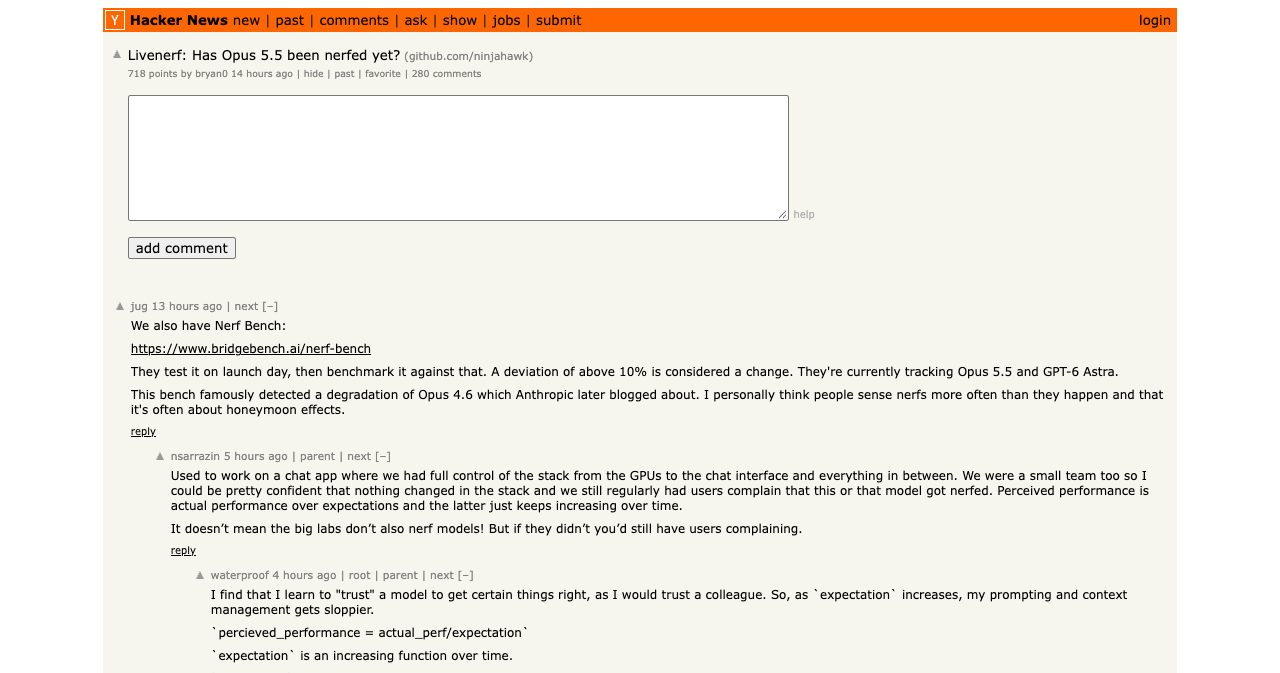
The Hacker News discussion surfaced several competing explanations for why developers perceive degradation where benchmarks find stability:
- Cognitive Habituation: Several commenters observed that developer expectations escalate faster than model capability. When a breakthrough model launches, users test it on solved problems and feel amazed. Within two weeks, users feed it difficult edge cases and attribute inevitable failures to model decay. One commenter summarized this with the equation:
perceived_performance = actual_perf / expectation. - Post-Launch Quantization: Other engineers suggested providers serve full-precision weights during launch weeks to maximize benchmark scores, then swap in quantized checkpoints once inference traffic hits scale.
- Peak Hour Load Shedding: Multiple commenters reported quality dips during US working hours rather than weekends, speculating that dynamic routing layers reduce context windows or reasoning depth under heavy server strain.
- The Benchmaxxing Problem: Several participants pointed out that now livenerf is public and sitting on Hacker News, Anthropic engineers could easily identify the 78 questions and ensure their caching or routing layers treat them favorably.
- Sample Size Skepticism: Senior engineers reminded the thread that single-turn prompt outputs are inherently non-deterministic, making individual failure anecdotes statistically meaningless.
The Historical Pattern: Why Quality Dips Are Usually Infrastructure Bugs
Suspicions that AI providers deliberately degrade their models overlook how modern inference stacks operate. Maintaining multiple hidden versions of a flagship model to save minor compute costs creates operational complexity without business upside. When model performance wobbles in production, the culprit is almost always an unannounced infrastructure change.
On April 23, 2026, Anthropic published an engineering postmortem titled An update on recent Claude Code quality reports, addressing a month of escalating user complaints. Business Insider reported on the findings the same day.
Anthropic stated its position unambiguously: "We never intentionally degrade our models."
Their investigation traced the complaints to three separate product-level changes affecting Claude Code, the Claude Agent SDK and Claude Cowork rather than the API: on March 4 they had lowered Claude Code's default reasoning effort from high to medium to cut latency, and reverted it on April 7; on March 26 a bug in the code that clears older thinking from idle sessions kept firing on every turn, fixed on April 10; and on April 16 a system-prompt instruction intended to reduce verbosity hurt coding quality and was reverted on April 20. All three were resolved by April 20 (v2.1.116), and Anthropic reset subscribers' usage limits on April 23. The model weights had not changed by a single float. The harness around the model had failed.
We documented an identical incident earlier this year when a remote feature flag silently broke agent project instructions (read our investigation into the Claude Code AGENTS.md telemetry gate). We saw similar friction when updated models broke client-side execution loops (analyzed in our breakdown of why newer models break agent tool calls).
Reasoning effort settings create another point of confusion. Claude Opus 5.5 defaults to medium reasoning effort. Claude Opus 5 defaulted to high. Developers who upgraded client libraries without explicitly specifying an effort flag immediately saw shorter answers and weaker reasoning traces. The model had not changed behind the scenes; the client simply passed a lower effort parameter by default.
Market competition adds another layer of complexity. On September 28, 2026—six days after Opus 5.5 released—Anthropic launched Claude Sonnet 5.5. In vendor benchmark reporting, Sonnet 5.5 scored 70.6% on Terminal-Bench 4.0 at Max effort, surpassing Opus 5.5's 66.4% at Xhigh effort. When a cheaper mid-tier model outperforms the flagship on agentic coding benchmarks, picking models based on brand tier becomes risky (we explore this dynamic in our guide to model fatigue and picking LLMs for SaaS). Anthropic itself has acknowledged that public benchmark margins are becoming less reliable guides to day-to-day software performance.
The SaaS Builder's Playbook: How to Build Your Own Drift Monitor
If your product relies on third-party model APIs, that model is a dependency without a public changelog. You cannot rely on Hacker News threads or vendor status dashboards to tell you when something breaks. You need your own instrumentation.
A practical internal monitor requires seven concrete steps:
- Curate 20 to 50 Real Tasks: Extract 30 actual prompts from your product logs where customer queries failed or required human intervention. Ensure every item has a clear target.
- Write Pure-Function Assertions: Never use an LLM to grade your test outputs. Write deterministic code: JSON schema validation, regex extractions, AST syntax parsers, or unit test runners.
- Pin Every Version String: Never call floating aliases like
claude-opus-latest. Pin exact model snapshot dates in API configurations, and pin SDK versions in your package lockfiles. - Pass Reasoning Effort Explicitly: Hardcode effort parameters in every API payload. Never leave reasoning depth to provider defaults.
- Log Output Tokens on Every Run: Token volume drops before accuracy fails. If your test suite average output token count drops by more than 20% while accuracy looks stable, your provider has likely altered prompt compression or reasoning limits.
- Maintain a Control Model: Run a small control subset against an alternative model family to isolate harness bugs from upstream weight changes.
- Schedule Weekly Batches: Run your suite once a week at an off-peak time, and log the results to an internal dashboard your team can inspect.
| What to Monitor | Why It Matters | Warning Threshold | Probable Root Cause |
|---|---|---|---|
| Output Token Volume | Leading indicator of thinking budget cuts | >20% drop from baseline | Silent change in default reasoning effort or context truncation |
| Pure-Function Pass Rate | True indicator of core task reasoning | >5 percentage points drop | Upstream model weight modification or system prompt steering |
| Time to First Token (TTFT) | Direct measure of server concurrency | >40% increase at peak hours | Infrastructure capacity strain or dynamic runtime quantization |
| Classifier Intercept Rate | Tracks changes in safety refusal behavior | >2% jump on benign tasks | Upstream safety classifier update or prompt filtering tweak |
| Structured Schema Errors | Measures output format compliance | >3% validation failures | Upstream tokenizer adjustments or agent scaffolding changes |
Rented Intelligence and the Value of Distribution
Renting frontier intelligence means building on shifting ground. A model that runs your core business logic today might receive a system prompt update tomorrow, a revised reasoning default next week, or an export control restriction next month. Model capabilities will keep leapfrogging. What feels like an untouchable moat today becomes a standard API endpoint tomorrow.
The defensibility of an AI startup never lived in the model weights. The defensibility lives in your proprietary customer workflows, your integrations, and your distribution. When an underlying model shifts, a company with distribution swaps endpoints and keeps shipping. A company with nothing but a wrapper around someone else's model card gets wiped out.
That is why establishing distribution early matters. If you are building a product in this ecosystem, list your startup on SaaSCity today. Claim your building on the live city map, get reviewed by human editors, earn a high-authority backlink, and put your software in front of founders who evaluate tools on merit rather than marketing. Check our pricing options to pick the launch tier that fits your timeline, and build on assets you actually own.
Get your SaaS in front of founders
List your product on the SaaSCity live city map - a permanent listing, real discovery, and a backlink from a high-DR directory. Free to start; upgrade for a dofollow link and a building on the map.