News
Lovable Just Crossed $600M ARR. The Vibe-Coding Business Model Is the Real Story (2026)
Lovable co-founder Fabian Hedin announced in Amsterdam that the platform crossed $600 million in run-rate revenue, less than two years after launch. Apps built on the system now pull 900 million visits a month while the company valuation doubled to $13.3 billion. You are reading this on SaaSCity, so here is the unvarnished breakdown of what these numbers prove about modern software margins and how builders can get discovered.


Contents (10)
- Key takeaways
- The Amsterdam stage and the $600M run-rate math
- Valuation doubling and multiple compression
- How the $600M run rate is assembled
- The architectural divide: products versus code
- The competitive field and market comparables
- Bottom-up enterprise adoption: the shadow IT wave
- Critical risks: lock-in, unreviewed code, and security debt
- The 900-million-visit traffic surface and the distribution reality
- What developers and founders should do this week
Quick answer: On Thursday, September 24, 2026, Lovable co-founder Fabian Hedin announced at the HumanX summit in Amsterdam that Lovable crossed $600 million in annualized run-rate revenue. The figure is up from roughly $500 million in June 2026 and $200 million in November 2025. The company raised $400 million in August 2026 at a $13.3 billion valuation. Web applications built on Lovable now attract approximately 900 million combined monthly visits, signaling that conversational software builders have evolved from novelty experiments into massive traffic engines.
Yesterday morning in Amsterdam, an engineer walked onto the HumanX stage and told an audience of founders that his 34-month-old company collects $50 million every thirty days from people typing plain text into a browser window.
The company is Lovable. The speaker was co-founder and chief technology officer Fabian Hedin. The headline, reported that same morning by TechCrunch, is that Lovable has crossed $600 million in annualized run-rate revenue. That number stood at roughly $500 million in June 2026 and sat near $200 million in November 2025.
Before examining the mechanics of that growth, you should know where you are reading this. This article is published on SaaSCity's blog. SaaSCity is a gamified startup directory with a live city map and human editorial review. If you build software, whether by hand or through prompt generation, you need people to see it. We will examine how that distribution works later in this piece. Right now, the numbers coming out of Stockholm deserve a forensic examination.
Key takeaways
- Fabian Hedin announced on September 24, 2026, that Lovable passed $600 million in annualized run rate, up from roughly $500 million three months prior.
- All numbers are company-reported figures shared at a tech conference, meaning they represent run-rate estimates rather than audited filings.
- Lovable closed a $400 million Series C on August 12, 2026, at a $13.3 billion valuation, co-led by Menlo Ventures and EQT's Scaleup Europe Fund.
- While the company's valuation doubled in eight months, its ARR multiple compressed from 33x down to roughly 22x because revenue grew faster than the share price.
- Apps created on the platform collectively pull roughly 900 million visits per month across 60 million generated projects.
- Hedin claims workers at two-thirds of the Fortune 500 use Lovable via bottom-up adoption, including Deutsche Telekom, which has built over 2,000 internal tools.
- Lovable routes user prompts across more than 100 underlying AI models automatically, balancing unit costs against response quality.
The Amsterdam stage and the $600M run-rate math
When Fabian Hedin spoke at the HumanX summit in Amsterdam on Thursday, September 24, 2026, he outlined a growth curve that few private software companies have ever matched.
Lovable was founded in Stockholm in November 2023 by Anton Osika and Fabian Hedin. The product opened to the public in November 2024. In the twenty-two months since that public debut, users have spun up more than 60 million individual projects.
The revenue climb, tracked across reporting from Business Insider and tech media, moved through distinct checkpoints:
- November 2025: roughly $200 million ARR.
- March 2026: crossed $300 million and then $400 million in rapid succession.
- June 2026: reached approximately $500 million ARR.
- August to September 2026: passed $600 million annualized run rate.
You need to read that curve with clear eyes. These are unaudited metrics announced by an executive on a conference stage. In venture-backed software, run rate almost always means taking the most recent month of gross booking revenue and multiplying it by twelve. If a startup brings in $50 million in August, it announces a $600 million run rate in September. That calculation assumes every paid seat renews, credit consumption remains steady, and churn does not spike. It represents an operating velocity, not twenty consecutive quarters of GAAP audits.
Yet even after discounting for conference optimism, the underlying volume is staggering. The coverage syndicated across daily.dev noted that Lovable added $100 million in annualized run rate in roughly ninety days. That pace confirms that non-engineers and product managers are opening wallets for tools that turn conversational English into working web software.
Valuation doubling and multiple compression
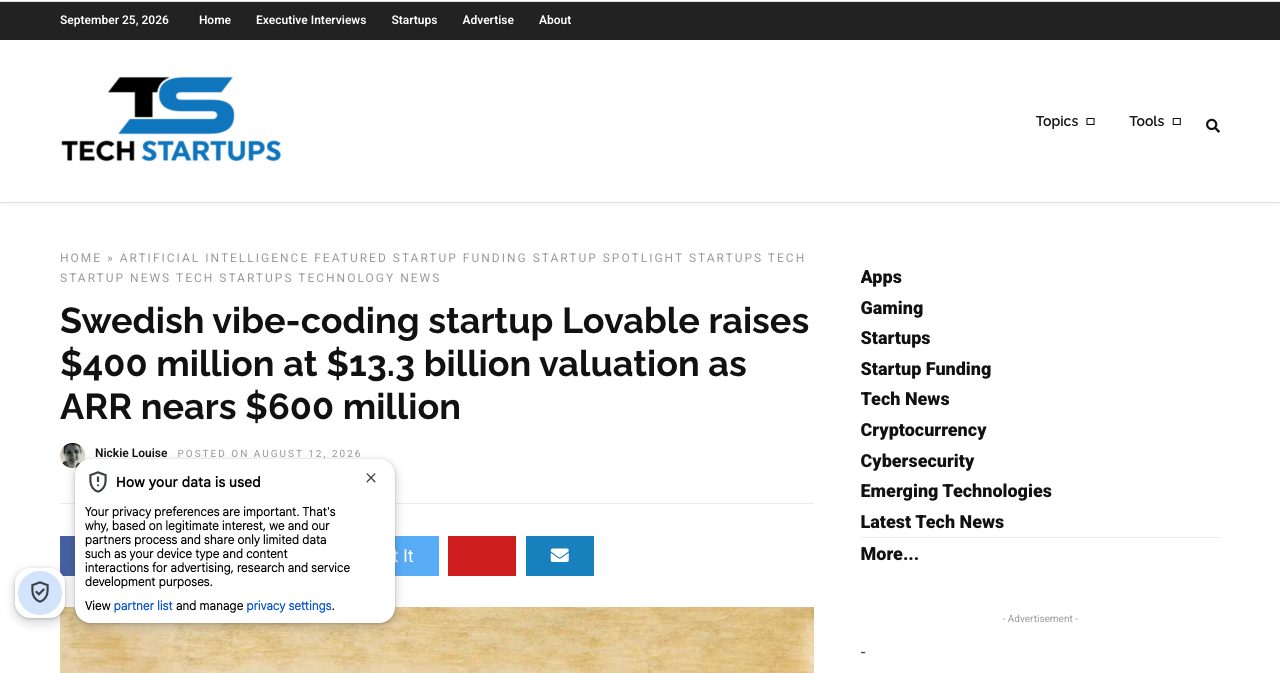
Six weeks before the Amsterdam announcement, Lovable completed one of the largest European financing rounds of the year. On August 12, 2026, the company announced a $400 million Series C round at a $13.3 billion post-money valuation.
The round was co-led by Menlo Ventures and the EQT-managed Scaleup Europe Fund. A wide syndicate joined them, including new investors Tencent, Balderton Capital, Carmignac, Kaszek Ventures, LTS Growth, World Innovation Lab, and Regent. Earlier backers also participated, among them Accel, Antler, CapitalG, DST Global, Evantic Capital, HubSpot Ventures, and Salesforce Ventures, as reported by TechCrunch's August 2026 report.
The funding history shows how quickly institutional investors revised their expectations for conversational software builders:
| Round | Date | Capital raised | Post-money valuation | Implied ARR multiple |
|---|---|---|---|---|
| Early funding | Mid-2025 | ~$200M | $1.8B | ARR not disclosed |
| Series B | December 2025 | $330M | $6.6B | ~33x on $200M ARR |
| Series C | August 12, 2026 | $400M | $13.3B | ~26x on $500M / ~22x on $600M |
As detailed by Tech Startups, Lovable has now raised roughly $950 million across five rounds. More than $700 million of that total was secured in two rounds closed just eight months apart.
The multiple mathematics tell the economic story. When Lovable raised at a $6.6 billion valuation in December 2025, investors paid roughly 33 times its trailing $200 million run rate. When the company raised at $13.3 billion eight months later, the price tag doubled, but the multiple fell to 26 times the June $500 million run rate, or roughly 22 times the current $600 million figure.
The valuation expanded while the revenue multiple contracted. That happens only when top-line revenue outpaces the rate of equity dilution. It mirrors the dynamics we observed when analyzing the Cognition $48 billion valuation, where rapid enterprise adoption forced investors to price rounds against forward growth projections rather than static trailing benchmarks.
How the $600M run rate is assembled
A $600 million run rate does not appear out of thin air. It requires a pricing model that captures revenue from hobbyists while extracting recurring commitments from growing teams.
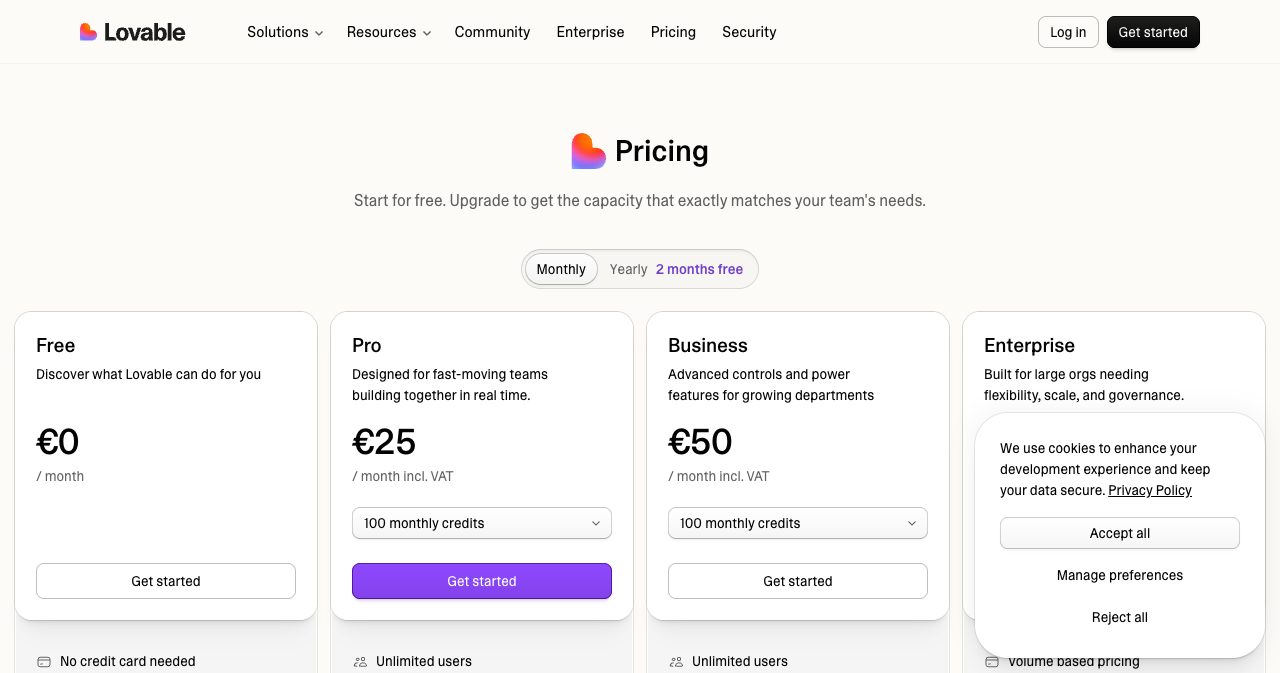
According to Lovable's pricing documentation, the company organizes its software into four distinct tiers:
- Free (EUR 0): Basic access for personal testing, limited daily message allowances, and standard sandbox execution.
- Pro (EUR 25 per month): Higher monthly message limits, custom domains, database connections, and priority generation queues.
- Business (EUR 50 per month): Team workspaces, centralized credit pools, extended project storage, and premium integration webhooks.
- Enterprise (Custom): Dedicated infrastructure options, single sign-on, advanced role-based access, and negotiated service level agreements.
The core of this structure lies in credit governance. Vibe coding can burn massive amounts of inference if users prompt carelessly. By attaching daily caps to entry tiers and charging monthly subscription renewals for additional compute credits, Lovable protects its gross margins.
Behind the editor, Lovable acts as a broker. The platform routes user requests across more than 100 underlying AI models automatically. Instead of letting users manually select Claude, GPT, or open-source checkpoints, Lovable's routing layer analyzes prompt complexity. Simple layout adjustments route to fast, cheap models. Architectural scaffolding and database schemas route to expensive reasoning models.
That routing layer defends unit economics. In June 2026, Lovable signed a multiyear cloud agreement with Google Cloud, with infrastructure usage expanding fivefold over the summer. Capital from the Series C round is targeted directly at enterprise governance: automated security scans, administrative permission controls, and directory integrations with Google Workspace, Microsoft 365, Salesforce, Stripe, and ElevenLabs.
The architectural divide: products versus code
During his Amsterdam presentation, Fabian Hedin delivered the line that best defines the company's positioning:
"You can use these tools to output code. The difference is that Lovable does not output code. The output is a product, and increasingly so, a business. We do a lot of things around hosting, deployment, and scaling apps."
That distinction represents an ideological fork in modern software engineering.
On one side stand developer-centric coding agents like OpenAI Codex, Anthropic's Claude Code, and desktop IDE tools. These systems assume the user is an engineer. They generate raw pull requests, write unit tests, manipulate git trees, and expect someone to manage a continuous integration pipeline, provision an AWS cluster, and debug Docker containers.
Lovable takes the opposite path. The user is treated as a product manager who wants a running application immediately. When someone types a prompt into Lovable, the system generates the frontend code, configures a relational database in Supabase, wires serverless functions, assigns a custom domain, and hosts the entire stack on managed cloud infrastructure. The user never touches a terminal or inspects a git log unless they intentionally eject.
Our ultimate guide to vibe coding explores this transition in detail. For rapid prototypes, internal administrative tools, client dashboards, and standalone micro-SaaS utilities, an integrated builder removes weeks of boilerplate configuration. A solo founder can build and publish a working software tool in a single afternoon.
The trade-off appears when systems grow complex. Integrated app builders struggle when dropped into existing enterprise monoliths, legacy on-premise databases, or systems requiring strict offline regulatory compliance. If an application demands specialized message brokers, microsecond database optimization, or extensive automated regression suites, raw code in a proper version control repository remains essential.
The competitive field and market comparables
Lovable does not operate in a vacuum. The prompt-to-app market has formed into a competitive arena featuring different architectures and monetization approaches.
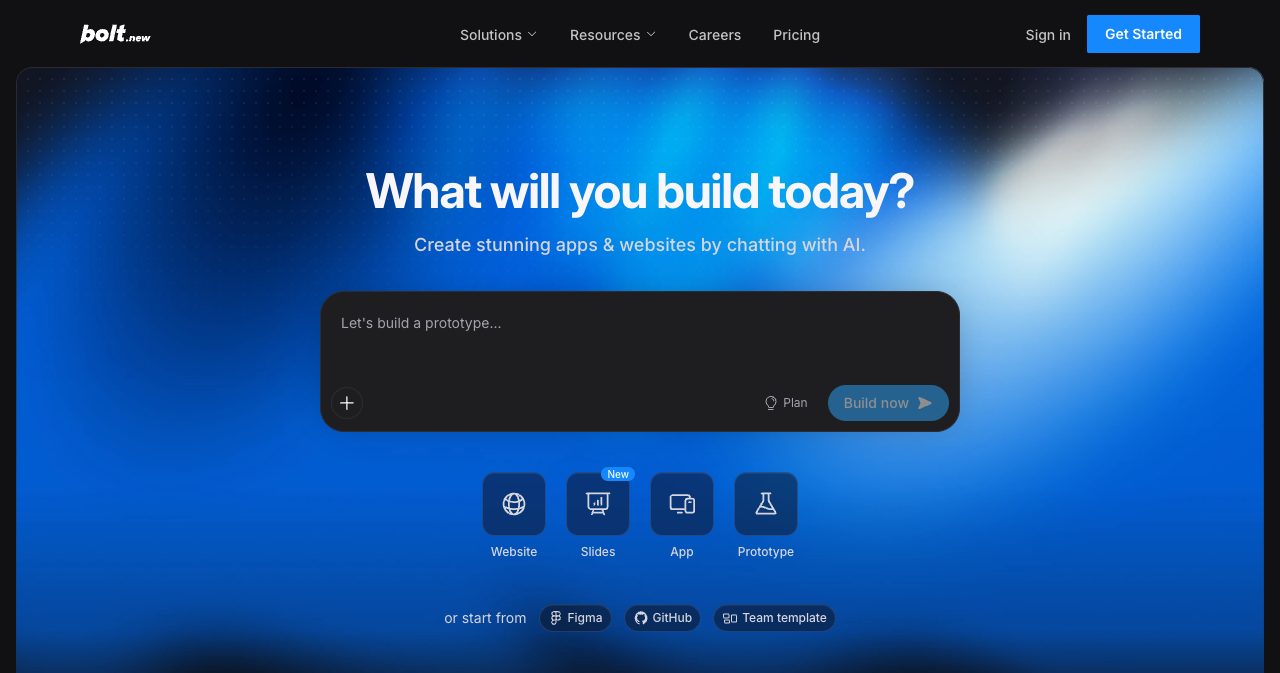
Browser-based environments like Bolt.new, created by StackBlitz, pioneered in-browser container execution via WebContainers. Bolt allows developers to prompt full-stack Node.js applications directly inside browser memory without provisioning remote virtual machines. Other players like Replit have evolved from cloud educational sandboxes into full-fledged autonomous agent environments.
The market valuation data compiled by ValueAddVC's analysis and financial updates from Gate.com illustrate how different sectors of AI software creation are priced:
| Platform | Latest reported ARR | Reported valuation | Implied ARR multiple | Primary user model |
|---|---|---|---|---|
| Lovable | ~$600M (Sep 2026) | $13.3B | ~22x | Prompt-to-app, non-technical builders & teams |
| Replit | ~$525M (Apr 2026) | $9.0B (Mar 2026) | ~17x | Cloud development, full agent environments |
| Cursor / Anysphere | $4.0B+ (mid-2026) | $29.3B valuation | ~7x | Desktop IDE fork for professional engineers |
| Bolt.new / StackBlitz | ~$40M (2025) | Undisclosed | Not disclosed | In-browser WebContainer sandboxes & app prototyping |
Lovable commands an order of magnitude more ARR than Bolt, while trading at a premium multiple relative to Replit. The comparison with Cursor is particularly instructive. Cursor generates massive raw revenue from professional software engineers, yet its multiple sits near 7x.
Why does Lovable command 22x while Cursor trades at 7x? Because private markets assign higher multiples to products that expand the addressable software-creation audience. A platform serving the 30 million professional engineers on Earth faces an eventual market ceiling. A platform that enables 500 million knowledge workers to build software captures the broader business software market, a thesis documented in the Harvard Business School case study titled "Lovable: Vibe Coding for the Other 99%".
Bottom-up enterprise adoption: the shadow IT wave
One of Fabian Hedin's most provocative claims in Amsterdam was that employees at two-thirds of Fortune 500 companies now use Lovable, up from roughly half the Fortune 500 six months earlier.
Lovable subsequently clarified what that metric means in practice. Two-thirds of the Fortune 500 does not mean enterprise procurement officers signed company-wide master service agreements. It means workers inside those corporations created accounts using their corporate email domains.
This is classic bottom-up enterprise adoption, identical to the pattern that originally propelled Slack, Dropbox, and Notion. An operations manager at an insurance conglomerate needs a portal to process regional claims. Central IT quotes an eighteen-month delivery timeline and a $250,000 internal budget. The manager opens Lovable, writes five prompts, connects an internal spreadsheet, and deploys a working internal portal before lunchtime.
Deutsche Telekom is the premier public example of this trend. Staff inside the European telecom provider have built more than 2,000 distinct applications on Lovable. Teams at Microsoft and Nvidia have established similar internal pockets of platform usage.
Once hundreds of employees build tools on an unauthorized platform, enterprise security teams step in. That is the exact moment where Lovable closes its largest contracts. The company uses its newly raised capital to build single sign-on, audit logs, and data residency controls, transforming unauthorized grassroots tools into paid enterprise deployments.
Critical risks: lock-in, unreviewed code, and security debt
Celebrating a $600 million run rate without examining its systemic risks produces bad analysis. Vibe-coding platforms carry three distinct vulnerabilities that founders and engineering leads must evaluate honestly.
Platform lock-in and migration friction
When you build a product inside a proprietary conversational environment, you inherit that environment's structural opinions. Lovable ties applications closely to its hosting architecture, serverless wrappers, and database templates.
If an application reaches scale and requires custom Kubernetes clusters or specialized database replication, ejecting from the platform can prove painful. Generated code frequently contains idiosyncratic abstractions that human engineers find frustrating to refactor. Leaving an all-in-one builder often requires rebuilding the core application from scratch.
Security liabilities in unreviewed code
AI models write code that appears functional on the surface while hiding subtle vulnerabilities underneath. When non-technical users prompt an application into existence, they rarely audit CORS policies, SQL injection vectors, or authentication middleware rules.
A database with misconfigured row-level security can expose customer records to the public internet without triggering a visual bug in the UI. Founders launching commercial products on prompt builders must run through a structured pre-launch security checklist for vibe-coded startups before taking real payments or processing confidential data.
Unaudited promotional metrics
As noted earlier, company-announced conference metrics do not equal audited financial statements. When a private startup announces a round number like $600 million ARR at an industry event, it aims to establish market dominance, attract engineering talent, and deter competitors. Founders building on these platforms should remember that vendor pricing, token allowances, and platform terms can change whenever underlying model costs shift.
The 900-million-visit traffic surface and the distribution reality
During his HumanX appearance, Fabian Hedin shared a metric that matters far more to independent founders than the $600 million ARR figure: applications created on Lovable now attract approximately 900 million visits every month.
Hedin pointed out that this aggregated traffic is an order of magnitude greater than the monthly visitor count of Lovable's own website. The 60 million applications deployed on the platform have become one of the largest web surfaces on the modern internet.
That single metric explains where software development is heading. Building software has become cheap, fast, and accessible to anyone with a browser. When the technical barrier to creating an application drops to zero, the volume of competing software expands exponentially.
Code supply is no longer the bottleneck. Distribution is the bottleneck.
If you spend forty minutes prompting a micro-SaaS into existence on Lovable or Bolt, you have accomplished the easy part. Tens of thousands of other builders did the exact same thing this morning. The hard part is getting paying customers to discover your specific URL among 60 million competing projects.
Successful creators do not rely on hope. They construct structured launch strategies, as detailed in our SaaS product launch playbook. They identify specific directories, search channels, and communities where potential buyers search for software solutions.
This distribution bottleneck is the reason SaaSCity exists. SaaSCity is a gamified startup directory featuring a live city map and human editorial review. Every approved product receives a dedicated, permanent listing page and a 3D building on an interactive city map browsed by thousands of founders, early adopters, and investors.
The submission process on SaaSCity is straightforward:
- Free listing: Submit your product details for editorial review. Once approved, your startup receives a permanent profile page and a building on the live map. Adding the SaaSCity badge to your website unlocks a dofollow backlink and automatically reserves your spot in the upcoming Monday launch cohort.
- Quick Pass ($19.99): Skips the badge requirement and accelerates your editorial review, guaranteeing your listing goes live within 24 hours.
- Premium ($99.99): Adds a custom launch review article written directly by the SaaSCity editorial team, complete with three dofollow links to strengthen your search presence.
- Proven domain rating: SaaSCity operates with an Ahrefs Domain Rating between 47 and 56, providing genuine referral visibility and indexed search citations.
When code generation takes minutes, discovering how to list your vibe-coded application in high-authority directories separates abandoned weekend experiments from sustainable recurring revenue.
What developers and founders should do this week
The transition of Lovable from a Swedish experiment into a $600 million revenue powerhouse provides an actionable playbook for tech workers and founders alike:
- Stop treating conversational builders as toys. If Deutsche Telekom can ship 2,000 internal productivity tools on a browser builder, you can use prompt-to-app environments to validate MVPs, launch administrative tools, and build internal dashboards in hours rather than quarters.
- Separate product logic from core IP. Use rapid builders for frontend presentation, user onboarding, and fast validation. Keep proprietary algorithms, complex data pipelines, and sensitive customer records inside controlled backends with independent security auditing.
- Plan your distribution before you write your first prompt. Infinite software generation means customer acquisition costs will continue to climb across paid ad channels. Securing permanent directory placements, building genuine backlinks, and earning organic community visibility must happen concurrently with software generation.
Software development has changed permanently. The advantage no longer belongs to the team that spends six months writing boilerplate components. The advantage belongs to the builder who turns an idea into a deployed product in an afternoon, secures distribution immediately, and iterates based on real user feedback.
TOPIC: === TOPIC BRIEF (verified facts - use these, cite the sources) ===
WHAT HAPPENED On Thursday 24 September 2026, Lovable co-founder Fabian Hedin said on stage at the HumanX summit in Amsterdam that Lovable has crossed $600 million in annualized run-rate revenue, up from roughly $500 million in June 2026 and about $200 million a year earlier (November 2025). TechCrunch reported it the same morning: https://techcrunch.com/2026/09/24/lovables-annualized-revenue-crosses-600m-as-vibe-coding-takes-off/
NUMBERS AND CLAIMS (all company-reported, at a promotional event, not audited - say so in the article)
- ARR trajectory: ~$200M (Nov 2025) -> $300M then $400M (March 2026, per Business Insider) -> $500M (June 2026) -> $600M+ (Aug/Sep 2026).
- Hedin said people at two-thirds of Fortune 500 companies now use Lovable, up from about half six months earlier. Lovable later clarified he meant "people at" two-thirds, not that the companies had signed contracts. Named users: Microsoft, Nvidia, Deutsche Telekom. Deutsche Telekom alone has built over 2,000 apps on the platform.
- Apps built on Lovable attract close to 1 billion (about 900M) visits per month combined - Hedin says an order of magnitude more traffic than Lovable's own site.
- Hedin's key quote, worth using: "You can use these tools [like Codex or Claude Code] to output code. The difference is that Lovable does not output code. The output is a product, and increasingly so, a business. We do a lot of things around hosting, deployment, and scaling apps."
- Lovable routes requests across 100+ underlying AI models automatically, chosen by cost and quality, rather than letting the user pick a model.
- 60+ million projects created since the public launch in November 2024. Company founded November 2023 in Stockholm by Anton Osika (CEO) and Fabian Hedin.
FUNDING HISTORY
- $400M Series C announced 12 August 2026 at a $13.3 billion post-money valuation. Co-led by Menlo Ventures and the EQT-managed Scaleup Europe Fund. New investors: Tencent, Balderton Capital, Carmignac, Kaszek Ventures, LTS Growth, World Innovation Lab, Regent. Returning: Accel, Antler, CapitalG, DST Global, Evantic Capital, HubSpot Ventures, Salesforce Ventures. Source: https://techcrunch.com/2026/08/12/lovable-confirms-new-13-3b-valuation-raises-another-400m/
- December 2025: $330M at a $6.6 billion valuation. Mid-2025: ~$200M at $1.8 billion. Total raised now ~$950M across five rounds; over $700M of that in two rounds just eight months apart.
- Multiple math: the December round priced ~33x ARR. The August round priced ~26x on the $500M figure, or ~22x against the $600M number - the valuation doubled while the multiple came DOWN, because revenue grew faster than the price.
- Comparables for a table: Replit valued at $9B (March 2026 round) on ~$525M ARR (April 2026) = about 17x. Cursor / Anysphere priced at $29.3B on $4B+ ARR = about 7x. Bolt (StackBlitz) ~$40M ARR, no standalone valuation disclosed. Lovable is roughly an order of magnitude ahead of Bolt on absolute ARR. Source for the comparison table: https://valueaddvc.com/blog/lovable-valuation-2026-13-2b-and-500m-arr-how-vibe-coding-actually-makes-money and https://gate.com/news/detail/lovables-400-million-series-c-funding-valuation-doubled-to-133-billion-in-8-23413845
- Capital from the round is earmarked for enterprise integrations, automated security scans and admin permission controls. Recent product updates added native payments, search optimisations and integrations with Google Workspace, Microsoft 365, Salesforce, Stripe and ElevenLabs. Lovable signed a multiyear Google Cloud contract in June 2026 with usage growing fivefold.
THE ANGLE (pick this up, do not drift) The interesting story is not the $600M. It is what the number proves about the business model underneath - and what it means for someone shipping their own product this week:
- Prompt-to-app platforms are now a real distribution channel, not a toy. Nearly a billion monthly visits land on Lovable-built apps. The 60+ million projects built on the platform are, collectively, a traffic surface most indie founders cannot buy.
- Enterprise AI adoption is bottom-up. Two-thirds of the Fortune 500 having internal users who found Lovable organically (rather than procurement buying it) is a template: the buyer is no longer a committee, it is one employee with a budget problem. That is the same door an indie SaaS walks through.
- "Output is a product, not code" is the real fork in the road. Be honest about when a builder beats Claude Code / Codex (shipping a hosted app fast, non-engineers, no infra) and when it loses (complex existing codebases, custom backends, anything that needs real test coverage). Do not turn this into a ranking of ten tools.
- The multiple lens. A 22-26x forward ARR multiple for Lovable versus ~7x for Cursor is a lesson in what growth rate, not revenue, is priced. Founders should read their own ARR benchmarks against it.
- The uncomfortable caveats, stated plainly: the figures are unaudited and shared at a promotional event; prompt-to-app platforms carry lock-in and model-cost risk; and AI-generated apps shipped without review are a security liability. Point at https://techcrunch.com/2026/09/24/lovables-annualized-revenue-crosses-600m-as-vibe-coding-takes-off/ and https://daily.dev/posts/lovable-reaches-600m-annualized-revenue-claims-two-thirds-of-fortune-500-as-users-wrwrezbfg for the sourced claims.
- Land it for the reader: if building is now cheap and near-instant, being found is the whole game. That is the SaaSCity tie-in - list the product, get on the map, take the badge backlink, take a launch slot. Do not force it in earlier than that.
EXTRA SOURCES YOU MAY LINK (nofollow)
- https://techcrunch.com/2026/09/24/lovables-annualized-revenue-crosses-600m-as-vibe-coding-takes-off/
- https://techcrunch.com/2026/08/12/lovable-confirms-new-13-3b-valuation-raises-another-400m/
- https://daily.dev/posts/lovable-reaches-600m-annualized-revenue-claims-two-thirds-of-fortune-500-as-users-wrwrezbfg
- https://techstartups.com/2026/08/12/swedish-vibe-coding-startup-lovable-raises-400-million-at-13-3-billion-valuation-as-arr-nears-600-million
- https://gate.com/news/detail/lovables-400-million-series-c-funding-valuation-doubled-to-133-billion-in-8-23413845
- https://lovable.dev/pricing
- https://bolt.new/
- https://www.hbs.edu/faculty/Pages/item.aspx?num=68475 (Harvard Business School case: "Lovable: Vibe Coding for the Other 99%")
SUGGESTED TITLE "Lovable Just Crossed $600M ARR. The Vibe-Coding Business Model Is the Real Story (2026)" You may sharpen it, but keep "Lovable" and the $600M in it.
INTERNAL LINKS - use only these, all verified to exist
- /blog/ultimate-guide-vibe-coding-2026
- /blog/best-directories-vibe-coded-apps-2026
- /blog/pre-launch-security-checklist-vibe-coded-startups-2026
- /blog/launching-a-saas-product-playbook-2026
- /blog/cognition-2b-series-e-48b-valuation-2026
- / (SaaSCity homepage)
SUGGESTED KEYWORDS lovable 600m arr, lovable revenue 2026, lovable valuation 13.3 billion, lovable vs cursor vs replit, vibe coding business model, is vibe coding profitable, lovable enterprise adoption, ai app builder arr, vibe coding market size 2026, lovable pricing, build saas with lovable, arr multiple ai startups
SUGGESTED TAGS Lovable, Vibe Coding, AI App Builders, SaaS Economics, Startup Funding, ARR Benchmarks, AI Coding Agents, Micro-SaaS
Get your SaaS in front of founders
List your product on the SaaSCity live city map - a permanent listing, real discovery, and a backlink from a high-DR directory. Free to start; upgrade for a dofollow link and a building on the map.