AI Trends & Tools
Xiaomi Just Open-Sourced a Frontier-Class Model for 1/50th the Price (MiMo-V2.6, 2026)
Xiaomi released MiMo-V2.6-Pro under the MIT license on September 22, 2026, matching closed frontier scores on the Artificial Analysis Intelligence Index for 1/50th the cost per task. If you run AI features in your SaaS, token bills just shifted from an unavoidable overhead into an aggressive margin opportunity. Here is the founder math, the benchmarks where MiMo still loses, and how to get your product seen while prices crash.

Contents (10)
- Key takeaways
- What Xiaomi shipped in the MiMo-V2.6 family
- Independent verification: the Artificial Analysis measurements
- Benchmark breakdown: where MiMo-V2.6 wins and where it breaks
- The founder calculation: token pricing as a gross margin decision
- Architecture and deployment: API, OpenRouter, or self-hosting?
- The routing framework: route instead of replace
- What the RL training receipts mean for software teams
- The distribution equation: cheap tokens mean nothing without traffic
- Practical playbook for Monday morning
Quick answer: On September 22, 2026, Xiaomi open-sourced its MiMo-V2.6 model family under the MIT license, with the flagship MiMo-V2.6-Pro scoring 46 on the Artificial Analysis Intelligence Index. That ties xAI's closed Grok 4.7 and leads all open-weights models worldwide. Independent measurement by Artificial Analysis shows a cost of $0.13 per benchmark task, compared to $5.86 for Claude Opus 5 and $7.63 for Claude Fable 5.1. That is a 50x price spread for equivalent intelligence scores. While MiMo-V2.6 trails on long-horizon terminal execution and offensive security, it converts token consumption from a punishing overhead into an 85%+ gross margin advantage for everyday SaaS workflows.
Paying for closed frontier models on routine engineering workloads burns cash on brand names. The compute underneath does not justify the markup. On September 22, 2026, Xiaomi open-sourced its MiMo-V2.6 suite under the MIT license. The flagship MiMo-V2.6-Pro reached the top of the open-weights standings, scoring 46 on the Artificial Analysis Intelligence Index v4.3.2. That ties xAI's closed Grok 4.7 (released September 21) and outscores Gemini 3.8 Flash, Kimi K3, Qwen3.8-Max, GLM-5.3, and DeepSeek V4.1 Flash. The measured cost per benchmark task settled at $0.13, compared to $3.26 for GPT-6 Astra, $5.86 for Claude Opus 5, and $7.63 for Claude Fable 5.1.
Yes, you are reading this on a startup directory blog. SaaSCity is a gamified startup directory with a live city map and human editorial review. We track where software products launch, how they maintain search visibility, and how their underlying economics pencil out.
Start here: list your product on SaaSCity. It is free, takes ten minutes, and gives you a permanent, indexed listing page plus a building on the live city map. Adding the SaaSCity badge to your website secures a dofollow backlink and books your spot in our weekly Monday launch queue. If you need immediate approval, Quick Pass costs $19.99 and goes live within 24 hours. The Premium tier at $99.99 includes a dedicated launch post written by our editorial team with three dofollow links. Our domain sits at DR ~47-56 at the last Ahrefs refresh. When inference costs plunge, distribution decides which tools win, and an indexed SaaSCity listing ensures your tool gets discovered by human software buyers and AI search engines.
Key takeaways
- Artificial Analysis ranked MiMo-V2.6-Pro #1 among 114 open-weights models at 46 on the Intelligence Index, tying closed Grok 4.7.
- Benchmark cost per task reached $0.13 on Artificial Analysis, compared to $3.26 for GPT-6 Astra, $5.86 for Claude Opus 5, and $7.63 for Claude Fable 5.1.
- Xiaomi published complete training receipts: $3.47 million total spend, 30 reinforcement learning steps per model, and 750,000 trajectories finished in under six days.
- Hosted API pricing matches the older V2.5 release at $0.435 per million input tokens and $0.87 per million output tokens, with a 99% prompt caching discount dropping cached inputs to $0.0036 per million.
- Xiaomi's vendor benchmark tables show clear weaknesses in complex terminal control (Terminal Bench 4.0 score of 34.9 vs 59.6 for GPT-6 Astra) and offensive cybersecurity (ExploitBench score of 47.9 vs 100.0 for GPT-6 Astra).
- The MIT license allows unrestricted commercial deployment, self-hosting, and fine-tuning, with weights available on Hugging Face and native support for vLLM and SGLang.
What Xiaomi shipped in the MiMo-V2.6 family
The release went live on September 22, 2026, via Xiaomi's MiMo-V2.6 release page. The lineup includes two natively omnimodal models: MiMo-V2.6-Pro for complex reasoning, and MiMo-V2.6-Flash for high-throughput operational tasks. Xiaomi is also rolling out MiMo-V2.6-Pro-UltraSpeed, which claims up to 20x faster output speeds at equivalent quality levels.
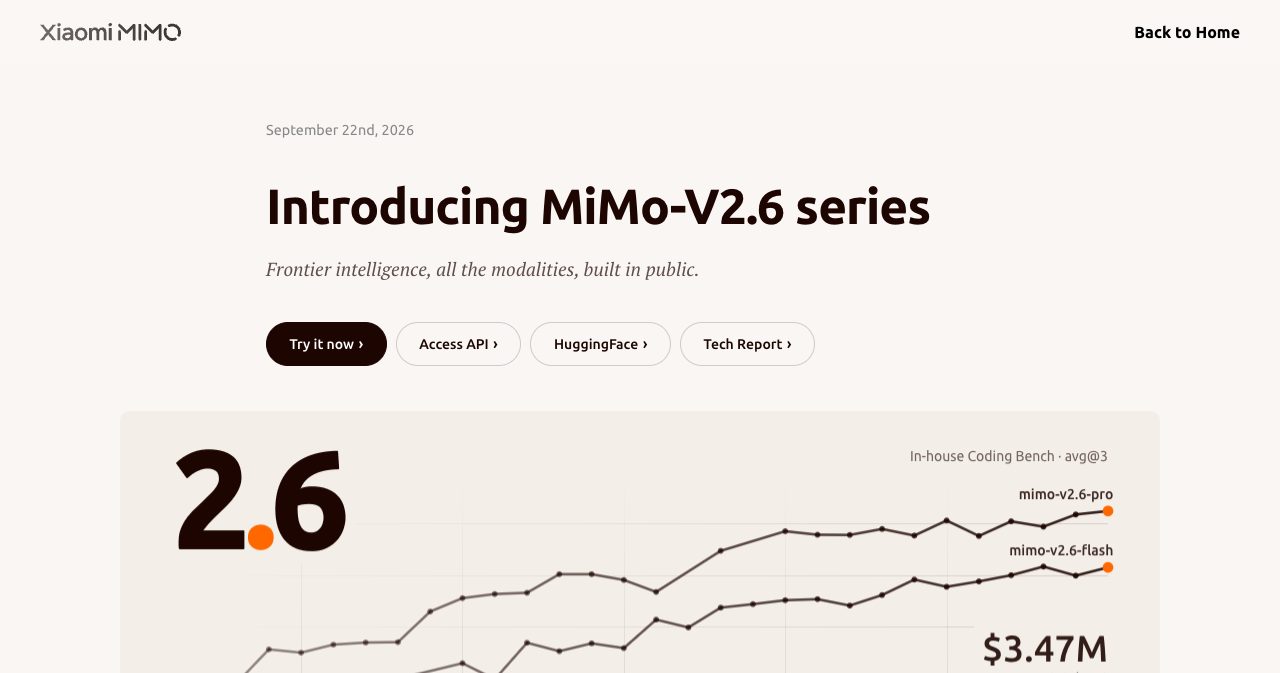
Xiaomi frames this release as research on recursive self-improvement, concentrating compute budgets on reinforcement learning across verifiable environments. Instead of hiding training expenses, Xiaomi printed the figures in the hero section of the announcement. The two models consumed $3.47 million in compute: $0.85 million for Flash and $2.62 million for Pro. Each training run finished in under six days, executing 30 discrete RL steps across approximately 750,000 trajectories. Compute scale during the run used 1,568 samples per gradient update, processing context lengths up to 1 million tokens and using 3.5 to 3.7 billion tokens per step. To demonstrate reproducibility, Xiaomi broadcast a live RL stream of the production run and published its training environments, technical report, and execution code.
The release ships native multimodal capabilities, including 3D spatial reasoning, Blender object generation, Franka Panda robotic arm simulations, frontend code generation, slide-deck design, and video creation. The formal mathematics demonstration is a Lean 4 proof of the Li-Yorke "Period Three Implies Chaos" theorem exceeding 6,000 lines of kernel-verified code without unfinished placeholders.
As noted by the AI/TLDR release note, weights for MiMo-V2.6-Pro-RL, MiMo-V2.6-Flash-RL, and MiMo-V2.6-Distill-Qwen-9B are hosted on Hugging Face under the MIT license. Access is available via Xiaomi AI Studio, MiMo Code, the standalone MiMo Desktop client, the MiMo API platform, and OpenRouter.
Independent verification: the Artificial Analysis measurements
Vendor-provided numbers require independent verification. Independent testing conducted by Artificial Analysis on its Intelligence Index v4.3.2 placed MiMo-V2.6-Pro at a score of 46. That score ranks the model #1 out of 114 evaluated systems in its category, establishing it as the top open-weights model available.
Reporting from The Outpost noted that this score puts MiMo-V2.6-Pro in a tie with xAI's Grok 4.7, which launched on September 21, 2026. Grok 4.7 is a closed proprietary model priced at $2.00 per million input tokens and $6.00 per million output tokens with a 500,000-token context window. Benchmark history documented by OfficeChai shows that the previous version, MiMo-V2.5-Pro, scored 26 on the index when it debuted in April 2026. That represents a 20-point leap in five months.
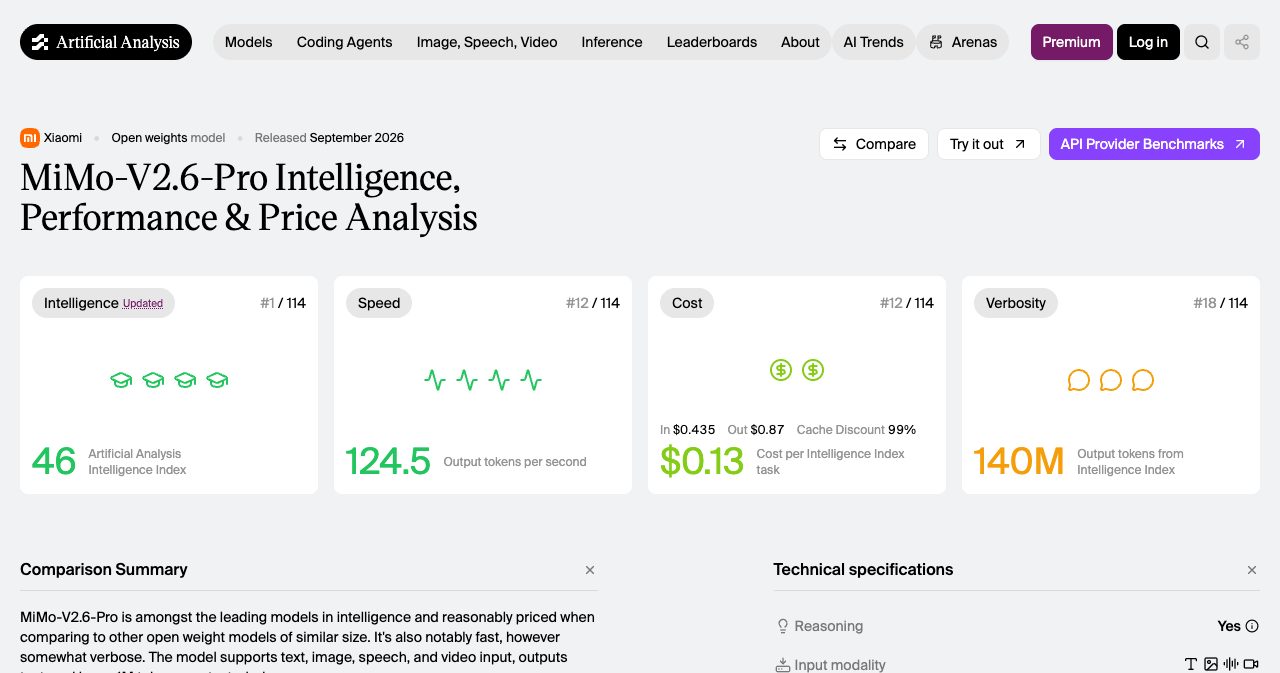
The decisive figure for software teams is the cost per benchmark task. Artificial Analysis calculated that evaluating MiMo-V2.6-Pro costs $0.13 per task. Comparing that against the wider field of frontier options shows the pricing gap:
| Model | Weight status | Cost per Intelligence Index task (USD) |
|---|---|---|
| MiMo-V2.6-Pro | Open (MIT) | $0.13 |
| GPT-5.6 Luna | Closed | $0.18 |
| DeepSeek V4.1 Flash | Open | $0.27 |
| Gemini 3.8 Flash | Closed | $1.24 |
| Kimi K3 | Open | $1.60 |
| Muse Spark 1.3 | Closed | $2.00 |
| GLM-5.3 | Open | $2.01 |
| GPT-6 Astra | Closed | $3.26 |
| Grok 4.7 | Closed | $3.74 |
| Claude Opus 5 | Closed | $5.86 |
| Claude Fable 5.1 | Closed | $7.63 |
That is a 50x cost difference between MiMo-V2.6-Pro and the upper tier of closed frontier models on identical tasks. Artificial Analysis spent $206.66 to complete its evaluation of MiMo-V2.6-Pro. The run produced 140 million output tokens, showing that the model generates lengthy chain-of-thought sequences during complex tasks. Output speed averaged 124.5 tokens per second, placing the model #12 out of 114 systems tested and ensuring responsive streaming in production software.
Benchmark breakdown: where MiMo-V2.6 wins and where it breaks
Vendor benchmark tables require cautious reading. Xiaomi published comprehensive evaluation scores in its technical documentation. While these numbers are vendor-reported, they clearly show both where the model performs well and where it fails.
| Benchmark | MiMo-V2.6-Pro | MiMo-V2.6-Flash | MiMo-V2.5-Pro | Claude Opus 5 | GPT-6 Astra | Claude Fable 5 / 5.1 | DeepSeek V4.1 Flash |
|---|---|---|---|---|---|---|---|
| DeepSWE v1.1 | 71.9 | 67.9 | 19.0 | 74.0 | 74.0 | 70.0 | 74.2 |
| ProgramBench | 26.5 | 26.0 | 12.5 | 37.0 | - | 33.0 | 20.3 |
| GDPVal 2.1 (Elo) | 1673 | - | 1107 | 1708 | 1542 | 1735 (Fable 5.1) | 1600 |
| Toolathlon-verified | 76.9 | 73.6 | 49.1 | 80.6 | - | 77.9 | - |
| AutomationBench v1.0.6 | 53.1 | 52.3 | 16.0 | 50.3 | 52.0 | 46.2 | 54.8 |
| Agents' Last Exam | 31.6 | 27.6 | 13.2 | 31.6 | 34.2 | 25.7 | 31.8 |
| Terminal Bench 4.0 | 34.9 | 28.8 | 1.5 | 49.0 | 59.6 | 55.1 (Fable 5.1) | 26.8 |
| Terminal Bench 2.1 | 89.9 | 87.6 | 65.2 | 89.1 | 89.9 | 91.4 (Fable 5.1) | 90.6 |
| OSWorld-Verified | 82.0 | 80.8 | - | 83.4 | - | 86.0 | - |
| JobBench | 62.0 | 61.2 | 25.0 | 65.7 | - | 57.4 | 45.8 |
| MiMo Visual Coding (in-house) | 72.3 | 71.5 | - | 70.0 | 82.2 | 69.1 | 70.6 |
| CyberGym | 94.0 | 95.1 | 40.0 | - | - | - | 88.1 |
| ExploitGym | 17.8 | 6.0 | 0.1 | 22.1 | 42.4 | 28.4 | 15.3 |
| ExploitBench | 47.9 | 25.3 | 16.6 | 70.0 | 100.0 | 78.0 | - |
| SEC Bench Pro | 66.3 | 47.5 | 17.7 | - | 85.4 | - | 62.8 |
On routine software development tasks, MiMo-V2.6-Pro matches commercial alternatives in Xiaomi's vendor-reported data. A score of 71.9 on DeepSWE v1.1 puts it near Claude Opus 5 (74.0) and GPT-6 Astra (74.0), and marks a steep improvement over the 19.0 scored by MiMo-V2.5-Pro. Single-step bash commands on Terminal Bench 2.1 show the model matching GPT-6 Astra at 89.9. On CyberGym defensive cyber exercises, MiMo-V2.6-Pro reaches 94.0 and MiMo-V2.6-Flash scores 95.1, up from 40.0 on MiMo-V2.5-Pro.
Severe drops occur when tasks demand persistent terminal state, multi-step error recovery, or adversarial modeling. Terminal Bench 4.0 evaluates prolonged command-line sessions where an agent must handle unexpected bash errors, inspect dynamic system state, and maintain session context across dozens of sequential commands. MiMo-V2.6-Pro drops to 34.9. In comparison, GPT-6 Astra scores 59.6, Claude Fable 5.1 scores 55.1, and Claude Opus 5 reaches 49.0. Unattended agent processes running complex system administration tasks will fail more frequently on MiMo than on closed frontier systems.
The second major gap appears on ExploitBench. The benchmark tests offensive vulnerability exploitation, asking models to discover vulnerabilities and chain multi-step exploits. MiMo-V2.6-Pro scores 47.9. GPT-6 Astra achieves 100.0, while Claude Fable 5 reaches 78.0. For offensive penetration testing and vulnerability discovery, closed frontier models maintain a wide lead. Competitive programming tasks show a similar gap: on ProgramBench, MiMo-V2.6-Pro scores 26.5, trailing Claude Opus 5 at 37.0. Engineering teams should assign MiMo to bounded, well-specified coding tasks while keeping frontier APIs for difficult edge cases.
The founder calculation: token pricing as a gross margin decision
In early software prototypes, API bills look like minor development costs. Once an agentic workflow scales across thousands of active users, token consumption becomes your primary cost of goods sold. Model pricing directly determines your gross margin.
Take a typical B2B feature: an automated code review and ticket-resolution agent. Each active customer account consumes roughly 10 million input tokens and 2 million output tokens per month across code repos, diffs, and test suites.
Here is how the unit economics compare across pricing structures:
Claude Fable 5.1 (Frontier Closed Model)
Using the list pricing established for the Claude Fable 5 line at its June 2026 launch ($10.00 per million input tokens and $50.00 per million output tokens):
- Input token pricing: $10.00 per million tokens (Claude Fable 5 launch list rate).
- Output token pricing: $50.00 per million tokens (Claude Fable 5 launch list rate).
- Monthly input expense: 10M tokens × $10.00 = $100.00.
- Monthly output expense: 2M tokens × $50.00 = $100.00.
- Total token cost per account: $200.00 per month.
On a $149 monthly subscription, you lose $51 on every active customer. Even on a $299 monthly plan, your gross margin sits at 33%, leaving little room for hosting, support, and marketing expenses.
MiMo-V2.6-Pro (Uncached API Calls)
- Input token pricing: $0.435 per million tokens.
- Output token pricing: $0.87 per million tokens.
- Monthly input expense: 10M tokens × $0.435 = $4.35.
- Monthly output expense: 2M tokens × $0.87 = $1.74.
- Total token cost per account: $6.09 per month.
At a $49 monthly subscription price, a $6.09 COGS yields an 87.5% gross margin.
MiMo-V2.6-Pro (With 80% Prompt Cache Hits)
In agent workflows, system prompts, schemas, and repository trees repeat across consecutive requests. Xiaomi provides a 99% prompt caching discount, reducing cached input tokens to $0.0036 per million.
- Cached input tokens (80%): 8M tokens × $0.0036 = $0.0288.
- Uncached input tokens (20%): 2M tokens × $0.435 = $0.8700.
- Output tokens: 2M tokens × $0.87 = $1.7400.
- Total token cost per account: $2.64 per month.
| Plan Tier | Model Deployed | Monthly Token Cost | Monthly Price | Gross Profit | Gross Margin |
|---|---|---|---|---|---|
| Enterprise Tier | Claude Fable 5.1 | $200.00 | $299.00 | $99.00 | 33.1% |
| Mid-Tier Plan | Claude Fable 5.1 | $200.00 | $149.00 | -$51.00 | -34.2% |
| Growth Plan | MiMo-V2.6-Pro (Uncached) | $6.09 | $49.00 | $42.91 | 87.6% |
| Starter Plan | MiMo-V2.6-Pro (80% Cached) | $2.64 | $29.00 | $26.36 | 90.9% |
Moving from $200.00 to $2.64 per user changes product viability. Instead of rationing usage credits, you can offer continuous background repository indexing while maintaining software gross margins above 85%. For teams following infrastructure developments, our analysis of OpenAI's Jalapeno custom silicon and SaaS margins explains how providers manage compute expenses, while our review of AI agent coding token plans outlines current pricing across developer tools.
Architecture and deployment: API, OpenRouter, or self-hosting?
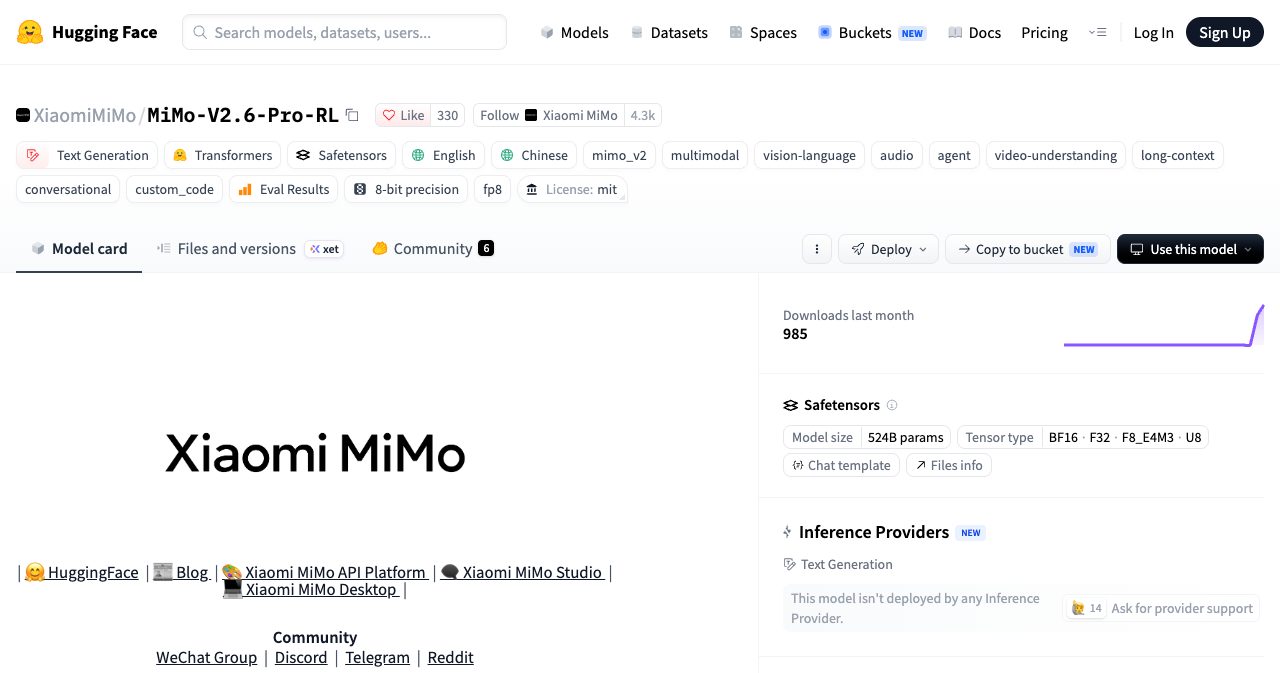
The model documentation on Hugging Face specifies an architecture containing 1.0 trillion total parameters with 42 billion active parameters per forward pass in a Mixture of Experts design. The MIT license permits full commercial usage, internal modification, and weights hosting without royalty obligations.
Teams should review the hardware realities of self-hosting before buying servers. Serving a 1-trillion parameter MoE model with a 1-million-token context requires multiple large-VRAM GPUs and reserved capacity. Because dedicated multi-GPU infrastructure carries heavy fixed commitments, self-hosting only pays off at very high sustained token volume. For standard startup workloads, calling the hosted API at $0.435 input and $0.87 output per million tokens keeps infrastructure expenses purely variable without hardware management overhead.
As Gate News noted, Chinese domestic pricing stands at 3 yuan per million input tokens and 6 yuan per million output tokens, alongside a 99% cache discount. Xiaomi claims that MiMo-V2.6 costs 1/20 to 1/60 of foreign alternatives at equal intelligence levels. That remains a vendor marketing claim, though Artificial Analysis data confirms the general cost spread.
Integrating the hosted API is simple. Xiaomi offers OpenAI-compatible endpoints, and the model is live on OpenRouter. Switching requires updating your configuration:
OPENAI_BASE_URL="https://mimo.mi.com/v1"
OPENAI_API_KEY="your-mimo-api-key"
In our earlier look at Xiaomi MiMo-V2.5-Pro as a backbone for Hermes Agent, inference speed averaged 44 tokens per second. With MiMo-V2.6-Pro reaching 124.5 tokens per second on Artificial Analysis evaluations, streaming responses feel fast and natural in web applications. For lightweight local workloads, the distilled 9B parameter model or the Flash variant provide faster execution, similar to patterns discussed in our review of DeepSeek V4.1 Flash's cost efficiency.
The routing framework: route instead of replace
Replacing closed models entirely is an unnecessary mistake. Software architectures benefit most from dynamic routing, sending requests to models based on task risk and required horizon length. We reviewed the mental cost of tracking model releases in our guide on model fatigue and selecting AI models for SaaS. The performance profile of MiMo-V2.6 suggests a practical 85/15 production split.
In standard software applications, roughly 85% of tasks are predictable and bounded:
- Parsing messy documents into structured JSON schemas.
- Generating SQL queries and schema migrations.
- Writing boilerplate components and unit tests.
- Summarizing support threads into bug tickets.
- Draft reviews and documentation updates.
Direct all 85% of these tasks to MiMo-V2.6-Pro (or MiMo-V2.6-Flash for simple transformations). At $0.435/$0.87 per million tokens, your operating bill drops significantly while output quality remains comparable to GPT-6 Astra and Claude Opus 5.
Reserve the remaining 15% of your token budget for high-complexity operations: multi-repository architectural refactors, unconstrained shell automation resembling Terminal Bench 4.0 conditions, deep security audits, and multi-step algorithmic proofs. Route those specific requests to Claude Opus 5, Claude Fable 5.1, or GPT-6 Astra. Because only 15% of requests hit the high-cost frontier, your blended token costs fall by more than 75% without sacrificing output quality on critical tasks.
What the RL training receipts mean for software teams
Beyond pricing data, the operational transparency of Xiaomi's release offers clear guidance for engineering teams building autonomous systems. Xiaomi disclosed complete training costs: $3.47 million across both models ($0.85 million for Flash and $2.62 million for Pro). Over 30 discrete RL steps and roughly 750,000 trajectories in under six days, the training process scaled compute on verifiable tasks.
The progression metrics show consistent gains. Average pass rates on training tasks rose 25% for Flash and 12% for Pro in relative terms. On the held-out DeepSWE v1.1 software benchmark, scores rose from 48.8 to 65.68 on Flash, and from 58.4 to 72.57 on Pro.
This confirms that post-training reinforcement learning anchored to deterministic verifiers (unit tests, code linters, formal proofs) builds strong reasoning capabilities without requiring hundreds of millions of dollars in foundational pre-training. Software teams building proprietary agents can adopt this methodology. By designing evaluation pipelines with clear pass/fail criteria, you can align open-weights models on domain-specific codebases with reasonable compute budgets.
The distribution equation: cheap tokens mean nothing without traffic
Engineering teams often focus on token optimization because it feels directly controllable. You refine prompts, configure caching, swap endpoints, and reduce your monthly bill. Lowering token costs improves unit margins, but high margins mean little without user demand. A software product with 92% gross margins and fifteen active users remains unsustainable.
When frontier-level intelligence becomes an affordable commodity, competitive moats shift toward customer acquisition and brand visibility. If competitors can replicate your technical stack using open-weights models and an API key, long-term defensibility requires proprietary distribution channels.
In our analysis of the SEO benefits of listing SaaS products in directories, we documented how modern AI answer engines like ChatGPT, Perplexity, and Gemini rely on third-party directories when answering product comparison queries. The Princeton GEO research verified that third-party citations and factual descriptions improve generative engine visibility by roughly 40%.
This is where SaaSCity provides structural support. You can submit your product to SaaSCity for free, claim your building on the live city map, and secure an indexed listing page. Adding the SaaSCity badge gives your site a verified dofollow backlink from our DR ~47-56 domain and schedules your launch for an upcoming Monday. To skip the badge, Quick Pass costs $19.99 and goes live within 24 hours. The Premium tier at $99.99 delivers a dedicated editorial review featuring three dofollow links to strengthen your search footprint.
While other founders spend weeks debating foundation model announcements on social media, smart operators lower their inference costs with MiMo-V2.6 and secure their distribution channels immediately.
Practical playbook for Monday morning
Here is a concrete sequence to implement these changes next week:
- Test your eval suite on MiMo-V2.6-Pro: Point your test harness to
https://mimo.mi.com/v1or OpenRouter. Run integration suites to measure output quality against your current closed endpoints. - Configure prompt caching: Review agent prompts to ensure system instructions and schema definitions remain consistent across requests. Maximizing cache hits unlocks Xiaomi's 99% discount, reducing input pricing to $0.0036 per million tokens.
- Set up dynamic routing: Direct standard code generation, formatting, and extraction requests to MiMo-V2.6-Pro while routing complex terminal interactions and security checks to Claude Fable 5.1 or Opus 5.
- Build distribution assets: Submit your software to SaaSCity to secure indexed backlinks and AI search citations before competitors enter your category.
Model prices dropped by 50x. Use those saved margins to build sustainable distribution.
TOPIC: WINNING TOPIC: Xiaomi open-sourced MiMo-V2.6 (Pro + Flash) on September 22, 2026 under the MIT license, and MiMo-V2.6-Pro is now the #1 open-weights model on the Artificial Analysis Intelligence Index at 46 - tied with xAI's Grok 4.7 (released September 21) and ahead of Kimi K3, Qwen3.8-Max, GLM-5.3, DeepSeek V4.1 Flash and Gemini 3.8 Flash. Xiaomi published the reinforcement-learning receipts: $3.47M total, 30 RL steps each, ~750k trajectories, under six days.
ARTICLE ANGLE: The open-weights ceiling just moved to within a couple of points of the closed frontier at roughly 1/20th to 1/50th the cost per task. Write the founder-facing economic read: what this does to the unit economics of an AI feature inside a SaaS, where the model still loses (long-horizon terminal work, offensive security, hardest reasoning), and the routing/self-host decision framework. Not a breathless "China wins" piece and not a spec dump - a numbers-driven "what do I actually do on Monday" article. Be honest that the benchmark numbers in Xiaomi's own table are vendor-reported, while the AA Intelligence Index and AA pricing figures are third-party measured.
VERIFIED FACTS (use these; do not invent numbers)
Primary source - Xiaomi, "Introducing MiMo-V2.6 series", September 22nd, 2026, https://mimo.xiaomi.com/mimo-v2-6
- The series ships two natively omnimodal models: MiMo-V2.6-Pro (most capable) and MiMo-V2.6-Flash (intelligence/efficiency/cost balance). Xiaomi is also rolling out MiMo-V2.6-Pro-UltraSpeed, up to 20x faster output at the same quality.
- Xiaomi frames the release as research on the RSI (recursive self-improvement) path: scaling RL compute on verifiable, complex tasks.
- Xiaomi's own benchmark table (vendor-reported) key rows: DeepSWE v1.1 - MiMo-V2.6-Pro 71.9, MiMo-V2.6-Flash 67.9, MiMo-V2.5-Pro 19.0, Claude Opus 5 74.0, DeepSeek V4.1 Flash 74.2, GPT-6 Astra 74.0, Claude Fable 5 70.0. Terminal Bench 2.1 - Pro 89.9, Claude Opus 5 89.1, GPT-6 Astra 89.9, Claude Fable 5.1 91.4. Terminal Bench 4.0 - Pro 34.9 vs GPT-6 Astra 59.6, Claude Fable 5.1 55.1, Claude Opus 5 49.0 (this is where it loses badly). Toolathlon-verified - Pro 76.9, Claude Opus 5 80.6, Claude Fable 5 77.9. AutomationBench v1.0.6 - Pro 53.1, DeepSeek V4.1 Flash 54.8, MiMo-V2.5-Pro 16.0. Agents' Last Exam - Pro 31.6, GPT-6 Astra 34.2. JobBench - Pro 62.0, Claude Opus 5 65.7. GDPVal 2.1 (Artificial Analysis Elo) - Pro 1673, Claude Opus 5 1708, Claude Fable 5.1 1735. ProgramBench - Pro 26.5, Claude Opus 5 37.0, Claude Fable 5 33.0. OSWorld-Verified - Pro 82.0, Claude Fable 5 86.0. CyberGym - MiMo-V2.6-Pro 94.0, MiMo-V2.6-Flash 95.1, MiMo-V2.5-Pro 40.0, DeepSeek V4.1 Flash 88.1, GLM 5.3 84.5. ExploitBench - Pro 47.9 vs GPT-6 Astra 100.0, Claude Fable 5 78.0 (offensive security is still a weak spot; say so).
- RL training receipts: 30 RL steps per model, roughly 750k trajectories, each run finishing in under six days; about $0.85M for Flash and $2.62M for Pro (the release page hero shows $3.47M total). Average pass rate on training tasks rose 25% (Flash) and 12% (Pro) in relative terms. On the held-out long-horizon software benchmark DeepSWE v1.1, scores rose from 48.8 to 65.68 (Flash) and 58.4 to 72.57 (Pro) across the run.
- RL compute scale: 1,568 samples per update, training at up to 1M context length, 3.5 to 3.7B tokens per step. Xiaomi streamed the production RL run live (https://mimo.xiaomi.com/rl) and open-sourced the technical report, the training environments and the RL code.
- API pricing, USD per 1M tokens (unchanged from the V2.5 series): MiMo-V2.6-Flash $0.0028 cache hit / $0.14 cache miss / $0.28 output; MiMo-V2.6-Pro $0.0036 / $0.435 / $0.87; MiMo-V2.6-Pro-UltraSpeed $0.036 / $4.35 / $8.7. Cache writes free for a limited time. Chinese pricing for Pro is reported at 3 yuan input / 6 yuan output with a 99% cache discount, and Xiaomi claims that at the same level of intelligence MiMo-V2.6 costs 1/20 to 1/60 of overseas models - label that as a Xiaomi claim, not a measured fact.
- Availability: AI Studio (aistudio.xiaomimimo.com), MiMo Code, MiMo Desktop (leaving early access with its first official release) and the MiMo API platform (mimo.mi.com), plus OpenRouter.
- Also in the release: 3D/spatial work, Blender object generation, embodied simulation with a Franka Panda arm, frontend and slide-deck generation, video creation, music composition demos, a materials-science MOF/PFAS case study, and a Lean 4 formalisation of the Li-Yorke "Period Three Implies Chaos" theorem (6,000+ lines, kernel-verified, no unfinished placeholders).
Third-party measurement - Artificial Analysis, https://artificialanalysis.ai/models/mimo-v2-6-pro
- 46 on the Artificial Analysis Intelligence Index v4.3.2, ranked #1 of 114 in its class and the top open-weights score. Cost per Intelligence Index task $0.13 - the lowest on that comparison, against $0.18 GPT-5.6 Luna, $0.27 DeepSeek V4.1 Flash, $1.24 Gemini 3.8 Flash, $1.60 Kimi K3, $2.00 Muse Spark 1.3, $2.01 GLM-5.3, $3.26 GPT-6 Astra, $3.74 Grok 4.7, $5.86 Claude Opus 5, $7.63 Claude Fable 5.1. That is roughly a 50x spread between the cheapest and most expensive model on the same index.
- Output speed 124.5 tokens per second (#12 of 114). 140M output tokens on the index evaluation - notably verbose.
- Technical specs: 1.0T total parameters, 42B active (MoE), 1M token context, reasoning model, text/image/speech/video input and text output, MIT license, weights on Hugging Face (https://huggingface.co/XiaomiMiMo/MiMo-V2.6-Pro-RL).
- It cost Artificial Analysis $206.66 to evaluate the model on the Intelligence Index; the vendor pricing it used is $0.435 input / $0.87 output with a 99% cache discount.
Supporting sources
- AI/TLDR release note (September 21-22, 2026): https://ai-tldr.dev/releases/xiaomi-mimo-v2-6 - reports weights for MiMo-V2.6-Pro-RL, MiMo-V2.6-Flash-RL and MiMo-V2.6-Distill-Qwen-9B on Hugging Face under MIT, and a 1M-token context.
- The Outpost (September 22, 2026): https://theoutpost.ai/news-story/xiaomi-mi-mo-v2-6-pro-debuts-as-top-open-source-ai-model-scoring-46-on-intelligence-index-31152 - notes MiMo-V2.6-Pro ties Grok 4.7 at 46 and that MiMo-V2.5-Pro launched in April 2026.
- OfficeChai: https://officechai.com/ai/xiaomi-mimo-v-2-6-pro-benchmarks - MiMo-V2.5-Pro sat at 26 on the index, so V2.6 is a 20-point jump.
- Gate News: https://gate.com/news/detail/xiaomi-mimo-v26-released-as-open-source-its-aa-index-score-of-46-makes-it-24465185 - yuan pricing, the 1/20-1/60 cost claim.
- xAI's Grok 4.7 (September 21, 2026, https://x.ai/news/grok-4-7) is the useful contrast: same index score, closed weights, reported at the same $2/$6 per million tokens and 500K context as Grok 4.6.
WHY IT MATTERS TO FOUNDERS (the analysis the post should actually make)
- Token cost is a margin line, not a line item. A reasoning model at 46 index points for $0.435/$0.87 per million tokens - with a 99% cache discount - changes what an AI feature can charge and still hold 80% gross margin. Show the arithmetic on a concrete example (e.g. 10M input + 2M output tokens a month at Fable 5.1 versus MiMo-V2.6-Pro prices, using the prices given above).
- MIT license means self-host, fine-tune and ship commercially with no licensing negotiation, and MiMo ships OpenAI-compatible endpoints plus vLLM/SGLang deployment paths, so switching is a base_url change plus evals.
- Route, don't replace: the places it loses (Terminal Bench 4.0, ProgramBench, ExploitBench/offensive security, hardest reasoning) are exactly where you keep a premium model. Tie this to the existing SaaSCity posts on model routing and model fatigue.
- The RL receipts are the real story for anyone building agents: published costs per successful task, 30 steps, 750k trajectories, and an open training stack you can reproduce.
SAASCITY FACTS YOU MAY USE (nothing else) SaaSCity is a gamified startup directory with a live city map and human editorial review. A free listing gives you a permanent listing page and a building on the map; add the SaaSCity badge to your site to get a dofollow backlink and a Monday launch slot. Quick Pass is $19.99 and goes live within 24 hours. Premium is $99.99 and adds a written launch post with three dofollow links. The domain sits at DR ~47-56 at the last Ahrefs refresh. Tie it in naturally: if you are shipping an AI product in this price war, visibility is the other half of the equation - buyers and answer engines have to find you, and an indexed listing page does that while your competitors are still arguing about which model won.
INTERNAL LINKS (verified slugs, use 3 to 5 of them) /blog/model-fatigue-choosing-ai-models-for-saas-2026 /blog/deepseek-v4-flash-0731-cheap-model-beats-expensive-2026 /blog/best-ai-agent-coding-token-plans-2026 /blog/xiaomi-mimo-v25-pro-hermes-agent-llm-backbone-2026 /blog/openai-jalapeno-custom-chip-ai-saas-margins-2026 /blog/seo-benefits-of-listing-saas-products-2026 plus [/] for the SaaSCity homepage.
SCREENSHOTS - embed each exactly once, exact paths, no others:
- /blog/xiaomi-mimo-v2-6-open-weights-model-economics-2026/mimo-v2-6-release-page.jpg - Xiaomi's MiMo-V2.6 release page dated September 22, 2026, with the Try it now, Access API, HuggingFace and Tech Report buttons, the in-house coding benchmark chart, and the $3.47M RL spend figure in the hero.
- /blog/xiaomi-mimo-v2-6-open-weights-model-economics-2026/artificial-analysis-mimo-v2-6-pro.jpg - Artificial Analysis page for MiMo-V2.6-Pro showing a 46 Intelligence Index, 124.5 output tokens per second, $0.435 input and $0.87 output per million tokens, the 99% cache discount, $0.13 cost per Intelligence Index task and 140M output tokens.
- /blog/xiaomi-mimo-v2-6-open-weights-model-economics-2026/huggingface-mimo-v2-6-pro-rl.jpg - the Hugging Face model card for XiaomiMiMo/MiMo-V2.6-Pro-RL, the MIT-licensed open weights behind the model.
SUGGESTED TITLE: "Xiaomi Just Open-Sourced a Frontier-Class Model for 1/50th the Price (MiMo-V2.6, 2026)" - or a sharper equivalent with the same keyword coverage. SUGGESTED SLUG: xiaomi-mimo-v2-6-open-weights-model-economics-2026 (already chosen for the file name above). SUGGESTED CATEGORY: "AI Trends & Tools". TARGET KEYWORDS: mimo v2.6, xiaomi mimo v2.6 pro, mimo v2.6 pricing, best open source model 2026, open weights vs closed models cost, cost per task ai model, cheapest ai model for agents 2026, self host llm for saas, ai saas margins token cost, does mimo v2.6 beat claude opus.
Get your SaaS in front of founders
List your product on the SaaSCity live city map - a permanent listing, real discovery, and a backlink from a high-DR directory. Free to start; upgrade for a dofollow link and a building on the map.