Reviews
AISA Review: Can an Adaptive Conversational AI Test Accurately Measure Your Real-World Fluency? (2026)
AISA replaces multiple-choice quizzes with a 20 to 40 minute conversational evaluation to measure practical AI fluency. Here is how the dual-track architecture works, what the 11 criteria and 10 personas reveal, what population data shows about self-assessment gaps, and how the free LinkedIn certificate works.

Contents (14)
- Disambiguation: which AISA is this?
- The core problem: the gap between AI literacy and AI fluency
- How the assessment works: the user journey
- The dual-track architecture: how scoring and integrity work
- The AISA rubric: five dimensions and eleven criteria
- The 10 AI personas: why profile shape matters more than a single score
- Empirical insights from the AISA AI Fluency Index
- Pricing model and commercial strategy
- Technical infrastructure, privacy, and data security
- Company background and leadership
- Balanced perspective: key strengths and product boundaries
- Who should use AISA?
- Frequently asked questions
- Summary verdict
When hiring managers screen candidates for technical, product, or operational roles today, nearly every resume claims proficiency with artificial intelligence. Standard job descriptions ask for fluency in generative tools, prompt design, and automated workflows. Yet when teams evaluate those claims, they run into a practical dead end. Multiple-choice tests measure rote memorization of acronyms rather than working habits. Self-assessment forms are notoriously optimistic. Meanwhile, watching someone build in a sandbox for three hours requires heavy engineering time and rarely scales across a hiring pipeline.
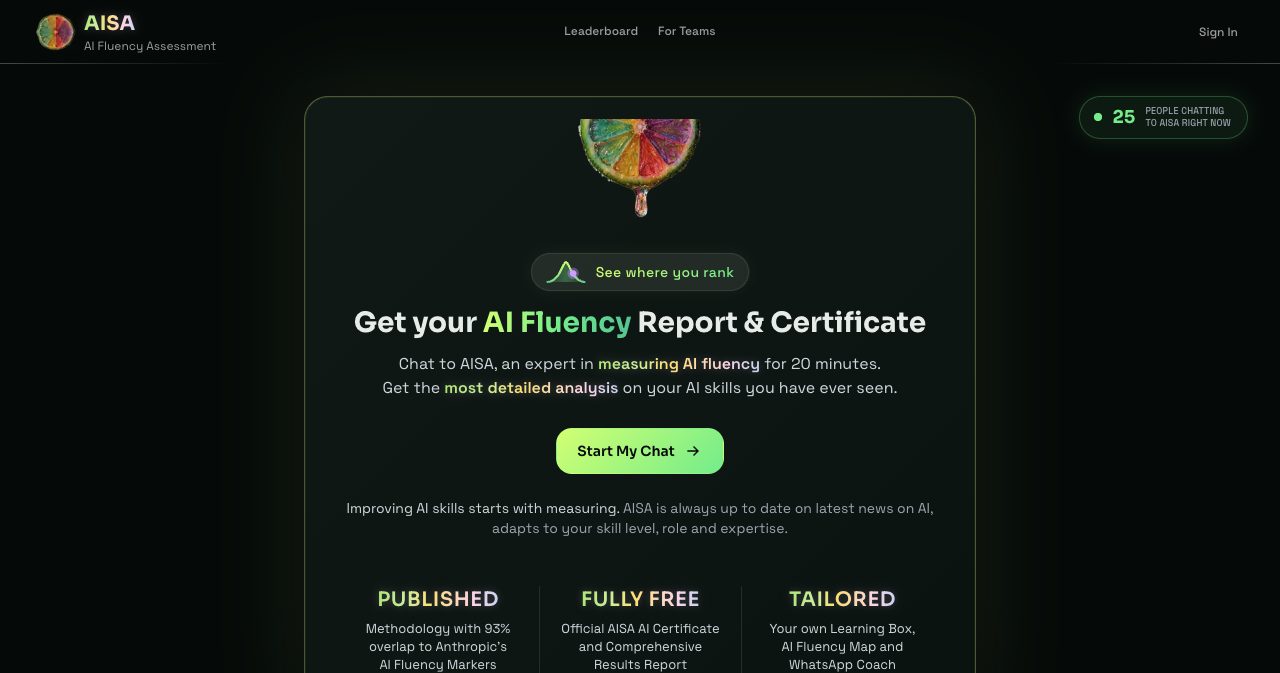
AISA enters this gap with a different approach. Developed in the United Kingdom by Common Wisdom Consultancy Ltd, AISA provides an untimed, adaptive conversational assessment. Instead of clicking radio buttons on a multiple-choice quiz, you sit down for a 20 to 40 minute structured conversation with an AI interviewer named Aisa.
Behind the interface, a secondary evaluation engine analyzes your responses against an 11-criterion rubric. Within three minutes of wrapping up the dialogue, the platform calculates a composite score out of 100, assigns you to one of ten diagnostic personas, surfaces direct quotes from your session as evidence, and issues a verifiable 12-month certificate that integrates with LinkedIn.
This review examines how the platform works, walks through the rubric mechanics and scoring architecture, analyzes findings from the published AISA AI Fluency Index, and evaluates how it fits into modern hiring and professional benchmarking.
Disambiguation: which AISA is this?
Because the acronym AISA appears across several industries, clarifying the exact company and domain is essential:
| Organization | Primary domain | Core focus |
|---|---|---|
| AISA (this review) | aisa.to | Conversational AI fluency assessment and credentialing |
| AIsa | aisa.one | Agent resource network and API payment infrastructure (San Francisco based) |
| AISA Automation | aisa.com | Swiss industrial packaging and tube-manufacturing machinery |
| Other AISAs | Various | Australian Information Security Association, student unions, and regional bodies |
This evaluation specifically covers the product at aisa.to. The product operator is Common Wisdom Consultancy Ltd (registered in England and Wales under company number 11259477), directed by founder Ozan Dagdeviren. The official social channel for the assessment platform is @aisafluency on X.
The core problem: the gap between AI literacy and AI fluency
Most corporate discussions treat AI familiarity as a single binary quality: someone either uses generative models or they do not. In reality, operational ability sits on a spectrum.
AISA models this progression across four distinct stages:
- AI Bystander: Observes industry headlines and tools from a distance without incorporating them into daily work routines.
- AI Literate: Understands primary concepts, basic terminology, and standard consumer interfaces. Can generate first-pass text or summarize documents.
- AI Fluent: Routinely integrates generative models into complex workflows. Deconstructs multi-step tasks, systematically evaluates edge cases, applies prompt engineering techniques, and recognizes model failure modes.
- AI Native: Architectures end-to-end autonomous loops, coordinates multi-agent systems, builds production-grade tooling, or trains and fine-tunes custom models.
Most working professionals currently sit between the Bystander and Literate tiers. However, traditional hiring screens fail to expose this difference. A candidate who simply copies text into a web interface often scores equally well on a multiple-choice quiz as an engineer who chains APIs, structures schema outputs, and systematically manages context windows.
Multiple-choice tests suffer from recognition bias. When presented with four predefined answers, candidates can easily eliminate unlikely options. Furthermore, multiple-choice tests are trivial to answer with an auxiliary browser extension open in another window.
Self-reporting creates an even larger distortion. According to data published in AISA's August 2026 AI Fluency Index, professionals overestimate their capability by an average of 19 points on a 100-point scale. The statistical correlation between self-reported literacy and scored operational fluency ranges from a weak r = 0.07 to 0.24. People who use AI casually every day assume they are power users simply because they have never encountered complex orchestration, rigorous task decomposition, or structured prompt evaluation.
How the assessment works: the user journey
Taking the assessment requires minimal friction. There is no paywall to begin, no mandatory credit card entry, and no lengthy onboarding questionnaire. You can create an account using Google authentication or standard email sign-in.
The conversational session
Once you begin, the platform launches a conversational interface featuring Aisa, the AI interviewer. The conversation is untimed, typically running between 20 and 40 minutes depending on how thoroughly you answer.
The discussion does not follow a rigid script. Aisa adapts dynamically based on your declared role, background, and level of experience. The system offers adaptive tracks for specific disciplines, including software engineering, product management, design, and data science, alongside a general professional track.
A typical session proceeds through several conversational phases:
- Context and baseline: The interviewer asks what projects you currently handle, what tools you touch regularly, and how generative models fit into your workflow.
- Task decomposition and workflow orchestration: You are asked to walk through an actual complex problem you solved using AI. The interviewer probes how you divided the objective, what sequence of prompts or tools you used, and where manual interventions occurred.
- Failure recovery and output verification: The interviewer explores how you verify factual accuracy, handle hallucinations, and test edge cases. You might be asked to describe a scenario where a model gave an incorrect or misleading answer and how you caught the problem.
- Context management and advanced technique: The conversation turns toward technical nuances: managing system prompts, passing reference documents, working around context window limits, or building multi-step automations.
- Ethics, privacy, and safety boundaries: You discuss data hygiene, intellectual property concerns, and the criteria you use to decide when an AI tool should not be used for unsupervised tasks.
Because the system supports voice dictation across 14 languages (including Spanish, German, French, Portuguese, Turkish, Japanese, Chinese, Arabic, and Hindi) using browser-level speech recognition, candidates can either type their answers or speak naturally. The scoring algorithms are calibrated to handle spoken-word pacing and voice-to-text syntax without penalizing candidates for colloquial pauses.
The diagnostic report and certificate
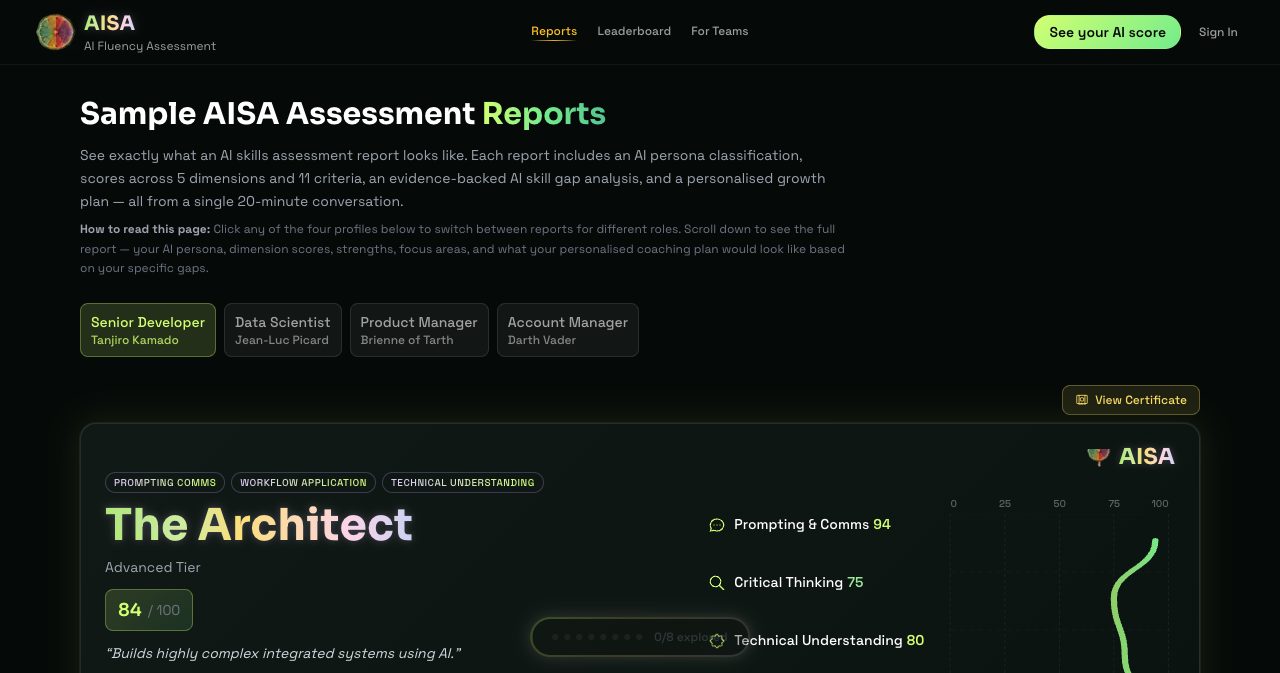
Within approximately three minutes of concluding your conversation, the platform generates a comprehensive report:
- Composite fluency score (0 to 100): A weighted summary of your demonstration across all tested competencies.
- Dimensional scorecards (1 to 10): Granular ratings across five core areas and eleven specific criteria.
- Assigned AI persona: One of ten diagnostic profiles representing your behavioral archetype.
- Evidence trail: Direct, verbatim quotes from your session paired with each criterion to show exactly where points were earned or deducted.
- Verifiable certificate: A permanent verification URL containing your name, credential ID, score breakdown, QR code, Open Badges 2.0 metadata, and a one-click button to attach the credential to your LinkedIn profile. The certificate carries a 12-month validity period.
The dual-track architecture: how scoring and integrity work
The foundational technical problem with using conversational AI for assessment is susceptibility to social engineering. If the conversational partner is also the judge, a clever candidate can use persuasive language, flattery, or prompt injections to trick the model into issuing a top score.
AISA solves this through a dual-track architecture detailed in their technical documentation:
[Candidate]
    │
    ▼ (Interactive dialogue)
[Track A: Facilitator / Conversationalist] (Adaptive, peer-level, no scoring access)
    │
    ▼ (Transcript turns)
[Track B: Evaluator] (Silent, scores against rubric, zero direct user contact)
    │
    ▼ (Candidate transcript + preliminary evidence)
[Holistic Calibration Pass] (High-reasoning model like Claude Opus reviews full transcript)
    │
    ▼
[Final 0-100 Score, Persona, Quote-Anchored Report, Certificate]
Track A: The conversational facilitator
Track A is the only model the user ever sees or speaks with. It is tuned to be warm, adaptive, and inquisitive. Its primary responsibility is eliciting concrete evidence. If you give a vague answer such as "I use AI to write better code," Track A immediately follows up: "Can you give me an example from this past week? What specific task were you addressing, how did you structure the initial instructions, and what did you have to adjust manually in the first draft?"
Track A has no awareness of your current score and possesses no technical capability to modify your grade.
Track B: The silent evaluator
Track B never interacts with the candidate. It monitors the conversation turns from the background, evaluating each response against the published rubric criteria.
Track B classifies candidate statements using a strict evidence hierarchy:
- Demonstrated evidence (highest confidence): The candidate details exact prompts, specific failure edge cases, technical trade-offs, and observable project outcomes from real experience.
- Described evidence (moderate confidence): The candidate explains how a tool or methodology works theoretically, but offers fewer concrete implementation specifics.
- Managed evidence (lower confidence): The candidate discusses overseeing colleagues who use AI or speaks in broad, high-level terms without personal tactical execution.
Track B blends multiple pieces of evidence per criterion, weighting consistent demonstration far higher than an isolated clever turn.
The holistic calibration pass
Once the dialogue concludes, the full transcript passes to a separate calibration model. AISA's methodology documents note the use of high-capacity models like Claude Opus for this phase. The calibration pass inspects the whole narrative arch to check for internal consistency.
Crucially, the calibration engine operates under a conservative rule: it cannot arbitrarily inflate scores. It can only adjust Track B's preliminary ratings if the broader transcript supplies clear disconfirming evidence showing that an earlier turn was misunderstood or taken out of context.
Transcript-level integrity checks
Because the evaluation is not proctored by webcams or screen-recording software, AISA implements behavioral integrity filters on the transcript text. The algorithms monitor response cadence, semantic coherence, copy-paste artifacts, and attempts to feed raw documentation into the prompt.
According to data shared by the founder on Medium, approximately 5% of all assessments trigger integrity blocks. When an assessment fails integrity checks, the platform withholds certification.
The AISA rubric: five dimensions and eleven criteria
A central differentiator between AISA and black-box consumer quizzes is that AISA publishes its full rubric publicly at /resources/the-aisa-rubric. Every criterion is rated on a 10-point scale:
- Novice (1 to 2): Minimal awareness, relies on basic copy-paste habits, rarely modifies initial outputs.
- Developing (3 to 4): Standard everyday usage, familiar with major commercial tools, recognizes obvious hallucinations.
- Competent (5 to 6): Reliable structured workflows, crafts clear prompts with constraints, checks factual accuracy methodically.
- Proficient (7 to 8): Advanced iterative technique, decomposes multi-stage problems, manages memory and context limitations, applies domain-specific guardrails.
- Expert (9 to 10): Systemic architectural thinking, coordinates multi-model pipelines, deep technical intuition regarding model mechanics, designs organizational safety protocols.
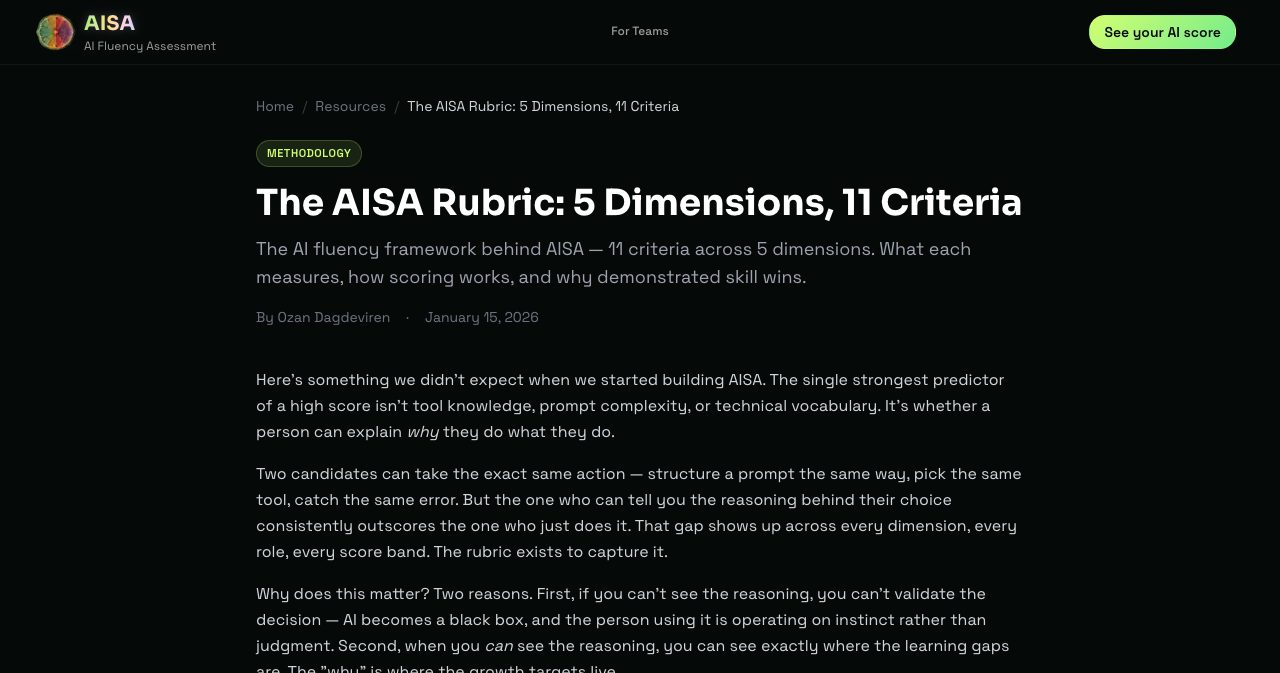
The composite score (0 to 100) represents a mathematically weighted combination of five distinct dimensions:
1. Workflow and application (25% weight)
This dimension measures how effectively a professional weaves AI into substantive, daily problem-solving rather than treating it as an occasional novelty:
- W1 Workflow Integration: How seamlessly AI tools fit into existing toolchains, IDEs, document pipelines, and operational cadences.
- W2 Task Decomposition: The ability to take an ambiguous, complex business problem and break it down into modular sub-tasks suitable for machine execution.
- W3 Domain Application: How effectively general-purpose models are tailored to specific professional fields, including legal review, financial analysis, software engineering, or UX architecture.
2. Prompting and communication (23% weight)
Rather than grading superficial prompt templates, this dimension tests conversational precision and context engineering:
- P1 Prompt Design: Structuring instructions with clear personas, explicit constraints, few-shot examples, and deterministic output formatting.
- P2 Iterative Dialogue: The ability to steer a model across multiple turns, diagnosing why a first pass missed the mark and correcting course without starting over.
- P3 Context and Memory Management: Understanding context windows, managing tokens, organizing reference files, and preventing context poisoning during long sessions.
3. Critical thinking (22% weight)
Using AI productively requires rigorous editorial oversight:
- T1 Output Evaluation: Systematically identifying factual hallucinations, logic flaws, subtle mathematical errors, and biased reasoning in model answers.
- T2 Limitation Awareness: Knowing what current model architectures can and cannot accomplish reliably, preventing teams from applying LLMs to tasks better handled by deterministic algorithms.
4. Technical understanding (20% weight)
Fluency requires an intuitive grasp of how underlying systems function:
- U1 AI Fundamentals: Comprehension of core concepts such as embeddings, temperature, tokenization, fine-tuning versus retrieval-augmented generation (RAG), and probabilistic inference.
- U2 Tool Landscape: Familiarity with the broader ecosystem of specialized models, open-weights releases, development frameworks, and emerging tooling.
5. Safety and responsibility (10% weight)
While safety carries a 10% numeric weight in the composite calculation, AISA treats it as a non-negotiable operational threshold:
- S1 AI Safety and Responsibility: Rigorous handling of private data, customer personally identifiable information (PII), intellectual property protection, copyright risks, and alignment with corporate governance standards.
AISA's documentation notes that candidates scoring below 4 out of 10 on S1 are flagged as requiring close oversight, regardless of their overall composite score. Even if an engineer scores 85 overall through exceptional coding speed, poor data privacy practices make unsupervised production access a corporate liability.
Framework alignment and benchmarking
AISA has cross-referenced its 11 criteria against two prominent public standards:
- Anthropic AI Fluency Index: AISA maps to 93% of the behavioral markers identified in Anthropic's observational study of approximately 10,000 conversational interactions. AISA expands beyond Anthropic's observational footprint by explicitly grading AI Fundamentals, Tool Landscape, Domain Application, and Safety.
- U.S. Department of Labor AI Literacy Framework (TEN 07-25): AISA covers 100% of the 25 sub-competencies established in federal workplace literacy guidelines.
AISA has noted that an academic validation study and expert panel review were in progress during 2026 to further document psychometric validity.
The 10 AI personas: why profile shape matters more than a single score
In psychometrics, a single composite score often conceals critical behavioral nuances. Two professionals might both receive a composite score of 72, yet operate in completely different ways. One might be a meticulous systems engineer who builds complex multi-agent automations but writes basic prompts, while the other might be a creative strategist who designs exquisite conversational chains but lacks systems infrastructure knowledge.
To capture these distinctions, AISA maps candidates to one of ten diagnostic personas based on the topological shape of their dimensional radar chart:
[Elite Tier]       Architect (87.4 avg)      Oracle (80.0 avg)
                         ▲                         ▲
[Advanced Tier]    Builder (70.9 avg)        Conductor (71.0 avg)
                         ▲                         ▲
[Proficient Tier]  Tactician (60.8 avg)      Enthusiast (52.2 avg)
                         ▲                         ▲
[Emerging Tier]    Sceptic (43.1 avg)        Copy-Paster (29.8 avg)
                         ▲                         ▲
[Beginner Tier]    Dabbler (27.4 avg)        Bystander (10.3 avg)
Beginner tier
- Bystander (Average score: 10.3): Aware that generative AI exists, but has not incorporated tools into real-world work. Relies on secondhand summaries and mainstream media headlines.
- Dabbler (Average score: 27.4): Experiments occasionally with consumer tools like ChatGPT or Claude for personal curiosity or ad-hoc questions, but has established no reproducible professional workflow.
Emerging tier
- Copy-Paster (Average score: 29.8): Uses AI regularly to produce text, code, or emails, but routinely accepts first-pass output without verification, critical editing, or contextual refinement. High volume, low quality control.
- Sceptic (Average score: 43.1): Possesses sharp critical thinking and quickly spots hallucinations, but remains overly hesitant to adopt tools, frequently under-utilizing AI in areas where it excels.
Proficient tier
- Enthusiast (Average score: 52.2): High curiosity, eager to test new models and apps weekly. Possesses broad breadth across consumer tools, but sometimes lacks deep execution discipline or rigorous task decomposition.
- Tactician (Average score: 60.8): Highly reliable, methodical, and disciplined with mainstream tools. Operates well-structured personal templates and prompts to accelerate day-to-day productivity.
Advanced tier
- Conductor (Average score: 71.0): Orchestrates multi-tool pipelines. Seamlessly hands off work between specialized models, vector databases, search tools, and manual review stages.
- Builder (Average score: 70.9): Has shipped functional products, internal tools, or client automations using AI APIs and frameworks. Intimately familiar with real-world latency, API limits, and model quirks.
Elite tier
- Architect (Average score: 87.4): Designs enterprise-grade, multi-agent production architectures. Implements robust telemetry, automated evals, security guardrails, and cost optimization at scale.
- Oracle (Average score: 80.0): Deep theoretical understanding of model architectures, transformer attention mechanics, fine-tuning protocols, loss curves, and research frontiers.
The August 2026 distribution of personas across 1,800 analyzed assessments demonstrates that the majority of users cluster in the Dabbler, Enthusiast, and Builder categories, while elite personas remain exceptionally rare:
| Persona | Sample count (Aug 2026 Index) | Average composite score |
|---|---|---|
| Dabbler | 340 | 27.4 |
| Enthusiast | 267 | 52.2 |
| Builder | 205 | 70.9 |
| Tactician | 85 | 60.8 |
| Copy-Paster | 85 | 29.8 |
| Sceptic | 69 | 43.1 |
| Architect | 53 | 87.4 |
| Conductor | 52 | 71.0 |
| Bystander | 34 | 10.3 |
| Oracle | 2 | 80.0 |
Empirical insights from the AISA AI Fluency Index
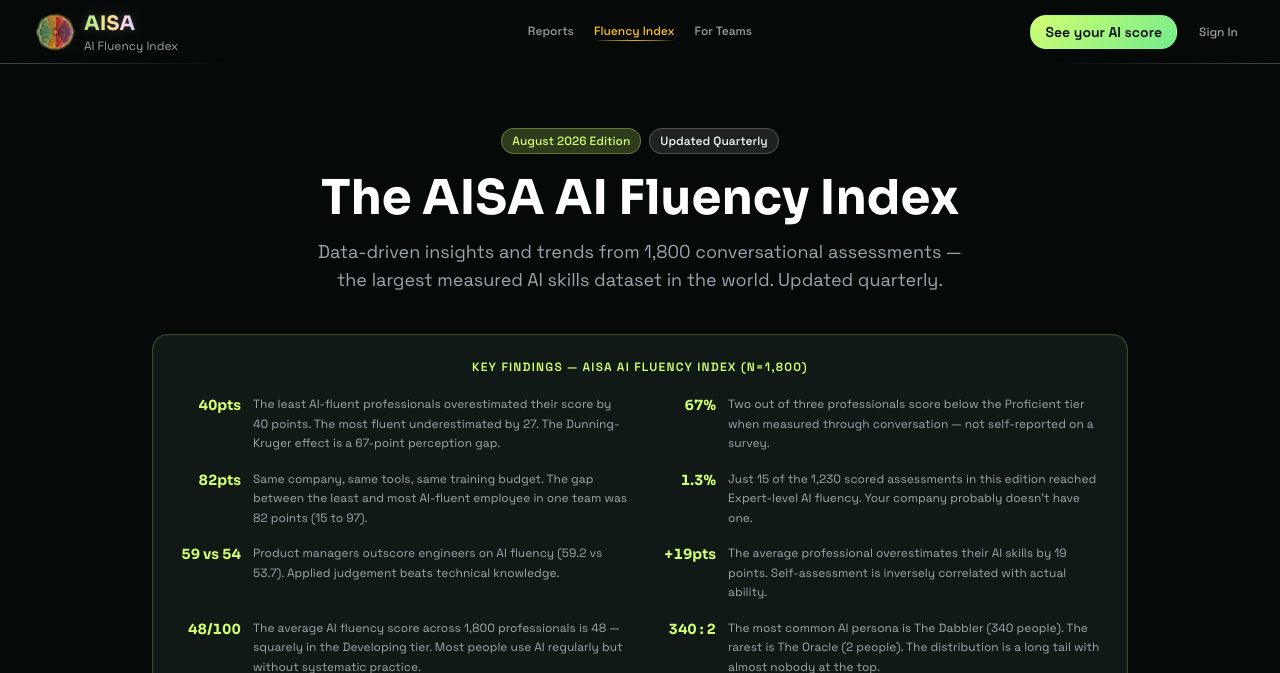
In August 2026, AISA published the first edition of its AI Fluency Index, analyzing 1,800 completed assessments conducted from March 12, 2026 onward. The dataset offers revealing empirical insights into how knowledge workers actually use AI versus how they imagine they use it.
1. The baseline workforce average is surprisingly modest
The overall mean and median score across the 1,800-person sample was 48 out of 100. Two-thirds of all candidates (67%) scored below the Proficient threshold (defined as 70 points). Only 1.3% of evaluated professionals scored in the Expert band (90 or higher).
Because 93% of the Index sample consisted of self-initiated participants who actively chose to take an AI test, AISA notes that the true general workforce baseline is likely even lower. The sample skews toward tech-curious professionals who already believe they have developed useful competence.
2. The 19-point perception gap
One of the Index's most striking revelations is the magnitude of human self-overestimation. Before beginning the assessment, participants rated their perceived AI fluency. When matched against their actual scored performance:
- Candidates overestimated their true fluency by an average of +19 points (with subsequent FAQ updates citing +19.6 points).
- The least fluent quartile overestimated their performance by as much as 40 points.
- Conversely, the most fluent cohort (candidates scoring above 85) tended to underestimate their relative capability by approximately 27 points, demonstrating a pronounced Dunning-Kruger dynamic across generative technology.
3. Dissecting the strongest and weakest competencies
Across the 11 criteria, the population showed significant divergence in mastery:
- Strongest competencies: Task Decomposition averaged 5.4 out of 10, followed closely by Context and Memory Management at 5.3 out of 10. Modern chat interfaces have trained users reasonably well on providing reference text and breaking larger goals into smaller prompts.
- Weakest competencies: Tool Landscape emerged as the absolute lowest scoring area, averaging only 4.8 out of 10. Most professionals remain locked inside a single commercial interface (such as ChatGPT), showing little awareness of specialized coding agents, local models, audio models, or custom API wrappers.
4. Role comparisons: product leads engineering
When segmented by occupational discipline, Product Managers outpaced Software Engineers:
- Product Management: 59.2 average score (n = 56)
- Software Engineering: 53.7 average score (n = 126)
- Data Science: 50.1 average score
- Product Design: 49.9 average score
- General Business / Operations: 46.7 average score
This discrepancy aligns with how roles interact with AI. While engineers often focus narrowly on code auto-completion tools (such as Copilot or Cursor), product managers routinely apply models across diverse operational workflows: user interview synthesis, PRD drafting, competitive analysis, metric framing, and stakeholder communications.
5. Wide internal variance within teams
In one documented case study of an 8-person product team evaluated together, scores ranged from 15 to 97 out of 100. This demonstrates that assigning an enterprise-wide tool license does not generate uniform capability. Without objective measurement, leaders cannot identify which team members need foundational coaching and which can mentor others.
Pricing model and commercial strategy
AISA structures its pricing across free access, optional individual upgrades, and corporate evaluation credits:
| Tier / Product | Pricing | What is included |
|---|---|---|
| Core Assessment | Free ($0) | Live adaptive conversation with Aisa, full 11-criteria diagnostic report, persona assignment, and a 12-month verifiable digital certificate |
| Additional Assessment Credit | $10 | One additional assessment attempt after consuming the initial free credit |
| AI Fluency Map | $19 (one-time) | Personalized skill geography visualization, categorized learning modules, gap analysis, and tailored step-by-step action plan |
| AISA AI Coach | $19 / month | Daily micro-coaching delivered via WhatsApp, curated tool updates, custom exercises, 7-day free trial, and 2 retake credits included |
| Master Bundle | $99 (one-time) | Comprehensive toolkit bundling the assessment, skill mapping, and advanced development resources |
| Employer Evaluation Credits | $10 per candidate | Prepaid candidate invites, candidate detailed reports, hiring benchmark analytics; credits never expire |
The pivotal certificate pivot of September 2026
When AISA originally launched in early 2026, the verifiable certificate sat behind a $49 paywall. While this generated immediate transactional revenue, it created a perception challenge. The product risked looking like a standard consumer sales funnel that gave away a score only to sell the credential.
In early September 2026, founder Ozan Dagdeviren permanently eliminated the certificate fee. The full credential, complete with a unique verification URL, Open Badges 2.0 metadata, PDF download, and one-click LinkedIn integration, became completely free for every user who completes the test.
The rationale was strategic distribution: approximately 15% to 20% of users who earn an AISA certificate share it directly to their LinkedIn profiles. By turning every certificate into a public, verifiable proof point, the credential acts as its own organic distribution mechanism.
The paid products were shifted entirely downstream. Users can take the AISA assessment without entering a credit card, receive their score and certificate, and only purchase coaching or skill maps if they actively want guided improvement.
The employer model
For organizations, AISA functions as a candidate screening and workforce benchmarking tool. Rather than locking companies into cumbersome enterprise contracts with seat minimums, AISA sells non-expiring evaluation credits at $10 per assessment.
Employers invite candidates via email. When candidates finish, the employer receives the exact same detailed report that the candidate sees: scores across all 11 criteria, the assigned persona, and direct quote evidence.
To maintain candidate trust, raw conversation logs are never shared with employers unless specifically authorized. Employers see the objective diagnostic evaluation, not an unedited diary of the candidate's conversational turns.
Technical infrastructure, privacy, and data security
Handling conversational evaluations requires clear data boundaries:
- Data hosting and compute: AISA's application layer runs on Vercel, with database infrastructure hosted via Supabase Postgres in the European Union (AWS eu-west-1 in Ireland).
- Model routing: The conversational and evaluation pipelines utilize Anthropic's Claude infrastructure.
- Model training exclusion: AISA explicitly confirms in its privacy policy and terms that user transcripts, conversational turns, and evaluation data are never used to train foundational AI models.
- Data retention and deletion: User assessment data is maintained to support certificate verification until an account holder requests deletion. Upon receiving a deletion request, records are wiped from active databases within 30 days. Anonymized statistical aggregates are preserved for population benchmarks like the AI Fluency Index.
- Accessibility: The chat interface conforms to standard web accessibility guidelines, supporting keyboard-only navigation and standard desktop screen readers.
Company background and leadership
AISA is built by Common Wisdom Consultancy Ltd, a boutique product studio based in London and Bexhill-on-Sea, UK. The company was founded by Ozan Dagdeviren, who serves as sole director.
Dagdeviren brings a combined background in psychology, product management, and hiring science. Holding degrees in Psychology and Sociology from Tilburg and Bosphorus Universities and an MA in Brand and Marketing Communications from Galatasaray University, he previously authored books on recruitment and team dynamics, including Creative Hiring: The Pinnacle Model (2015) and Startups Grow With People (2018). Prior to AISA, he built and sold HerGünÖğren (HGO), an enterprise video learning platform serving over 80,000 learners across 40 corporate accounts.
The AISA advisory board brings cross-functional perspective across product and enterprise AI:
- Mehmet Yalcin: Director of Products at The Guardian, previously holding product leadership roles at Amazon and Vodafone.
- Andrew Olaleye: Co-founder of Remarkable AI (140+ employees, serving major global accounts including Unilever and Mars) and former McKinsey consultant.
- Tunca Ulubilge: Staff Software Engineer at Shopify, previously with Amazon and Babylon Health.
- Meir Benezra: AI systems architect, designer, and co-founder of Luka.
Balanced perspective: key strengths and product boundaries
A balanced assessment requires understanding both what AISA does well and where its natural limitations sit.
Notable strengths
- Published behavioral rubric: While most AI quizzes hide their grading mechanics behind proprietary black boxes, AISA makes its 11 criteria, weights, and behavioral anchors fully transparent.
- Structural anti-gaming architecture: Separating the conversational interviewer from the scoring model prevents users from sweet-talking their way to a high score through prompt injection.
- Verbatim quote-backed evidence: Every score is justified by specific words the candidate uttered during the dialogue, eliminating arbitrary grades.
- Permanent, verifiable credential: Giving away the LinkedIn-shareable certificate for free creates genuine professional utility without high-pressure upsell tactics.
- Rigorous population data: AISA openly shares its Index statistics, complete with methodological notes acknowledging self-selection sampling biases.
Practical boundaries to keep in mind
- Conversational format favors articulate communicators: Because the evaluation occurs through natural dialogue or voice dictation, professionals who naturally articulate their thought processes perform better than those who code brilliantly in silence but struggle to explain their workflow.
- Single-session evaluation: A 30-minute dialogue provides a high-signal diagnostic snapshot of working habits, but it cannot measure a developer's real-time productivity inside an IDE like Cursor over six continuous months.
- Unproctored environment: Without webcam surveillance or locked-down browser environments, a determined candidate could theoretically have an external AI assistant running in another tab. AISA relies on transcript-level anomaly detection and adaptive follow-up questioning rather than intrusive surveillance software.
- Self-asserted framework validation: While AISA demonstrates close conceptual alignment with Anthropic's index and Department of Labor guidelines, independent peer-reviewed psychometric validation was still in development during 2026.
Who should use AISA?
For individual professionals
If you want an objective measure of where your generative AI skills actually sit, AISA's conversational assessment offers a clear diagnostic mirror. It takes under 40 minutes, costs nothing, provides actionable feedback across five dimensions, and generates a credible digital credential to validate your capabilities on LinkedIn or your resume.
For engineering and product leaders
If you manage an existing team, having team members take the assessment can uncover operational imbalances. Learning that your team excels at Task Decomposition (5.4) but struggles with Tool Landscape (4.8) gives you a clear roadmap for internal workshops and tooling investment.
For hiring managers and recruiters
If your pipeline is overwhelmed with candidates claiming to be AI experts, using AISA's $10 employer credits provides an affordable top-of-funnel filter. Reviewing a candidate's dimensional scores and quote evidence before scheduling a live technical interview ensures you spend engineering interview hours only on candidates who possess genuine operational fluency.
Frequently asked questions
How long does the AISA assessment take?
Most sessions take between 20 and 40 minutes. The conversation is completely untimed, allowing you to reflect and elaborate on your real-world workflows at your own pace.
Do I need to be a software developer to take the test?
No. Aisa adapts dynamically to your declared role. The platform features specialized tracks for Product Managers, UX Designers, Data Specialists, and Software Engineers, alongside a general professional track for operational and business roles.
How does AISA ensure that scores are not manipulated?
AISA operates two separate AI models that do not communicate in real time. Track A chats with you, while Track B quietly scores the transcript against a strict behavioral rubric. Because Track A has no scoring authority, you cannot manipulate your score by steering the interviewer. Additionally, a secondary calibration pass checks the entire transcript for consistency and flags suspicious automated text patterns.
What is the difference between an AI persona and an AI score?
Your score (0 to 100) measures your overall operational fluency across five weighted dimensions. Your persona (such as Tactician, Builder, Conductor, or Architect) describes your behavioral archetype based on the specific shape of your skills. Two people with a score of 70 can receive different personas depending on whether their strengths lie in hands-on building, workflow orchestration, or structured prompt discipline.
Can I retake the assessment to improve my score?
Yes. Your first assessment is completely free. Subsequent assessments cost $10 per credit, or you can receive two retake credits every month as part of the optional $19/month AISA AI Coach subscription.
Does AISA integrate with LinkedIn?
Yes. Upon completing the assessment, you receive a verification link with Open Badges 2.0 metadata and a one-click button that adds your certificate directly to the Licenses and Certifications section of your LinkedIn profile. The certificate remains valid for 12 months.
Summary verdict
AISA provides a structured, thoughtful alternative to the chaotic landscape of generative AI credentialing. By replacing trivial multiple-choice quizzes with an adaptive conversational interview, separating the interviewer from the evaluator, and tying every grade to verbatim transcript quotes, the platform delivers a diagnostic signal that holds real value for professionals and hiring teams alike.
Get your SaaS in front of founders
List your product on the SaaSCity live city map - a permanent listing, real discovery, and a backlink from a high-DR directory. Free to start; upgrade for a dofollow link and a building on the map.