Reviews
Graded Prompts Review 2026: The AI Prompt Marketplace Where a Person Tests Every Prompt Before It Goes on Sale
Graded Prompts is a UK prompt marketplace with one rule: nothing goes on sale until a reviewer has run it on the model it was written for and checked the seller's examples against what that model actually makes. We went through the grading process, the catalog, the AI search, the bonus credits, the licence, the refund policy and the seller side.

Contents (18)
- Graded Prompts at a glance
- What is Graded Prompts?
- How does Graded Prompts test every prompt?
- What a Graded Prompts listing shows you before you pay
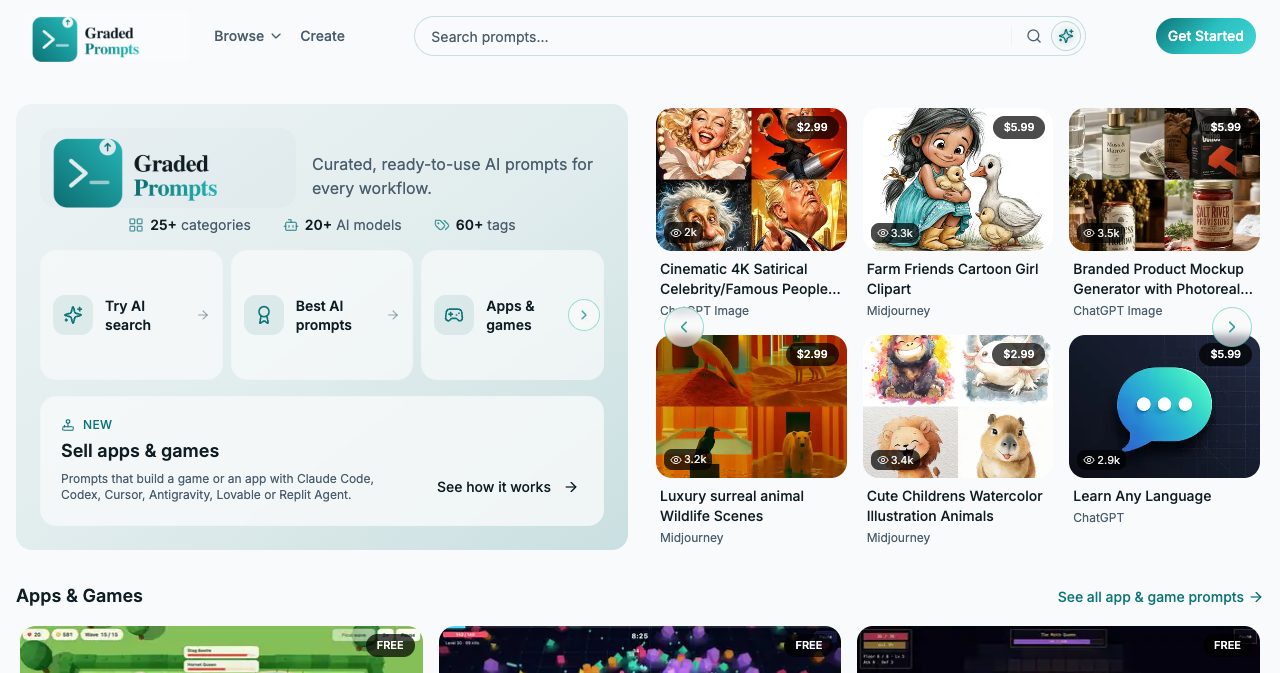
- What's in the Graded Prompts catalog?
- Finding the right prompt with AI search
- How much do Graded Prompts prompts cost?
- How do Graded Prompts bonus credits work?
- Licence: personal, commercial and client work
- Refunds and buyer protection
- Privacy, reviews and the company behind Graded Prompts
- Selling prompts on Graded Prompts
- Graded Prompts vs upload-and-publish prompt marketplaces
- Who is Graded Prompts for?
- What we liked, and what to know first
- How to get started with Graded Prompts
- Is Graded Prompts worth it?
- FAQ
Disclosure: this is a sponsored review.
Quick answer: Graded Prompts is an AI prompt marketplace built around one rule: nothing goes on sale, free or paid, until a person has run the prompt on the model it was written for and checked the seller's examples against what that model actually produces. Prompts that pass carry a Graded badge. As of November 7, 2026, paid prompts on the homepage cost $2.99 to $9.99 as a one-time purchase, every paid prompt includes at least 100 bonus credits to run image and video prompts on the real model inside the site, and every purchase comes with a perpetual licence for personal and commercial use. Sellers keep 85% of each sale. The company behind it, Graded Prompts Ltd, is registered in England and launched the marketplace in June 2026.
If you've ever bought a prompt online, you probably know how it goes. The preview images look wonderful. You pay a few dollars, paste the prompt into Midjourney or ChatGPT, and get something that looks nothing like the listing. Then you spend an evening and a stack of generation credits trying to work out whether the prompt is broken, your settings are wrong, or the preview was the one good result out of forty. By the end, the few dollars are the smallest part of what it cost you.
Graded Prompts is built to take that gamble out of buying a prompt. Before a listing goes live, a reviewer fills in its variables, runs it on the real model and puts the output next to the seller's examples. If they match, it publishes. If they don't, it goes back to the seller with notes. The catalog is smaller because of it, and the team says so openly.
We went through the whole marketplace: the grading guide, the listings, the AI search, the apps and games section, the credits system, the licence, the refund policy, the company details and the seller side. Here's how it all works and who it suits.
Graded Prompts at a glance
- What it is: a curated marketplace for AI prompts, where every listing is tested by a person on its target model before it's published.
- Prompt types: image, video, text, and apps and games (prompts that build a game or an app with a coding agent).
- Models: 12 image, 6 video and 6 text models in the catalog filters, plus 6 coding and no-code tools for apps and games.
- Prices: $2.99 to $9.99 on the paid prompts we saw, plus free prompts to claim. One-time purchase, no marketplace subscription.
- Bonus credits: at least 100 with every paid prompt, up to 300 on a $9.99 prompt, for running image and video prompts on the site.
- Licence: worldwide and perpetual, for personal, commercial and client work.
- Buying: guest checkout through Stripe, prices in US dollars.
- Refunds: handled by Graded Prompts as merchant of record, raised within 3 days of purchase.
- For sellers: 85% of every sale, no listing fees, prices from free to $19.99, payouts through Stripe or in USDC.
- Company: Graded Prompts Ltd, London, United Kingdom. Launched June 2026.
What is Graded Prompts?
Graded Prompts describes itself as "an AI prompt marketplace where a human reviewer runs every prompt on its real model before it goes on sale", so that what you see in the examples is what the model makes.
The reason that matters is that a prompt is an odd thing to sell. The moment a seller shows it to you, there's nothing left to buy, so you pay on the strength of a few example outputs. On a marketplace that publishes whatever is uploaded, a prompt that works every time and a prompt that worked once after forty attempts and some retouching look exactly the same on the listing page. Ratings sort it out eventually, but only after the first buyers have paid to find out.
Graded Prompts moves the checking to before the sale. Its about page sums up the idea in three parts:
- Tested before sale. Nothing is auto-published. A reviewer checks each listing for accuracy, runs the prompt on its model and compares the seller's examples with the real output.
- Run it before you build on it. Every paid prompt comes with bonus credits, so you can run an image or video prompt yourself on the real model before you depend on it.
- Fair creator economics. Creators keep 85% of every sale, and the marketplace handles payments, refunds and buyer support.
There's a nice touch on the same page, too. The team says the site itself was built with roughly 80% AI-generated output and 20% human direction, guided by carefully written prompts. It's a fitting proof of concept for a business that sells prompts.
How does Graded Prompts test every prompt?
The full process is published in the Graded Prompts grading guide, along with an 80-second video walkthrough. A submission goes through five steps, and each one is done by a person.
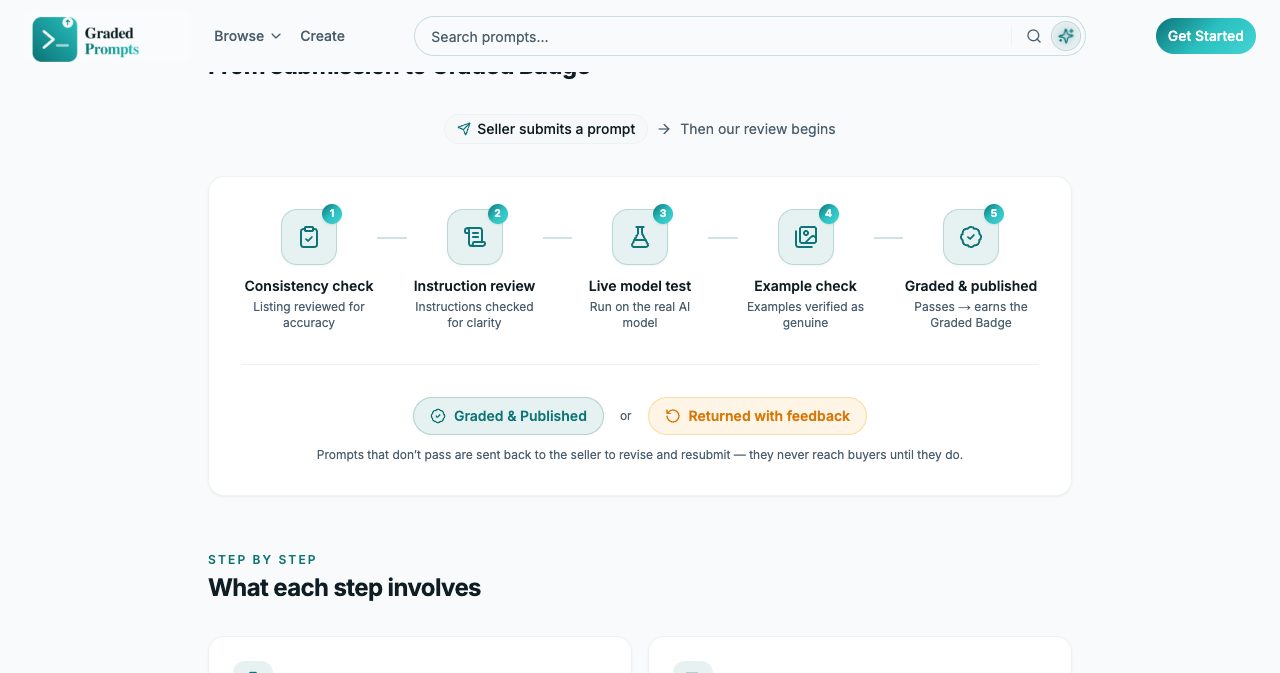
The five checks, step by step
- Consistency check. The reviewer reads the whole listing, including the title, description, category, target model and tags, and checks it against the prompt itself. A description that over-promises, or details that contradict each other, means the prompt doesn't pass.
- Instruction review. The instructions have to be complete, well structured and usable, with every variable clearly labelled, so the prompt works the first time you run it.
- Live model test. The reviewer runs the prompt on the real model it's built for, trying different values for its variables, to check that it holds up across varied inputs and not just once.
- Example check. The seller's example outputs are compared with what the model actually generates, so the previews you see are genuine and representative rather than hand-picked or edited.
- Graded and published. Only when every check passes does the prompt go live with the Graded badge. Anything that falls short goes back to the seller with specific feedback to fix and resubmit.
The seller page adds a detail we liked. A reviewer fills the variables with sample values, runs the filled prompt on Midjourney (or whichever model it targets), and sets the output beside the seller's examples. That one comparison catches most of the tricks that make prompt shopping risky.
What the Graded badge promises, and what it doesn't
The grading guide closes with a checklist of what every graded prompt has been checked for: an accurate description, clear and complete instructions, genuine examples, correct model compatibility, valid formatting (structured and JSON prompts are validated) and policy and IP compliance.
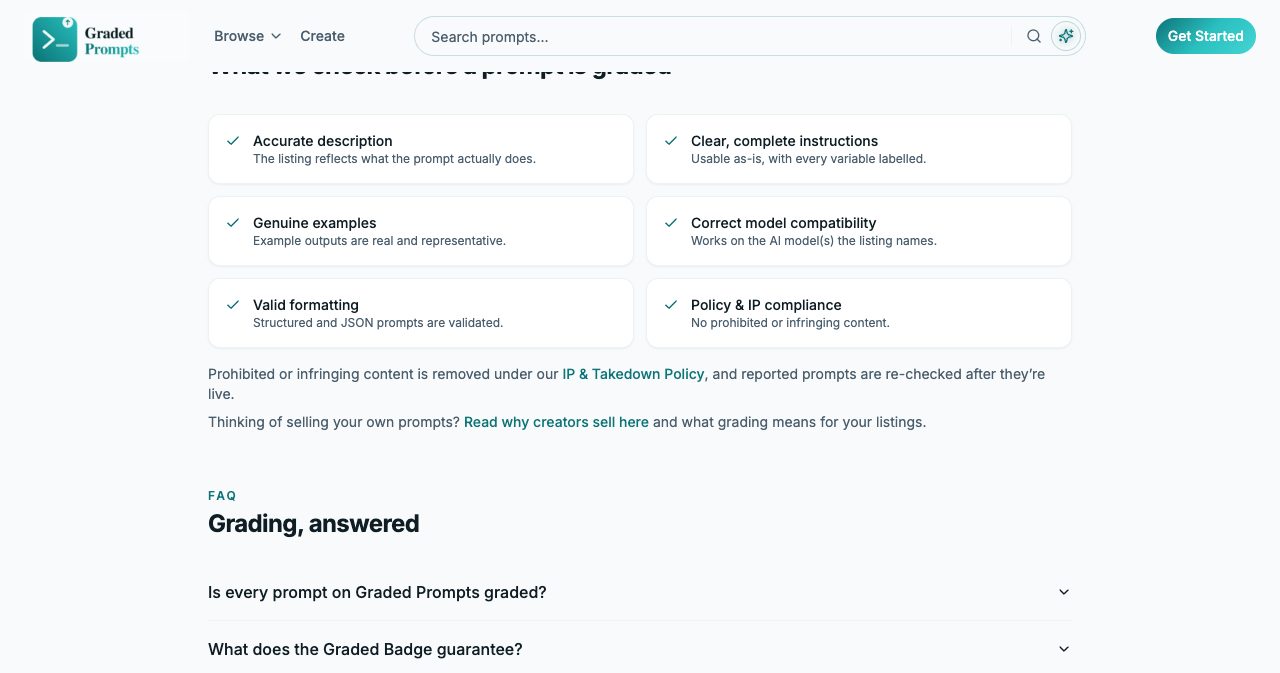
Graded Prompts is careful about the limits, which is reassuring. The badge doesn't promise identical results every time, because generative models give a different output on every run. What it does promise is that the examples are real output from that prompt on that model, and that the prompt performs as the listing describes. If it doesn't, you're covered by the refund policy, which we cover below.
Reported prompts are also re-checked after they go live, so the badge isn't a one-time stamp.
What a Graded Prompts listing shows you before you pay
Every listing follows the same layout, and it answers the questions you'd want answered before spending money.
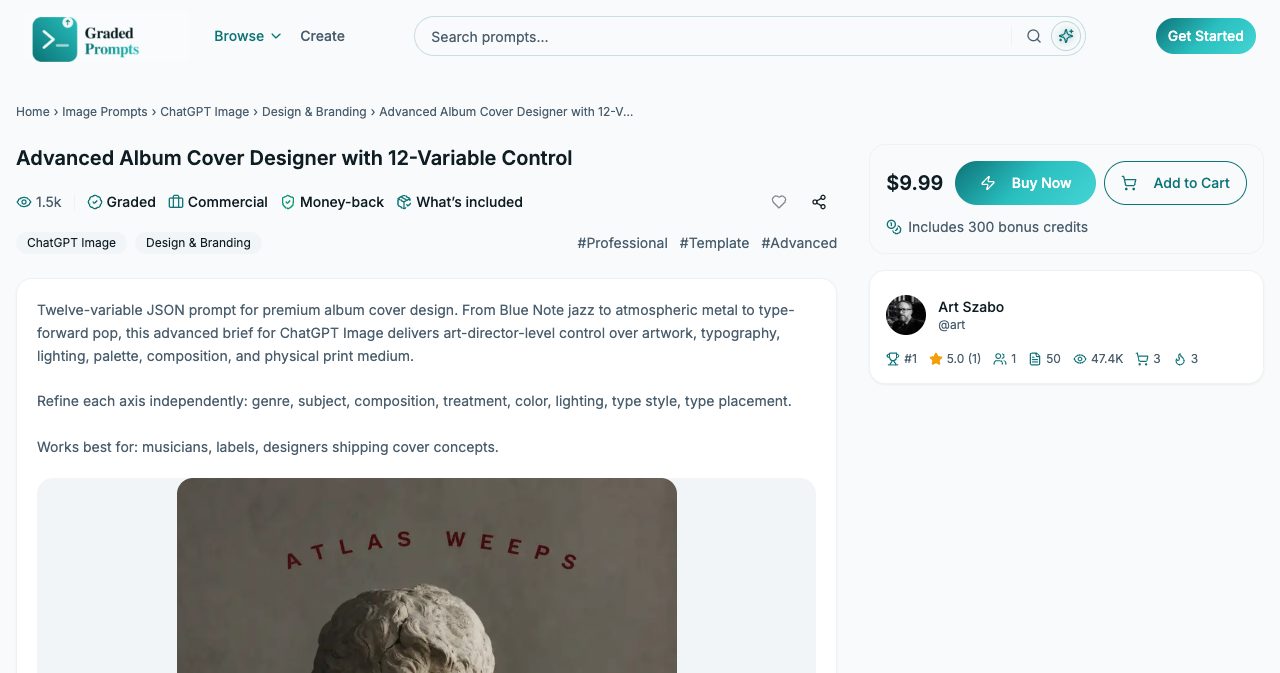
At the top you get the model the prompt is built for (ChatGPT Image, in this case), its category and tags, and four short labels: Graded, Commercial, Money-back and What's included. The description says what the prompt does and who it's for. This one is a twelve-variable JSON brief for album covers that lets you control genre, subject, composition, treatment, colour, lighting, type style and type placement separately, and it "works best for musicians, labels, designers shipping cover concepts".
Below that sit the seller's example outputs, which are the ones the reviewer checked. On the right you see the price, the bonus credits included with it and the seller's profile with their ranking and number of published prompts. You can message a seller directly about their prompt, which is handy for more involved templates like this one.
What's in the Graded Prompts catalog?
The homepage lists 25+ categories, 20+ AI models and 60+ tags, and the about page counts 27 categories. Prompts are grouped by type, and each type has its own model and category filters.
Image prompts
Image is the biggest part of the catalog. As of November 7, 2026, the filters cover 12 image models: Midjourney, ChatGPT Image, FLUX, Stable Diffusion, Ideogram, Leonardo AI, Recraft, Seedream, Gemini Image, Grok Image, Qwen Image and Hunyuan. The ten categories run from Art & Illustration and Characters & Avatars to Design & Branding, Infographics & Technical, Photography & Realistic and UI & Product.
The best-sellers give a feel for what people buy here: watercolour clipart sets, product mockups with photoreal packaging, black-and-white street photography styles, pastel clay emoji, book cover and event poster generators, cinematic educational infographics and caricature styles.
Video prompts
Video prompts cover six models: Kling AI, Seedance, Veo, Wan, Hailuo AI and Midjourney Video. Categories include Marketing & Ads, Product & E-commerce, Cinematic & Storytelling, Social Media and Educational & Explainer.
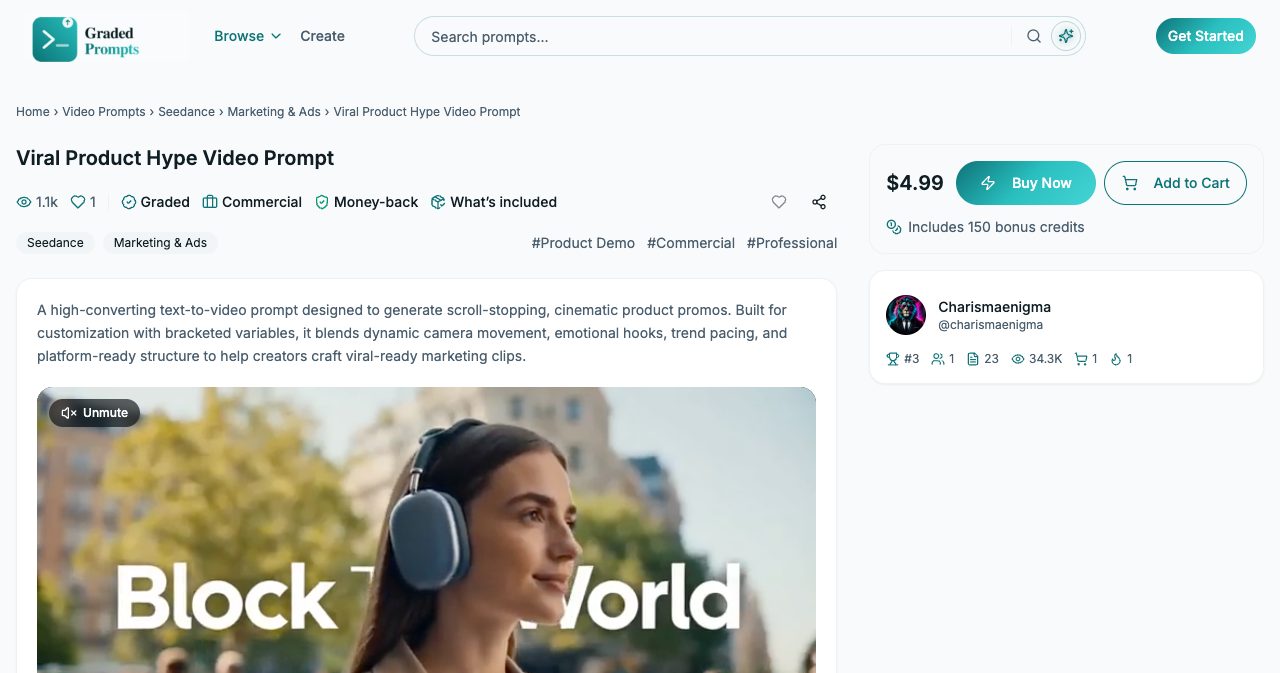
Video listings play the seller's example clips right on the page, with sound if you unmute. The "Viral Product Hype Video Prompt" above is a typical one: a bracketed-variable Seedance prompt for short, scroll-stopping product promos.
Text prompts
Text prompts cover ChatGPT, Claude, Gemini, Llama, DeepSeek and Grok, across Business & Productivity, Code & Development, Creative & Storytelling, Editing & Translation, Education & Learning, Marketing & Sales, Research & Analysis and Writing & Content.
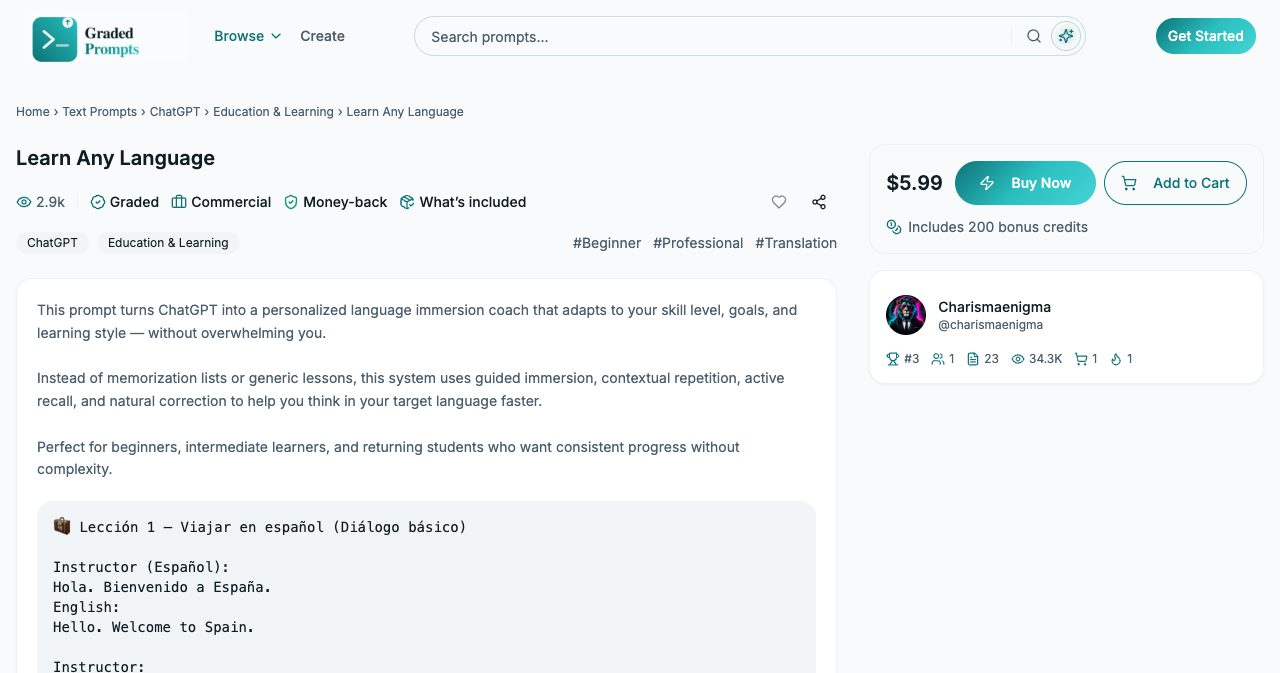
For text prompts, the examples are full conversations. The "Learn Any Language" listing shows a complete first Spanish lesson, with dialogue, situations at an airport and a hotel, practice questions and a summary, so you can judge the teaching style before you buy. Among the newer arrivals you'll find practical working prompts too: a resume bullet rewriter, a contractor quote comparison table, real estate listing descriptions, a wedding budget breakdown, a STEM lesson plan generator and a grant application assistant for artists.
App and game prompts
The newest section is the one we found most fun to browse. App & Game Prompts are prompts that build a playable game or a working app when you paste them into a coding agent or a no-code builder: Claude Code, Codex, Cursor, Google Antigravity, Lovable or Replit Agent.
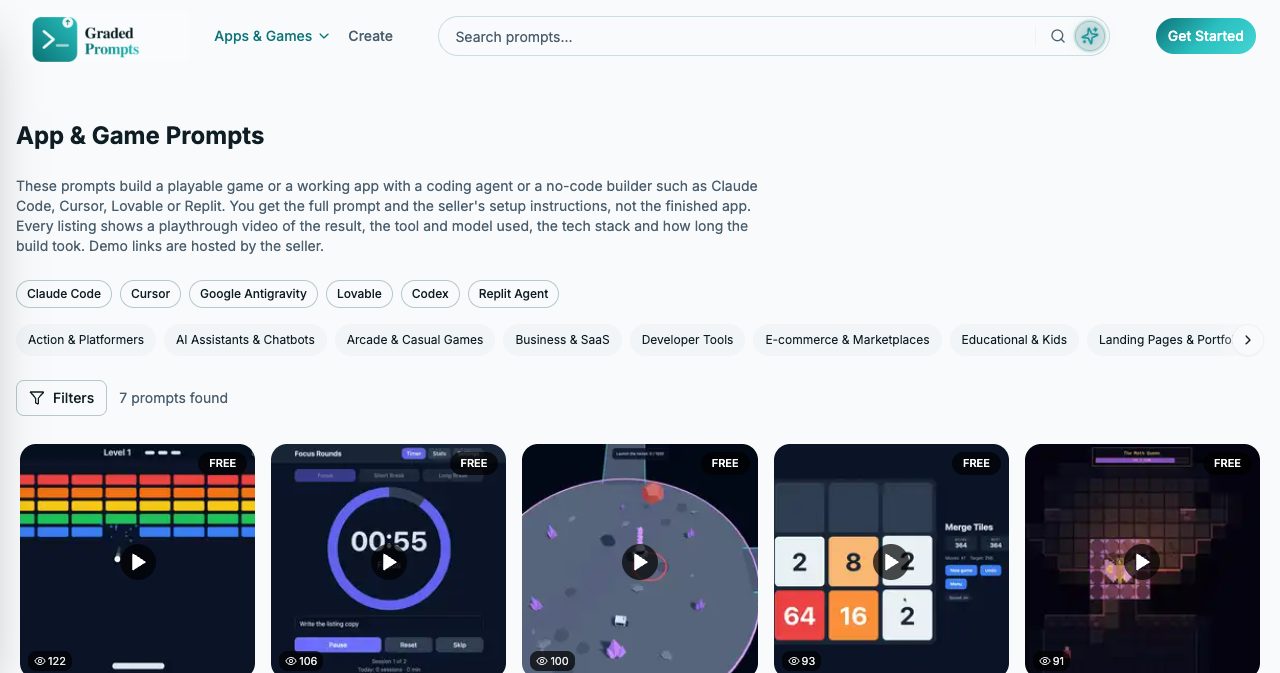
Since you can't preview code the way you preview a picture, each listing shows one to four playthrough videos of the finished result, plus a "Project details" block with the tool and model the seller built it with, the tech stack and how long the build took.
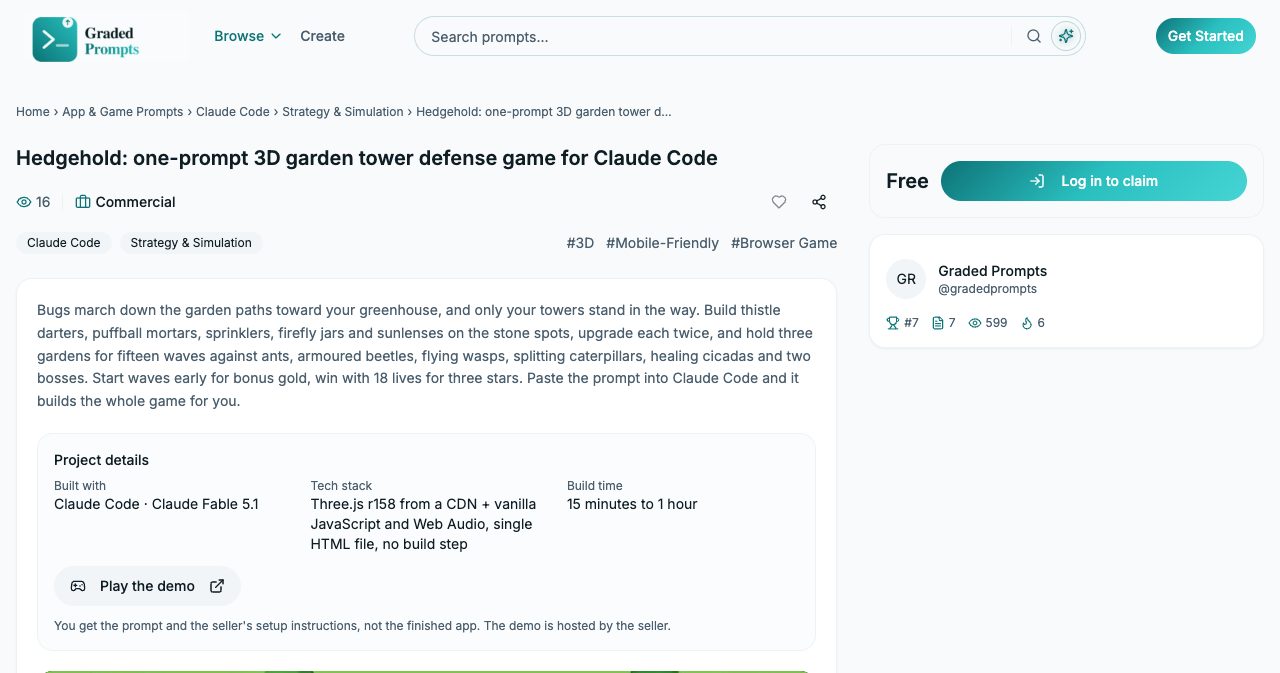
Hedgehold, above, is a 3D garden tower defence game with fifteen waves, five tower types and two bosses, built in Claude Code with Claude Fable 5.1 as a single HTML file in 15 minutes to an hour. A "Play the demo" button opens the seller's hosted version so you can try it first. As of November 7, 2026, the section holds seven prompts, all free to claim, which makes it a low-risk way to see what a one-prompt build looks like. If you're new to coding agents, our guide to your first Claude Code project pairs well with these, and our list of Claude Code project ideas has more builds to try.
Two things to know about this type. You get the prompt and the seller's setup instructions, not the finished app or its source code. And reviewers check app prompts in a different way from image and text prompts: they don't rebuild the app themselves, but they watch every video, open the demo to confirm it matches, check that the instructions are enough to reproduce the result and check that the tool and model are the ones the build actually used.
Finding the right prompt with AI search
Browsing works well when you know the category. When you don't, Graded Prompts has an AI search that lets you describe what you're after in plain English, with no account needed. You don't have to guess the words a seller used in their title.
We typed "a vintage travel poster for my bakery".
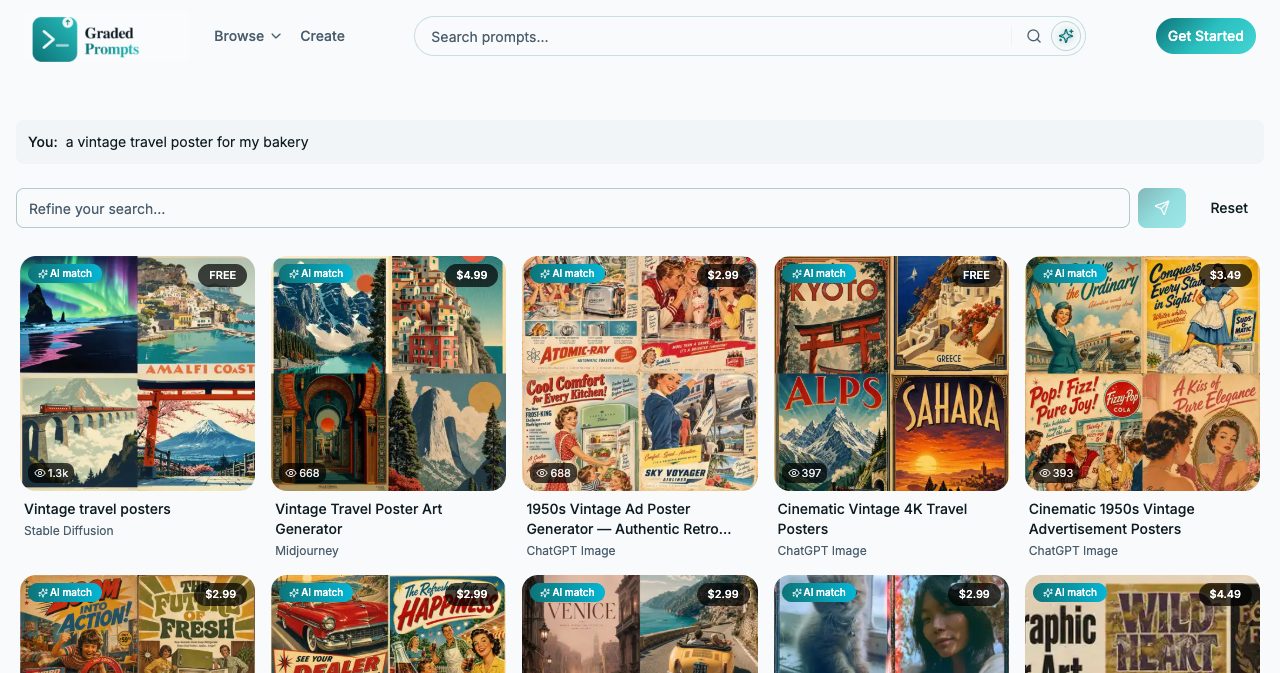
The first row came back with two travel poster prompts that are free to claim, a $4.99 Midjourney travel poster generator, and two retro advertising poster prompts at $2.99 and $3.49, across three different models. That's a sensible spread: the travel-poster look you asked for, plus the 1950s advertising style a bakery poster would likely borrow from. The "Refine your search" box under your query lets you narrow it down conversationally, for example by asking for a ChatGPT Image prompt only or for a poster with room for your shop's name.
How much do Graded Prompts prompts cost?
Every prompt is a one-time purchase in US dollars. There's no subscription to the marketplace itself, and no per-use fee once you own a prompt. Here's what we saw on the site on November 7, 2026:
| Price | Bonus credits | Examples from the catalog |
|---|---|---|
| Free | None | Literary Ink Illustrations, High-impact brand banners, Dark Fantasy Characters, Vintage travel posters, The Prompt Architect Pro, every app and game prompt |
| $2.99 | 100 | Whimsical Storybook Style, Dreamy Vintage Film Portraits, Pastel Clay Emoji Creator |
| $4.49 to $4.99 | 150 | Cute Magical Tiny Fairy Houses Coloring, Viral Product Hype Video Prompt |
| $5.99 | 200 | Learn Any Language, Branded Product Mockup Generator, Cute Watercolor Animal Clipart |
| $7.99 | 250 | Book Cover Generator, Event Poster Generator, Brand Positioning Statement Generator |
| $9.99 | 300 | Advanced Album Cover Designer, Agent Backend Integration Blueprint |
Sellers can set any price from free to $19.99, so you may see higher prices as the catalog grows. You can pay by card and the other methods Stripe shows at checkout. Graded Prompts runs site-wide promotions from time to time, such as percentage discounts or buy-two-get-one-free offers, and applies them automatically at checkout with no promo code.
Guest checkout
You don't need an account to buy. Click Buy Now, enter your email on the Stripe payment page and pay. Graded Prompts creates a free account for that email in the background and puts the prompt in your Library, and you can sign back in later with a one-time code sent to your inbox. Free prompts are the exception: you sign in first, then claim them to your Library.
What's included with every purchase
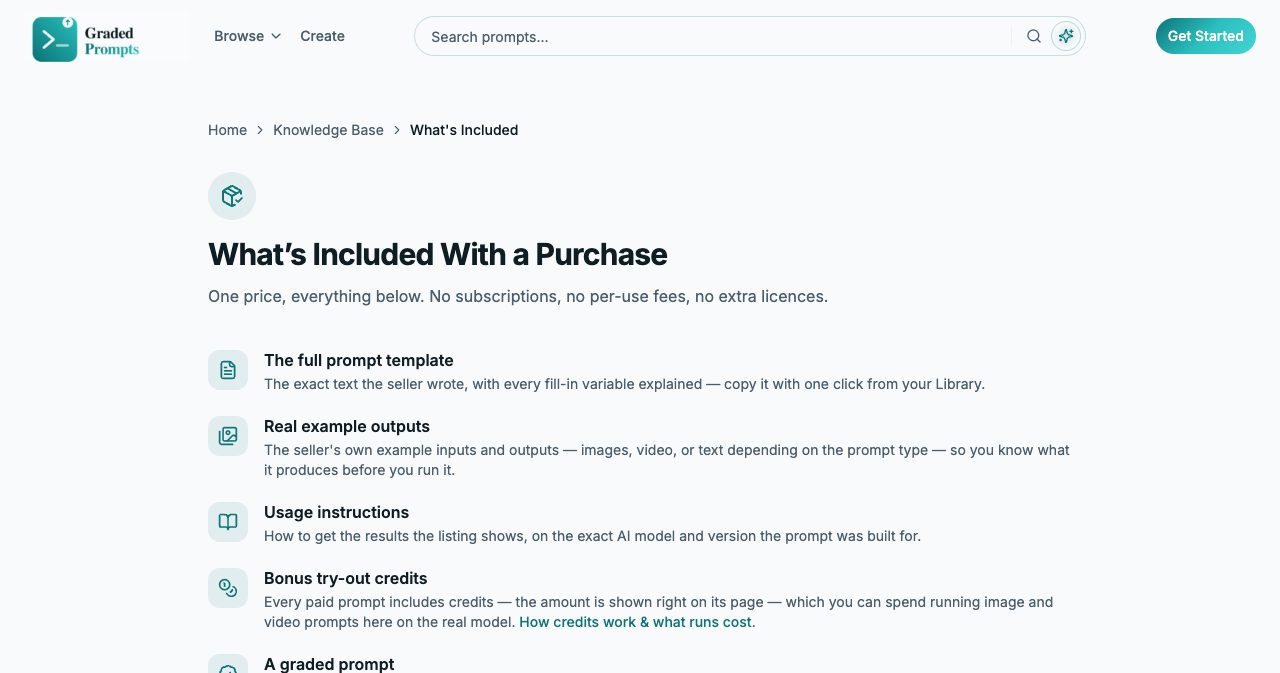
One price covers:
- The full prompt template, exactly as the seller wrote it, with every variable explained and a one-click copy button in your Library.
- The seller's real example inputs and outputs.
- Usage instructions for getting the listing's results on the exact model and version it was built for.
- Bonus credits for running image and video prompts on the site.
- A perpetual licence with commercial use included.
- Lifetime Library access, so you can reopen and copy the prompt any time.
- A line to the creator, to ask questions about getting the most from their prompt.
- Refund protection if the prompt doesn't work as described.
How do Graded Prompts bonus credits work?
The credits are the most practical part of the whole offer. They let you check a prompt yourself, on the real model, with your own inputs, before you build anything on it.
Open a purchased prompt in your Library, click Use this prompt and fill in its variables. The page shows the exact credit cost before you run. Some models offer extra options, such as a priced high-resolution tier for images or a cheaper five-second preview cut for longer video prompts. Click Run, and the result is generated fresh by the real model and appears on the page. Everything you make is kept in an outputs gallery for that prompt, with the exact prompt text each run used and full-size downloads.
You don't have to wait around, either. Many image models finish in seconds, Midjourney usually takes a couple of minutes and video takes several. You can leave the page while it runs, and the result will be waiting in the gallery. If a run fails or never finishes, its credits come back automatically.
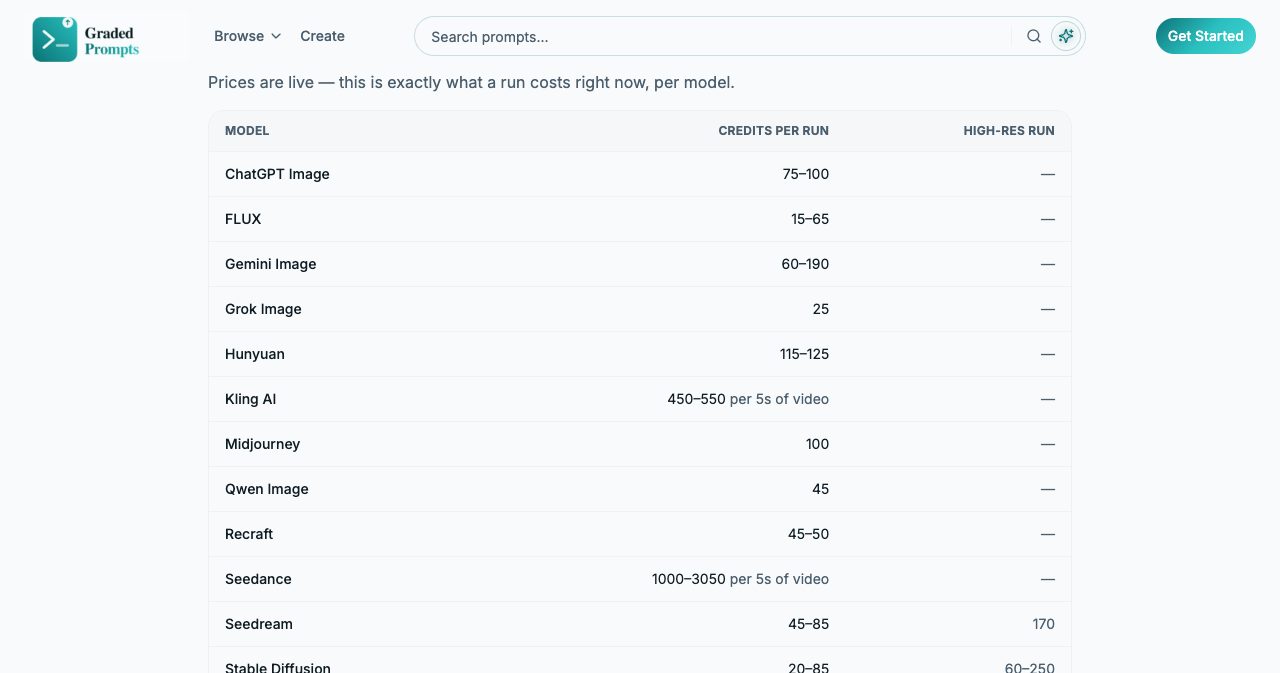
Here's what a run costs as of November 7, 2026, from the live price table:
| Model | Credits per run | High-res run |
|---|---|---|
| Grok Image | 25 | |
| FLUX | 15 to 65 | |
| Stable Diffusion | 20 to 85 | 60 to 250 |
| Qwen Image | 45 | |
| Recraft | 45 to 50 | |
| Seedream | 45 to 85 | 170 |
| Gemini Image | 60 to 190 | |
| ChatGPT Image | 75 to 100 | |
| Midjourney | 100 | |
| Hunyuan | 115 to 125 | |
| Kling AI | 450 to 550 per 5 seconds of video | |
| Seedance | 1,000 to 3,050 per 5 seconds of video |
Where a range is shown, the cost depends on the model version, and video is priced per five seconds of output, so a ten-second prompt costs twice the listed rate.
How far do the bonus credits go?
Credits from all your purchases pool into one balance, and your Credits page shows every entry. In practice:
- A $2.99 prompt (100 credits) covers one Midjourney run, one ChatGPT Image run, or four Grok Image runs.
- A $9.99 prompt (300 credits) covers three Midjourney runs, or three to four ChatGPT Image runs. The album cover prompt we looked at is a ChatGPT Image prompt, so that's enough to try it on your own band name and genre a few times.
- Video costs more than a single purchase includes. A five-second Kling run is 450 to 550 credits and Seedance starts at 1,000, so you'd pool credits from several purchases, or from bundles and seller subscriptions, which also grant credits.
Text prompts don't use credits at all. The team's reasoning makes sense: a text prompt is built for a conversation you steer over several turns, and a single fixed reply would short-change what you bought. So you copy text prompts into your own ChatGPT, Claude or Gemini chat, and your credits go towards image and video runs instead.
Licence: personal, commercial and client work
The licence is generous and written in plain English. When you buy a prompt, Graded Prompts Ltd grants you a worldwide, non-exclusive, perpetual licence to use it for personal and commercial purposes. You can:
- run it as many times as you like on the platform the listing names;
- use it for personal projects, professional work and client deliverables, across as many clients and projects as you want, without buying extra licences;
- adapt it for your own use.
You can't share, resell or republish the prompt text itself, including with clients, and you can't use it to train or fine-tune AI models. Put simply: deliver what you make with it, but keep the prompt to yourself. There's no attribution requirement for the prompt or the outputs.
Two details worth knowing. The licence survives account closure as long as you keep your own copy, so save the prompts that matter to you. And rights in the outputs you generate follow the terms of the AI platform you run the prompt on, such as OpenAI or Midjourney, so check those terms before commercial use.
Refunds and buyer protection
Graded Prompts is the merchant of record. You buy from Graded Prompts, not from the individual seller, so payment, receipts, support, refunds and disputes all go through one company.
A refund is on the table when a prompt doesn't work as described: it doesn't match its listing or examples, won't run on the platform it names, or was materially misrepresented. To ask for one, email [email protected] within 3 days of purchase with your order ID, the prompt name, a description of the problem, screenshots or share links of the output, and the platform and model you used. You can message the seller first, but you don't have to.
Graded Prompts acknowledges requests within 2 business days and aims to decide within 5. Approved refunds go back to your original payment method within 5 to 10 business days. Normal variation between runs, a change of mind, or running the prompt on a different model from the one listed aren't covered, which is fair for a digital product you can use the moment you pay.
Privacy, reviews and the company behind Graded Prompts
A few details from the FAQ stood out because they're unusual for a marketplace:
- No ads and no trackers. Graded Prompts says it doesn't sell personal data, run advertising or use third-party analytics or advertising trackers.
- No cookie banner, for a good reason. It uses only strictly necessary cookies (one for your sign-in, one for your cart) plus a short-lived security token, so no consent banner is needed.
- Verified reviews only. Only buyers can leave a review, from their Library, and reviews are screened before they appear.
- Card details stay with Stripe. Payments run through Stripe, and Graded Prompts never stores your full card number.
The company is Graded Prompts Ltd, a private company limited by shares registered in England and Wales (company number 17080335), with its registered office at 128 City Road, London EC1V 2NX. Its legal pages are complete: buyer terms, a privacy policy, a subprocessor list, the prompt licence, an IP and takedown policy and a company information page. Each kind of query has its own address, from support@ and orders@ to sellers@, legal@ and privacy@, and complaints get an acknowledgement within 5 working days.
The founder, Ahmed, explains why he started it on the seller page. He burned every credit he had trying to get Kling to shoot a clothing ad, a model and a boot staged beside a car, and no rewrite of the prompt ever put them on the right side of it. "The cost of a bad prompt was never the $3," he writes. Getting an image or video prompt to deliver takes hours and credits, and that's what a buyer is really paying a skilled creator for.
Selling prompts on Graded Prompts
If you're good at writing prompts, the seller side is worth a look. The Graded Prompts seller guide is written by the founder and sets out the economics, the grading and, unusually, the downsides.
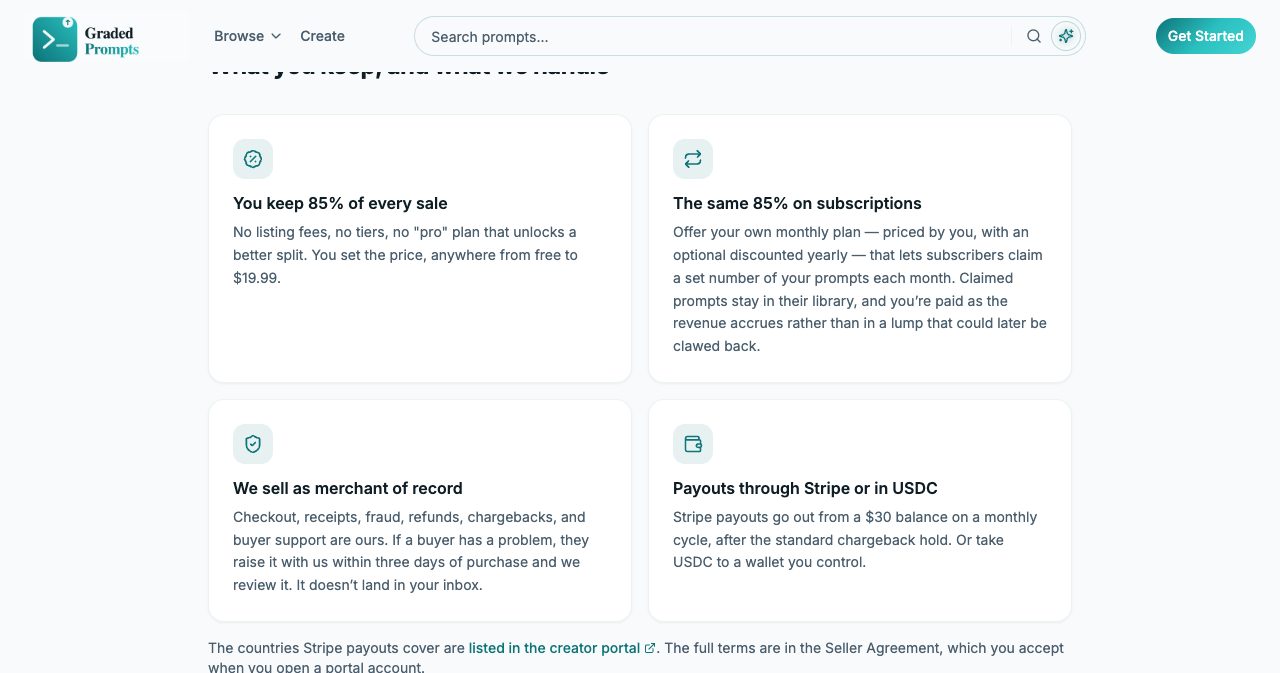
The terms in short:
- 85% of every sale. A flat 15% platform margin, with no listing fees, no tiers and no "pro" plan that unlocks a better split.
- Your price. Anywhere from free to $19.99.
- Your own subscription. You can offer a monthly plan, with an optional discounted yearly price, that lets subscribers claim a set number of your prompts each month. You keep the same 85%, paid out as the revenue accrues.
- Payouts. Through Stripe from a $30 balance on a monthly cycle, after the standard chargeback hold, or in USDC to a wallet you control.
- No support inbox to run. Graded Prompts handles checkout, taxes, fraud, refunds, chargebacks and buyer questions.
The marketplace also works to bring you buyers. Your prompts show up in category browsing, keyword search and AI search. Followers get an email digest when you publish something new. Bundles and seller subscriptions are there once you have a catalog, homepage Spotlight and Featured spots are available to premium sellers on request, and site-wide promotions include your prompts automatically, with a per-prompt opt-out. In a multi-seller buy-two-get-one cart, the revenue is shared by listed price, so no single seller's prompt ends up as the free one.
You build a listing in the creator portal, which uses the same account you shop with. A wizard walks you through the template, the variables, the examples and the price, and your prompt goes into review. A public Top Sellers page ranks creators by activity on the marketplace.
The trade-offs, in the founder's own words
The seller guide has a section called "The honest downsides", and it's worth reading before you list:
- Grading takes time. Auto-publish platforms list you in minutes. Graded Prompts won't quote a turnaround, because it depends on the queue and on how many rounds your prompt needs.
- The catalog is young. The marketplace launched in June 2026 and is smaller than the names you know. Early sellers get more visibility on a growing site, with fewer buyers than an established one.
- Rejections are usually avoidable. The most common reason is examples made with a different version of the prompt from the one uploaded. Generate your examples with the exact template you submit and you'll sail through.
- Text prompts don't run on the site, so the credits argument helps image and video sellers most.
For a seller with prompts that genuinely work, the review is an advantage. Your listing doesn't sit next to an untested upload with prettier, retouched previews, and every buyer knows a person ran your prompt before it went live.
Graded Prompts vs upload-and-publish prompt marketplaces
| Graded Prompts | A typical upload-and-publish marketplace | |
|---|---|---|
| When a prompt is checked | Before it goes on sale, by a person, on the real model | Mostly after sale, through buyer ratings |
| Example outputs | Compared with the reviewer's own run | Supplied by the seller |
| Catalog size | Smaller, by design | Large |
| Running a prompt before you rely on it | Bonus credits on every paid prompt for image and video runs | Usually your own subscription only |
| Who handles refunds | The marketplace, as merchant of record | Varies |
| Commercial licence | Included on every purchase | Varies |
| Account needed to buy | No, guest checkout | Varies |
| Seller share | 85%, flat | Varies |
The trade is clear and Graded Prompts makes it on purpose: a smaller catalog in exchange for knowing that everything in it has been run on its model by a person. If you want the biggest possible selection, a larger marketplace gives you more to scroll through. If you'd rather have fewer options that have each been tested, Graded Prompts is built for you.
Who is Graded Prompts for?
- Designers, marketers and small business owners who want a specific look, such as a product mockup, a book cover, a poster or a brand banner, without spending an afternoon reverse-engineering a style.
- Freelancers and agencies who need commercial and client rights spelled out on every purchase.
- Midjourney and ChatGPT Image users who've been burned by previews that didn't match, and want to run a prompt on their own inputs before relying on it.
- Teachers, writers and professionals looking for structured text prompts, from lesson plans and proposals to resumes and ad copy.
- Vibe coders and indie game makers curious about one-prompt builds in Claude Code, Codex or Cursor, with a playable demo to try first.
- Prompt creators who want a quality filter, an 85% share and no support inbox to run.
What we liked, and what to know first
What stands out
- Every prompt is tested by a person on its real model before sale. That includes the free ones.
- The examples are checked against real output, which is the part that matters most when you're buying from previews.
- Bonus credits on every paid prompt let you run image and video prompts yourself, on the real model, with no API keys or extra subscriptions.
- The licence is clear and covers commercial and client work across as many projects as you like.
- One company handles refunds, with a published process and response times.
- AI search understands plain English and works without an account.
- The apps and games section shows playthrough videos, the exact tool and model, the tech stack and the build time, with a playable demo.
- The documentation is unusually candid, from what the badge does and doesn't promise to the founder's list of downsides.
- Privacy is taken seriously: no ads, no trackers and no cookie banner because there's nothing to consent to.
Worth knowing
- The catalog is still small. The marketplace launched in June 2026, so a niche style may not be covered yet.
- The refund window is 3 days. Run or paste a new prompt soon after you buy it.
- Credits suit image prompts best. One purchase covers a few image runs, while a video run costs more credits than a single purchase includes.
- Text and app prompts run in your own tools, so you'll need your own ChatGPT, Claude or coding agent account for those.
- Some configurations don't run on the site yet, such as image-to-image or video with audio, though copying the prompt always works.
- Output rights follow the model's terms, so check the platform's rules for commercial use.
How to get started with Graded Prompts
- Describe what you need in AI search, or browse by type, model and category. No account is needed to look around.
- Claim a free prompt to see the quality bar and how your Library works.
- Read the listing before you buy: the model, the Graded and Commercial labels, the examples and the bonus credits.
- Buy as a guest with your email at the Stripe checkout, or with your account.
- Run image and video prompts on the real model from your Library with your credits, checking the cost shown before each run.
- Copy text and app prompts into the tool the listing names and follow the seller's instructions.
- Email [email protected] within 3 days if a prompt doesn't do what its listing says.
Is Graded Prompts worth it?
If you buy prompts for real work, yes. Graded Prompts sells something that's hard to find in a prompt marketplace: confidence before you pay. A person has run the prompt on its model, the examples are genuine, the image and video prompts come with credits so you can see them work on your own inputs, and if something's wrong, one company handles the refund. At $2.99 to $9.99 a prompt, with a commercial licence included, that's a lot of reassurance for the price of a coffee.
The catalog is young and smaller than the big names, and the team is upfront about it. The best way to judge it is the way the marketplace itself suggests: claim a free prompt, try one paid image prompt with its bonus credits, and see whether the result looks like the listing. A few dollars and ten minutes will tell you whether it fits the way you work.
FAQ
What is Graded Prompts?
Graded Prompts is an AI prompt marketplace at gradedprompts.com where a human reviewer tests every prompt, free or paid, on the AI model it was written for before it goes on sale. Prompts that pass get the Graded badge. It sells image, video, text and app-building prompts for Midjourney, ChatGPT, ChatGPT Image, Claude, Gemini, FLUX, Kling, Seedance, Veo, Claude Code, Cursor and more. It is run by Graded Prompts Ltd, a company registered in England and Wales, and launched in June 2026.
How does Graded Prompts test prompts?
Every submission goes through five steps done by a person. The reviewer checks that the title, description, category, model and tags match the prompt, checks that the instructions are complete and every variable is labelled, runs the prompt on its real model with different inputs, compares the seller's example outputs with what the model actually produces, and then either publishes it with the Graded badge or sends it back with specific feedback. Automated checks help with format validation, but the testing and the decision to publish are human.
How much do prompts on Graded Prompts cost?
Prompts are a one-time purchase in US dollars, with no subscription to the marketplace. As of November 7, 2026, paid prompts on the homepage cost between $2.99 and $9.99, and a set of prompts is free to claim. Sellers can price a prompt anywhere from free to $19.99. Each paid prompt includes bonus credits for running image and video prompts on the site.
What are Graded Prompts bonus credits?
Every paid prompt includes at least 100 bonus credits, and pricier prompts include more: we saw 100 credits on $2.99 prompts, 150 on $4.49 and $4.99, 200 on $5.99, 250 on $7.99 and 300 on $9.99. Credits from all your purchases pool into one balance, which you spend running image and video prompts on the real model inside the site. A Midjourney run costs 100 credits, ChatGPT Image 75 to 100 and FLUX 15 to 65. Failed runs are refunded automatically.
Can I run prompts on Graded Prompts without my own AI subscription?
For image prompts, and video prompts on supported models, yes: you can run them on the site with your bonus credits, with no API key or subscription of your own. Text prompts are copy-and-paste by design, so you use them in your own ChatGPT, Claude, Gemini or other account. App and game prompts run in your own coding tool, such as Claude Code or Cursor.
Can I use Graded Prompts prompts for commercial or client work?
Yes. Every purchase includes a worldwide, perpetual, non-exclusive licence for personal and commercial use, including client deliverables across as many clients and projects as you like. You can deliver the work you make with a prompt, but you can't share, resell or republish the prompt text itself, or use it to train AI models. Rights in the outputs follow the terms of the AI platform you run the prompt on.
Does Graded Prompts offer refunds?
Yes, when a prompt doesn't work as described: it doesn't match its listing or examples, won't run on the platform it names, or was materially misrepresented. Email [email protected] within 3 days of purchase with your order ID and screenshots of the output. Graded Prompts acknowledges requests within 2 business days and aims to decide within 5. Normal output variation, a change of mind or running the prompt on a different model aren't covered.
Can I buy on Graded Prompts without an account?
Yes. Paid prompts support guest checkout: you enter your email on the Stripe payment page, and Graded Prompts creates a free account for that email so the purchase lands in your Library. You can sign back in later with a one-time email code. Free prompts need you to sign in before you claim them.
Will my results look exactly like the example outputs?
Not exactly, because generative AI gives a different result each run. What grading confirms is that the examples are genuine output from the prompt on its named model, not cherry-picked or edited, and that the prompt performs as the listing describes.
Which AI models does Graded Prompts support?
As of November 7, 2026, the catalog filters cover 12 image models (Midjourney, ChatGPT Image, FLUX, Stable Diffusion, Ideogram, Leonardo AI, Recraft, Seedream, Gemini Image, Grok Image, Qwen Image and Hunyuan), 6 video models (Kling AI, Seedance, Veo, Wan, Hailuo AI and Midjourney Video) and 6 text models (ChatGPT, Claude, Gemini, Llama, DeepSeek and Grok). App and game prompts cover Claude Code, Codex, Cursor, Google Antigravity, Lovable and Replit Agent.
What are app and game prompts on Graded Prompts?
They are prompts that build a playable game or a working app when you paste them into a coding agent or a no-code builder: Claude Code, Codex, Cursor, Google Antigravity, Lovable or Replit Agent. Each listing shows one to four playthrough videos, the tool and model used, the tech stack and the build time. You get the prompt and the seller's setup instructions, not the finished app.
How much do sellers earn on Graded Prompts?
Sellers keep 85% of every sale, including subscription revenue, with no listing fees and no tiers. They set their own price from free to $19.99 and can offer a monthly subscription. Payouts go through Stripe from a $30 balance on a monthly cycle, after the standard chargeback hold, or in USDC to a wallet. Graded Prompts is the merchant of record and handles checkout, refunds and buyer support.
Who owns Graded Prompts?
Graded Prompts is operated by Graded Prompts Ltd, a private company limited by shares registered in England and Wales under company number 17080335, with its registered office at 128 City Road, London EC1V 2NX. The founder, Ahmed, writes that he built it after burning his credits on a Kling video prompt that never delivered. General support is at [email protected].
Is Graded Prompts a good PromptBase alternative?
It suits buyers who would rather choose from a smaller catalog where each listing has been run on its model by a person, with examples checked against real output, included credits to run image and video prompts yourself and refunds handled by the marketplace. PromptBase has a far bigger catalog. If you want the widest choice, the bigger marketplace wins; if you want fewer, pre-tested options and a clear refund path, Graded Prompts is the better fit.
If you're building an AI product of your own, like Graded Prompts, SaaSCity is a human-reviewed startup directory with a live city map where a listing is a permanent page other founders actually see. Submitting takes about ten minutes.
Get your SaaS in front of founders
List your product on SaaSCity for $19.99, one-time: a permanent listing, a dofollow backlink and a building on the live city map.
Founder resources
Related articles
AI Art Create Review 2026: One Credit Balance for 12 Image and Video Models, Built for Characters
AMW Suite Review 2026: Your CRM, Proposals, Client Portal and Helpdesk on One Login, With AI Agents That Wait for Your OK