News
Apertus: The Open Foundation Model That Takes Sovereign AI from Slogan to Source Code
EPFL, ETH Zurich, and CSCS just released Apertus — a fully open foundation model trained on 15 trillion tokens across 1,800 languages. Not just open weights. Open data, open training recipes, open science. Here's what it is, what it actually delivers, and what it means for SaaS builders who care about data residency and compliance.

Contents (8)
Quick answer: Apertus is a fully open foundation model from EPFL, ETH Zurich and the Swiss National Supercomputing Centre, released at 8B and 70B parameters in Base and Instruct variants. It was trained on 15 trillion tokens across more than 1,800 languages with roughly 40% non-English content, on public Swiss compute, under Swiss data protection law. Unlike open-weight releases, it publishes training data, code, methods and alignment principles alongside the weights, and its paper passed peer review at ACL 2026.
Key Takeaways
- Open means more than weights: data, code, training recipes and alignment principles are all published and reproducible.
- Peer reviewed, not announced: the technical paper was accepted at ACL 2026, a venue with roughly a 20% acceptance rate.
- Scale and breadth: 15 trillion tokens, 1,800+ languages, about 40% of pretraining on non-English content.
- Compliance is architectural: the Goldfish objective suppresses verbatim memorization during training rather than filtering output afterward.
- Auditable provenance: robots.txt honored, PII removed before training, toxic content filtered at the data stage, Swiss copyright compliance documented.
- It does not lead on benchmarks: Nemotron reportedly beats it on multiple standard tasks, especially coding.
- Known limits: a March 2024 knowledge cutoff and uneven translation quality on lower-resource language pairs.
- Apertus Mini extends the range: 16 distilled and quantized models for edge, air-gapped and cost-constrained deployment.
Your AI vendor knows your prompts. Every call to a closed model — GPT, Claude, Gemini — lands on someone else's infrastructure, governed by someone else's terms, subject to someone else's jurisdiction. For most use cases, that's an acceptable trade. For healthcare records, legal discovery, defense procurement, or any data that crosses a regulatory boundary, it's a structural problem with no patch.
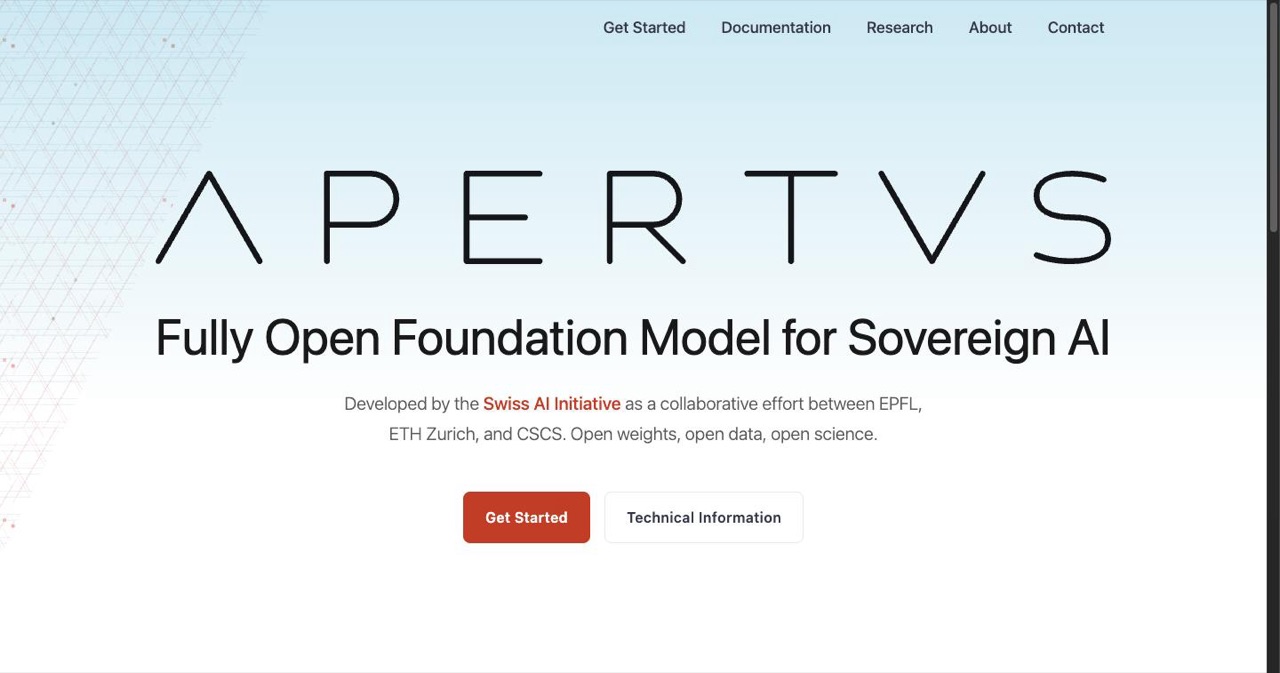
Apertus is a direct answer to that problem — and it's one of the few answers backed by peer-reviewed science. Built by EPFL, ETH Zurich, and the Swiss National Supercomputing Centre (CSCS) as part of the Swiss AI Initiative, Apertus is a fully open foundation model at 8B and 70B parameters, trained on 15 trillion tokens across 1,800+ languages, with every component of its existence documented and publicly verifiable.
That last part is what separates Apertus from almost everything in the open model ecosystem right now. "Open weights" has become a marketing term. Releasing weight files while keeping training data and recipes proprietary is what most major labs do. Apertus means something different by open: weights, training data, code, methods, and alignment principles — all documented, all available, all reproducible. The team summarizes it as "open weights, open data, open science."
The technical paper was accepted at ACL 2026 — one of NLP's highest-bar venues, running roughly a 20% acceptance rate. That's not a press release. That's peer review.
What "Sovereign AI" Actually Means Here
The phrase gets thrown around in policy circles until it loses meaning. When Apertus uses it, there's a specific technical claim underneath.
Most large-scale AI deployments are sovereign only on paper. You might run inference on your own hardware, but the model weights came from a US company's training run, on US-controlled compute, using datasets assembled under US copyright interpretations. The model's knowledge, its cultural defaults, its failure modes — they reflect choices made in that training run. When those choices are opaque, you can't audit them, reproduce them, or challenge them in a procurement review.
EPFL's Martin Jaggi described the goal plainly: "With this release, we aim to provide a blueprint for how a trustworthy, sovereign, and inclusive AI model can be developed." ETH Zurich's Imanol Schlag framed Apertus as "the first of its kind to embody multilingualism, transparency, and compliance as foundational design principles."
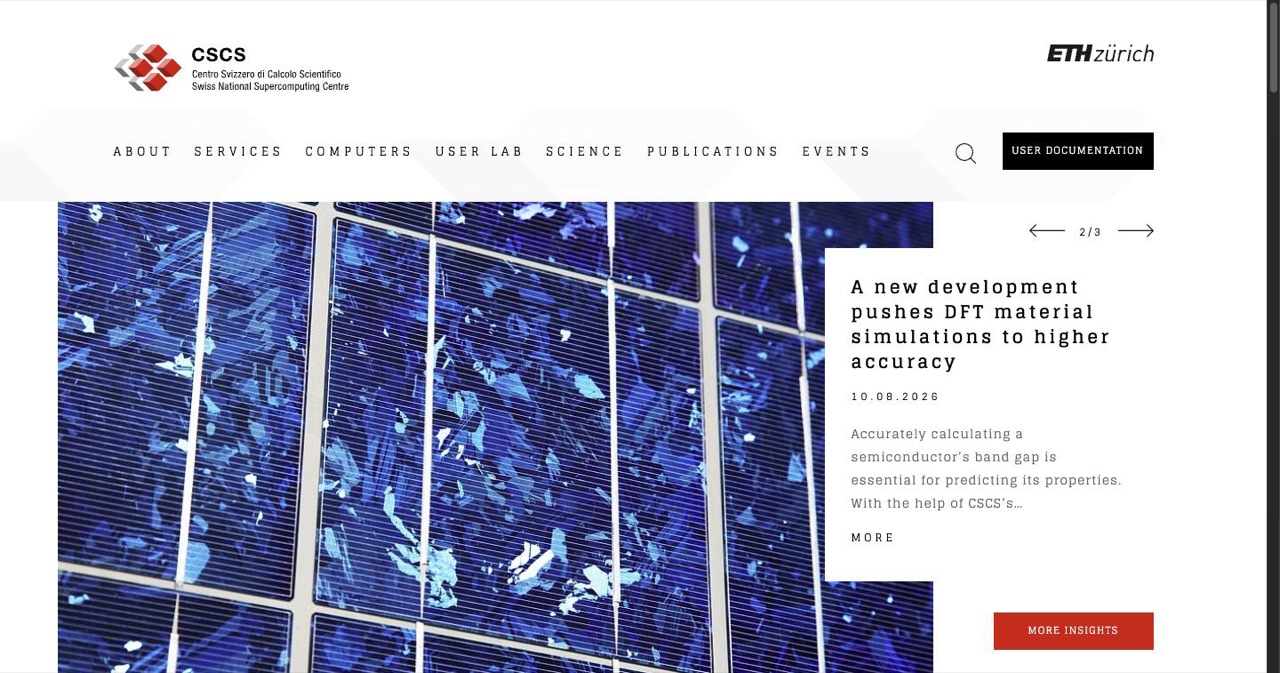
The Swiss AI Initiative built the model on public infrastructure — CSCS is Switzerland's national supercomputing center, not a commercial cloud provider. The training corpus was compiled under Swiss data protection law, with EU AI Act compliance baked into the data pipeline, not bolted on afterward.
If you're in a regulated industry and need to answer the question "where did this model's training data come from, and can you prove it?" — Apertus is one of the few places you can actually answer that.
The Technical Architecture
Model Sizes and Variants
Apertus ships in two scales, each available in Base and Instruct variants:
| Model | Parameters | Best for |
|---|---|---|
| Apertus 8B Base | 8 billion | Research, custom fine-tuning, resource-constrained deployments |
| Apertus 8B Instruct | 8 billion | Conversational tasks, instruction-following workloads |
| Apertus 70B Base | 70 billion | High-performance inference, complex reasoning tasks |
| Apertus 70B Instruct | 70 billion | Enterprise-grade instruction tasks, multilingual production use |
All four variants were trained using identical hyperparameters on the same dataset. That consistency matters for researchers: when you observe behavioral differences between the 8B and 70B, the variable is scale — not confounded training choices.
15 Trillion Tokens, 1,800 Languages
The training corpus is the most distinctive part. At 15 trillion tokens spanning 1,800+ languages, Apertus allocated roughly 40% of pretraining to non-English content — a proportion that's unusual at this scale. The dataset includes lower-resource languages like Swiss German and Romansh that have near-zero representation in typical English-first training pipelines.
This isn't symbolic diversity. It reflects a genuine design claim: a model intended for global sovereign deployment needs to perform across linguistic contexts without requiring a separate fine-tune for every region.
The Goldfish Objective
One of the most technically interesting components is the Goldfish objective — a modification applied during pretraining to suppress verbatim memorization.
Standard LLMs memorize training data. When you can extract exact passages from a model's weights, you simultaneously have a copyright liability and a GDPR violation waiting to happen. The Goldfish objective modifies the training loss to reduce exact-repetition probability without degrading general language modeling quality. It's one of several mechanisms Apertus uses to address EU AI Act compliance at the architecture level rather than as a post-hoc content filter.
The distinction matters for compliance: a filter applied at inference time can be circumvented or bypassed. A training objective that shapes what the model learns cannot.
Data Compliance Infrastructure
Beyond the Goldfish objective, the data pipeline included:
- Robots.txt exclusions honored across the entire web-sourced corpus
- PII removal before training, not after
- Toxic content filtering applied at the data stage
- Swiss copyright law compliance documented and auditable
Organizations in regulated industries can point to the training process, not just output behavior, during compliance audits. That's not possible with any closed-weight model.
Apertus Mini: June 2026
In June 2026, the Swiss AI team released Apertus Mini — 16 small language models demonstrating distillation and quantization techniques derived from the main suite. The release serves two purposes: it's a research artifact showing how Apertus-class capabilities compress for edge deployment, and a practical toolkit for builders who need inference in environments where a 70B model is operationally impractical.
On-device inference. Air-gapped deployments. Cost-constrained pipelines. Mini is the entry point for all of these.
What the Benchmarks Actually Show
Being honest about this requires being honest about what Apertus is optimized for — and what it isn't.
The competition is strong. Allen AI's OLMo 3.1, MBZUAI's K2 Think V2, and Nvidia's Nemotron family are all competitive in the fully-open or near-open space. On raw benchmark scores, several outperform Apertus, particularly on coding-heavy evaluations. Nemotron reportedly surpasses Apertus on multiple standard tasks. If your only metric is "highest MMLU score," Apertus is not the winner today.
The knowledge cutoff is a real constraint. Apertus v1 carries a March 2024 knowledge cutoff — over two years behind current events. For knowledge-retrieval-heavy applications, that gap matters. For applications where provenance, compliance, and reproducibility matter more than current events, it matters much less.
Multilingual quality has rough edges. Early testers reported hallucination issues in translation tasks, including generating words that don't exist in target languages. The 1,800-language training claim reflects data breadth, not uniform production quality across every language pair. Lower-resource languages will need fine-tuning investment before production use.
What Apertus isn't trying to win on is raw benchmark position. The optimization target is: a fully auditable, legally defensible, sovereignty-preserving AI foundation that can be reproduced, inspected, and extended by anyone. That's a different competition from "highest HumanEval score" — and one where almost no other model at this scale is competing at all.
For where Apertus sits in the broader open-weights landscape, the Kimi K2.7 breakdown on SaaSCity and the MiniMax M3 review cover what's shipping at the competitive frontier across different priorities.
List Your AI Tool on SaaSCity
Building with open models? Fine-tuning Apertus for a regulated vertical? Shipping an EU AI Act-compliant product?
SaaSCity.io is the premier directory for AI tools and open-source products. Your listing doesn't get a static page — every product is visualized as a building in an interactive 3D digital city, visible to the founders, engineers, and buyers actively looking for what you ship.
- Free to list: Submit your project in under 2 minutes — no credit card, no catch.
- Earn dofollow backlinks: Every listing earns high-quality backlinks that move your domain rating. Our complete guide to domain rating covers why this compounds over time.
- 3D map visibility: Your product appears in the SaaSCity engine — the most distinctive directory experience in the space.
- Reach the right audience: Founders, tooling engineers, and early adopters — not generic traffic.
What This Means for SaaS Builders
Three things worth taking seriously if you're building AI-powered products in 2026.
1. The Compliance Moat Is a Real Differentiator
If your customers operate in regulated industries — healthcare, legal, finance, government — "we use a fully auditable, EU AI Act-compliant foundation model" is a sales argument your GPT-4-based competitors structurally cannot make. The ability to hand a procurement team the complete training provenance of your AI stack is increasingly a deal qualifier, not just a nice-to-have. It's the kind of capability that makes or breaks enterprise contracts in heavily regulated markets.
Apertus is one of the few paths to that argument that doesn't require building your own pretraining infrastructure from scratch. If your target market has compliance requirements, the choice of underlying model is product strategy, not a pure engineering decision.
2. The Self-Hosting Path Just Got More Viable
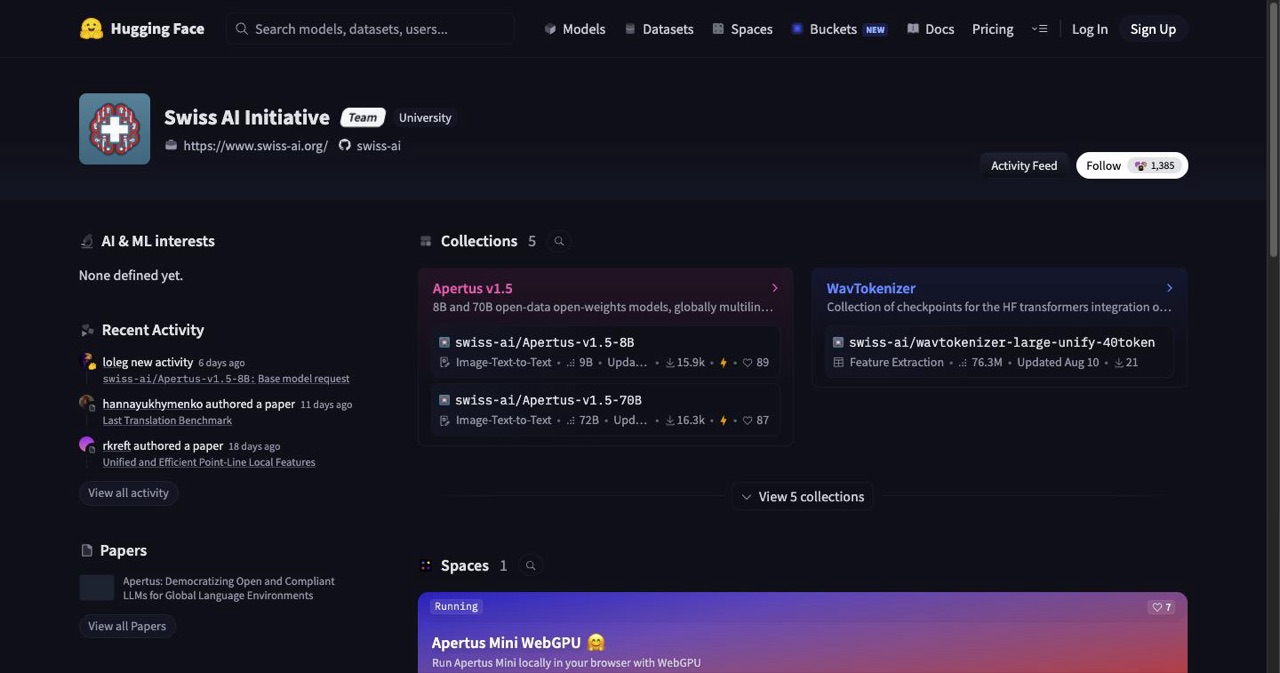
Running inference on your own infrastructure eliminates the data exposure question entirely. With Apertus weights freely available on Hugging Face (@swiss-ai collection), a 70B model that holds its own in specific domains, and the Mini toolkit for resource-constrained deployment, the self-hosting path for smaller teams is more achievable than it's ever been. If you're mapping out what that costs to build on, the open-source AI SaaS boilerplates comparison walks through the starting stack.
3. Non-English Markets Have a New Starting Point
A model trained on 1,800+ languages with 40% non-English content at 70B scale starts with multilingual coverage that English-centric fine-tuning approaches can't match. For SaaS products targeting Southeast Asia, Latin America, Central/Eastern Europe, or multilingual European markets, Apertus is worth evaluating as a foundation before assuming you'll need a separate localization layer.
The rough edges on some language pairs are real. But the rough edges on English-centric models deployed into non-English contexts are often worse — and harder to catch in standard benchmarks.
The Bet Behind It
There's a broader pattern forming in 2026 that Apertus fits squarely into: public institutions deciding that AI is infrastructure, not a product. Roads, water, electrical grids — these aren't left to private companies to operate as competitive moats. The Swiss AI Initiative built this model on public compute, published it without a commercial license, and framed the release explicitly as public infrastructure.
The counterargument is also real: private companies move faster, invest more, and ship better results than academic committees. The criticism that Apertus moves "at the speed of a committee" isn't wrong about pace. It might be wrong about whether pace is the right metric for infrastructure meant to outlast any particular commercial model cycle.
GPT-4's weights aren't publicly auditable. Llama 3's training data isn't fully disclosed. Claude's pretraining corpus can't be inspected by any external party. If you need a model whose behavior you can understand, audit, and reproduce — fully, not just approximately — the options are few. Apertus is one of them.
The question isn't whether it beats the frontier on a coding benchmark today. It's whether, five years from now, you'd rather have built your stack on something auditable or something you took on faith.
SaaSCity.io covers AI tools and open-source releases. Explore the SaaSCity directory to discover what's shipping right now — or list your own product.
Get your SaaS in front of founders
List your product on the SaaSCity live city map - a permanent listing, real discovery, and a backlink from a high-DR directory. Free to start; upgrade for a dofollow link and a building on the map.