News
Qwen 3.6 27B Is the Sweet Spot for Local Development
A 27B dense model that beats Alibaba's own 807 GB flagship on SWE-bench, fits on a single RTX 3090, and has developers canceling their Claude API subscriptions. Here's what makes it actually work.

Contents (10)
Quick answer: Qwen 3.6 27B is Alibaba's Apache 2.0 dense model, released April 22, 2026, that scores 77.2% on SWE-bench Verified while fitting in 16.8 GB of VRAM at Q4_K_M on a single RTX 3090. It beats the Qwen 3.5 397B-A17B MoE flagship (76.2%) that needed 807 GB in BF16. A 3:1 hybrid of Gated DeltaNet linear attention to Gated Attention keeps its 256K context fast, and Multi-Token Prediction adds a 1.4x to 2.2x generation speedup for about 1 GB more VRAM.
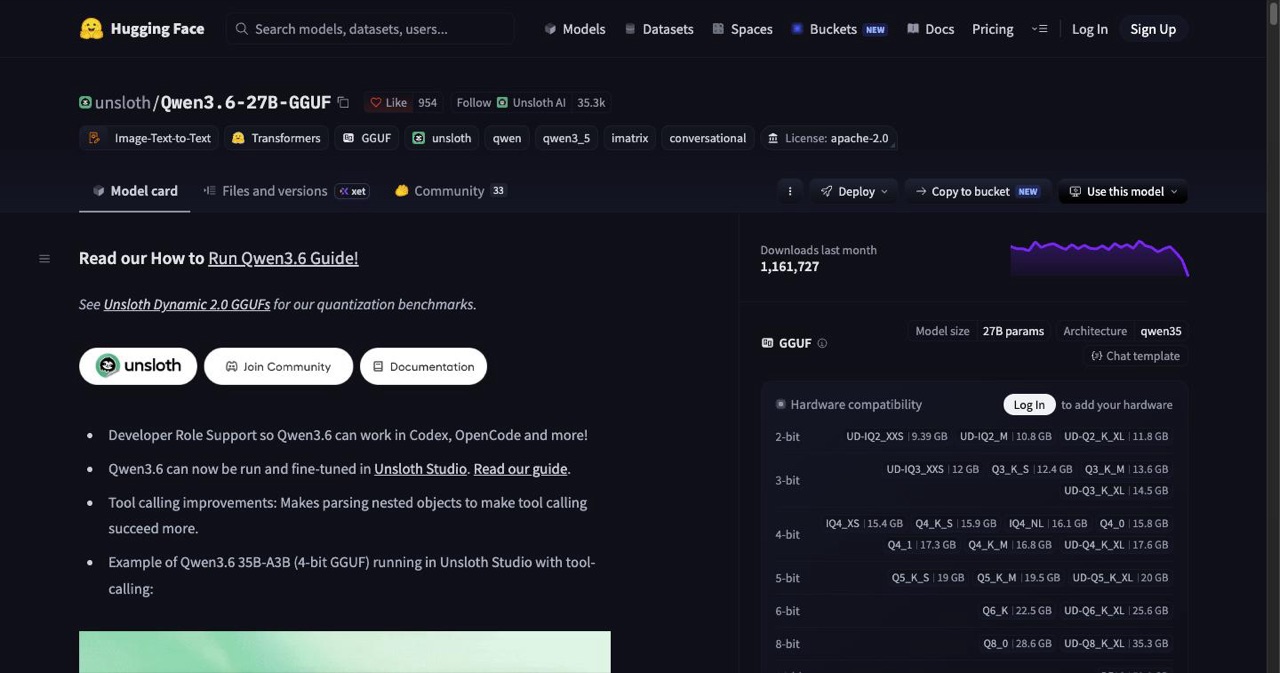
A model that requires 807 GB of storage to run was Alibaba's flagship six weeks before Qwen 3.6 27B shipped. The 27B dense model outperforms it on SWE-bench — the benchmark that measures real GitHub bug-fixing, not toy coding puzzles — and fits in 16.8 GB of VRAM on a single RTX 3090.
That's not a compression trick. It's a different architectural bet, and understanding why it works explains a lot about where local AI inference is actually heading in 2026.
Key Takeaways
- Beats a 807 GB flagship at 16.8 GB: 77.2% on SWE-bench Verified versus 76.2% for the Qwen 3.5 397B-A17B MoE, with 1/14th the active parameter count.
- Single-GPU target: Q4_K_M at 16.8 GB fits an RTX 3090, 4090 or 5080; Q3_K_M at 15 GB fits an RTX 4080 or 5070 Ti.
- 3:1 hybrid attention: Three Gated DeltaNet linear sublayers per Gated Attention sublayer keep the 256K context fast, with 1,010,000 tokens reachable via YaRN.
- MTP is worth enabling: About 1 GB extra VRAM for a 1.4x to 2.2x speedup, taking an M5 Max from 18 tok/s to 32 tok/s at Q8_0.
- Bandwidth beats capacity on Mac: M5 Max at 614 GB/s versus M4 Mini at 273 GB/s explains the 6x gap; a base Mac M4 32GB manages only about 5 tok/s at Q4.
- Dense wins on long context: MoE quality degrades past 32K to 64K tokens, which is why the 27B dense outscores the faster 35B-A3B MoE on real repo-scale bug fixing.
- Known gaps: Ollama's build has no vision projector, the Terminal-Bench 59.3% run used non-standard settings, and Gemma 4 31B leads on security bug hunting.
What Qwen 3.6 27B Is
Alibaba's Qwen team released Qwen 3.6 27B on April 22, 2026 under an Apache 2.0 license. Dense model — not a Mixture-of-Experts (MoE) architecture — meaning all 27 billion parameters activate on every single token. 64 layers organized as 16 repeating blocks. 256,000-token native context window, extendable to 1,010,000 tokens via YaRN scaling. 201 languages supported.
Weights are available on Hugging Face in BF16 (55.6 GB) and FP8. The quantized GGUF versions from Unsloth are what most people are running. The Q4_K_M quantization at 16.8 GB is where the majority of community testing has concentrated — it's the point where the model fits cleanly on the most common prosumer GPU without compromising quality below the point of usefulness.
The predecessor it displaced was the Qwen 3.5 397B-A17B MoE, a model that required 807 GB in BF16 just to store. Qwen 3.6 27B beats it on SWE-bench Verified (77.2% vs 76.2%) with 1/14th the active parameter count.
The Architecture Behind the Efficiency
Standard transformers use quadratic attention — processing cost grows as the square of sequence length. At 256K tokens, quadratic attention becomes the dominant cost, which is why most models that claim large context windows are slow and expensive to use at that scale in practice.
Qwen 3.6 27B uses a 3:1 hybrid architecture: three Gated DeltaNet sublayers (linear attention) for every one Gated Attention sublayer (quadratic). Linear attention processes tokens at constant cost regardless of sequence length. Quadratic attention only fires on one out of four sublayers — handling the precise reasoning that linear attention can't replicate — but it's not dominating the compute budget.
The practical consequence: long contexts are genuinely fast. A user on an RTX 5090 reported 50 tokens/s at 123K context using Q6_K quantization. That's the 27B dense maintaining real agentic-loop speeds at context lengths where dense models typically grind down.
The model also ships with Multi-Token Prediction (MTP) support. The MTP variant adds ~1 GB of VRAM but delivers 1.4–2.2x generation speedup on dense architectures. On an M5 Max 128GB MacBook, llama.cpp with MTP jumps from 18 tok/s to 32 tok/s at Q8_0. An RTX 6000 setup with MTP hits 160 tok/s. It's worth enabling if your inference stack supports it.
Hardware Requirements
What you actually need to run this locally:
| Quantization | VRAM | Target Hardware |
|---|---|---|
| Q3_K_M | 15 GB | RTX 4080, RTX 5070 Ti |
| Q4_K_M | 16.8 GB | RTX 3090, RTX 4090, RTX 5080 |
| Q6_K | ~22.5 GB | RTX 4090 (24 GB), RTX 5090 |
| Q8_0 | ~29 GB | RTX 5090 (32 GB), Mac M5 Max 64GB+ |
| BF16 | 55.6 GB | High-end workstation, multi-GPU |
MTP variants add ~1 GB. Enable --spec-draft-n-max 2 in llama.cpp for the speedup — optimal value varies between 1 and 6 per hardware setup.
Real-world generation speeds across common setups:
| Hardware | Quantization | Speed |
|---|---|---|
| MacBook M5 Max 128GB | Q8_0 (llama.cpp + MTP) | 32 tok/s |
| MacBook M5 Pro 128GB | Q4_K_M | 25 tok/s gen, 54 tok/s prefill |
| RTX 5090 (32 GB) | Q6_K at 123K context | 50 tok/s |
| RTX 5090 | Q8_0 | ~67 tok/s |
| RTX 4090 (24 GB) | Q4_K_M | ~43 tok/s |
| RTX 3090 (24 GB) | Q4 Int4 via vLLM | 70–75 tok/s |
| 2× RTX 3090 | Q4 | 110 tok/s |
| Mac M4 (32 GB) | Q4 | ~5 tok/s |
That Mac M4 number is the important cautionary data point. Memory bandwidth matters more than RAM capacity for inference speed. M5 Max at 614 GB/s vs M4 Mini at 273 GB/s explains the 6x speed difference. A used RTX 3090 setup runs cheaper and significantly faster than a base M4 for inference-heavy work.
One quirk: Ollama's GGUF implementation for Qwen 3.6 27B doesn't wire up the vision projector — multimodal image input fails. Text-only tasks work fine via ollama pull qwen3.6:27b. For vision, use llama.cpp directly with the mmproj file.
The Benchmarks
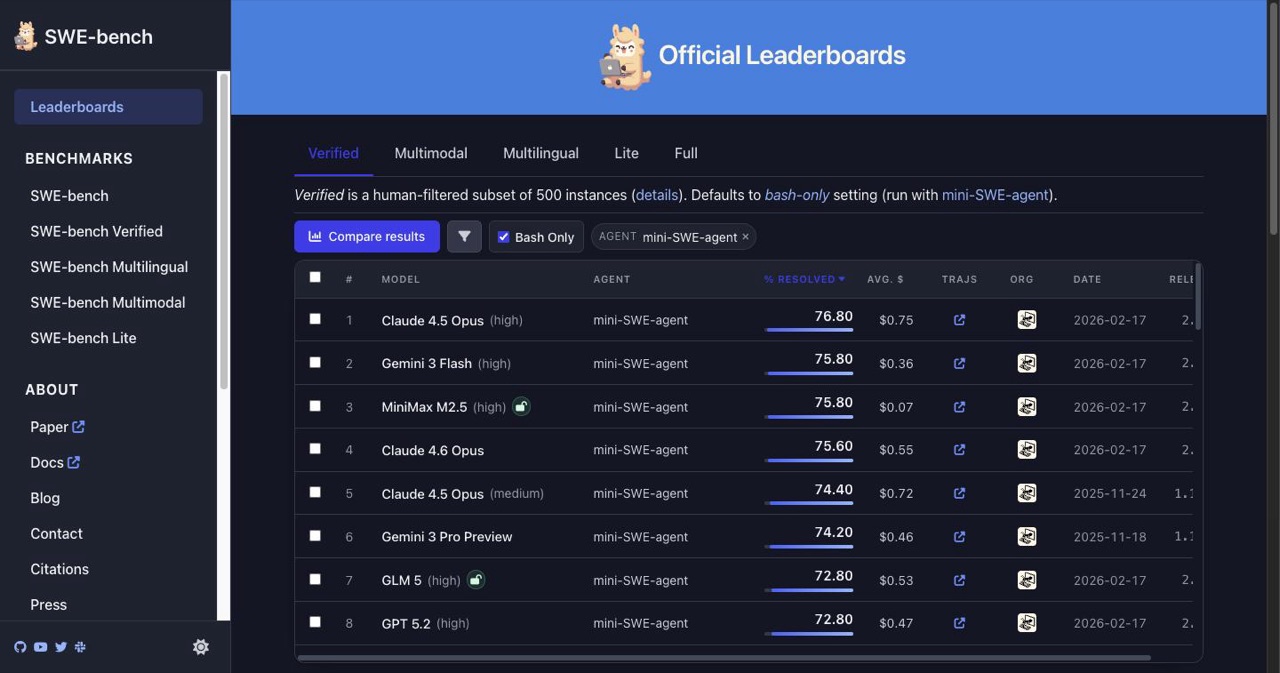
SWE-bench Verified is the benchmark that actually matters for development use. It measures whether a model can fix real GitHub issues in production repositories — not synthetic coding challenges. Scores here correlate strongly with agentic coding utility.
| Model | SWE-bench Verified | VRAM at Q4 |
|---|---|---|
| Claude 4.5 Opus | 80.9% | API only |
| DeepSeek V4-Pro | 80.6% | ~150 GB |
| Qwen 3.6 27B (dense) | 77.2% | 16.8 GB |
| Qwen 3.5 397B-A17B (MoE) | 76.2% | 807 GB (BF16) |
| Qwen 3.6 35B-A3B (MoE) | 73.4% | 22 GB |
| Qwen 3.5 27B | 75.0% | ~16 GB |
Qwen 3.6 27B beats both its predecessor MoE flagship and its own sibling 35B MoE at SWE-bench, despite being "smaller" by parameter count. On SkillsBench, it scores 48.2 versus the Qwen 3.5 27B's 27.2 — a 77% improvement in one generation. Terminal-Bench 2.0 at 59.3% matches Claude 4.5 Opus.
One caveat the community noted: HN commenters raised concerns about Terminal-Bench methodology, noting Qwen ran the evaluation with non-standard settings (3-hour timeouts, 32 CPUs, 48 GB RAM) that the official rules don't allow. The SWE-bench numbers were run under more standard conditions. Take Terminal-Bench at face value with that in mind.
Dense vs. MoE: Why the 27B Wins on Quality
The comparison between Qwen 3.6 27B dense and Qwen 3.6 35B-A3B MoE generates real community debate. The confusion comes from comparing parameter counts that measure different things.
The 35B-A3B MoE has 35B total parameters but activates only 3B per token. The 27B dense activates all 27B per token. At the same VRAM budget (around 22 GB), you're comparing 27B active parameters vs 3B active parameters per forward pass — the dense model is doing roughly 9x more computation per token.
MoE's upside is inference speed. The 35B-A3B hits 105 tok/s on an M5 Max 128GB vs the 27B dense at 32 tok/s. On CPU-offload setups like AMD R9700, one HN commenter reported ~80 tok/s for the MoE vs ~20 tok/s for the 27B dense. If raw throughput for shorter contexts is your priority, the MoE wins.
Where dense wins is long-context quality. MoE architectures degrade significantly as sequence length grows — community benchmarkers rarely test them past 32K–64K tokens because of this. Dense models hold quality as context grows. For agentic coding with full-repo context (32K–128K), the 27B dense consistently outscores the 35B MoE despite the speed gap. That's why SWE-bench favors the dense model: real bug-fixing tasks require the model to hold coherent context across large code chunks.
What This Means for SaaS Builders
The Hacker News thread that hit 995 points was full of developers running the numbers on whether they could cancel their Claude API plans. The consensus that emerged: yes, for development-time coding assistance — with the caveat that the 3.7-point SWE-bench gap versus Claude 4.5 Opus is real and compounds over long agent runs.
Three things worth doing now:
Set up a local inference endpoint. Point your coding agent at a local Qwen 3.6 27B endpoint via llama.cpp or vLLM. For code generation, debugging, and code review within a single repo, the quality is production-viable and your prompt data never leaves your machine. No API costs after hardware amortization. Research on where tokens actually go in agentic coding pipelines shows that 59% of agent tokens land in review and observation loops — the exact workload where local inference is most cost-effective to substitute.
Build pipelines that route by difficulty. Use local Qwen 3.6 27B for high-volume, fast-turnaround operations: code generation, autocomplete, summarization, lightweight planning. Route the hard reasoning tasks — complex multi-step agent decisions, final verification — to a closed frontier model. If you're building agentic software tooling on top of open models, the open-source AI SaaS boilerplate comparison covers which stacks support local model inference cleanly versus requiring cloud-first architectures.
Don't generalize from single-benchmark wins. HN commenters noted that Gemma 4 31B outperforms Qwen 3.6 27B on security bug hunting specifically. Qwen leads on agentic tool calling and multi-file coding. The Kimi K2.7-Code release is another option worth benchmarking for your specific workloads — the best local model depends on the task distribution you're actually running.
Getting Started
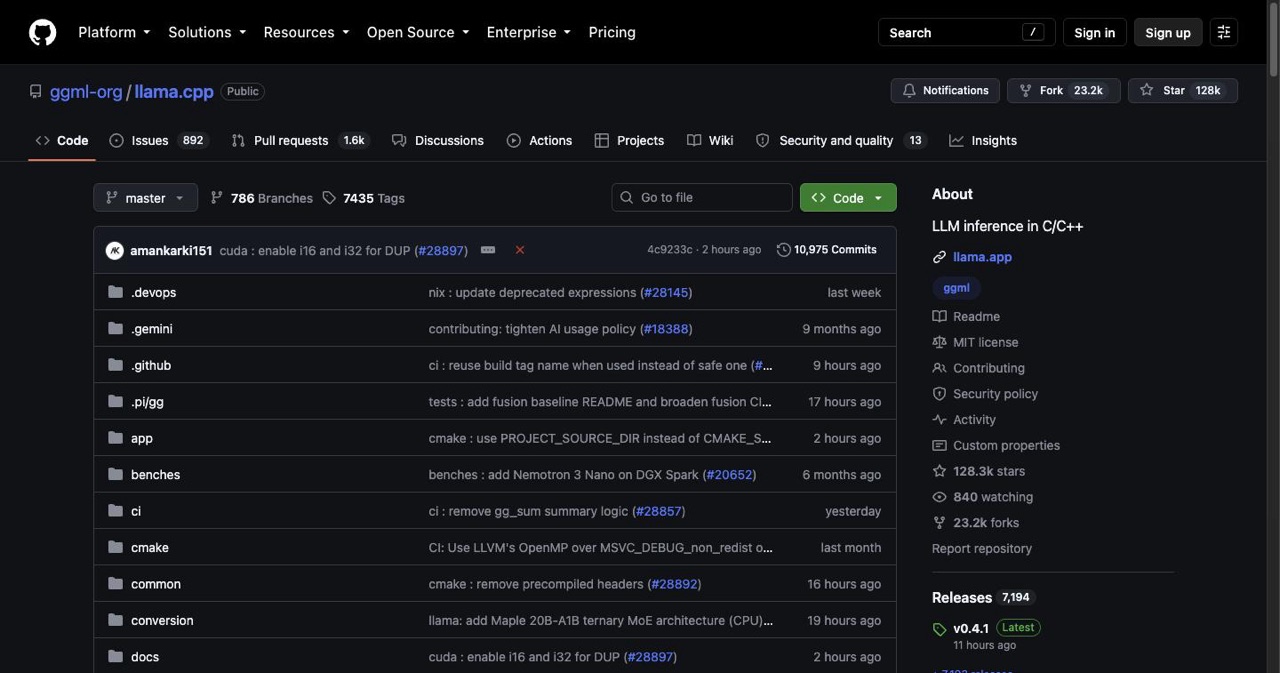
The fastest path to a local endpoint:
# Ollama — text-only, quickest setup
ollama pull qwen3.6:27b

# llama.cpp — full featured, vision works, MTP speedup available
./llama-server \
  -m Qwen3.6-27B-MTP-Q8_0.gguf \
  --spec-draft-n-max 2 \
  --repeat-penalty 1.1 \
  -c 131072
Recommended inference parameters:
- Coding/thinking mode:
temperature=0.6, top_p=0.95, top_k=20 - Chat/non-thinking mode:
temperature=0.7, top_p=0.8, top_k=20, presence_penalty=1.5 - Minimum 128K context — reasoning quality degrades meaningfully below this
- CUDA 13.2 driver: avoid it; outputs can be gibberish. Use below 13.2 or 13.3+
List Your AI Tool on SaaSCity
Building with local models? Shipping inference infrastructure or developer tooling powered by open-weight models like Qwen 3.6 27B?
SaaSCity.io is the premier directory for AI tools and developer infrastructure. Your listing doesn't get a static page — every product is visualized as a building in an interactive 3D digital city, visible to the founders, engineers, and buyers actively looking for what you ship.
- 🆓 Free to list: Submit your project in under 2 minutes — no credit card, no catch.
- 📈 Earn dofollow backlinks: Every listing earns high-quality backlinks that move your domain rating. Our complete guide to domain rating covers why this compounds over time.
- 🗺️ 3D map visibility: Your product appears in the SaaSCity engine — the most distinctive directory experience in the space.
- 🎯 Reach the right audience: Founders, tooling engineers, and early adopters — not generic traffic.
The Actual Implication
The 27B parameter range is where the "good enough vs closed API" line is crossing for local development. Not because 27B is a magic number — because at 27B dense, you can fit flagship-competitive coding quality onto a single consumer GPU at interactive speeds. The next size up requires two GPUs or Apple Silicon pricing. The size below loses too much quality for agentic tasks.
What's changed isn't just the model. Running Qwen 3.6 27B locally two years ago would have required specialized MLOps knowledge and significant infrastructure investment. Today it's an Ollama command and a compatible GPU. The time-to-first-token is under a second on most setups listed above.
The benchmark chase between open-weight and closed models isn't over. Claude 4.5 Opus's 80.9% SWE-bench versus Qwen 3.6 27B's 77.2% is a 3.7-point gap that matters on demanding tasks. But that gap is now the conversation, not the chasm. And it's being evaluated on hardware most developers already own.
SaaSCity.io covers AI tools and developer infrastructure. Explore the SaaSCity directory to discover what's shipping right now — or list your own product.
Get your SaaS in front of founders
List your product on the SaaSCity live city map - a permanent listing, real discovery, and a backlink from a high-DR directory. Free to start; upgrade for a dofollow link and a building on the map.