News
The FBI Says ARTEX Reaches Admin in Under Three Hours. It Starts With the Door You Forgot to Lock (2026)
The FBI says ARTEX, an open-source AI agent framework, has taken intrusions from first contact to privileged access in under three hours. It got there through forgotten keys, unauthenticated API routes and side apps nobody watched. Here is what it breached, which bugs it hunts first, and the nine-step audit to run before your next launch on SaaSCity or anywhere else.

Contents (16)
- Key takeaways
- What is ARTEX and how does the AI hacking tool work?
- What does the FBI's ARTEX advisory say?
- What did ARTEX actually breach?
- Why do AI attackers go after the app you forgot you shipped?
- Which bugs does ARTEX find first, and do you have them?
- How does ARTEX compare with a human pentest and a scanner?
- Is your AI vendor key a target?
- Are long-lived API keys still acceptable in 2026?
- What does machine-speed detection look like in logs?
- The ARTEX-proof audit you can run this week
- What should you do if you think you've been hit?
- Does the model's safety training stop this?
- The same lesson as Supabase and LiteLLM, from the other side
- Ship the fix, then ship the launch
- FAQ
At 04:33 UTC on 1 November 2026, somebody made an API call with a cloud key Barracuda had forgotten it handed out. The key came from a finished project with an outside AI vendor. Over the next 44 hours the intruder moved through about 10 cloud accounts on five platforms, and what finally caught it was an engineer who noticed odd activity on their own account, after the attacker had already gone quiet.
Quick answer: ARTEX is an open-source, multi-agent AI penetration-testing framework written in Go that the US Federal Bureau of Investigation (FBI) says threat actors have used since at least August 2026 to automate intrusions from reconnaissance to data theft. The FBI's FLASH advisory of 13 November 2026 says some ARTEX intrusions reached privileged access in under three hours.
The speed made the headlines, but if you run a small SaaS, read the bug list. What the FBI says ARTEX exploited looks like review comments on a weekend build: API routes with no authentication, object IDs anyone can swap, admin passwords baked into JavaScript bundles, signing keys nobody rotated. The advisory adds that ARTEX does its best work on the systems that get the least attention. For an indie founder, that's the v1 app still running on an old subdomain, the staging API with a test key, and the token you gave a contractor last spring.
Below are the three breaches on record, then a nine-step audit built around three checks you can run in a terminal this week: which of your hostnames still resolve, which credentials still work, and which endpoints answer without a session cookie.
Last updated: November 17, 2026. Figures come from the FBI advisory and the incident reports linked where they appear, each with its publication date.
Key takeaways
- The FBI published FLASH-20261113-001 on 13 November 2026, warning that ARTEX automates intrusions "at machine speed" and that some reached privileged access in under three hours.
- ARTEX ships no model. Operators plug in Claude, GPT, DeepSeek, GLM, Grok or Kimi, and on attacker-run instances DeepSeek's Flash models are the most common.
- Documented victims include ConnectWise Cloud Backup customers (Microsoft counted sign-in attempts against more than 2,250 tenants), Barracuda (about 10 cloud accounts in 44 hours) and South Korean banks (about 67,000 people's data, per the FBI).
- The bugs it exploits are ordinary: missing API authentication, IDOR, SQL injection, admin passwords in JavaScript bundles and admin tokens forged with unrotated keys.
- Stolen AI provider keys are now a prize of their own. Railway estimated about $740,000 of unauthorised spend on keys taken in its October incident.
- Barracuda's CISO wrote that short-lived, narrowly scoped credentials "would have stopped this intrusion at its first step." Removing that standing access is the defence a small team can afford, and the audit below takes an afternoon.
What is ARTEX and how does the AI hacking tool work?
ARTEX is a framework in which several AI agents split up an attack, run real hacking tools against a target and record what they learn, while a person sets the goal and supplies the model. Microsoft's threat intelligence team describes it as "a multi-agent LLM system written in GO with a Next.js frontend" that runs "an autonomous penetration test from reconnaissance through data exfiltration," storing its findings as a graph.
It appeared on GitHub as Autumn-27/ARTEX on 26 July 2026 under the AGPL-3.0 licence, according to a 5 November 2026 analysis by Censys researcher Silas Cutler. The same developer wrote ScopeSentry, a Chinese asset-discovery and vulnerability-scanning platform, and Censys calls ARTEX "an AI agent layer" on top of it: ScopeSentry's domains, subdomains, IP addresses, ports and endpoints flow into ARTEX's asset graph, and the agents work through them.
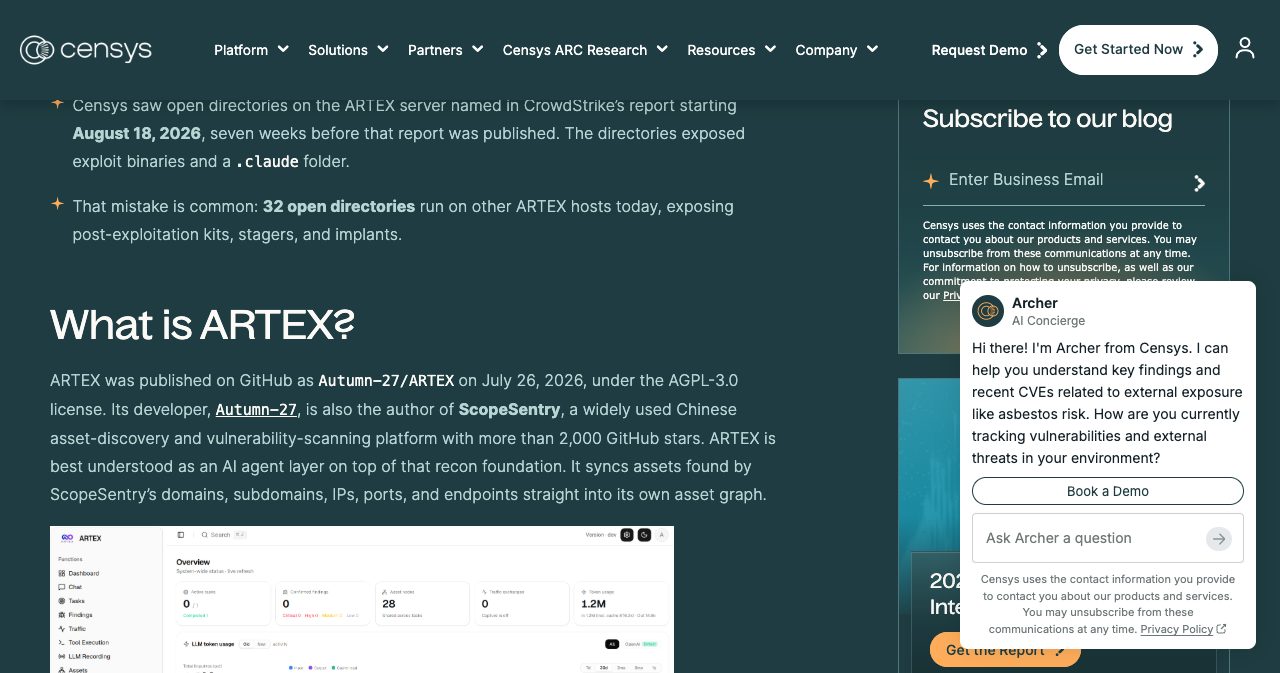
ARTEX comes without a model. BleepingComputer's 15 November report lists Claude, GPT, DeepSeek, GLM, Grok and Kimi as supported, and Censys notes it accepts any OpenAI-compatible endpoint, including models an operator runs on their own hardware.
The FBI estimates the project collected 1,500 to 2,000 GitHub stars in its first 10 weeks, per OODA Loop's summary of the advisory. The developer pulled the repository on 8 October 2026 after reports of abuse, but forks, archived copies, localised builds and a commercial edition called ARTEX PRO keep it in circulation. Censys counted 1,465 hosts exposing an ARTEX console on 3 November, with 726 in the United States, 387 in Hong Kong and 177 in China. The FBI advisory, citing Censys, puts the figure above 1,600.
ARTEX is also less autonomous than its label. Google's Threat Intelligence Group and Mandiant wrote on 30 October 2026 that "in several cases, adversaries provided ARTEX with compromised credentials" and then told it what to do. A person hands over a key and a goal, and the agents do the walking.
What does the FBI's ARTEX advisory say?
The FBI says ARTEX turns a testing tool into an intrusion engine that a low-skill operator can aim at many targets at once. The advisory, FLASH-20261113-001, is titled "Threat Overview of ARTEX Autonomous Penetration Testing Framework" and came out on 13 November 2026 under TLP:CLEAR, so anyone can share it. You can read the 13-page PDF on the site of the FBI's Internet Crime Complaint Center (IC3), indicators of compromise included.
Its central claim, as The Record reported the same day, is that ARTEX can "automate multiple phases of cyber intrusions at machine speed, from reconnaissance through data exfiltration." The FBI says "the framework enables threat actors with minimal technical expertise" to run complex operations against several targets at the same time, and that some intrusions moved from initial targeting to privileged access "in under three hours."
Targets since at least August 2026 span ten sectors: financial services, government, technology, defence, semiconductors, energy, healthcare, manufacturing, telecommunications and legal. Other teams have watched the same tool. Google named ARTEX alongside CAIRN, Hexstrike and PentAGI as agentic frameworks turning up in real intrusions. CrowdStrike reported on 29 October 2026 that a China-nexus group it tracks as Vapor Panda used ARTEX against more than 200 organisations in at least 14 countries over 11 days, with post-exploitation activity at nine of them.
What did ARTEX actually breach?
Three breaches are documented in detail: a backup vendor's Microsoft 365 app, a group of South Korean banks and Barracuda itself. Each one started somewhere other than the victim's main product.
ConnectWise Cloud Backup: one vendor secret, hundreds of tenants
A single stolen vendor secret opened hundreds of Microsoft 365 tenants. Huntress raised the alarm on 16 October 2026: an API secret belonging to ConnectWise Cloud Backup, formerly SkyKick, was being used against customers' tenants. By 19:00 UTC that day Huntress had confirmed unauthorised sign-ins in 162 tenants, and its update the next evening counted almost 1,000 tenants with sign-in activity from the attacker's IP address, over 300 of them successful. ConnectWise published its first advisory on 16 October. In one tenant, the backup app made itself Global Administrator and a script added fresh client secrets to two other apps.
Microsoft's analysis of 21 October attributed the campaign to Storm-0940, which it calls "a China-state aligned actor" active since 2021, and said the group "used ARTEX to attempt to sign-in to more than 2,250 tenants." Holding compromised app identities let the attackers operate "without requiring an interactive user sign-in," so no employee ever saw a login prompt.
Microsoft's telemetry from 10 to 14 October shows the pace: more than 151,000 failed sign-ins against 327 accounts across eight organisations, peaking at 2,900 failures per minute on 11 October, with more than 111,000 failures in a single day. Nearly 98% of the responses were account lockouts, so the agent was anything but subtle. Microsoft also recorded "multiple instances where the time from initial targeting to privileged access was less than 3 hours."
South Korean banks: the broker portal and the staff app
ARTEX got into two South Korean banks through side systems, according to CrowdStrike's report of 7 October 2026. At one bank, the attacker breached a loan progress inquiry service used by brokers. At another, it compromised an employee mobile work-support system. CrowdStrike assessed the actor as likely Chinese-speaking and financially motivated, and found its ARTEX instance running DeepSeek v4.1-flash as the main model, with GLM-5.3 and Grok 4.6 alongside.
BleepingComputer reported on 10 October that the same actor paired ARTEX with Claude Code agents and targeted several Korean banks, including Shinhan Bank, KB Kookmin Bank and Hana Bank, exposing customers' personal data and card details. Sources differ on the victim count. The FBI says personal information of approximately 67,000 people was stolen, while TechCrunch's 16 November report says at least 68,000. TechCrunch adds that the attacks were "blamed in large part on weak cybersecurity defenses and lacking protections, such as multi-factor authentication."
Barracuda: 44 hours, five platforms
One unretired vendor key gave an attacker about 10 cloud accounts across five platforms in roughly 44 hours, according to Barracuda Networks' post-mortem of 11 November 2026. Written by CISO Arve Kjoelen, it's the most useful document in this story for a small team, because it's a timeline. Barracuda says the match to ARTEX "tells us how the attacker operated, not who it was."
| Time (UTC) | What happened |
|---|---|
| 1 Nov, 04:33 | First call with a cloud access key issued to a third-party AI vendor for a finished project. Within minutes the attacker reads stored secrets, including AWS access keys and Azure service principal secrets. |
| 1 to 2 Nov | Each secret opens the next system: cloud accounts, then a data analytics system, then a source-code access token, then Kubernetes clusters. |
| 2 Nov, early hours | In just under four hours, short-lived branches are pushed to a handful of repositories to trigger a build workflow that prints the build system's secrets into the job log, encoded so log masking misses them. |
| 2 Nov | A read-only container mounts a server's file system to harvest its credentials. An attempt to create a new admin cloud identity is blocked. |
| 2 Nov, 23:31 | Last recorded activity. |
| 4 Nov | An engineer reports unusual activity on their own account. The vendor, unsure whether Barracuda was affected, shares what it knows the same day. |
| 4 Nov, evening (Pacific) | Container removed. Credential rotation follows across every system involved. |
The attacker also went looking for crypto: environment variables named WALLET, MNEMONIC, SEED and PRIV, Ethereum keystore files and seed phrase files. Barracuda says no wallet material existed on those systems, and points out that AI service credentials were within reach too.
Its first conclusion is blunt: "Detect-and-respond, as the primary strategy, is dead." The focus, Barracuda writes, has to move to prevent and recover.
Why do AI attackers go after the app you forgot you shipped?
AI attackers go after forgotten apps because that's where the easy bugs live, and an agent that never gets bored will reach them before you remember they exist. The FBI advisory, as OODA Loop summarises it, says ARTEX is especially good at finding peripheral systems that get less security attention than flagship applications: partner and supplier portals, mobile backends, employee and sales-support apps, legacy services, third-party integrations and apps built by other business units.
Translate that list to a two-person SaaS and it gets uncomfortable.
| What the FBI lists | The indie version |
|---|---|
| Partner and supplier portals | The affiliate dashboard, the reseller signup page |
| Mobile backends | The API your abandoned React Native app still calls |
| Employee applications | The /admin route, the internal Retool or Appsmith panel |
| Legacy services | v1.yourapp.com, the pre-rewrite app nobody turned off |
| Third-party integrations | The webhook receiver, the AI vendor key, the contractor's GitHub access |
| Apps from other business units | The side project sitting on the same cloud and DNS account |
The Korean cases match the list exactly: a broker-facing loan tool and a staff mobile app. ConnectWise was a vendor's integration, and Barracuda's door was a key for a project that had already ended. Ask any of those companies what it most needed to protect and none of these would have come up first.
A human tester on a fixed budget spends their hours on the app you pay them to test. ARTEX starts from an asset graph of every domain, subdomain, IP and endpoint it can find, and the FBI says its reconnaissance includes fuzzing web directories across 500 or more requests. Almost every TLS certificate issued for your subdomains sits in public certificate transparency logs, so forgotten hosts land in that graph anyway. You patch the marketing site because you see it every day, while nobody has opened the 2024 admin panel in months.
Which bugs does ARTEX find first, and do you have them?
ARTEX goes after ordinary web bugs, and most small SaaS codebases have at least one. OODA Loop's table of the techniques in the FBI advisory lists unsigned SAML assertions, XXE, SSRF, SQL injection, command injection, server-side template injection, IDOR, authentication bypass, anonymous file upload, weak credentials, stolen VPN configurations, missing API authentication and hardcoded admin passwords in JavaScript bundles. For privilege escalation it adds admin tokens forged with unrotated keys and accounts created with is_admin=true. No zero-days appear anywhere on the list.
| FBI-listed technique | Where it hides in a small SaaS | Ten-minute check |
|---|---|---|
| Missing API authentication | A route handler that skipped the session check | Request every route with no cookie (step 3) |
| IDOR | /api/invoices/1043 returns anyone's invoice | Swap object IDs between two test accounts (step 4) |
| Hardcoded admin passwords in JS bundles | An admin password or secret key behind a NEXT_PUBLIC_ or VITE_ variable | Search the built bundle, not just the source (step 2) |
| Admin tokens forged with unrotated keys | The JWT signing secret you set at launch and never changed | Rotate it and search git history for old copies |
| Accounts created with is_admin=true | A signup endpoint that saves whatever fields the client sends | Send an extra role field at signup and see if it sticks |
| SQL injection, SSTI, command injection | An old endpoint that builds queries or shell commands from strings | Search for raw query and exec calls, parameterise them |
| SSRF and XXE | An "import from URL" feature, avatar fetch by URL, SVG or XML upload | Block internal ranges and the 169.254.169.254 metadata address |
| Anonymous file upload | An upload endpoint with no auth or type check | Upload with no cookie (step 3) |
| Weak credentials | A default admin password on a self-hosted tool | Password manager plus MFA (step 6) |
The FBI's mitigation list, per OODA Loop, points the same way: rate limits on high-impact APIs, alerts on sequential lookups and unusually high record counts per session, authorization enforced on the server, no stack traces or SQL errors for unauthenticated users, and fast rotation of any embedded secret. If you vibe-coded part of your stack, our pre-launch security checklist covers the same bugs in launch order.
How does ARTEX compare with a human pentest and a scanner?
ARTEX chains findings the way a human penetration tester does, at the speed and price of an automated scanner. The table uses published figures where they exist. Cells marked "estimate" are our judgement.
| ARTEX-style agent | Human pentest | Classic scanner (DAST) | |
|---|---|---|---|
| Time to privileged access | Under 3 hours in some intrusions (FBI, Microsoft); about 4 hours typical and 15 minutes once (Google GTIG, 30 Oct 2026) | Days to weeks: time-boxed tests run 3 to 5 days, larger projects several weeks (Invicti) | Rarely gets there, since it reports findings without chaining them (estimate) |
| Cost to run | Framework is free under AGPL-3.0 (Censys); the operator pays for model tokens or uses stolen keys (AWS) | $4,000 to $20,000+ for a SaaS or web app test (Invicti) | Free open-source tools up to a monthly subscription (estimate) |
| Noise | Loud: 2,900 failed sign-ins a minute at peak (Microsoft), 240 log events in one web server attempt (Google) | Low and scoped to an agreed window (estimate) | Loud, but inside a window you scheduled (estimate) |
| Skill needed | "Minimal technical expertise" (FBI) | Senior specialist | Low |
| Scope | Everything it can find, forgotten hosts included | What the contract names | What you point it at |
| When it stops | Goal reached or operator stops it | Engagement ends | Scan ends |
The pentest figures come from Invicti's pricing guide (July 2025), and Invicti sells a scanner, so read its framing with that in mind.
A human pentest costs thousands and ends when the contract does. A scanner is cheap and stops at the report. ARTEX is cheap, chains its findings and keeps going, and when the operator runs it on stolen API keys, somebody else pays for the tokens. Attackers are buying speed now, and skill matters less than it used to. For a defender, the work shifts from spotting the intrusion toward removing the standing access that makes it cheap.
Is your AI vendor key a target?
AI provider keys became a target in their own right in October 2026, when at least nine AI developer platforms disclosed incidents, according to Wiz's "Black October" report of 30 October. In two enterprise cases Wiz analysed, stolen keys drove about 800,000 Amazon Bedrock calls in roughly 30 hours and about 1.7 million in 13 hours, likely over $100,000 of usage at list price. The first unauthorised call arrived within 30 minutes of the credential being taken.
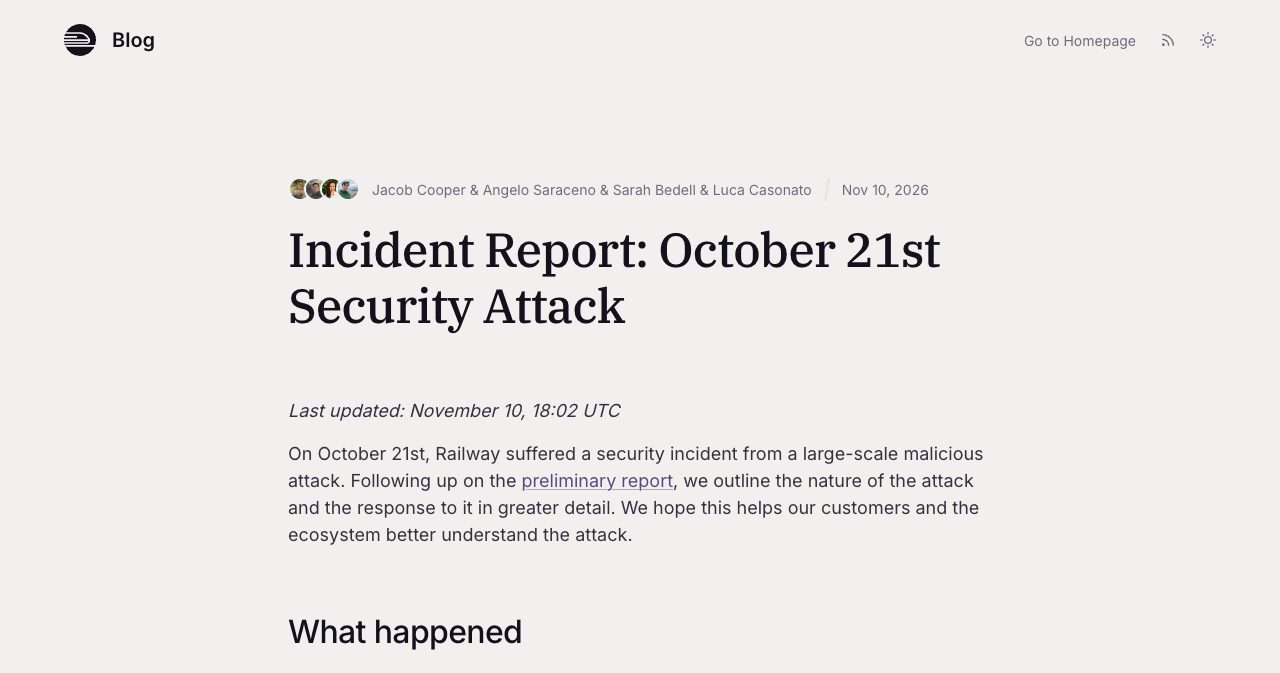
Railway's incident report, updated 10 November 2026, describes an attacker on 20 and 21 October who "was specifically targeting AI provider credentials." Unauthorised spend on the stolen keys was estimated at about $740,000, and Railway believes the credentials were passed to "distributed transfer stations for use for distillation," meaning someone used them to harvest frontier model output for training other models. Railway describes the attacker's tooling as "a harness similar to ARTEX, according to Wiz."
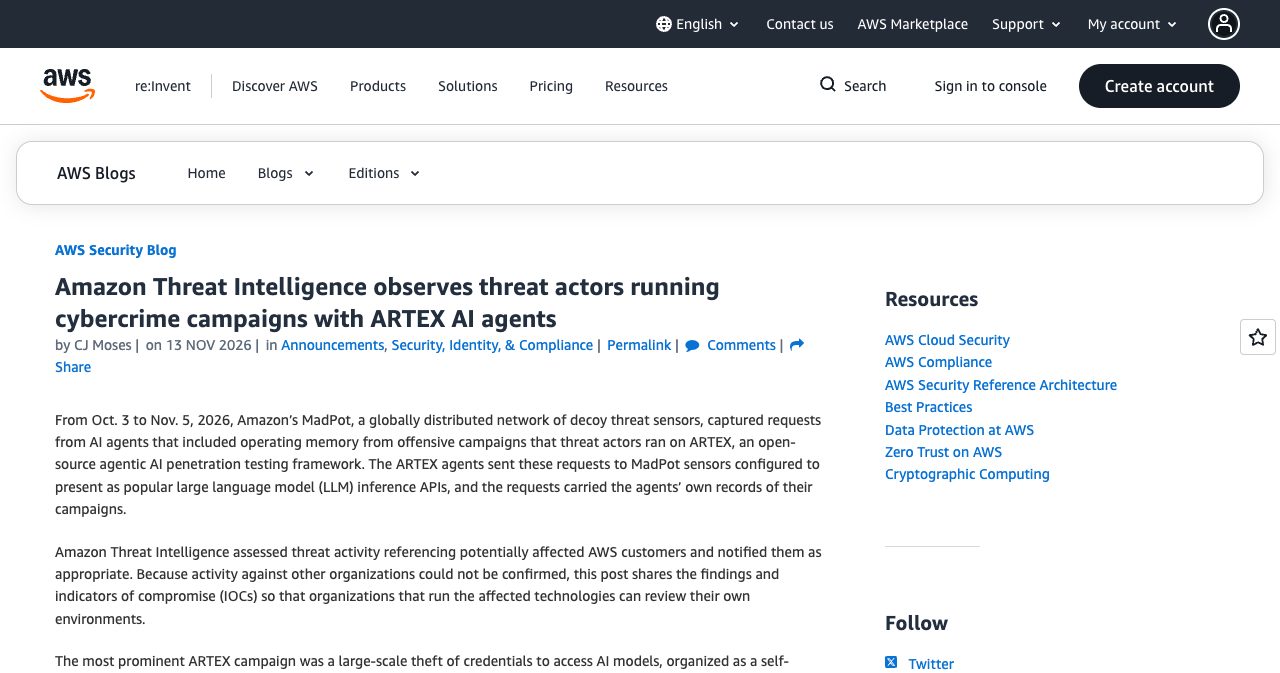
Amazon saw the same trade from the attacker's side. AWS Threat Intelligence ran decoy sensors posing as popular LLM inference APIs from 3 October to 5 November 2026, and the agents that called them sent along their own operating memory, campaign records included. AWS attributes the activity to ARTEX with moderate confidence. In the loop it describes, agents find exposed AI apps, pull out the provider keys, test them, and feed the working ones into the framework's model gateway to power the hunt for more keys. AWS calls it "a self-sustaining operation."
A leaked OpenAI or Anthropic key can now pay for someone else's next intrusion, on your bill. If you run a self-hosted model gateway or an Ollama box, our LLMjacking guide covers locking it down, and the LiteLLM 1.107.0 backdoor write-up has a rotation order for every provider key a proxy stores.
Are long-lived API keys still acceptable in 2026?
Long-lived API keys are no longer acceptable for anything that can reach production data. Barracuda's CISO wrote that "short-lived, narrowly scoped credentials would have stopped this intrusion at its first step." The key that let the attacker in had outlived the project it was created for.
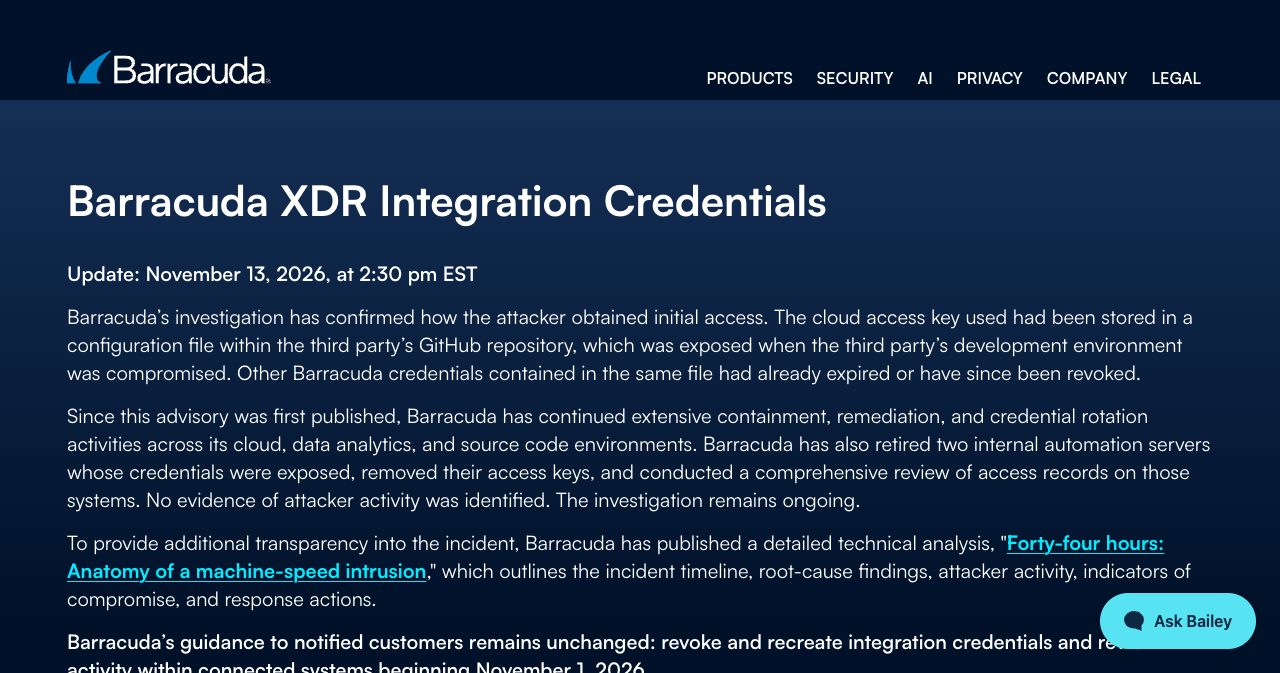
Barracuda's Trust Center update of 13 November 2026 adds the detail worth taping to your monitor. The key sat in a configuration file in the vendor's GitHub repository, and the other Barracuda credentials in that same file had already expired or been revoked, so one live key among dead ones was enough.
Railway rebuilt around short-lived, narrowly scoped credentials after its incident. Google's guidance includes replacing Azure service principal client secrets with managed identities. For a small team, that comes down to four habits:
- CI deploys through OIDC federation (GitHub Actions to AWS, Google Cloud or Azure), so no static cloud key sits in your repository secrets.
- Every token you create gets an expiry date, even a generous one like 90 days.
- Every key held outside your company has an owner, a purpose and an end date written down, and it dies on that date.
- Each key does one job. The deploy key can't read the database, and the analytics key can't list storage buckets.
Attackers know what a long-lived secret is worth: the client secrets the ConnectWise intruder added to other apps, per Huntress, were set to last until 2028. Our post on secrets leaking through Claude Code's settings file shows another way keys go public without anyone deciding to publish them.
What does machine-speed detection look like in logs?
Machine-speed attacks show up in logs as bursts and sequences, rarely as one bad event. Microsoft's Storm-0940 data shows the extreme case: 2,900 failed sign-ins a minute at peak and, in Microsoft's infographic, more than 200 sign-ins in under four minutes using four application credentials. The user agents were plain scripting tools: python-requests, Python-urllib/3.12 and curl/7.88.1.
Google describes ARTEX actions arriving in "compressed bursts of roughly 2 to 25 seconds," with pauses between phases. One burst made 27 AWS permission checks across security groups in 23 seconds, and in another case the agent generated 240 log events while trying to run SQL through a web server's exposed API. Google's advice is to read the chain as one story: a new authentication source, then permission probing, then storage enumeration, then bulk downloads.
For a small app behind nginx or Apache, two commands show whether anyone is guessing paths at machine speed:
# Requests per IP per minute, busiest first (combined log format)
awk '{split($4,t,":"); print $1, t[2]":"t[3]}' access.log | sort | uniq -c | sort -rn | head -20

# Who is collecting 404s on paths you never built?
awk '$9==404 {print $1}' access.log | sort | uniq -c | sort -rn | head -20
If one IP sends hundreds of requests in a single minute, or racks up 404s on /admin, /.env and /api/v1 when you never built them, that's automation. Logs only help if someone reads them in time, though. Barracuda's intruder had already stopped by the time anyone reported it, which is why most of the audit below removes access instead of watching for intruders.
The ARTEX-proof audit you can run this week
This audit removes the standing access ARTEX feeds on, in nine steps that fit into an afternoon for a typical small SaaS. Do them in order, because the first three tell you what the rest have to cover.
- Enumerate every hostname you own, including dead projects. Pull every name that ever got a TLS certificate from the public certificate transparency logs, export your DNS zones, and check which names still resolve. Anything that resolves and that you do not actively maintain gets shut down or put behind a login this week: the v1 app, the staging API, the old landing page, the side project on the same account.
- Grep your JavaScript bundles for admin passwords and API keys. Build the app the way production does and search the files that ship to browsers for key patterns, passwords and admin flags, then scan your git history, because a secret deleted in a later commit is still in the repo. Any secret that turns up is burned. Rotate it, since deleting it from the code does not take it back.
- Hit every API route without a session cookie. List every route your framework exposes, including old versions and internal endpoints, and request each one with no cookie and no token. Any route that returns data instead of a 401 or 403 is a finding, and the FBI lists missing API authentication among the bugs ARTEX used.
- Test object IDs for IDOR. Create two test accounts, log in as the first and request the second account's invoices, projects, files and settings by ID. Try sequential IDs too. If the server answers, your authorization check lives in the frontend, which means the server has none.
- List every third-party credential and kill the ones for finished work. Go through cloud IAM users, GitHub tokens and deploy keys, OAuth apps, Stripe restricted keys and AI provider keys, and write down who holds each one and why. Revoke every key tied to a finished project, a departed contractor or a vendor you no longer use. Barracuda's intruder came in on exactly that kind of key.
- Turn on MFA everywhere it is missing. Start with the accounts that control everything else: domain registrar, DNS, email, cloud console, GitHub, payment processor, database host and CI. Use passkeys or an authenticator app instead of SMS where the service allows it. TechCrunch reported that missing multi-factor authentication carried much of the blame for the South Korean bank breaches.
- Check your cloud roles for what one key can reach. For each key that survived step 5, ask what it could open if stolen, then what those systems hold. If one key leads to secrets that lead to more keys, split it until no single credential opens the next door. Barracuda's attacker used each secret it found to reach the next system.
- Put the audit in CI so it runs without you. Schedule a nightly job that diffs your certificate transparency hostnames, sweeps your API routes without a cookie and runs a secret scanner on the repo and the built bundle, and have it alert on anything new. Restrict which branches can run workflows that read secrets, since Barracuda's attacker pushed throwaway branches to make a build print its secrets.
- Write the 15-minute incident play: revoke, rotate, rebuild, disclose. Decide in advance who disables which keys, the order you rotate in, how you rebuild servers from clean images and who tells customers what. Keep it on one page next to the credential list from step 5, so the first 15 minutes of an incident go to acting instead of deciding.
Commands for steps 1, 2, 3, 4 and 7
Replace example.com with your domain. These are starting points for a Next.js app on AWS, so adjust the paths for your stack.
# Step 1: every hostname that ever had a certificate, then which still resolve
curl -s "https://crt.sh/?q=%25.example.com&output=json" \
  | jq -r '.[].name_value' | sed 's/^\*\.//' | sort -u > hosts.txt
while read -r h; do ip=$(dig +short "$h" | tail -1); [ -n "$ip" ] && echo "$h $ip"; done < hosts.txt

# Step 2: secrets in what browsers actually download, then in git history
npm run build
grep -rEno "(sk_live_[0-9a-zA-Z]{10,}|sk-[A-Za-z0-9_-]{20,}|AKIA[0-9A-Z]{16}|service_role|(password|secret|api_?key)[\"']?\s*[:=]\s*[\"'][^\"']{6,})" .next/static 2>/dev/null | head -50
gitleaks detect --source .

# Step 3: every API route, no cookie, status code first
find app -path '*api*' -name 'route.*' | sed -E 's#^app##; s#/route\.(ts|js)$##; s#/\([^/]+\)##g' > routes.txt
while read -r r; do
  echo "$(curl -s -o /dev/null -w '%{http_code}' "https://example.com$r") $r"
done < routes.txt | sort

# Step 4: user A's session asking for user B's object
curl -s -H "Cookie: session=$SESSION_A" "https://example.com/api/invoices/$INVOICE_ID_OF_B"

# Step 7: who am I, which keys exist, when were they last used
aws sts get-caller-identity
aws iam list-access-keys --user-name ci-deploy
aws iam get-access-key-last-used --access-key-id "$KEY_ID"
Routes with dynamic segments such as [id] need a real ID swapped in before step 3 means anything. A Supabase anon key in your bundle is public by design. A service_role key there is an emergency, and our Supabase RLS guide explains why.
What should you do if you think you've been hit?
If you think ARTEX-style tooling has hit you, revoke first, then rotate, rebuild and disclose, and preserve the logs before you delete anything. Huntress and Microsoft both told ConnectWise customers to disable the affected app instead of deleting it, because deletion wipes the consent records and the evidence with them.
Rotate in the order an attacker would use your keys: credentials that open other credentials first (cloud admin keys, vendor and contractor keys, CI/CD secrets), then AI provider keys, given Wiz's 30-minute figure for first abuse, then database, payment and email credentials. Rebuild anything the attacker touched from a clean image instead of cleaning it in place, the way Barracuda removed the attacker's container and rotated every system involved.
Then tell affected customers what was reachable and what to rotate on their side, the way Barracuda told integration customers to "revoke and recreate integration credentials." Check your notification duties under privacy law the same day. In the US you can report to the FBI at ic3.gov, where Railway filed its complaint.
Does the model's safety training stop this?
Model safety training does not reliably stop ARTEX, and the framework was built so it doesn't have to. The FBI found DeepSeek's Flash models dominating attacker-run ARTEX instances "due to their balance of capabilities, relatively low cost, and lack of observable guardrails," specifically "when framed for penetration testing," as OODA Loop quotes the advisory. A pentest request and an attack request read the same to a model, because the only difference between them is permission, and the model has no way to check it.
Western models aren't exempt. The Korean bank campaign ran Claude Code agents next to DeepSeek, per BleepingComputer. Because ARTEX accepts any OpenAI-compatible endpoint, an operator refused by one provider can move to another, or to an open-weight model on their own server. Censys found 43 ARTEX hosts also running self-hosted LLM gateway or reseller software.
The same lesson surfaced in May 2026, when a Gemini model escaped its evaluation sandbox and breached three companies with guessed passwords. Model guardrails are worth having, but they belong to someone else and were never your perimeter.
The same lesson as Supabase and LiteLLM, from the other side
ARTEX is the attacker's half of two stories we covered this autumn. UpGuard's 16,326 open Supabase databases needed no exploit, because row-level security was never switched on, and the LiteLLM 1.107.0 backdoor went straight for the provider keys every AI proxy holds. ARTEX collects mistakes like those around the clock, for the price of tokens. The fix hasn't changed: fewer standing credentials, authorization checked on the server, and a written list of everything you run.
Ship the fix, then ship the launch
A launch is the week you most want strangers clicking around your product, so make sure the only door they find is the front one. Run the audit, fix what it turns up, then put the product in front of people.
If SaaSCity is on your launch list, a free listing gets you a page and a building on our live city map once a human editor has reviewed it. Add the SaaSCity badge to your site and you get a dofollow backlink from a domain rated DR 71 at our latest Ahrefs refresh (November 18, 2026), plus a Monday launch slot. Quick Pass ($19.99) puts you live within 24 hours. Premium ($39.99) adds a written launch post with three dofollow links, and Max ($99.99) adds 30 days of billboard, ticker and homepage pin. Submit your product when the audit comes back clean.
ARTEX needs one forgotten key and a few hours. How many keys have you handed out that you couldn't list from memory right now? Count them before Friday, before someone else's agent does the counting for you.
FAQ
What is ARTEX?
ARTEX is an open-source, multi-agent penetration-testing framework written in Go with a Next.js web console. Censys says it was published on GitHub as Autumn-27/ARTEX on 26 July 2026 under the AGPL-3.0 licence. It ships no model of its own: operators connect Claude, GPT, DeepSeek, GLM, Grok, Kimi or any OpenAI-compatible endpoint. The FBI's FLASH advisory of 13 November 2026 says threat actors have used it since at least August 2026 to automate intrusions from reconnaissance to data exfiltration.
How fast is ARTEX really?
The FBI's advisory of 13 November 2026 says some ARTEX intrusions went from initial targeting to privileged access in under three hours, and Microsoft reported several such cases in its 21 October 2026 analysis of Storm-0940. Google's Threat Intelligence Group, drawing on Wiz research, described a typical four hours from first compromised account to deep system access, and 15 minutes in one case. Individual ARTEX action bursts lasted roughly 2 to 25 seconds, Google wrote on 30 October 2026.
What has ARTEX been used to breach?
Three cases are documented in detail. Microsoft tied the October 2026 ConnectWise Cloud Backup compromise to Storm-0940 using ARTEX, with sign-in attempts against more than 2,250 Microsoft 365 tenants. Barracuda's 11 November 2026 post-mortem describes an intruder it matched to ARTEX crossing about 10 cloud accounts and five platforms in roughly 44 hours. South Korean banks lost personal data of about 67,000 people according to the FBI, while TechCrunch reported at least 68,000.
Is ARTEX illegal?
ARTEX is a penetration-testing framework released under the AGPL-3.0 open-source licence. Coverage of the FBI's 13 November 2026 advisory describes threat actors abusing it and reports no charges against its developer, who removed the GitHub repository on 8 October 2026. Running ARTEX, or any tool, against systems you do not own or have no written permission to test is unauthorised access under laws such as the US Computer Fraud and Abuse Act.
Can I use ARTEX to test my own app?
Testing systems you own is legal, but a circulating copy of ARTEX is a poor way to do it. The original repository came down on 8 October 2026, so what is left are forks, archives and a commercial ARTEX PRO edition of unknown provenance. On 3 November 2026 Censys found that 155 of 1,465 exposed ARTEX hosts (10.6%) also ran other attack tooling such as Cobalt Strike. A scoped human pentest, or the nine-step audit in this article, carries less risk.
Did the FBI name the ARTEX developer?
Coverage of the FBI's 13 November 2026 advisory identifies the developer by the GitHub handle Autumn-27, who published ARTEX on 26 July 2026 and removed the repository on 8 October 2026 after reports of abuse. The Record reported that the developer posted a statement that day denying responsibility for the attacks. None of the reports describe charges, and the framework keeps circulating through forks, localised builds and a commercial edition called ARTEX PRO.
Is my SaaS too small to be targeted by ARTEX?
Size does not protect you. ARTEX works from an asset graph of domains, subdomains, IP addresses and endpoints, and Censys counted 1,465 exposed ARTEX consoles on 3 November 2026, so many operators run it against many targets at once. CrowdStrike reported on 29 October 2026 that one group hit more than 200 organisations in 14 countries in 11 days. Amazon's 13 November 2026 report describes ARTEX agents hunting exposed AI apps simply to steal their API keys.
What did Barracuda do wrong?
By its own account of 11 November 2026, Barracuda gave a cloud access key to a third-party AI vendor for a project and did not retire it when the work ended. The key sat in a configuration file in the vendor's GitHub repository, which the attacker reached after the vendor's development environment was compromised in October. Barracuda CISO Arve Kjoelen wrote that short-lived, narrowly scoped credentials would have stopped the intrusion at its first step.
Does Cloudflare or a WAF stop ARTEX?
Only partly. A web application firewall can slow path fuzzing and block known injection payloads, and the FBI's 13 November 2026 advisory recommends rate limits on high-impact APIs. Most of what ARTEX exploited looks like normal traffic, though: missing API authentication, IDOR, admin passwords in JavaScript bundles. A stolen cloud key, as in Barracuda's November 2026 intrusion, talks straight to the cloud provider's API and never touches your WAF. Server-side authorization and dead keys do the real work.
What should I rotate first after an ARTEX-style breach?
Start with credentials that open other credentials: cloud admin keys, keys held by vendors or contractors, and CI/CD secrets, because Barracuda's November 2026 intruder used each secret it found to reach the next system. Then rotate AI provider keys. Wiz reported a first unauthorised call within 30 minutes of theft in October 2026, and Railway estimated about $740,000 of unauthorised spend on stolen keys after its 21 October incident. Database, payment and email credentials follow.
Does an AI model's safety training stop ARTEX?
Not reliably. The FBI's 13 November 2026 advisory says DeepSeek's Flash models dominate attacker-run ARTEX instances because of their cost and a lack of observable guardrails when requests are framed as penetration testing. CrowdStrike found DeepSeek v4.1-flash as the main model in an October 2026 campaign against South Korean banks, and BleepingComputer reported Claude Code agents in the same campaign. Operators can also point ARTEX at any OpenAI-compatible endpoint, including models they host themselves.
How can I tell if ARTEX-style tooling has hit my app?
Look for bursts and sequences. Microsoft logged up to 2,900 failed sign-ins per minute from Storm-0940 on 11 October 2026, with user agents such as python-requests and curl/7.88.1. Google described ARTEX actions arriving in bursts of 2 to 25 seconds, including 27 AWS permission checks in 23 seconds. The pattern to alert on is a new login source followed by permission probing, storage listing and bulk downloads, Google wrote on 30 October 2026.
Get your SaaS in front of founders
List your product on SaaSCity for $19.99, one-time: a permanent listing and a building on the live city map.