News
Claude Opus 5 Is Insane: 10 Wild Examples of AI One-Shotting Full 3D Games, Worlds, and Blender Builds
A playable Call of Duty clone from one prompt. 1660 New Amsterdam rebuilt from historical maps. An F1 car modeled in Blender by 50 parallel agents. The wildest Claude Opus 5 demos on X right now, and what they say about where game dev is going.

Contents (13)
- Key Takeaways
- 1. A full Call of Duty-style FPS from one prompt
- 2. A CoD Zombies map rebuilt in a single prompt
- 3. A Brawl Stars-style battle royale, 100% procedural Unity
- 4. A painterly world with millions of grass blades, in one HTML file
- 5. 1660 New Amsterdam, reconstructed from real historical maps
- 6. An F1 car in Blender, built by 50 parallel agents
- 7. Tabletop D&D in Three.js with a live AI dungeon master
- 8. A world that improves itself by walking through it
- 9. A 38-second cinematic motion sequence in under 10 minutes
- 10. The Subway Surfers test, and why most people use Opus 5 wrong
- What all ten have in common
- So what do you do with this?
Quick answer: Claude Opus 5, which Anthropic shipped on July 24, 2026 at $5/$25 per million tokens with a 1M context window, is being used to generate complete 3D games and worlds with no external assets. The viral demos include a playable Call of Duty-style FPS from a single prompt, 1660 New Amsterdam rebuilt from historical maps, and an F1 car modeled in Blender by roughly 50 parallel agents over 10+ hours. Everything is procedural code: Three.js, Unity C#, WebGL shaders, and Blender Python.
Someone built a playable Call of Duty clone with one prompt. Not a mockup, not a cutscene. A working FPS with headshot XP, a minimap, and enemy AI, where every texture on screen is generated code.
That was the demo that kicked off the thread everyone is passing around this week. Min Choi (@minchoi) posted it with the line "Ok Opus 5 is insane. People are already one-shotting 3D games, worlds, and Blender builds with it," and the thread promptly did huge numbers.
Quick context: Anthropic shipped Claude Opus 5 on July 24, 2026. On paper it is the mid-tier model, close to Fable 5 intelligence at half the price ($5/$25 per million tokens, 1M context). In practice, the thing people keep noticing is not the benchmarks. It is that Opus 5 can produce complete, playable, genuinely good-looking 3D experiences from a single prompt or a short agent loop, with zero external assets. No downloaded models, no texture packs, no sound libraries. Everything is code: Three.js, Unity, raw WebGL, Blender Python.
I went through the whole thread and the source posts behind it. Here are the ten demos worth your time, with enough detail that you can judge for yourself.
Key Takeaways
- Released July 24, 2026: Anthropic positions Opus 5 as the mid-tier model, close to Fable 5 intelligence at half the price, with $5/$25 per million tokens and a 1M-token context window.
- No external assets: Every texture, model, particle effect, HUD element, and in some cases the background music is generated as code. No asset stores, no stock models, no pasted AI images.
- One-shot gets prototypes, agents get polish: The FPS and the single-file grass world came from one prompt; the F1 Blender car and the endless runner came from hours of orchestrated agent loops.
- The heavy runs are expensive: The Unity battle royale took about 6 hours and a few million tokens; the 50-agent Blender F1 build burned around 10 million tokens across 10+ hours.
- Agents can review their own output: The F1 build used 27 part builders, 5 competing monocoque designers, and 18 inspector agents deep-zooming for defects.
- The tooling composes: Demos pair Opus 5 with ElevenLabs for sound effects and voice, and local models running as a live dungeon master.
- Limits are still visible: New Amsterdam has weird canal geometry and open house edges, and every impressive result had a human deciding what "better" meant.
1. A full Call of Duty-style FPS from one prompt
Matt Shumer (@mattshumer_) posted 56 seconds of first-person gameplay in a Middle Eastern-style urban map. Dusty streets, sandbags, burned-out cars, multi-story buildings with laundry hanging off the balconies. You sprint past market stalls with a wooden-stocked scoped rifle, drop enemies ("ENEMY ELIMINATED," plus headshot XP popups), and watch smoke and debris kick up under bright daylight. Minimap, ammo counter, health bar. Sound on.
His caption: "EVERYTHING you see in this demo is custom code... not a single external asset was used. AI games are going to be amazing."
I have watched a lot of "AI made a game" videos and most of them fall apart the moment the camera moves. This one doesn't. The lighting is coherent, the HUD reads like an actual shooter, and it came from one prompt.
2. A CoD Zombies map rebuilt in a single prompt
Rishi (@0xRishi) had an existing zombie shooter, a simpler thing he'd originally built with Kimi K3. He handed the codebase to Opus 5 on High mode and asked it to transform the game. One prompt later: a new night map, all-new weapons, Pack-a-Punch and perk machines, a mystery box, teleporters, buyable doors, a star-filled sky, new particles and muzzle flashes. All of it code-generated. Sound effects came from ElevenLabs SFX and Voice Design for the characters.
The 87-second clip shows glowing pink-and-black sci-fi weapons, green neon ray guns, zombie hordes shambling through industrial brick areas labeled "KRAFTWERK" and "WAFFEN," and a points counter sitting around 40k. Rishi called the transformation "mindblowing" and shipped a playable link.
This one matters for a different reason than the FPS. It wasn't a fresh build. It was a full asset and map replacement on an existing codebase, which is the boring, painful work that eats real dev teams alive.
3. A Brawl Stars-style battle royale, 100% procedural Unity
saturadev (@saturadev) built a robot battle royale entirely from scratch in Unity: red, green, blue, and pink robots brawling in an industrial arena with hazard stripes, glowing pillars, and crates. Health bars, energy meters, timers, lasers, explosions, area attacks. The graphics are fully procedural. It even wrote its own background melody, which is genuinely catchy.
The process is the interesting part. The prompts were plain, stuff like "use the best possible practices for game design / procedural 3D generation / UI design," followed by iterative improvement and bug-checking passes. Total cost: about 6 hours and a few million tokens.
Half a day, one person, a polished multiplayer prototype. If you're an indie dev, sit with that for a second.
Building something with Opus 5 right now? When it's ready for real users, list it free on SaaSCity and put it in front of people who actively browse for new tools.
4. A painterly world with millions of grass blades, in one HTML file
Lentils (@Lentils80) posted a 71-second cinematic fly-through that made me stop scrolling. Rolling green hills, stylized trees, a stone viaduct with a steam train crossing it (smoke and lights included), a canal, a village with thatched roofs, mountains behind everything, and volumetric haze tying it together. The whole scene lives in a single HTML file.
The technical flex is the grass: millions of blades with a wind-field simulation, so they ripple in waves as the camera passes. That is a hard rendering problem. People write engine talks about it. Here it's a browser tab.
Zero install, pure code, and it looks like a painting. Browser-native worlds at this fidelity used to be a studio's tech demo, not a tweet.
5. 1660 New Amsterdam, reconstructed from real historical maps
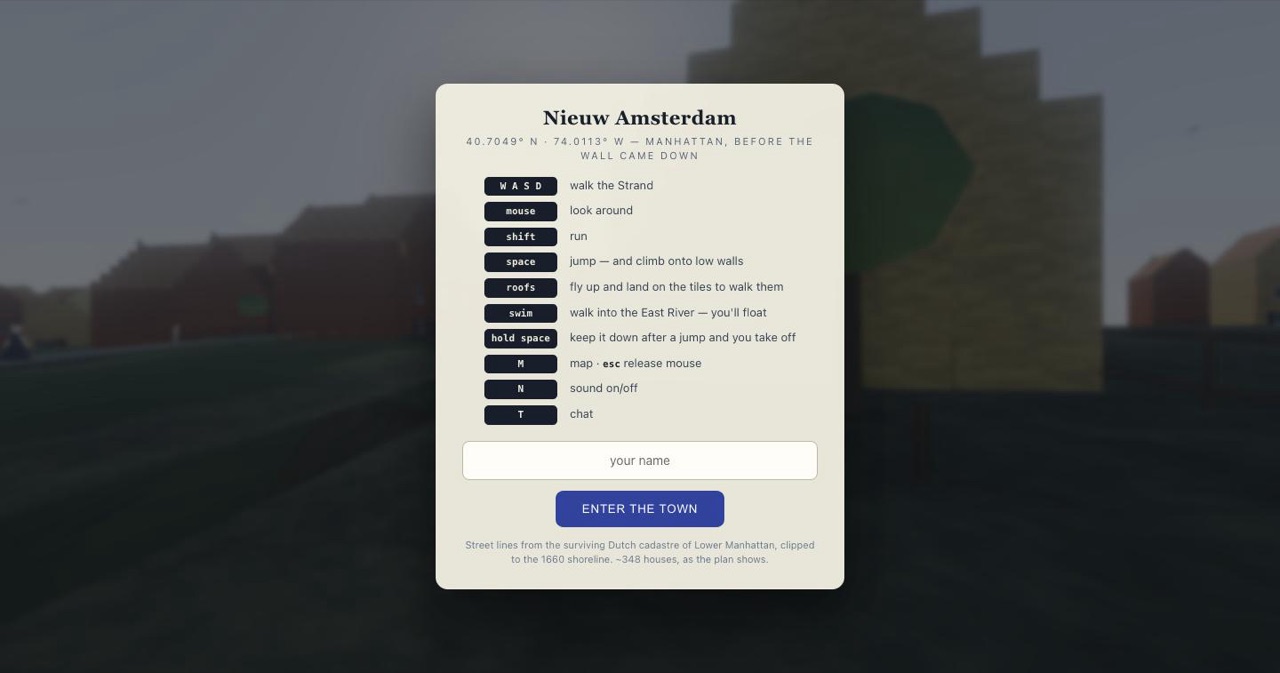
levelsio (@levelsio) asked Opus 5 to rebuild New Amsterdam, the Dutch colony that became New York City, as it looked in 1660. The model did its own research on historical maps and mostly one-shotted it: stepped-gable Dutch houses in red brick and yellow, windmills (one labeled "Ignie's Windmolen"), canals, and streets with period names like Slyck Steegh, Heere Straat, and Brouwer Straat. You can walk or fly through it at skunkworks.levels.io/newamsterdam.
Levels was honest about the flaws, which I appreciate: weird canal geometry in places, some open house edges, a windmill that doesn't look properly Dutch. Fine. It researched a 366-year-old city and built a walkable version of it in one shot. Historians and educators should be paying very close attention to this one.
6. An F1 car in Blender, built by 50 parallel agents
This is my favorite, and it's not a one-shot. It's the opposite, and that's the point.
aipulsedaily (@aipulseda1ly) put Opus 5 into "ultracode" mode and turned a rough car draft into a production-detail F1 model in Blender. The setup: 27 agents each building a high-detail part and iterating against its own renders, 5 agents competing on independent monocoque designs with the winner getting refined, and 18 inspector agents deep-zooming every region hunting for defects. Around 50 agents, roughly 10 million tokens, 10+ hours of runtime.
The renders show carbon-weave wishbones, machined uprights, anodized rod ends, drilled brake discs, and a complete steering wheel with buttons and a display, all on a showroom turntable. The next step is a fully rendered 60 to 80 second video, still pure Blender, no AI images or video involved.
This is what a 3D asset pipeline looks like when the artists are agents. (If you're running setups like this on a subscription, check our breakdown of the best AI coding token plans first, because runs like this eat quota for breakfast.)
7. Tabletop D&D in Three.js with a live AI dungeon master
BOOTOSHI (@KingBootoshi) built "AETHERBOARD," a fully 3D tabletop RPG in Three.js. Grid map, walls, furniture, glowing orbs, character tokens (one named "Elara Vance Chad," which tells you everything about the vibe). A side panel runs the narrative through local models acting as the game master. Stats, inventory, dice rolls. You move tokens around a moody tavern-and-dungeon scene and objects stay where you put them.
His victory lap: "YOU CALLED THIS PROMPT SLOP? FOOLS."
Persistent 3D state plus an autonomous GM is the part to notice. Pretty graphics demos are everywhere this week. A game that runs its own sessions is rarer, and much harder.
8. A world that improves itself by walking through it
Prompt (@engineerrprompt) posted the longest video of the bunch, over three minutes of "HOLLOWBROOK, a village in the western valleys." Opus 5 generated the interactive world from reference images: timber-framed thatched houses, cobblestone streets, wells, carts, ivy, forests, stained-glass interiors. You can pick objects up and they stay moved.
Then comes the clever bit. The agent walks the world itself, first-person, and refines the visuals at every step. You can see the quality climb over the course of the run. It ends with a proper title screen and a controls overlay. The cost was real (he noted the run ate 15% of his weekly Max limits), but a closed loop where the model explores its own creation and polishes what it finds is a preview of how this stuff will actually get used.
9. A 38-second cinematic motion sequence in under 10 minutes
Samnang Aing (@SammmAing) went in skeptical and came out calling the result "kind of insane." First iteration, pure Claude Code chat, no editing tools: a polished 38-second product-video sequence with kinetic typography ("Meet your TEAM," "SLUID," "ship"), floating stat cards, Kestrel branding, and a dashboard flying through sessions, latency, and uptime graphs. Smooth transitions, coherent pacing, done in under ten minutes.
Motion designers charge real money for sequences like this, and they should, because the taste still matters. But the floor for "acceptable product video" just moved a long way down the price curve.
10. The Subway Surfers test, and why most people use Opus 5 wrong
Max Blade (@_MaxBlade) might have posted the most useful take in the whole thread. He started out disappointed. Opus 5 felt slow, output felt mediocre. Then he stopped prompting it like a chatbot and started orchestrating: loops, graphs, reviewer agents, parallel orchestrators.
Three-plus hours of agent work later he had a polished Subway Surfers-style endless runner in the browser. Train tracks through a city, coins, hoverboard and magnet and jetpack power-ups, multipliers up to x10, day-night transitions, "BOARD WRECKED" fail states, and a leaderboard that logged his new personal best. He still had most of his usage left on the base Claude plan.
His framing stuck with me: "Fable 5 can take a shit prompt and give you gold, but it will also burn all your tokens. Opus is the opposite... The skill ceiling is insanely high... Opus 5 is a true daily driver."
That is the actual lesson of this whole list. If you want to level up the orchestration side, our advanced Claude Code guide covers subagents, hooks, and context discipline, and the pricing breakdown will tell you what these runs really cost.
What all ten have in common
Strip away the genres and a clear pattern shows up.
Everything is procedural. Three.js, Unity, single-file WebGL, Blender Python. No asset stores, no stock models, and in most cases no AI-generated images either. The textures are math.
One-shots get you a shocking prototype. Multi-agent gets you production quality. The FPS and the grass world came from single prompts. The F1 car and the endless runner came from hours of orchestrated agents reviewing each other's work. The gap between those two modes is where the new skill lives.
The tooling composes. ElevenLabs for audio, local models as a dungeon master, agents that render and inspect their own output. Opus 5 is the engine, not the whole car.
And the limits are still visible if you look. Weird canal geometry in New Amsterdam. Token bills in the millions for the big runs. Every impressive result had a human with taste deciding what "better" meant. None of the creators pretend otherwise, which is exactly why the thread landed. This is the same trajectory we tracked in the wildest Claude Code projects back in February, except the output went from clever utilities to entire worlds in five months.
Worth noting the replies weren't a monoculture either. A few people argued Grok Build still wins on certain 3D room-scale tasks. Good. Competition is why the demos keep getting better this fast.
So what do you do with this?
Stop treating these models like a search box. The people getting results that look like the ten above are designing agent systems: builders, critics, inspectors, and loops that run until the output stops improving. The prompt is the least interesting part.
Full credit to the people who actually built these things: Min Choi for assembling the thread, plus Matt Shumer, Rishi, saturadev, Lentils, levelsio, aipulsedaily, BOOTOSHI, Prompt, Samnang Aing, and Max Blade. Follow them, try the playable links, and then go break something yourself.
And when your weekend experiment turns into an actual product, submit it to SaaSCity for free and get it listed where early adopters are already looking. The next wave of AI-native games is being built this weekend, by people who look a lot like you.
The question is no longer "can AI make games?" It's "how wild are you willing to go with the agents?"
Get your SaaS in front of founders
List your product on the SaaSCity live city map - a permanent listing, real discovery, and a backlink from a high-DR directory. Free to start; upgrade for a dofollow link and a building on the map.