News
Cloudflare Just Bought Deno — and Put a One-Year Clock on the Runtime (2026)
Ryan Dahl just announced that the entire Deno team is moving to Cloudflare, putting a one-year sunset on official runtime development. Deno Deploy closes within six months, while celld merges into workerd to make self-hosted Durable Objects possible. Here is what the acquisition means for your production stack and why SaaS founders need to watch their infrastructure dependencies, with the distribution lessons we track on SaaSCity.

Contents (9)
- Key Takeaways
- The October 9 Announcements: What Breaks and When
- The Deno Deploy Shutdown: The Reversal of a $26M Bet
- Component Status and Sunset Schedule
- Why Cloudflare Bought Deno: The celld Engine and AI Agent Harnesses
- The Great Dev-Tool Rollup: Bun, Astral, and Now Deno
- What to Do If You Run on Deno: A Three-Step Migration Plan
- The Distribution Lesson: Stop Renting Your Foundation
- Final Thoughts: The Shelf Life of Dev Tool Runtimes
Quick answer: On October 9, 2026, Deno creator Ryan Dahl announced that the entire Deno team is joining Cloudflare. Official development on the Deno runtime will end after one year of monthly security and bug fixes, concluding in October 2027. Deno Deploy will shut down within six months (around April 2027), with customers guided toward Cloudflare Workers. Cloudflare acquired Deno primarily for celld, an open-source engine built by Deno to run Workers and Durable Objects on private hardware, merging it into workerd to create a self-hostable foundation for autonomous AI agents.
Ryan Dahl spent sixteen years trying to build a server environment you could actually trust, and yesterday he sold the whole thing to a CDN that plans to dismantle it by next October.
That sentence sounds cynical until you read the source text. Dahl introduced Node.js in 2009, walked away because he regretted its module resolution and lack of security sandboxing, founded Deno in 2018 to fix those exact architectural mistakes, raised $26 million from top venture firms, and built a hosted cloud platform. On October 9, 2026, the entire Deno team agreed to join Cloudflare.
The commercial product the company raised millions to build is being shuttered in six months. The runtime itself has a twelve-month expiration date on its engineering payroll. If your application boots with deno run, your runtime is officially on notice.
I am reading this news from inside a startup directory, so the disclosure up front: SaaSCity is a directory platform, and this post ends with an argument for owning your own distribution. That argument only makes sense once you see what happened to Deno's roadmap, because relying on a venture-backed infrastructure runtime is the fastest way to get stranded when investor capital wants an exit.
Key Takeaways
- One-year clock on the runtime: The Deno runtime receives monthly bug-fix and security updates for twelve months. In October 2027, official team maintenance ends.
- Deno Deploy shuts down in six months: Managed hosting ceases around April 2027. Paying users receive migration pathways to Cloudflare Workers.
- JSR and rusty_v8 survive: The jsr.io package registry moves its infrastructure onto Cloudflare, while rusty_v8 will be integrated into workerd.
- Missing from the deal: Fresh (Deno's web framework) and Deno Subhosting were not mentioned in either announcement, signaling an uncertain future.
- The real target was celld: Cloudflare bought Deno to acquire celld, an open-source Rust runtime launched in August 2026 that executes Workers and Durable Objects on bare metal.
- The AI agent motive: Durable Objects are being repositioned as open, stateful harnesses for autonomous AI agents running on private servers.
- Acquisition price: Terms were not disclosed in either post.
The October 9 Announcements: What Breaks and When
Two blog posts dropped simultaneously on October 9, 2026, and reading them side by side reveals two completely different stories.
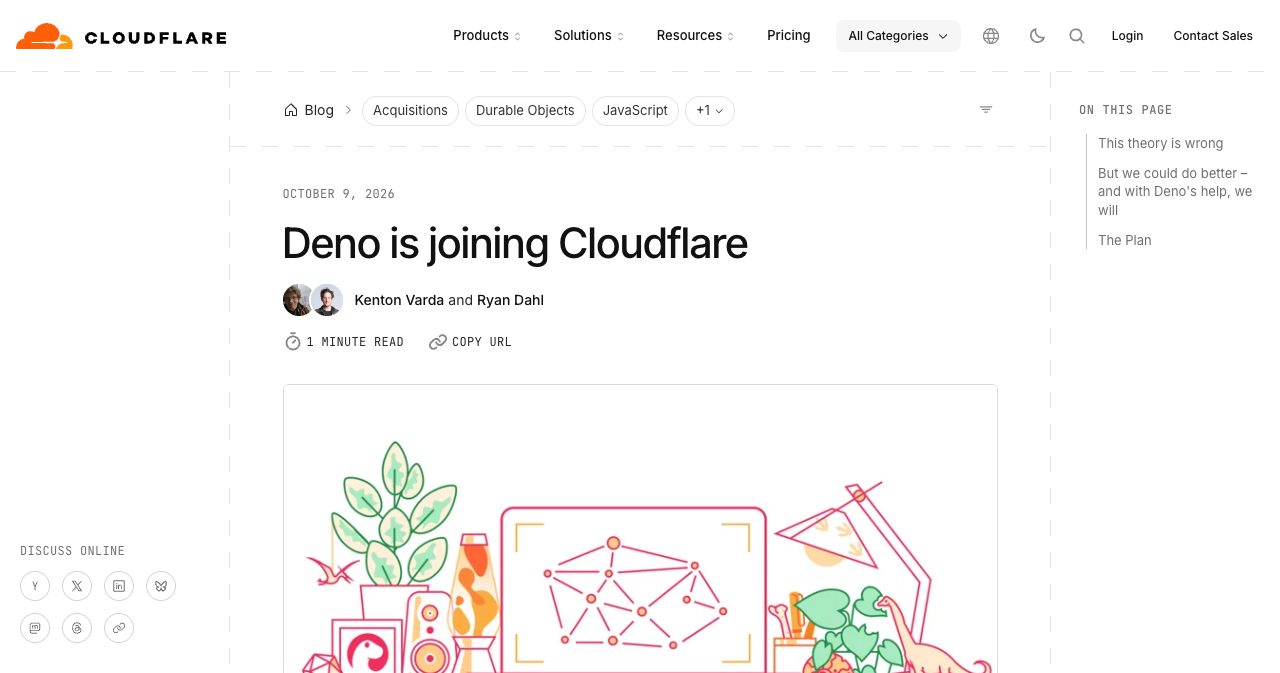
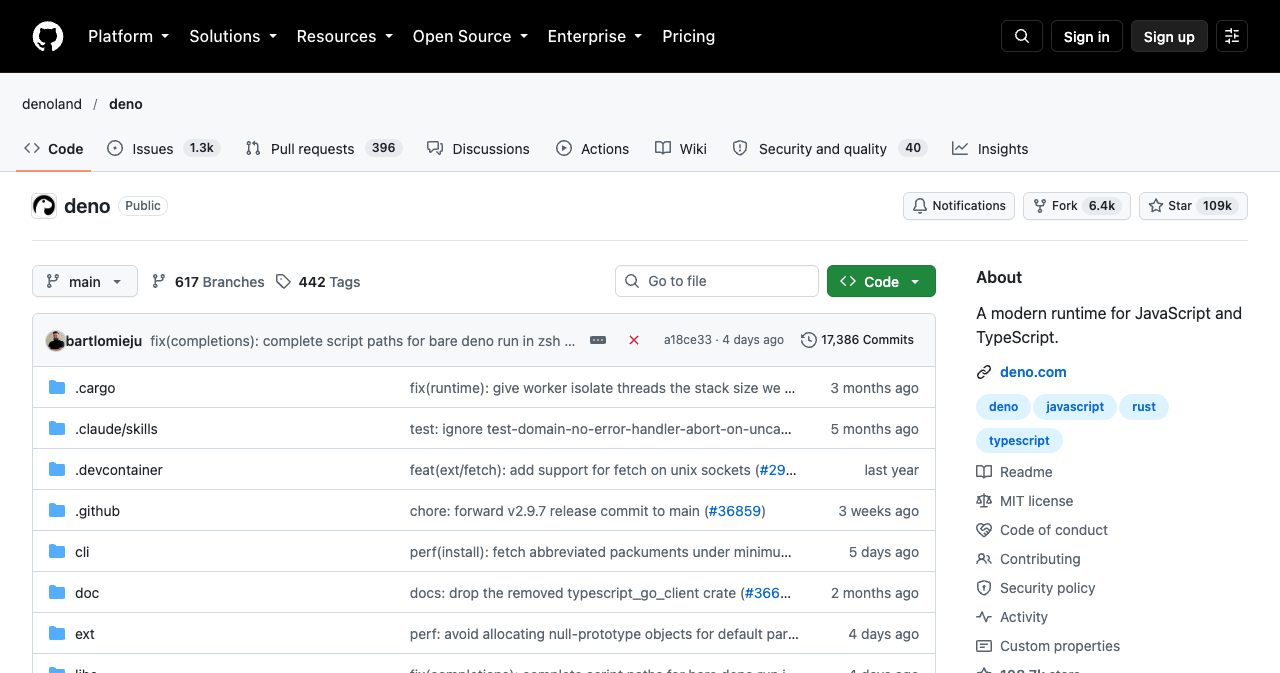
The first was published on the Deno corporate blog, titled "Deno is joining Cloudflare," written by Ryan Dahl's announcement. This post contains the operational reality that every engineering manager needs to read. Dahl wrote that the entire Deno team is moving to Cloudflare. He then explained what happens to Deno's assets.
The Deno runtime will receive bug fixes and security patches on a monthly cadence for exactly one year. Once that year concludes in October 2027, the Deno team will step away from active development. Dahl noted that Deno remains open source under MIT and Apache-2.0 licenses, so third parties are welcome to maintain it. In commercial open source, when the company that created the project stops committing code, the project enters a slow maintenance decline unless an external foundation adopts it.
The second post appeared on the Cloudflare corporate blog, co-signed by Ryan Dahl and Cloudflare Systems Architect Kenton Varda: Cloudflare announcement. This post does not spend time discussing deprecations or sunset timelines. Its stated theme is to "radically simplify self-hosting Workers and Durable Objects so developers can use the same primitives in more places."
Cloudflare is not interested in running an alternative CLI runtime to compete with Node.js or Bun. Cloudflare wants the Workers programming model, specifically Durable Objects, to become the universal standard for modern backend development. To achieve that, they needed Deno's engineering talent and an open-source project named celld.
The Deno Deploy Shutdown: The Reversal of a $26M Bet
The most painful detail of the announcement is the fate of Deno Deploy.
Deno Deploy will remain active for six months, meaning its servers will shut down around April 2027. Paying customers will receive migration support to move their workloads to Cloudflare Workers.
To understand why this shutdown matters, you have to look at Deno's fundraising history. On June 21, 2022, Deno raised a $21 million Series A round led by Sequoia Capital, bringing total capital raised to roughly $26 million, as reported by TechCrunch. Other participants in the round included Four Rivers, Mozilla Corporation, Shasta Ventures, Long Journey Ventures, and Nat Friedman.
That $21 million check was raised for one explicit reason: to commercialize Deno Deploy. The thesis was that open-source runtimes could generate venture returns by offering a global, multi-tenant V8 isolate hosting platform. Four years later, that exact commercial engine is being turned off.
The other quiet casualty is the Deno ecosystem tooling. Neither Ryan Dahl's post nor Kenton Varda's post mentioned Fresh, Deno's full-stack web framework that pioneered island architecture in JavaScript. Neither post mentioned Deno Subhosting, the enterprise product that allowed SaaS applications to run untrusted customer code. If a product was not named in the acquisition release, you should assume its engineering priority is zero.
JSR, the modern package registry Deno launched at jsr.io, will survive. Cloudflare will take over the hosting and compute costs for the registry. Because JSR serves TypeScript definitions and ESM modules directly, keeping it online costs Cloudflare relatively little while maintaining goodwill across the JavaScript community.
Component Status and Sunset Schedule
The table below outlines every major piece of the Deno platform, its revised status under Cloudflare, and the deadline for engineering action.
| Component | Status Under Cloudflare | Sunset Date | Required Action |
|---|---|---|---|
Deno Runtime (deno) | Maintenance mode; monthly security patches | October 2027 (12 months) | Plan migration to Node.js 24+, Bun, or workerd |
| Deno Deploy | Shutting down completely | April 2027 (~6 months) | Migrate services to Cloudflare Workers |
JSR (jsr.io) | Active; moving to Cloudflare servers | None announced | None; packages remain accessible |
| rusty_v8 | Active; being integrated into workerd | None announced | None; ongoing low-level engine support |
| Fresh Framework | Omitted from announcements | Unclear | Audit usage; consider standard meta-frameworks |
| Deno Subhosting | Omitted from announcements | Unclear | Contact Cloudflare support or prepare alternatives |
| celld | Merging into workerd open-source repo | Active development | Evaluate for self-hosted Workers deployments |
Why Cloudflare Bought Deno: The celld Engine and AI Agent Harnesses
If Cloudflare is killing Deno Deploy and letting the Deno runtime drift after twelve months, why spend capital to acquire the company?
The answer is celld.
In August 2026, the Deno team released celld under the Apache-2.0 license. celld is a single Rust binary capable of running a Cloudflare Workers application, complete with Durable Objects, on your own physical servers or virtual machines. You point it at an existing wrangler.json configuration file, and it executes your code locally without touching Cloudflare's edge network.
Before celld, Cloudflare had an open-source runtime called workerd. But workerd had a glaring limitation that Kenton Varda admitted candidly in the announcement: workerd only implemented Durable Objects as a single instance. That was sufficient for local unit tests on a developer laptop, but it could not scale across multiple machines in a production cluster.
Cloudflare plans to merge celld's distributed architecture directly into workerd. Ryan Dahl and Bert Belder, who co-founded Deno and worked on Node.js core, will lead this integration. The goal is to make self-hosting Cloudflare Workers a first-class, supported option for enterprise systems.
For teams following infrastructure trends, this move directly addresses the growing demand for self-hosting alternatives for Vercel and Supabase, where developers want the convenience of edge primitives without platform lock-in.
The technical core of this deal revolves around Durable Objects. In Cloudflare's architecture, a Durable Object is a distributed singleton with its own embedded SQLite database. Each object runs single-threaded JavaScript execution, handles persistent WebSocket connections, and reads directly from local storage with microsecond latency.
This architecture has become the primary design pattern for autonomous AI agents. An AI agent is not a stateless request. An agent needs an execution harness: a long-running process that holds memory state, keeps socket connections open to client tools, and commits execution history to a relational table.
As Cloudflare expands its developer tools for autonomous software, which we covered in our review of the Cloudflare Web Search API and AI agents, Durable Objects have become Cloudflare's foundational building block for AI systems. By making workerd and Durable Objects portable via celld, Cloudflare is betting that developers will write agent harnesses using Workers primitives, whether they run on Cloudflare's global edge or inside an on-premise Kubernetes cluster.
The Great Dev-Tool Rollup: Bun, Astral, and Now Deno
Deno's acquisition is not an isolated event. It is the continuation of a clear pattern reshaping developer tooling throughout 2025 and 2026.
Look at the timeline of independent runtime and developer tooling acquisitions over the past twelve months:
- December 2025: Bun creator Jarred Sumner and the Bun team joined Anthropic. Bun remains MIT-licensed, but Claude Code now ships as a Bun-powered binary, tying the runtime directly to Anthropic's developer experience.
- March 19, 2026: Astral, the company behind the popular Python package manager
uvand the linterRuff, announced an agreement to join OpenAI's Codex engineering group. - September 2026: Shopify acquired Tailwind Labs, as we analyzed in our breakdown of Shopify acquiring Tailwind CSS, absorbing an open-source framework after AI tooling disrupted its commercial business.
- October 9, 2026: Cloudflare acquires Deno to power its workerd runtime and agent compute platform.
The economics behind these deals are straightforward. Building a foundational developer tool requires millions of dollars in systems engineering payroll. Monetizing that tool through hosted services, documentation ads, or enterprise plugins rarely generates the venture-scale returns investors demand.
Frontier AI labs and hyperscale cloud providers have the opposite equation. They possess vast balance sheets and need systems engineers who understand V8 bindings, Rust memory management, and process sandboxing. When an independent runtime company reaches the end of its funding runway, an acquisition by a cloud or AI giant is the inevitable outcome.
The neutral ground of independent developer tooling is shrinking. If you write code for production systems, you are increasingly building on platforms governed by a handful of AI labs and infrastructure giants.
What to Do If You Run on Deno: A Three-Step Migration Plan
If you have Deno running in your infrastructure today, panic is unnecessary. Twelve months is enough time to execute a clean migration if you start before the clock runs out.
Here is a practical, three-step action plan to audit and migrate your stack.
Step 1: Audit your operational exposure
Classify your Deno dependencies into three distinct buckets:
- Local utility scripts: If you use Deno for one-off CLI scripts, data transformation scripts, or internal automation, you face minimal operational risk. You can continue running the current pinned Deno binary indefinitely.
- Production backend services: If your core APIs run on
deno run, you are on a twelve-month maintenance window. After October 2027, you will not receive security patches for new V8 vulnerabilities. - Deno Deploy hosting: If your production apps are hosted on Deno Deploy, your deadline is six months (April 2027). This is an active operational risk that requires immediate engineering allocation.
Step 2: Choose your migration target
Depending on where your code runs, select the target that minimizes rewrite overhead:
- If you are on Deno Deploy, move to Cloudflare Workers. Because Cloudflare acquired Deno specifically to bridge these environments, their migration tooling will be the smoothest path. If your codebase relies on standard Web Fetch APIs, moving to Workers requires adjusting your routing handlers and deployment pipeline.
- If you need a long-term production server, move to Node.js 24+. Node.js has addressed many of the complaints that originally prompted Deno's creation. Node now features native support for executing TypeScript files without external compilers, full support for ES Modules, and built-in SQLite bindings. Node.js has an independent foundation and will not be discontinued by a corporate acquisition.
- If you need raw performance and native TypeScript, evaluate Bun. Bun offers fast startup times, native TypeScript execution, and high compatibility with npm modules. Keep in mind that Bun now sits inside Anthropic, so you are trading one corporate steward for another.
Step 3: Pin your versions and set a migration deadline
Do not leave your CI/CD pipelines pulling latest for Deno. Pin your exact version in your Dockerfiles, deployment scripts, and GitHub Actions workflows today.
Establish a migration calendar:
- By December 1, 2026: Complete your inventory of all Deno Deploy and Deno CLI touchpoints across your repositories.
- By February 1, 2027: Complete the migration of any production services hosted on Deno Deploy to Cloudflare Workers or your own infrastructure.
- By June 1, 2027: Transition backend API services off the Deno runtime onto Node.js, Bun, or the merged workerd runtime, well ahead of the October 2027 maintenance cutoff.
The Distribution Lesson: Stop Renting Your Foundation
There is a larger business lesson here for indie hackers and SaaS founders.
Deno raised $26 million to build a cloud hosting business. They built clean developer tools, shipped performant code, and cultivated an enthusiastic community. Yet four years later, their commercial product is gone, and their runtime is entering an end-of-life glide path.
If a well-funded company with elite systems engineers can have its commercial roadmap wiped out, your startup faces the same structural vulnerability whenever you rent your foundation from a single vendor.
This applies directly to how you acquire customers. Founders frequently rent their entire visibility from third-party channels they cannot control. They rely on search engine algorithms that drop organic traffic overnight, or they build funnels on platforms that change their terms of service. When that single channel pivots, the business has no second leg to stand on.
The solution is to own distribution assets that persist regardless of platform shifts. You need real backlinks, indexed brand profiles, and citations on sites that search engines and AI models recognize as authoritative sources.
This is the exact reason we built SaaSCity as a gamified startup directory with a live city map and human editorial review. Rather than submitting your product to an automated database that gets ignored, a listing on SaaSCity gives you a permanent, indexed page and a physical building on our interactive map.
Founders who want to build durable domain equity can start with our free listing, which provides a permanent profile page. Adding the SaaSCity badge to your website earns you a verified dofollow backlink and books your launch into our next Monday launch cohort.
For teams that need accelerated indexing, our Quick Pass is $19.99 and guarantees your listing goes live within 24 hours. For startups seeking maximum visibility, our Premium tier is $99.99, adding a written launch post containing three dofollow backlinks. Our domain rating sits between 47 and 56 at the most recent Ahrefs refresh, delivering real link authority from an indexed domain rather than an unranked link farm.
In infrastructure, you protect your software by avoiding vendor lock-in and writing portable code. In marketing, you protect your business by building backlinks and directory profiles that nobody can take away when an acquisition closes.
Final Thoughts: The Shelf Life of Dev Tool Runtimes
Software runtimes are not permanent monuments. They are temporary scaffolding that solves specific engineering problems for specific eras.
Ryan Dahl solved real architectural problems with Node.js, and he proved that secure, native TypeScript runtimes were viable with Deno. The fact that Deno is being absorbed into Cloudflare does not diminish that technical contribution. It simply reminds us that in software engineering, the code you write will almost always outlive the startup that sold you the runtime.
Audit your repositories, pin your versions, and migrate your services before April 2027. The clock is already ticking.
Get your SaaS in front of founders
List your product on the SaaSCity live city map - a permanent listing, real discovery, and a backlink from a high-DR directory. Free to start; upgrade for a dofollow link and a building on the map.