News
Cloudflare Just Put Web Search Inside AI Gateway — at $0.25 per 1,000 Queries (2026)
Ask most AI agents to check something on the live web and they will guess a URL, get a 404, and keep going anyway. Cloudflare's Web Search API inside AI Gateway gives them real results from Ceramic, Exa or Linkup at list price with no markup. Here's the cost math against model-native search, what the crawler rules mean for your content, and why being a citable page now matters for SaaS discovery, SaaSCity included.

Contents (9)
Quick answer: On October 2, 2026, Cloudflare opened a Web Search API in open beta inside AI Gateway. It returns live web results from Ceramic.ai, Exa or Linkup, bills at each provider's list price with no markup, and costs $0.25 per 1,000 requests on the default Ceramic option. The bigger change is that search spend now shows up as a metered line item you can log, cap and route, the same way you already handle model calls.
Ask an AI agent to research something on the open web and it will often make up a URL, fetch it, get a 404, and carry on as if it had read a source. Cloudflare's launch post calls out that exact habit. Search fixes it by giving the agent a real address to read before it writes a word.
Quick disclosure before the analysis: you are reading this on a directory's blog. SaaSCity is a gamified startup directory with a live city map and human editorial review. I'll flag where it comes up below, and the argument stands without it.
What Cloudflare actually launched
Cloudflare announced the Web Search API on October 2, 2026, as part of Birthday Week. The authors of the announcement on the Cloudflare blog are Michelle Chen, Sam Else and Gabriel Massadas. The product is a single search call that lives in AI Gateway, which Cloudflare already sells as a proxy and control layer for model traffic.
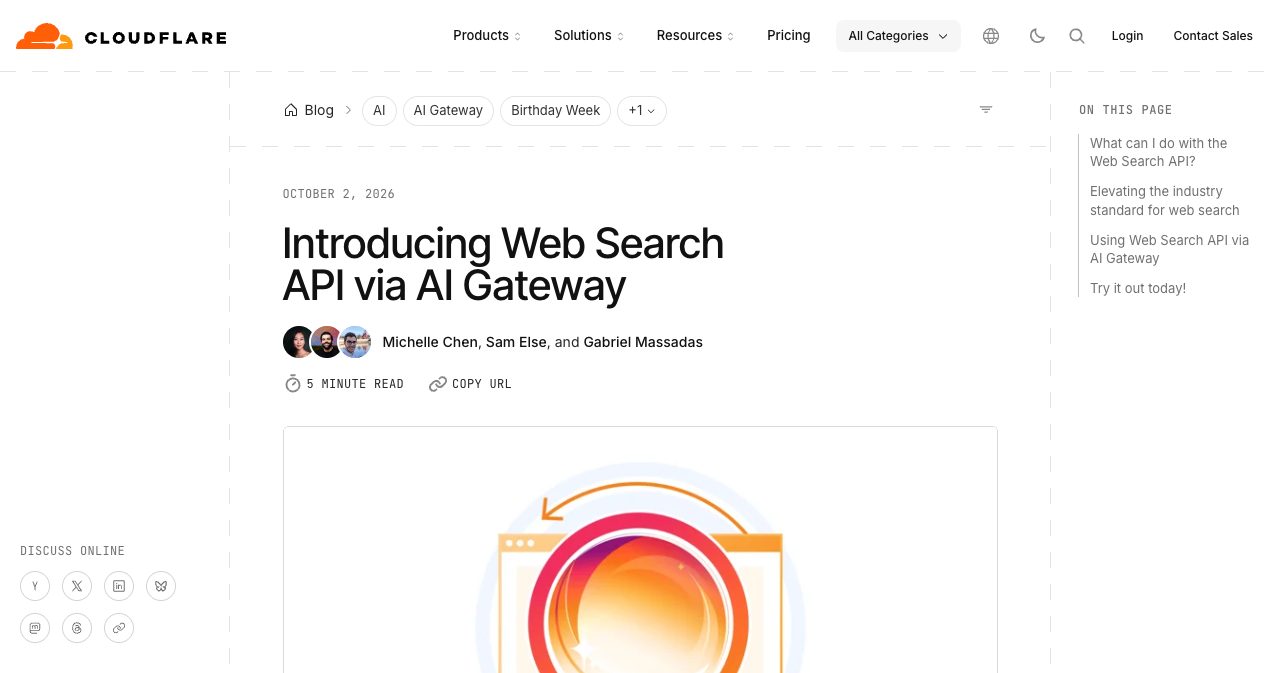
Three things make this more than another search wrapper. The results come from three partners, not one. Every partner returns the same shape, so swapping providers does not mean rewriting your code. And the charges land on the same bill as your model calls, so you can cap them with the same tools.
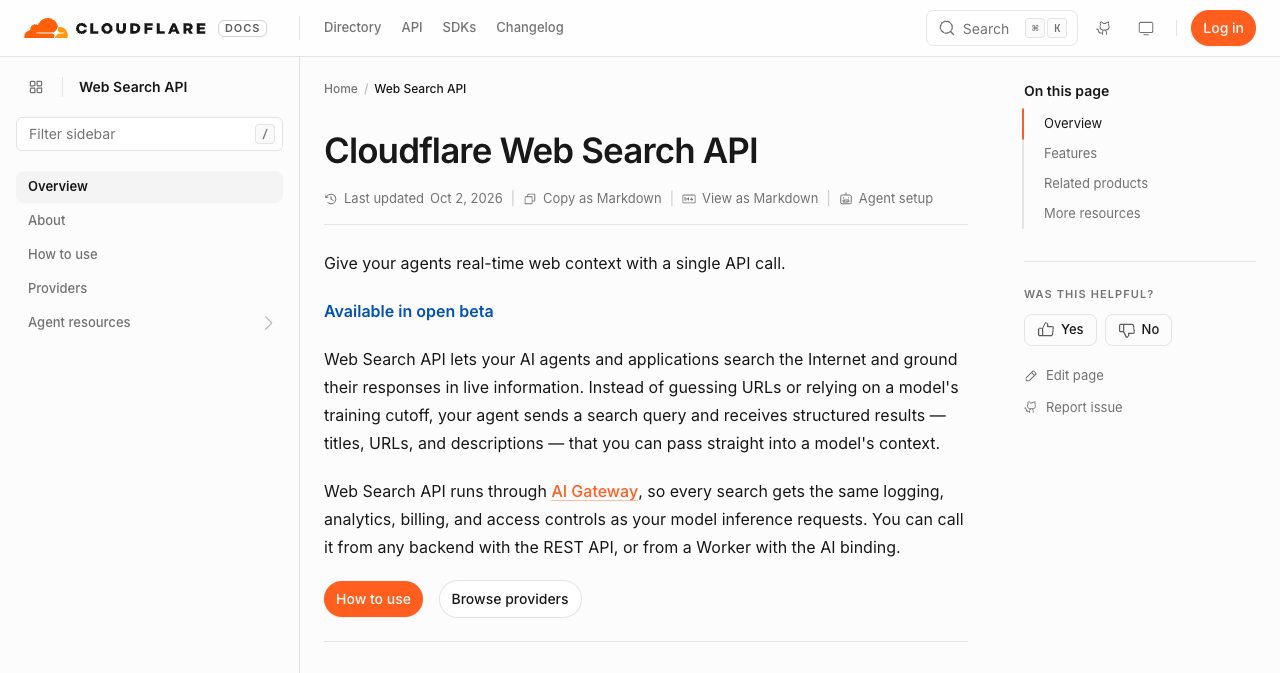
The Cloudflare docs were last updated on October 2, 2026, and label the product "Available in open beta." The overview confirms two ways in: a REST API, or the Workers AI binding if your agent already runs on Workers.
The endpoint, in one request
The REST call is a POST to your account's AI endpoint. You authenticate with a Cloudflare API token that has read permission for both Workers AI and AI Gateway. Every account gets a gateway called default, so you can start without creating anything.
curl -X POST "https://api.cloudflare.com/client/v4/accounts/{account_id}/ai/websearch/" \
  -H "Authorization: Bearer $CLOUDFLARE_API_TOKEN" \
  -H "Content-Type: application/json" \
  -d '{
    "query": "open source feature flag tools 2026",
    "provider": "ceramic",
    "limit": 5,
    "options": { "gateway": { "id": "default" } }
  }'
The body is small. Here is what each field does and where the limits sit.
| Field | Purpose | Limit or default |
|---|---|---|
query | The search string | 1 to 1,024 characters |
provider | ceramic, exa or linkup | Defaults to ceramic |
limit | Number of results | 1 to 10, default 10 |
byokAlias | Uses your own provider key instead of gateway credits | Optional |
options.gateway.id | Which AI Gateway handles the call | Every account has default |
The ten-result ceiling is worth planning around. If your agent needs twenty sources, you make two calls with different queries or pass the first batch back and ask for follow-ups.
Three providers, one result shape
Each provider has a different index and a different idea of what a good result is. Cloudflare's decision to normalize the output is the part that matters for your code.
| Ceramic.ai | Exa | Linkup | |
|---|---|---|---|
| Index | Own index of more than 40 billion pages | Own index, keyword plus embeddings | Raw web results |
| Search style | Default provider | auto search type | fast search depth |
| Description field | Up to 8,000 characters | Page highlights | Raw result text, no generated answer |
| Zero Data Retention | Yes | No at launch | Yes |
| List price per 1,000 | $0.25 | $7.00, plus about $1 per 1,000 page-content fetches billed separately | $5.00 |
Ceramic is the cheapest and the default, and its descriptions can run long enough to give a model real context. Exa is the semantic option. If your agent is searching for "tools like X that feel calmer," embeddings tend to beat keywords, and the page highlights give the model passages rather than teasers. The Zero Data Retention gap is the one to check before you send sensitive queries. Linkup sits in the middle on price and returns raw material, so your own model writes the answer.
Because provider is one parameter, you can run the same query set through all three and compare cost against answer quality. That experiment takes an afternoon. Re-integrating three SDKs takes a sprint.
The cost math that changes the decision
The pricing story is where this launch gets interesting. Cloudflare says it passes through each provider's list price, so the per-query number is the partner's number. What changes is the comparison set.
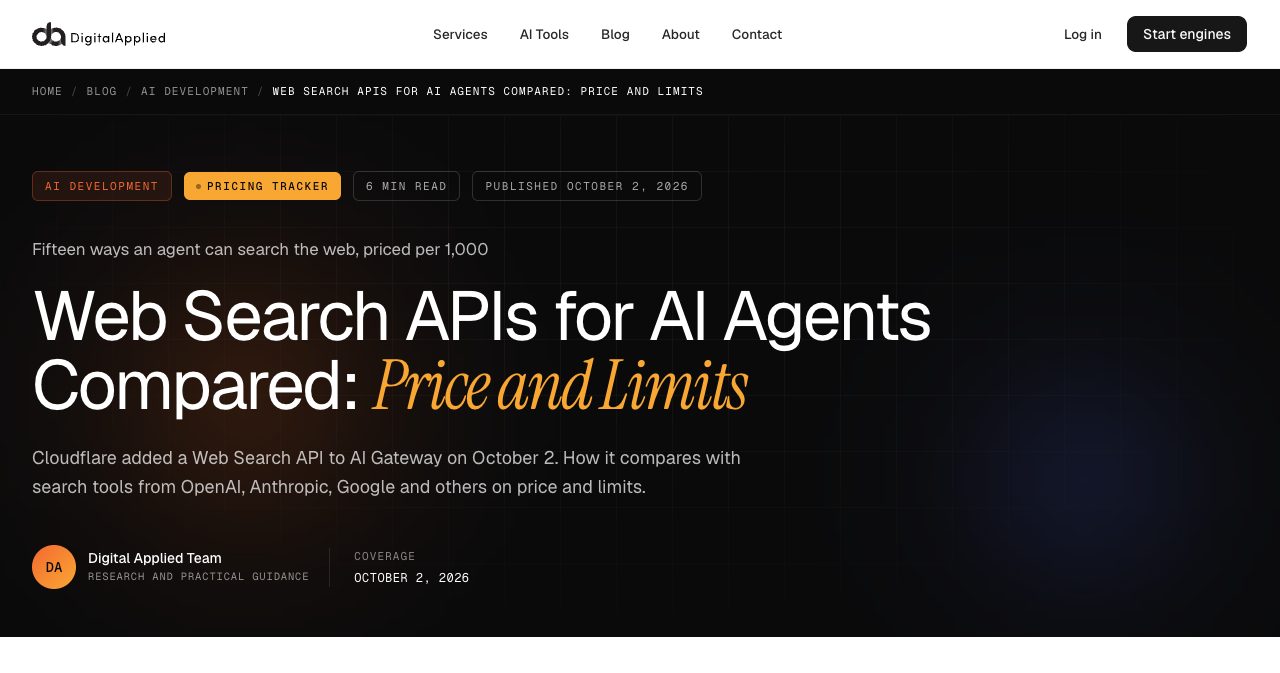
Digital Applied's pricing tracker, dated October 2, 2026, puts the field side by side. The figures below are per 1,000 requests, from that table.
| Tool | Per 1,000 requests | Notes |
|---|---|---|
| Ceramic via Cloudflare | $0.25 | Default provider, no markup |
| Parallel (turbo/fast) | $1.00 | Standalone API |
| Perplexity (Fast) | $1.00 | Standalone API |
| Brave | $5.00 | Standalone API |
| Linkup via Cloudflare | $5.00 | No markup |
| Exa | $7.00 | Page contents billed separately |
| Tavily (basic) | $8.00 | Standalone API |
| OpenAI web search | $10.00 | Search results also billed as model tokens |
| Anthropic web search | $10.00 | Search results also billed as model tokens |
| Google Gemini 3.x grounding | $14.00 | Search results also billed as model tokens |
| Microsoft Bing | $14.00 | Listed in the same tracker |
The spread from the cheapest tier to the most expensive is $0.25 to $14, which is a 56x difference. Put it in dollars. At 100,000 queries a month, Ceramic costs $25. Linkup costs $500. Exa costs $700. An OpenAI- or Anthropic-style search fee alone costs $1,000, and that figure excludes the tokens the model spends reading what came back.
That last part is the trap. A model-native search tool decides when to search, returns a set of pages, and then charges you for those pages as input tokens on the next turn. The search fee is the visible number. The token bill quietly grows with every result the model ingests. A standalone search API returns structured results and stops there, so your cost per call is predictable.
Cloudflare added a second control here. AI Gateway already supports dollar-denominated spend limits, which entered public beta on June 5, 2026. That means search spend can sit under the same budget as your model calls, instead of living in a separate vendor invoice nobody checks until the end of the month.
The rules that come with the results
Cloudflare did not only ship a cheaper search. It attached conditions to every provider on the platform.
Each provider must comply with Cloudflare's Verified bots crawling requirements. Cloudflare's summary of those requirements covers honoring robots.txt, identifying the crawler transparently, and behaving like a bot you can trace. And every web search response has to include a link to the location of the crawled content.
That last rule matters more than it looks. Agents that ground answers in search results will name their sources, or at least carry the links along. Cloudflare says the requirement raises the bar for honest crawlers and gives site owners more control. In practice it means the sources an agent cites are the ones that were crawled under rules, with a URL attached.
What the launch doesn't tell you
Cloudflare's post contains no quality benchmark. There is no table showing which provider finds the best answer for a support question or a product comparison. The launch gives you prices, providers and a shape. You have to measure relevance yourself, and a test set of forty queries from your real product is enough to see the differences.
Two other gaps are worth tracking. The native server tool, where a model calls search without your wrapper, is still marked coming soon. And the Zero Data Retention status of Exa at launch matters if your queries include customer names, internal product plans or anything you would not want stored. The Hacker News discussion from October 5, 2026 had about 93 points and 47 comments, and the people arguing in it mostly asked the same questions: quality, retention and how stable the list prices will stay.
Pricing will move. Check each provider's current list price before you build a budget around a number from a launch week.
Why citable pages just got a new job
Here is the part that matters beyond developer tooling.
When an agent grounds its answer in live search, it does not pick from the whole web. It picks from what the search index returns for that query. The pages that come back are the indexed, specific, factual pages that a crawler can read and a model can quote. Generic marketing copy with no clear claim is the first thing that falls out of that set.
That is the same dynamic covered in our guide to optimizing your website for AI citations, and it is why the SEO case for listing a SaaS in directories keeps getting stronger. A directory page with a clear one-line description, a category and a crawlable URL is exactly the sort of source a search index can return for "best tool for X." A product that exists only behind a login or in a pitch deck cannot be returned at all.
This is where I'll be direct about SaaSCity. It is a free listing with a permanent page, a human editorial review before it goes public, and a building on the live city map. Adding the SaaSCity badge to your site gets you a dofollow backlink and books a Monday launch slot. Quick Pass at $19.99 skips the badge and goes live within 24 hours. Premium at $99.99 adds a written launch post with three dofollow links. The domain sat in the DR 47 to 56 range at the last Ahrefs refresh. None of that makes SaaSCity a search engine, and nothing here says an agent will pick your listing. It is a crawlable, reviewed, factual page, which is the kind of thing a search index is built to return.
What to build this week
If you run an AI product or an internal agent, here is the order I would work in.
- Define the search as a function. Since the native tool is not live, write a
search(query)function that calls the endpoint withlimitset to five or ten. Return the title, URL and description to the model unchanged, so the links survive. - Log cost per call. Route the calls through the
defaultgateway, or your own gateway, and tag requests so you can see search spend by feature. - Set a spend limit. Put a dollar cap on the gateway before a loop in your agent discovers it can search forty times per user turn.
- Run a provider test. Send the same forty queries to Ceramic, Exa and Linkup. Score answer quality by hand for a day. Pick the cheapest provider that clears your bar.
- Check the Zero Data Retention status for any queries that carry customer data, before you choose Exa.
If your agents already talk to tools through MCP, our roundup of MCP servers for Claude Code shows where a search function would sit in that setup. If you plan to charge agents for your own endpoints, the same agent-payment logic runs the other way in our piece on Cloudflare's Monetization Gateway and x402.
The question to ask about your own page
Cloudflare made it cheap for an agent to search the web. It did not make it any easier for a human to be found by that agent. The cost of a search is now $0.25 per 1,000 on the cheap path. The cost of being absent from the results is harder to put on an invoice.
Next time you ask an agent about your category, read the links it cites. Are any of them yours? If not, the search index already decided, and it decided without asking you. Submit your product to SaaSCity so that at least one clear, crawlable, reviewed page about it exists on the open web.
TOPIC: WHAT HAPPENED On October 2, 2026, during its Birthday Week, Cloudflare launched a Web Search API inside AI Gateway, in open beta. It lets AI agents and applications search the live web and ground their answers in real-time results instead of guessing URLs (the post's fun fact: agents usually curl a guessed URL and get a 404). Announcement: https://blog.cloudflare.com/introducing-web-search-api/ (authors Michelle Chen, Sam Else, Gabriel Massadas, Oct 2, 2026). Changelog: https://developers.cloudflare.com/changelog/post/2026-10-02-introducing-web-search-api/ . Docs (last updated Oct 2, 2026): https://developers.cloudflare.com/web-search/ .
KEY FACTS
- Three launch providers: Ceramic.ai (the DEFAULT), Exa, and Linkup. Every provider returns the same shape — title, URL, description per result — so switching providers is one parameter.
- Billing: at each provider's LIST price, NO markup, charged to AI Gateway credits OR bring-your-own-key (byokAlias). List price per 1,000 requests: Ceramic $0.25, Linkup $5.00, Exa $7.00.
- Ceramic.ai: own index of more than 40 billion pages, descriptions up to 8,000 characters, Zero Data Retention = Yes.
- Exa: own index combining keyword + embeddings search,
autosearch type, page highlights as description, Zero Data Retention = No (at launch). - Linkup:
fastsearch depth, raw results with no generated answer, Zero Data Retention = Yes. - Endpoint: POST https://api.cloudflare.com/client/v4/accounts/{account_id}/ai/websearch/ with a Cloudflare API token (read permission for Workers AI AND AI Gateway). Body: query (1-1,024 chars), provider ("ceramic"|"exa"|"linkup", defaults to ceramic), limit (1-10 results, default 10), optional byokAlias, options.gateway.id (every account has a gateway called "default"). Also callable from a Worker via the AI binding.
- Every provider must comply with Cloudflare's "Verified bots" crawling requirements, and web search responses must include a link to the location of the crawled content. Cloudflare frames this as raising the bar for honest crawlers and giving site owners control.
- Limits: max 10 results per request. A native "server tool" that the model can call on its own is marked "coming soon" — for now you define a search function and call the API from it.
- AI Gateway already shipped dollar-denominated spend limits in public beta on June 5, 2026 — so search spend is now budgetable alongside model spend.
COST COMPARISON (for a table)
- Raw-result / standalone APIs, per 1,000 requests: Ceramic via Cloudflare $0.25; Serper ~$1.00 (down to ~$0.30 at volume); Brave Search ~$5; Linkup $5-6 (Cloudflare $5.00); Exa $7 (plus ~$1/1,000 page contents, billed separately), Tavily ~$8 basic / $16 advanced; SerpAPI ~$15.
- Model-native "the model decides when to search" tools cost much more: OpenAI and Anthropic charge ~$10 per 1,000 searches AND then bill the returned results as model tokens; Google's grounded prompting runs ~$35 per 1,000 prompts on Gemini 2.5. Cheapest tier across the whole field runs $0.25 to $14 per 1,000 — a 56x spread. Source: https://www.digitalapplied.com/blog/web-search-apis-for-ai-agents-compared-2026 (Oct 2, 2026).
- Cloudflare's angle: no markup, one control plane, provider-agnostic result shape. Source: https://ppc.land/cloudflare-web-search-for-ai-agents-costs-0-25-to-7-per-1-000-requests (Oct 4, 2026, Luis Rijo).
- HN discussion (Oct 5, 2026, ~93 points, ~47 comments): https://news.ycombinator.com/item?id=49963171
WHY IT MATTERS TO SAAS FOUNDERS
- Agent web search is now a metered line item you can log, cap and route like any other model call — one gateway, one bill, no markup.
- Switching search providers becomes a one-parameter change, so you can A/B cost vs quality (Ceramic cheap, Exa semantic, Linkup factual/raw) without re-integrating.
- Crawler compliance and source attribution are part of the deal: the sources agents pull from are named. If agents ground answers in live search, the citable, crawlable layer is the new storefront — GEO/AEO, not just classic SEO.
- The "coming soon" native server tool tells you where this goes next: models calling search on their own, which changes how much of the retrieval plumbing you build.
ARTICLE ANGLE News + practical analysis: what Cloudflare launched, the real cost math ($0.25 vs $10 model-native tools), the three providers compared, the verified-bot/attribution rules, and the bigger shift — when AI agents search the web to answer, being present and citable in the crawlable layer (directories, docs, structured content) is how a SaaS gets found. Bring SaaSCity in honestly: a free, crawlable, editorially-reviewed directory listing (plus badge → dofollow backlink) is exactly the kind of source AI search grounds on. Working title: "Cloudflare Just Put Web Search Inside AI Gateway — at $0.25 per 1,000 Queries (2026)" Slug: cloudflare-web-search-api-ai-agents-2026 Primary keyword: "cloudflare web search api" Secondary keywords: "web search api for ai agents", "cloudflare ai gateway web search", "cheapest web search api", "exa vs linkup vs ceramic", "ai search grounding pricing", "ai agents search the web"
RELATED INTERNAL SLUGS (all verified to exist — use ONLY these, relative paths /blog/<slug>)
- how-to-optimize-website-for-ai-citations-geo-aeo-2026
- best-mcp-servers-claude-code-2026
- cloudflare-monetization-gateway-x402-edge-payments-2026
- seo-benefits-of-listing-saas-products-2026
- reddit-rss-shutdown-public-api-saas-2026
SCREENSHOTS (already on disk — reference each exactly once, exactly one of them per paragraph it supports)
- /blog/cloudflare-web-search-api-ai-agents-2026/cloudflare-web-search-api-announcement.jpg — Cloudflare's Oct 2, 2026 Birthday Week blog post announcing the Web Search API via AI Gateway, tagged AI / AI Gateway / Birthday Week.
- /blog/cloudflare-web-search-api-ai-agents-2026/cloudflare-web-search-docs.jpg — Cloudflare's Web Search API docs overview page (last updated Oct 2, 2026), showing "Available in open beta" and that it runs through AI Gateway with REST API or Workers AI binding.
- /blog/cloudflare-web-search-api-ai-agents-2026/web-search-api-pricing-comparison.jpg — Digital Applied's Oct 2, 2026 pricing tracker comparing web search APIs for AI agents per 1,000 requests, the piece that puts Cloudflare's $0.25-$7 tier beside model-native tools.
Get your SaaS in front of founders
List your product on the SaaSCity live city map - a permanent listing, real discovery, and a backlink from a high-DR directory. Free to start; upgrade for a dofollow link and a building on the map.