SaaS Business
Cloudflare Monetization Gateway: Charge for APIs and Content at the Edge Without Building a Payment Stack
Cloudflare's new Monetization Gateway lets you charge for any resource behind Cloudflare — APIs, MCP tools, datasets — with payment verification handled at the edge via the x402 protocol. Here's what it means for SaaS founders who want usage-based pricing without becoming a payments company.

Contents (5)
Quick answer: The Cloudflare Monetization Gateway, announced July 1, 2026, lets you put a price on any asset already behind Cloudflare: a page, an API endpoint, an R2-hosted dataset, or an MCP tool. Cloudflare enforces payment at the edge before the request reaches your origin, using x402, an open protocol built with a coalition of 25+ partners through the x402 Foundation. Payments settle in stablecoins, which makes sub-cent pricing viable, and one control plane manages pricing rules and access policies across every protected resource.
Every SaaS founder who has tried to charge per API call knows the real cost isn't the infrastructure — it's the plumbing around it. You need a metering system, a billing engine, a way to reconcile usage against invoices, fraud protection, and a payment processor that doesn't eat 30 cents plus 2.9% on a transaction that might be worth a tenth of a cent. Stripe solved subscriptions. Nobody solved micropayments. So most founders default to monthly tiers and API keys with rate limits, even when usage-based pricing would fit the product better.
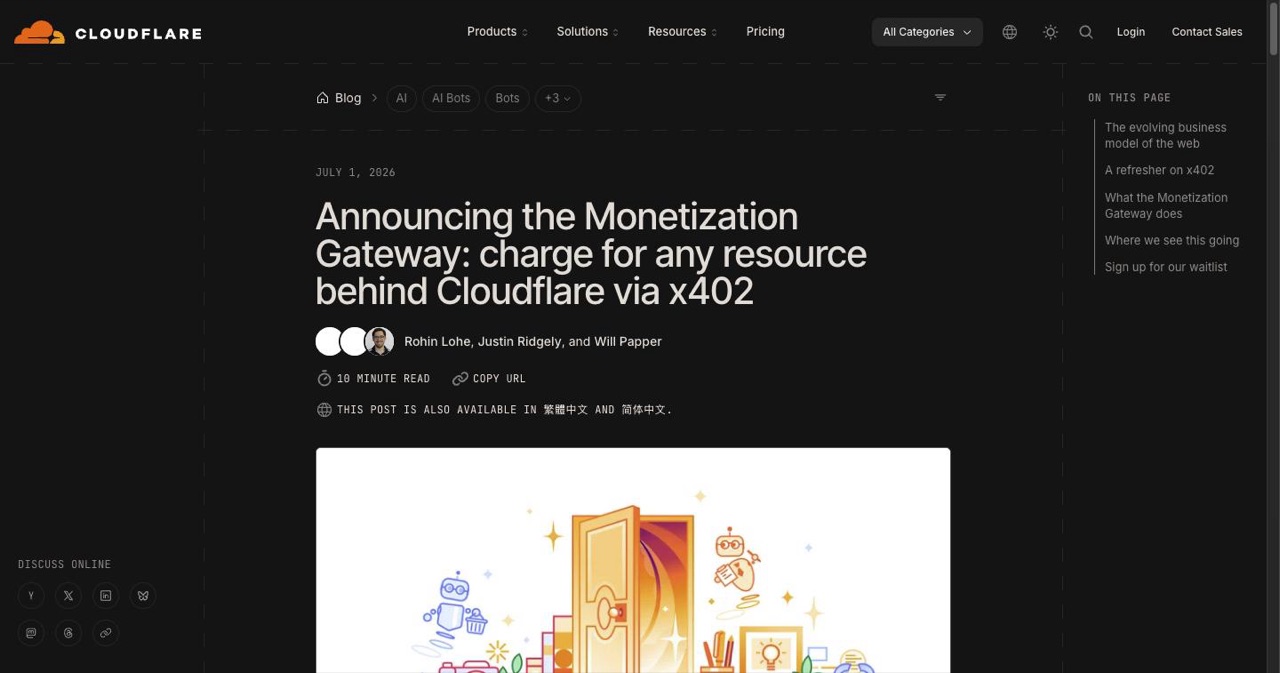
On July 1, 2026, Cloudflare announced the Monetization Gateway, a product that treats payment verification as an edge networking problem instead of a billing problem. If you already run traffic through Cloudflare, you can now put a price on any asset behind it — a page, a dataset, an API endpoint, or an MCP tool — and Cloudflare enforces payment before the request ever reaches your origin.
This lands at a specific moment. Traffic to APIs and content is increasingly coming from AI agents, not browsers with humans attached. Agents don't click ads, they don't convert on a pricing page, and they don't tolerate a login wall. They need a payment primitive that works in milliseconds, machine to machine, at fractions of a cent. That's the gap Cloudflare is filling.
Key Takeaways
- Announced July 1, 2026: Cloudflare's Monetization Gateway prices any resource behind Cloudflare, including Workers, Pages, CDN origins, R2 datasets, and MCP servers.
- Enforcement happens at the edge: Unpaid or invalid requests are rejected before they reach your origin, so scraper traffic stops costing you compute and bandwidth for nothing.
- x402 revives HTTP 402: A client hits a paid endpoint, receives a 402 response carrying payment terms, and settles within the same request flow. No OAuth, no pre-registered billing account.
- Stablecoin settlement enables sub-cent pricing: Card networks have fixed minimums and percentage fees that make a $0.001 charge lose money; stablecoin rails strip that overhead out.
- One control plane: Pricing rules and access policies for every protected resource live in one place instead of separate billing logic per endpoint.
- Built for agent traffic: An autonomous agent cannot create an account or enter a card mid-task, so it needs machine-to-machine payment in the same request cycle.
- Not yet GA: Pricing details are not public and Cloudflare has not released a general availability date, though x402 is already live with 25+ partners.
What Cloudflare Actually Shipped
The Monetization Gateway sits in front of whatever you're already serving through Cloudflare — Workers, Pages, an origin server behind the CDN, R2-hosted datasets, or an MCP server. You define a price and a policy for a route or resource, and Cloudflare enforces it at the edge before the request touches your infrastructure. Unpaid or invalid requests never reach your origin, which matters as much for cost control as for revenue: today, a scraper hammering your unprotected API costs you compute and bandwidth for zero return. Under this model, the same traffic either pays or gets rejected at the edge.
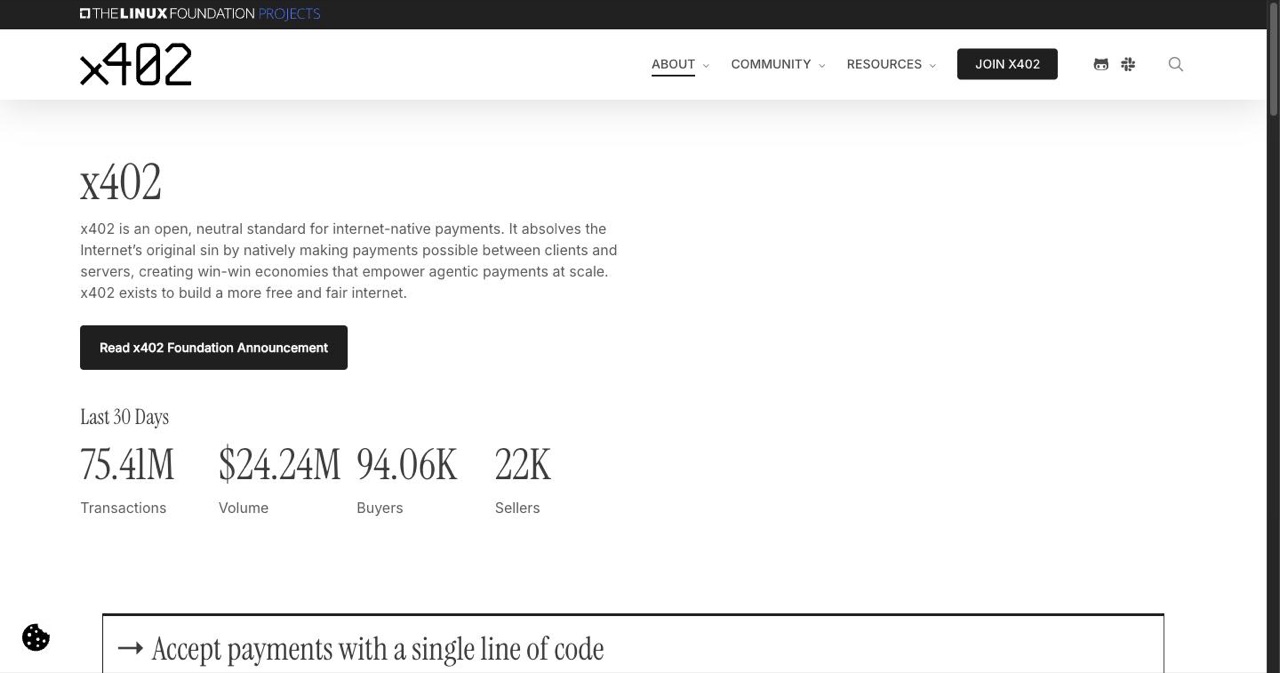
The mechanism is x402, an open protocol Cloudflare built alongside a coalition of 25+ industry partners through the x402 Foundation. The name is a nod to the long-dormant HTTP 402 "Payment Required" status code — defined in the original HTTP spec, never operationalized, because there was no fast settlement layer to back it. x402 finally gives that status code a working payment rail: a client hits a paid endpoint, gets a 402 response with payment terms, and settles the amount in stablecoins as part of the request flow. No OAuth dance, no pre-registered billing account, no subscription — just pay-as-you-go at the protocol level.
Stablecoin settlement is the piece that makes sub-cent pricing viable. Card networks and traditional processors have fixed minimums and percentage fees that make a $0.001 charge nonsensical — you'd lose money on every transaction. Stablecoin rails strip that overhead out, so charging fractions of a cent per API call stops being a novelty and becomes a real pricing tier.
On top of that, Cloudflare gives you a single control plane to manage pricing rules and access policies across everything you've put behind the gateway — one place to say "this dataset costs $0.05 per row export" and "this MCP tool costs $0.002 per call" without wiring up separate billing logic for each.
Why This Changes the Monetization Playbook
Usage-based pricing has always been the pricing model founders want and the one they avoid, because the tooling cost more than it was worth to build. Stripe metering, usage aggregation, invoice reconciliation, and fraud handling are a multi-week project even for a simple per-request model. The Monetization Gateway collapses most of that into a policy you set in a dashboard. That's not an incremental improvement — it's the removal of the reason usage-based pricing was hard.
What that unlocks:
- Per-request API pricing without building a metering pipeline. Charge $0.01 per call on a compute-heavy endpoint and $0.0005 on a cheap lookup, enforced before your servers spend a cycle on the request.
- Pay-per-MCP-call monetization. As AI agents increasingly discover and invoke tools via MCP, you can price individual tool invocations instead of gating the whole tool behind a subscription an agent can't sign up for.
- Content and dataset paywalls at the CDN layer, priced per page view or per row exported, with no app-level paywall code to maintain.
- Sub-cent microtransactions that were structurally impossible under card-network economics, now economically sane because settlement overhead approaches zero.
The throughline is the agent economy. A human hitting a paywall can create an account, enter a card, and wait for a trial. An autonomous agent calling your API mid-task can't do any of that — it needs to see a 402, pay in the same request cycle, and get the resource. Pricing models built around checkout funnels and monthly invoices don't serve that traffic. Machine-native payment rails do. If you want a sense of how fast the agent side of this is moving on the model layer, we covered the pricing shifts in Claude Sonnet 5's release and the GPT-5.6 rollout — the agents are getting cheaper to run at the same time the rails to pay for what they consume are getting built.
What SaaS Founders Should Do Now
If you're already on Cloudflare, audit what you're serving that could carry a per-use price instead of a flat tier: internal APIs you've never monetized, datasets you're giving away as lead magnets, MCP tools you built for your own agents that other agents would pay to call. The Monetization Gateway is rolling out now — worth testing on a low-stakes endpoint before betting a core product line on it.
If you're not on Cloudflare, this is one more reason to move. Between this and the edge-inference cost curve we wrote about in OpenAI's Jalapeño chip coverage, the infrastructure gap between "on Cloudflare" and "not" keeps widening for anyone shipping API-first or AI-facing products.
If you're building an API-first product today, design the pricing model for usage from day one rather than retrofitting it later — metering bolted onto an existing flat-rate product is a much harder migration than starting usage-native. And if your product is or will be consumed by AI agents rather than humans clicking through a UI, treat x402 as the payment layer those agents will expect, the same way you'd assume they expect a REST or MCP interface instead of a web form.
Where This Fits on SaaSCity
We track tools like this because the founders building on SaaSCity are exactly the ones this affects first — API-first products, dev tools, and AI agent infrastructure where the old subscription-only model was always a bad fit. If you're building an API, a dataset service, or an MCP tool and usage-based pricing is finally within reach, list it on SaaSCity for free — it's where builders come looking for exactly this kind of tool.
Get your SaaS in front of founders
List your product on the SaaSCity live city map - a permanent listing, real discovery, and a backlink from a high-DR directory. Free to start; upgrade for a dofollow link and a building on the map.