Growth & SEO
How to Optimize Your Website for AI Citations: The Complete GEO Playbook (2026)
A research-backed guide to Generative Engine Optimization — the technical foundations, content tactics, and monitoring setup that get your site cited by ChatGPT, Perplexity, Google AI Overviews, Gemini, and Claude.

Contents (12)
- Key Takeaways
- What Is GEO, AEO, and an AI Citation?
- Why AI Visibility Matters Now: The Research
- Technical Foundations: Make Your Site Crawlable and Machine-Readable
- Content Optimization: What Actually Gets Extracted
- Entity, Brand, and Third-Party Authority
- List Your SaaS on SaaSCity
- Measuring and Monitoring AI Visibility
- Engine-Specific Notes
- The 30-Day Implementation Checklist
- What to Ignore
- The Bottom Line
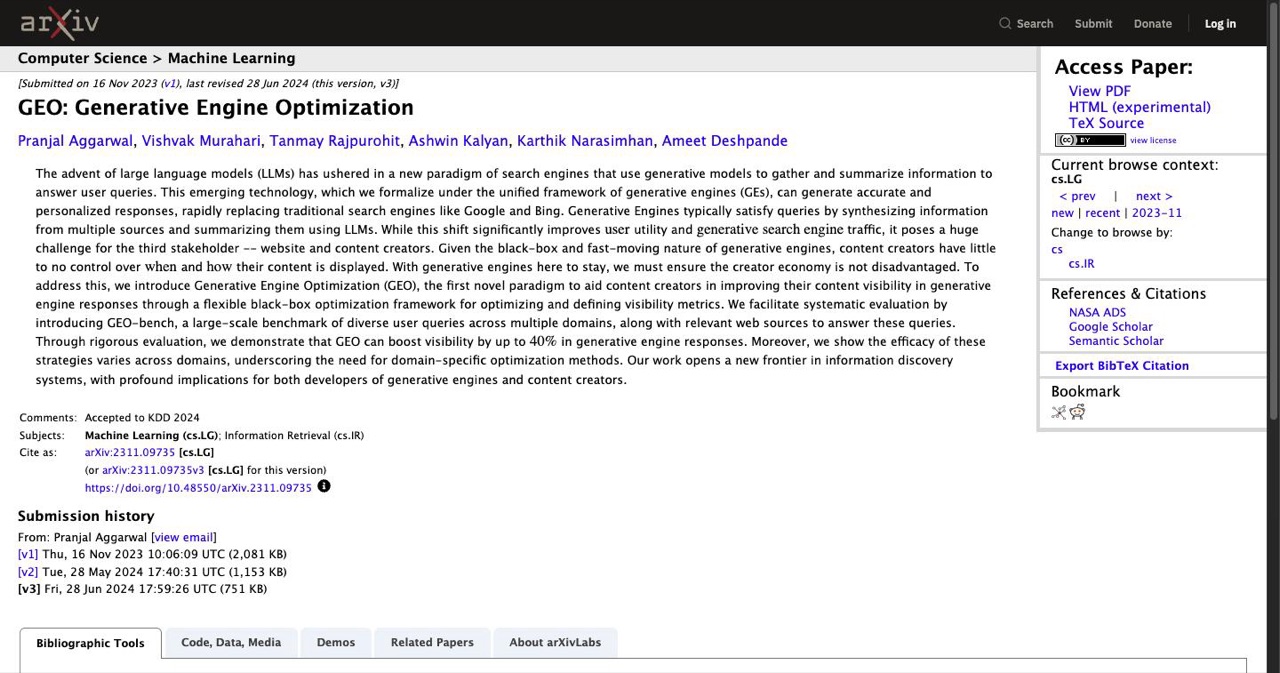
Quick answer: Generative Engine Optimization (GEO) is the practice of structuring content, technical signals, and brand entities so ChatGPT, Perplexity, Google AI Overviews, Gemini, and Claude cite your site inside synthesized answers. The Princeton GEO study (KDD 2024, arXiv:2311.09735) tested nine methods against real Perplexity queries: citing authoritative sources lifted visibility about 40%, adding statistics 37%, and quotations 30%, while keyword stuffing cost 10%. Practical work means allowing OAI-SearchBot, PerplexityBot, ClaudeBot, and Google-Extended, publishing llms.txt, adding FAQPage and Article schema, writing answer-first 40 to 80 word blocks, and earning third-party listings.
Ranking #1 on Google used to be the finish line. Now it's a starting position that doesn't guarantee anyone sees you — because a growing share of searches never produce a list of blue links at all. They produce one synthesized answer, with a handful of citations attached, and your site is either in that handful or it doesn't exist for that query.
Generative Engine Optimization (GEO) is the practice of structuring content, technical signals, and brand entities so AI answer engines — ChatGPT, Perplexity, Google AI Overviews, Gemini, Claude — retrieve, trust, and cite your site inside those synthesized answers. It sits alongside traditional SEO rather than replacing it, but it optimizes for a different outcome: citation, not just rank.
The stakes are already visible in the data. AI Overviews now appear in roughly 45% of Google searches and cut click-through to websites by as much as 58% on the queries where they show. ChatGPT passed 900 million weekly users in 2026. And in Ahrefs' analysis of ChatGPT's most-cited pages, a striking share carry zero organic visibility on Google — meaning the sources AI systems trust and the sources Google ranks highest are not the same list. Optimize only for the second list and you're invisible in the first.
This guide walks through what actually moves the needle, based on the Princeton GEO research (KDD 2024) and Google's own published guidance on AI search — plus what to ignore, because a lot of "GEO hacks" circulating right now do nothing or actively hurt.
Key Takeaways
- Citation, not rank, is the goal: A page ranking on page two or three of Google can still win the AI citation if it is the clearest, best-sourced answer to the query.
- Sourcing is the highest-lift tactic: The Princeton GEO paper measured +40% visibility from citing authoritative sources, +37% from statistics, and +30% from quotations.
- Keyword stuffing actively hurts: It was the only method in the study to reduce visibility, at roughly -10%.
- Google needs no special files: Google states AI Overviews and AI Mode require no special markup or
llms.txt, and that separate "content for AI" risks the scaled content abuse policy. - Crawler access is absolute: Blocking OAI-SearchBot, PerplexityBot, ClaudeBot, or Google-Extended removes that platform's ability to cite you, and CDN or WAF rules can block them silently.
- Third-party domains carry your brand: Analyses of ChatGPT citations put Wikipedia at roughly 7.8% of all citations and Reddit around 1.8%, ahead of most individual brand domains.
- Lower-ranked pages gain most: The research found buried sources saw the biggest relative gains from adding citations and data, in some cases more than doubling citation odds.
What Is GEO, AEO, and an AI Citation?
Three terms get used almost interchangeably. They're related but not identical:
| Term | What It Means |
|---|---|
| GEO (Generative Engine Optimization) | Optimizing content and technical signals so AI systems cite you inside generated answers |
| AEO (Answer Engine Optimization) | Overlapping discipline focused on winning the direct-answer position — featured snippets, voice answers, AI Overview boxes |
| AI citation | The actual outcome: your domain named or linked as a source inside an AI-generated response |
In practice, GEO and AEO describe the same underlying work from slightly different angles. This guide treats them as one discipline: getting cited.
How Generative Answer Engines Actually Work
At a high level, every major AI search system follows the same pipeline: crawl and index → retrieve relevant passages for a given query → synthesize an answer → cite the sources it drew from. The differences between platforms are mostly in step two — what they retrieve from and how they weight it.
| Platform | How It Sources Answers |
|---|---|
| Google AI Overviews | Summarizes top-ranking pages; strongly correlated with traditional Google rankings |
| ChatGPT (with search) | Searches the live web, cites sources; draws from a wider range than just top-10 rankings |
| Perplexity | Always cites sources with links; favors authoritative, recent, well-structured content |
| Gemini | Google index plus Knowledge Graph entity data |
| Copilot | Bing index plus authoritative-source weighting |
| Claude | Brave Search results when search is enabled, layered on training-data knowledge |
The key structural difference from traditional SEO: a page doesn't need to rank #1 to get cited. AI systems select sources on structure, extractability, and trust signals — not purely on rank position. A page ranking on page two or three of Google can still win the citation if it's the clearest, best-sourced answer to the query the AI is synthesizing.
Google's Stance Is Different From Everyone Else's
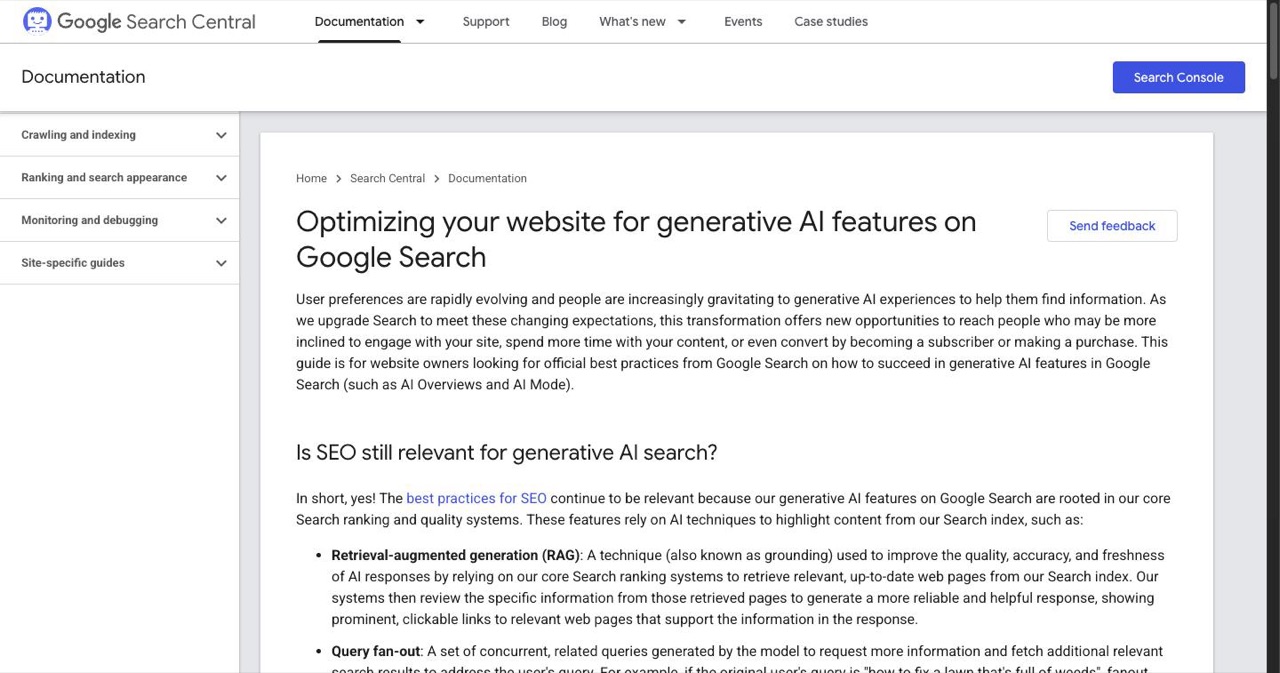
This matters enough to state plainly, because a lot of GEO advice online contradicts it. Google's own AI features optimization guide says foundational SEO — helpful, reliable, people-first content — is what drives AI Overviews and AI Mode visibility, because those features are "rooted in our core Search ranking and quality systems." Google explicitly states:
- No special markup or files are required for AI Overviews or AI Mode
- Don't chunk content into AI-bait fragments — write for people, organize normally
- Don't write separate content "for AI" — that risks the scaled content abuse spam policy
- There's no AI-specific Search Console report; the standard Performance and Coverage reports are what you use
The other engines behave differently. ChatGPT, Claude, and Perplexity actively reward extractable structure — self-contained answer blocks, comparison tables, FAQ sections — and they parse llms.txt and machine-readable files when present. They also cite third-party sources (Wikipedia, Reddit, review sites) more heavily than Google does relative to top-ranked pages.
The practical rule: write for people, organize for clarity. That satisfies Google. Layer extractable structure and machine-readable files on top for the non-Google engines, and you've covered both without contradiction.
Why AI Visibility Matters Now: The Research
The most cited study in this space is the Princeton/Georgia Tech GEO paper (Aggarwal et al., arXiv:2311.09735, presented at KDD 2024). The researchers tested nine content optimization methods against real Perplexity.ai queries and measured visibility impact directly.
| Method | Visibility Impact | What It Means in Practice |
|---|---|---|
| Cite authoritative sources | +40% | Link to primary research, named studies, original data |
| Add statistics | +37% | Specific numbers, dated, sourced |
| Add quotations | +30% | Named-expert quotes with title and organization |
| Write with authoritative tone | +25% | Demonstrated expertise, not hedged phrasing |
| Improve clarity | +20% | Simplify complex concepts, direct sentences |
| Use technical/domain terms | +18% | Precise terminology over vague generalities |
| Increase unique vocabulary | +15% | Word diversity over repetition |
| Optimize fluency | +15–30% | Readability and flow |
| Keyword stuffing | −10% | The only method that actively hurt visibility |
Two findings matter more than the headline numbers. First, fluency plus statistics together produced the largest combined lift the researchers measured. Second, lower-ranked sources benefited disproportionately — pages that started buried saw the biggest relative visibility gains from adding citations and data, in some cases more than doubling their citation odds. If you're not already dominating page one, GEO is arguably a bigger opportunity for you than it is for the incumbent.
That's the mechanism. The market context is why it's urgent: third-party monitoring consistently shows optimized, well-structured content getting cited multiple times more often than unoptimized content on the same topic, and the citation gap between well-sourced and poorly-sourced pages is widening as more of these platforms mature their retrieval systems.
Technical Foundations: Make Your Site Crawlable and Machine-Readable
Content quality is wasted if the crawler that would cite you can't reach the page. Start here.
Allow the Right AI Crawlers
Every AI platform runs its own bot. Block it, and that platform can never cite you — full stop, regardless of how good the content is.
| Bot | Platform | Recommendation |
|---|---|---|
OAI-SearchBot, ChatGPT-User | OpenAI / ChatGPT | Allow |
PerplexityBot | Perplexity | Allow |
ClaudeBot, Claude-SearchBot | Anthropic / Claude | Allow |
Google-Extended | Gemini, AI Overviews | Allow |
Bingbot | Microsoft Copilot | Allow |
GPTBot, anthropic-ai, CCBot | Training-only crawlers | Optional to disallow if you want citation but not training use |
A minimal robots.txt that keeps citation open while opting out of pure training use looks like this:
User-agent: OAI-SearchBot
Allow: /

User-agent: ChatGPT-User
Allow: /

User-agent: PerplexityBot
Allow: /

User-agent: ClaudeBot
Allow: /

User-agent: Google-Extended
Allow: /

User-agent: GPTBot
Disallow: /

User-agent: CCBot
Disallow: /
Check any CDN or WAF (Cloudflare's bot-fight modes are the usual culprit) for rules that silently block these user agents at the edge — robots.txt compliance is voluntary, but a firewall block is absolute, and it won't show up when you just read the text file.
Publish an llms.txt
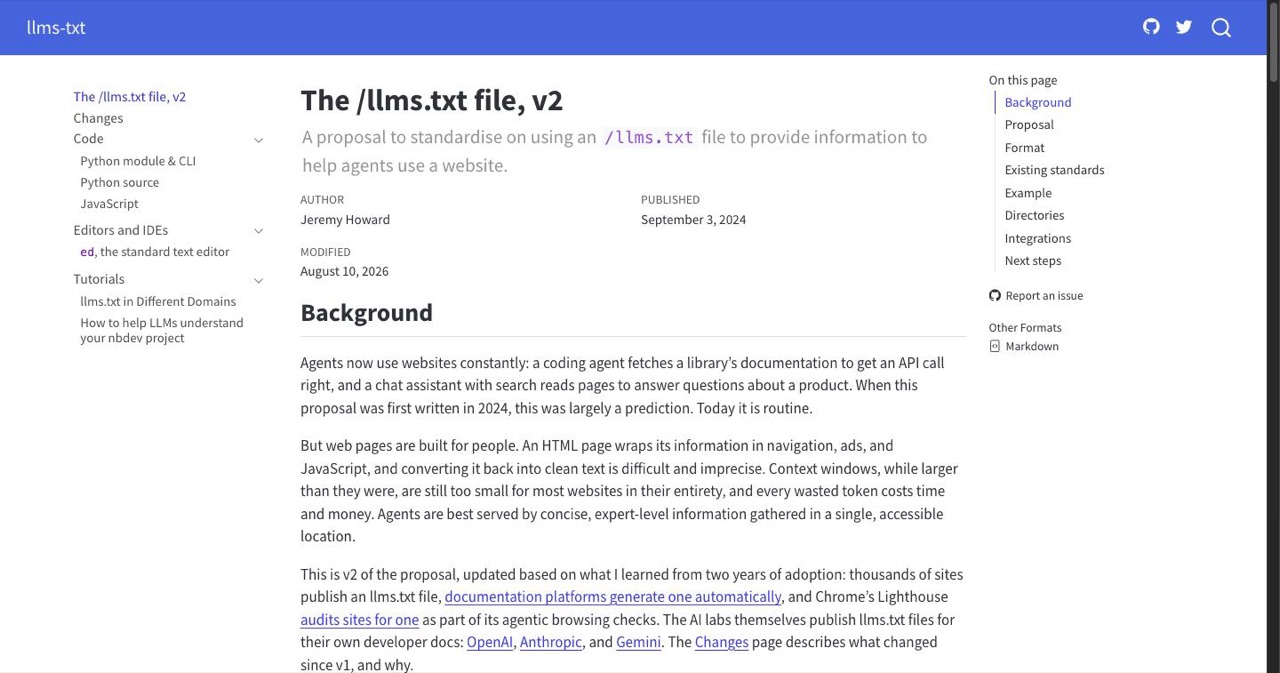
llms.txt (llmstxt.org) is a plain-Markdown convention that gives AI systems a fast, structured overview of your site: what it does, who it's for, and links to the pages that matter most. It's not a Google ranking file — remember, Google says explicitly it doesn't need one — but ChatGPT, Claude, and Perplexity do parse it when present.
Keep it short. A workable structure:
# Your Product Name

> One-sentence description of what the product does and who it's for.

## Key Pages
- [Pricing](/pricing): Plans and pricing details
- [Docs](/docs): Product documentation
- [Blog](/blog): Guides and product updates
Under ~200 lines. Link to your highest-value, most-canonical pages only — this is a map, not a sitemap dump.
Schema Markup
Structured data gives AI systems (and Google) explicit, unambiguous facts instead of forcing inference from prose. The types that matter most for AI citation:
| Schema Type | Use Case |
|---|---|
Article / BlogPosting | Author, publish date, topic for editorial content |
FAQPage | Direct Q&A extraction for natural-language questions |
HowTo | Step-by-step extraction for process queries |
Organization | Entity recognition and brand disambiguation |
Product / Offer | Pricing and feature extraction |
Content with proper schema shows measurably higher AI visibility on non-Google engines in third-party analyses, even though Google itself doesn't require it for AI Overviews eligibility. For a full implementation walkthrough — including the exact JSON-LD for WebApplication, FAQPage, and AggregateRating — see our JSON-LD structured data guide for SaaS.
Other Technical Hygiene
- Server-render your core content. If the page is blank until four JavaScript frameworks finish loading, both Google and AI crawlers see blank.
- Semantic HTML.
<main>,<nav>,<article>, proper heading hierarchy,alttext — AI agents increasingly read the accessibility tree, not just visible pixels. - Freshness signals. A visible "last updated" date, refreshed on a real cadence, not just a cosmetic year-swap.
- Avoid negative signals. Hidden text, prompt-injection-style content aimed at manipulating AI summarizers, and excessive interstitials all work against you — and some cross into spam-policy territory.
Content Optimization: What Actually Gets Extracted
Structure and sourcing beat volume. AI systems extract passages, not pages, so every important claim needs to work as a standalone statement.
The Structural Patterns That Win Extraction
- Answer-first openings. Lead every H2 with a direct answer in the first sentence — don't build up to it.
- Question-form headings. "What is X?" and "How does Y work?" match how people phrase queries to AI systems, and match how those systems phrase their own retrieval queries.
- Self-contained answer blocks. Keep the core answer to 40–80 words that make sense with zero surrounding context. That's roughly the length AI systems tend to lift verbatim.
- Tables over prose for comparisons. "X vs Y" queries are answered from tables far more reliably than from paragraphs describing the same tradeoffs.
- Named frameworks. A labeled process or model ("the three pillars," "the 40/30/20 rule") is more citable than the same idea described loosely, because it gives the AI a clean handle to reference.
- Front-load the page. The first 30% of the content carries disproportionate retrieval weight — don't bury your best material under throat-clearing.
E-E-A-T Signals AI Systems Weight
- Real author bylines with credentials and an author page, not "Admin" or a faceless team
- Original data or first-hand experience, not summarized aggregation of someone else's research
- Transparent sourcing — name the study, name the year, link it
- Consistent brand description across your own site and third-party mentions of you
One practical note tying this back to the Princeton data: the highest-lift tactics (cite sources, add statistics, add quotations) are also the ones most guides skip because they take real research time. That's exactly why they work — they're the hardest to fake at scale, so AI systems that are trained to prefer trustworthy-looking content correctly treat them as a strong signal.
Entity, Brand, and Third-Party Authority
Here's the part that surprises most teams: AI systems cite your brand via other people's domains more often than your own. Third-party analyses of ChatGPT citations show Wikipedia alone accounts for roughly 7.8% of all citations, with Reddit around 1.8% — both ahead of most individual brand domains, including large ones.
That reframes the whole channel. It's not just "write better blog posts." It's:
- Get listed accurately wherever entities get corroborated — Wikipedia (if you're notable enough), Crunchbase, LinkedIn, industry-specific databases
- Participate authentically in Reddit and forum discussions where your category gets discussed — AI systems weight multi-source corroboration heavily, and a real thread mentioning you is a stronger signal than a paid mention
- Earn placement in third-party roundups and listicles — comparison articles and "best of" lists are among the highest-citation content formats across every platform studied
- Build topic-cluster authority on your own site with consistent internal linking, so AI systems find you covering the full topic, not one isolated page
Building this kind of durable domain authority compounds with the technical and content work above rather than replacing it — see our complete guide to improving domain authority for the link-building side of the equation.
List Your SaaS on SaaSCity
This is exactly the kind of third-party surface the research above says matters. AI systems cite listicles, directories, and comparison pages disproportionately — often more than they cite a brand's own homepage — because a listing on an independent, structured, indexed page functions as corroboration, not marketing copy.
SaaSCity is a free startup directory with an interactive 3D city map. Every listed product gets a permanent, indexed page and a dofollow backlink — the same kind of third-party presence signal that shows up in the citation data above.
What you get:
- A dedicated, indexed product page (the third-party surface AI systems favor)
- A dofollow backlink (DR 40+) that strengthens your domain authority baseline
- A 3D city presence — your SaaS on the map, not buried in a spreadsheet
- Direct visibility to founders and early adopters actively browsing new tools
Submit your product for free →
Measuring and Monitoring AI Visibility
You can't improve what you don't check. Set up a baseline before you change anything.
DIY Monthly Check (No Tools Required)
- List your 15–20 highest-value queries (category definitions, "best X for Y," "X vs [competitor]," pricing queries)
- Run each through ChatGPT, Perplexity, and Google
- Log whether you're cited, who else is, and which of your pages got pulled
- Track month over month in a spreadsheet — trend matters more than any single snapshot
Dedicated Monitoring Tools
| Tool | Coverage | Best For |
|---|---|---|
| Otterly AI | ChatGPT, Perplexity, Google AI Overviews | Share-of-voice tracking |
| Peec AI | ChatGPT, Gemini, Perplexity, Claude, Copilot | Multi-platform monitoring at scale |
| ZipTie | Google AI Overviews, ChatGPT, Perplexity | Brand mention and sentiment tracking |
| LLMrefs | ChatGPT, Perplexity, AI Overviews, Gemini | Mapping SEO keywords to AI visibility |
For Google specifically, remember there's no AI-specific report in Search Console — standard Performance and Coverage data is what you have. The third-party tools above are the only way to see cross-platform citation behavior directly.
There's also an open-source option worth knowing about if you want to self-score a page before publishing: Auriti Labs' geo-optimizer-skill scores pages against roughly 47 citability factors across robots.txt configuration, llms.txt presence, schema completeness, and content structure, and returns a 0–100 score with specific fixes. Useful as a pre-publish checklist, not a replacement for the citation-tracking tools above.
Engine-Specific Notes
The fundamentals overlap heavily across platforms, but weighting differs enough to matter at the margin:
| Engine | What It Weights Extra |
|---|---|
| ChatGPT | Bing index influence, third-party reviews and "best of" list mentions |
| Google AI Overviews / Gemini | Classic SEO floor — ranking well still correlates strongly with citation |
| Perplexity | Real-time freshness, transparent inline citation of recent sources |
| Claude | Brave Search results (when search is enabled) layered on training-data familiarity with well-documented brands |
Foundational work — clean technical access, well-sourced content, real third-party presence — compounds across all four rather than requiring separate strategies per platform. Chase platform-specific hacks last, if at all.
The 30-Day Implementation Checklist
In priority order, cheapest and highest-leverage first:
- Audit robots.txt — confirm OAI-SearchBot, PerplexityBot, ClaudeBot, and Google-Extended aren't blocked, at both the file level and the CDN/WAF level
- Add author bylines and dates to your top 10 highest-traffic pages if they're missing
- Rewrite your top 5 pages' opening paragraphs to lead with a direct, 40–80 word answer instead of a scene-setting intro
- Add cited statistics to those same pages — specific numbers, dated, sourced, per the +37% Princeton lift
- Publish
llms.txt— 20 minutes, one file, no downside - Add FAQ schema to any page with real Q&A content already visible on the page
- Get listed on 3–5 relevant third-party directories or roundups this month — see our directory submissions guide for a prioritized list
- Run the DIY monthly check on your top 15 queries and record the baseline before you've changed anything else
Everything after that — deeper schema, /pricing.md for AI agents evaluating you programmatically, ongoing monitoring tooling — layers on top once the fundamentals are in place. If you haven't sequenced the rest of your launch and SEO work yet, our startup launch checklist covers where GEO fits relative to everything else.
What to Ignore
Google's guide is explicit about a few things that circulate as "GEO hacks" but don't hold up:
- Don't write separate content for AI. Same content should serve people and machines — variants written to game an AI summarizer risk the scaled content abuse spam policy.
- Don't chunk pages into AI-bait fragments. Normal paragraphs and headings work; artificial fragmentation doesn't help and can hurt readability for actual humans.
- Don't fabricate third-party mentions. Bulk-spamming Reddit or gaming Wikipedia for citation signal is both against those platforms' rules and detectable.
- Don't assume special files are a ranking lever for Google.
llms.txtand similar files help the non-Google engines; Google has said directly they don't move AI Overviews eligibility.
The Bottom Line
GEO isn't a separate discipline bolted onto SEO — it's SEO's logical extension into a world where the answer sometimes arrives without a click. The mechanics are consistent across the research: make your site technically reachable by the bots that matter, write answer-first content dense with cited statistics and real sourcing, build genuine third-party presence beyond your own domain, and check monthly whether it's working.
None of it is exotic. Most of it is work every serious content team should have been doing anyway — it just turns out citation-worthy content and genuinely useful content are, for the most part, the same content.
SaaSCity.io covers SaaS growth, SEO, and the startup ecosystem. Explore the SaaSCity directory to discover what's shipping right now — or list your own product.
Get your SaaS in front of founders
List your product on the SaaSCity live city map - a permanent listing, real discovery, and a backlink from a high-DR directory. Free to start; upgrade for a dofollow link and a building on the map.