Launch & Growth
Google August 2026 Spam Update: What It Targets, Who's at Risk, and What to Do
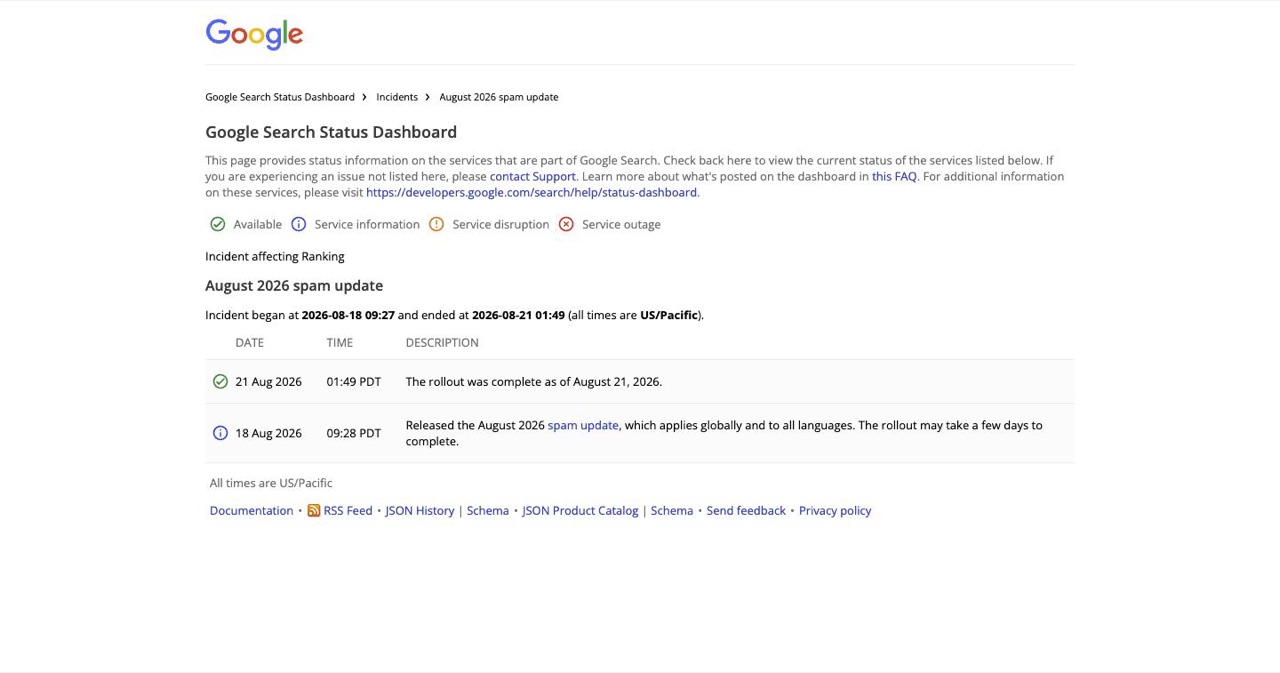
Google released the August 2026 Spam Update on August 18. It applies globally to all languages, may take a few days to roll out, and focuses on spam policy violations via SpamBrain improvements.

Contents (11)
Quick answer: The August 2026 Spam Update is Google's third spam update of the year, launched August 18, 2026 at 09:27 US/Pacific. It is a normal spam update applying globally to all languages, expected to take a few days, with no new policies attached. It improves SpamBrain, Google's AI spam-detection system, to better enforce the existing spam policies: scaled content abuse, cloaking, doorway pages, keyword stuffing, expired domain abuse, scraped content, and manipulation of generative AI answers in Search.
Google started rolling out the August 2026 Spam Update on August 18, 2026 at 09:27 Pacific time. It's global, it covers all languages, and Google expects it to take a few days to complete. This is the third spam update of the year, after March and June, and Google's own framing is deliberately boring: a "normal spam update," with no new policies attached.
Boring framing doesn't mean nothing happens. Spam updates reshuffle real traffic, and the last few have been landing harder on sites that thought they were playing it safe. Here's what Google announced, what the update targets, what SEOs like Glenn Gabe and Marie Haynes are saying, and what to do if your charts move this week.
Key Takeaways
- Launched August 18, 2026 at 09:27 Pacific: Global, all languages and locations, with a rollout Google expects to take a few days.
- No new policies: It is a SpamBrain improvement that enforces the spam policies Google already publishes, not a new rule set.
- Not an anti-AI update: The policy is scaled content abuse, content produced primarily to manipulate rankings, whether a human, an AI, or both wrote it.
- AI answers are now in scope: Google's spam policies explicitly cover attempts to manipulate generative AI responses in Search, so AI Overview citation farming counts as spam.
- Link spam is not the named target: Per Barry Schwartz's reporting, this update does not specifically target link spam or site reputation abuse, which separate systems handle.
- Rollouts are getting faster: March 2026 finished in under a day, June 2026 took about two days, and the August 2025 update took roughly four weeks.
- There is no reconsideration request: Spam updates are automated, so that path only exists for manual actions, which appear in Search Console.
- Recovery takes months: SpamBrain has to reassess the site across crawls, so cleanup pays off slowly and panic changes mid-rollout make diagnosis harder.
Quick Facts
| Item | Detail |
|---|---|
| Name | August 2026 Spam Update |
| Launched | August 18, 2026, 09:27 US/Pacific (~12:30 pm ET) |
| Type | Normal / standard spam update |
| Scope | Global, all languages and locations |
| Expected duration | A few days |
| New policies? | No |
| Primary system | SpamBrain improvements |
The announcement came through the usual channels: the Google Search Status Dashboard logged the incident at 09:27 with an official note at 09:28 PDT, and Google Search Central posted the same message on X and LinkedIn. Google's wording:
"Today we released the August 2026 spam update. It's a normal spam update, applying globally to all languages. It may take a few days to complete, and we'll update our ranking release history page when the rollout is complete."
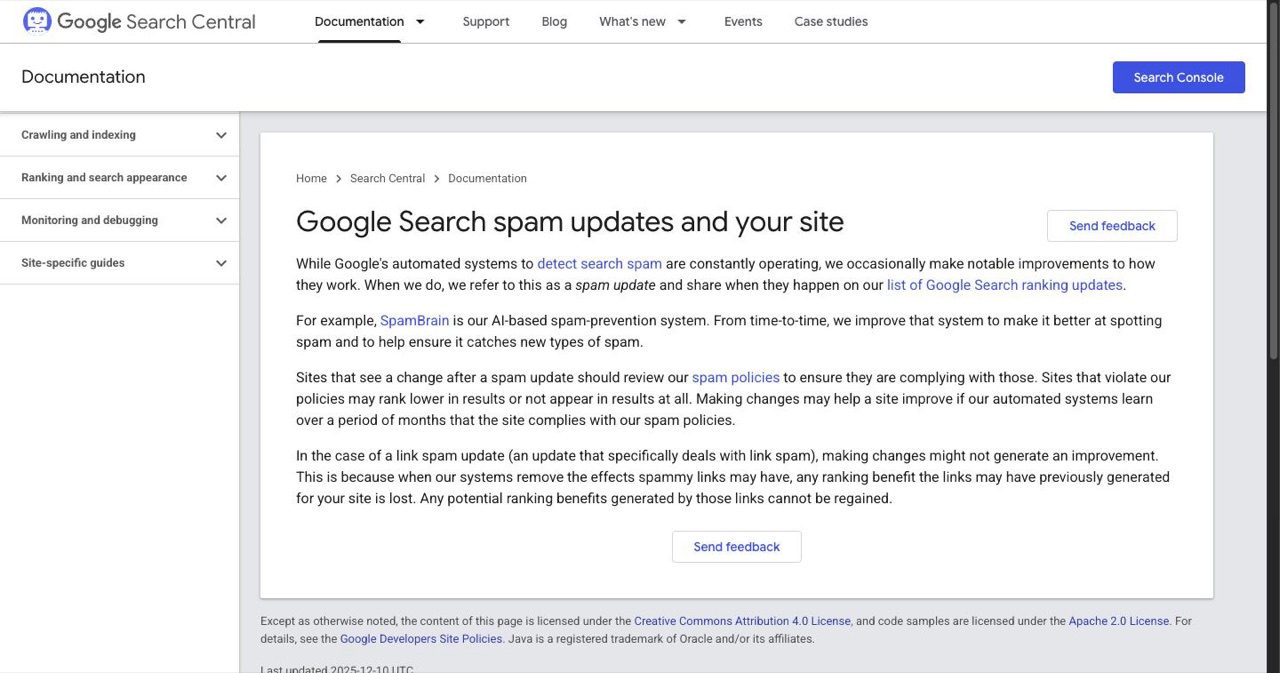
That release history lives on Google's spam updates documentation page, which is the page to watch for the official "completed" stamp.
What a Google Spam Update Actually Is
Google's spam-fighting systems run continuously. What gets a named "spam update" is a notable improvement to those automated systems, the biggest of which is SpamBrain, Google's AI-based spam-detection system. Periodically Google retrains or extends it to catch new and evolving spam patterns, and when the change is significant enough to move rankings noticeably, it gets announced.
The distinction from a core update matters for diagnosis. A core update reassesses quality and relevance broadly; you can lose visibility in one without violating anything. A spam update is narrower: it improves enforcement of the spam policies Google already publishes. If a spam update drops your site, Google's systems have most likely classified something on it as a policy violation, and the fix starts with figuring out which one.
What the August 2026 Update Targets (and What It Doesn't)
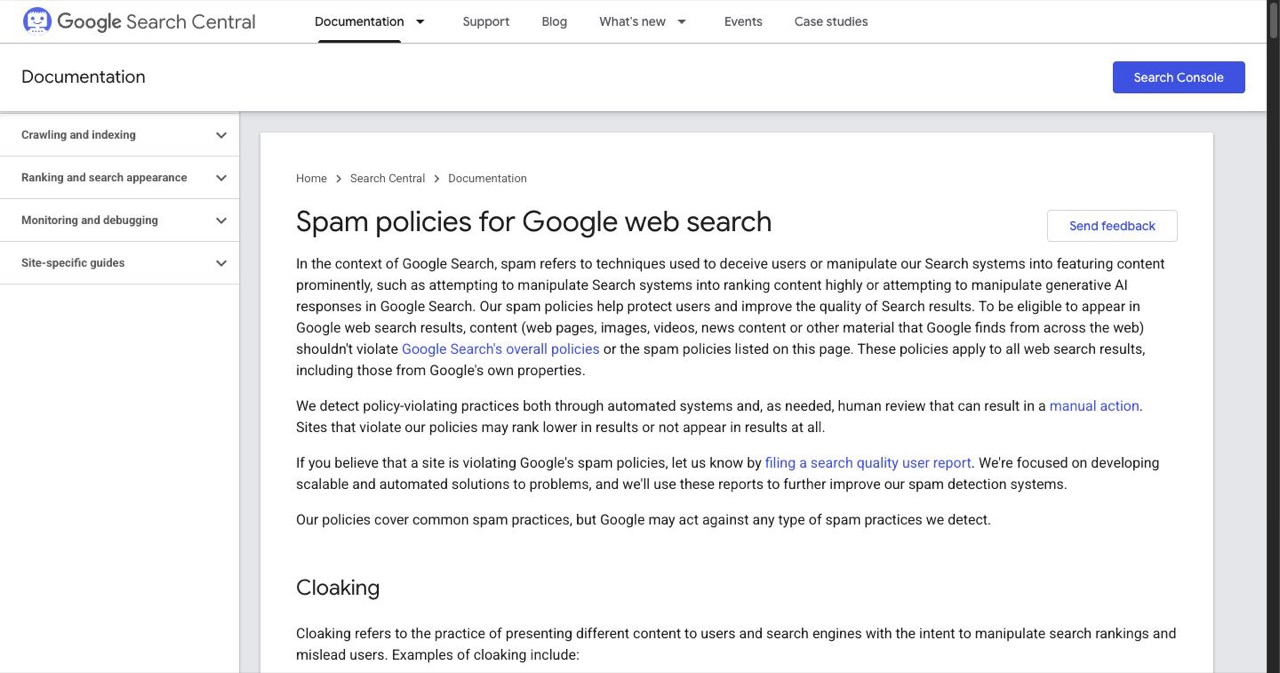
Google didn't name specific tactics, which is standard for spam updates. The target set is the existing policy list:
- Scaled content abuse: large volumes of pages produced primarily to rank, not to help anyone, regardless of whether AI, humans, or a mix produced them
- Cloaking: showing different content to Google than to visitors
- Doorway pages and thin pages built for search engines rather than people
- Keyword stuffing
- Expired domain abuse: buying a domain with history and repurposing it to host low-value content that rides the old signals
- Scraped content
- Manipulative use of generative AI to game rankings or AI answers
Per Barry Schwartz's reporting at Search Engine Roundtable, consistent with recent spam updates, this update does not specifically target link spam or the site reputation abuse policy. Those get handled by separate systems and, in the site reputation abuse case, largely through manual actions.
One thing worth sitting with: Google's spam policies now explicitly cover attempts to manipulate generative AI responses in Search. Content churned out to farm AI Overviews and AI Mode citations is spam-policy territory the same way content churned out to farm blue links always was. The surface changed; the rule didn't. If you're doing GEO or AEO work, the line between optimization and manipulation is the one to know, and our GEO playbook covers where Google itself draws it.
The other pattern from recent updates is that SpamBrain works on patterns, not individual tactics. It doesn't need to catch your keyword stuffing specifically; it learns what manipulated sites look like in aggregate. Which leads directly to what the experts are worried about.
What SEOs Are Saying
Glenn Gabe (@glenngabe) said he hopes the update further reduces GEO and AEO spam, the wave of content built purely to get quoted by AI answer engines, and that he'll be tracking the rollout closely. He's been documenting that category of spam for months, so his data over the next week is worth following.
Marie Haynes (@Marie_Haynes) raised the more uncomfortable point: SpamBrain has been increasingly catching "good" sites that use manipulative patterns without thinking of themselves as spammers. The patterns she's observed since the August 2025 spam update:
- Pages propped up by built or artificial links
- Scaled content produced primarily for rankings rather than for genuine user value
- Machine-learning detection of manipulation patterns getting sharper each cycle
That middle one deserves a second read. "Scaled content produced primarily for rankings" describes a large share of ordinary content marketing. The question SpamBrain effectively asks is whether the content would exist if search engines didn't. If your honest answer is no, you're in the blast radius even if every individual page passes a smell test.
The rest of the community response was the standard early-rollout mix: calls for patience, warnings against panic changes mid-rollout, and speculation about scaled AI content and programmatic spam being the real target. Volatility trackers (AccuRanker, Semrush Sensor, Sistrix, MozCast) started showing elevated movement on day one, though day-one readings during an active rollout are noisy by definition.
The 2026 Spam Update Cadence
Three spam updates in eight months is a fast rhythm, and the rollouts themselves have been unusually quick:
| Update | Rollout time |
|---|---|
| March 2026 Spam Update | Under 1 day (~19-20 hours) |
| June 2026 Spam Update | ~2 days (June 24-26) |
| August 2026 Spam Update | "A few days" (in progress) |
| For comparison: August 2025 Spam Update | ~4 weeks |
The compression from four weeks to under a day says something about infrastructure, but the frequency says something about the problem. Cheap AI generation made low-value sites nearly free to produce at scale, and Google is refreshing its spam systems more often to keep pace. Expect this cadence to hold, and expect the policy surface to keep expanding into AI answer results.
Who Should Worry
Highest risk, roughly in order:
- Sites running scaled, thin, or templated AI content with no original value added
- Programmatic page farms where the pages exist for query coverage, not users (programmatic SEO done properly is a different thing; the difference is whether each page answers something real, which our programmatic SEO guide gets into)
- Expired domain plays
- Sites with built or bought link profiles, per Marie Haynes's pattern list, even though link spam isn't the named target
- Anyone producing content purely to farm AI citations
Possible effects range from ranking drops on specific pages to sitewide visibility loss to de-indexing in severe cases. There's also collateral damage: some clean sites wobble during rollouts and recover on their own once things settle, which is exactly why panic changes during an active rollout are a mistake.
On the other side of the ledger, spam updates are zero-sum. Every position a spam site loses, a legitimate site gains. If you've been doing the unglamorous work, this week is when it pays.
Watch Google Search Console through the rollout: the Performance report for ranking movement, coverage for de-indexing, and the manual actions panel (spam updates are automated, but it costs nothing to confirm the panel is empty).
If Your Site Gets Hit
A recovery sequence that doesn't waste motion:
- Confirm the timing. Overlay your traffic drop against August 18. A drop that started August 12 is not this update.
- Audit against the actual policies. Read Google's spam policies start to finish and score your site honestly against each one.
- Focus where SpamBrain focuses. Scaled content, AI content with no expertise or original insight, unnatural links, thin and doorway pages.
- Fix or remove, don't dilute. Improve pages that can carry real value with first-hand experience, original data, and a real author behind them. Delete the ones that can't. A thousand mediocre pages hurt you more than a hundred good ones help.
- Be patient. Recovery from automated spam systems takes months, not days. SpamBrain has to re-learn that your site is compliant across crawls.
- Don't thrash mid-rollout. Wait for Google to mark the update complete before drawing conclusions or shipping big changes.
- Reconsideration requests only apply to manual actions. If Search Console shows one, fix the issue and file. If it doesn't (the common case with spam updates), there's nothing to file; the system just has to re-evaluate you.
- Change the strategy, not just the pages. If the model was "publish at volume, rank, monetize," the model is the violation.
Protecting Yourself Going Forward
The durable position is the one where spam updates are good news for you. That looks like:
- AI as a tool, not a spam engine. Use AI for drafts, research, and structure, with human judgment, fact-checking, and original insight on top. The output should be something a knowledgeable person would publish under their own name.
- Links you'd earn anyway. Real directories, real partnerships, real coverage. Legitimate, editorially given listings are exactly the kind of signal that survives every update; that's the model behind SaaSCity, where launches earn dofollow links by actually launching, not by buying placements. Our guides on directory submissions and free directories with real backlinks cover how to build that layer without touching anything Marie Haynes would flag.
- Domain authority built slowly. If you're working on DR, do it the way that compounds; see our guide to increasing domain rating for what works without manufactured links.
- A monitoring habit. Search Console weekly, a volatility tracker during announced rollouts, and Google's update history page bookmarked.
- GEO and AEO on the right side of the line. Structure content so AI engines can cite it because it's the best answer, not because it's engineered bait.
The Bottom Line
The August 2026 Spam Update is a standard global refresh of SpamBrain, the third of the year, targeting sites that violate Google's existing spam policies. No new rules, a few days of rollout, and the usual sorting: sites that produce content people actually need have little to fear, and sites built on scaled content, artificial links, or AI-citation farming face another round of sharper detection.
Review the spam policies, watch Search Console, follow Glenn Gabe, Marie Haynes, and Barry Schwartz for rollout data, and hold off on big moves until Google marks it complete. We'll update this post once the rollout finishes and the impact data is in.
Sources and Further Reading
- Google Search Status Dashboard: August 2026 spam update incident
- Google: Search spam updates and your site
- Google: Spam policies for Google web search
- Search Engine Roundtable (Barry Schwartz's rollout coverage)
- Search Engine Land and Search Engine Journal
- Glenn Gabe (@glenngabe) and Marie Haynes (@Marie_Haynes) on X
- Related on SaaSCity: GEO playbook, does domain rating affect SEO?, JSON-LD structured data guide
SaaSCity.io covers SaaS growth, SEO, and the startup ecosystem. Explore the SaaSCity directory to discover what's shipping right now, or launch your own product and earn a legitimate dofollow backlink the way Google intends: by building something worth listing.
Get your SaaS in front of founders
List your product on the SaaSCity live city map - a permanent listing, real discovery, and a backlink from a high-DR directory. Free to start; upgrade for a dofollow link and a building on the map.